
Commercial and industrial security systems and installation in the Lehigh Valley, PA. Bethlehem-based Northeast Remote Surveillance and Alarm, LLC (NERSA) designs, installs, integrates and supports cameras, access control and alarm systems for businesses and managed facilities.

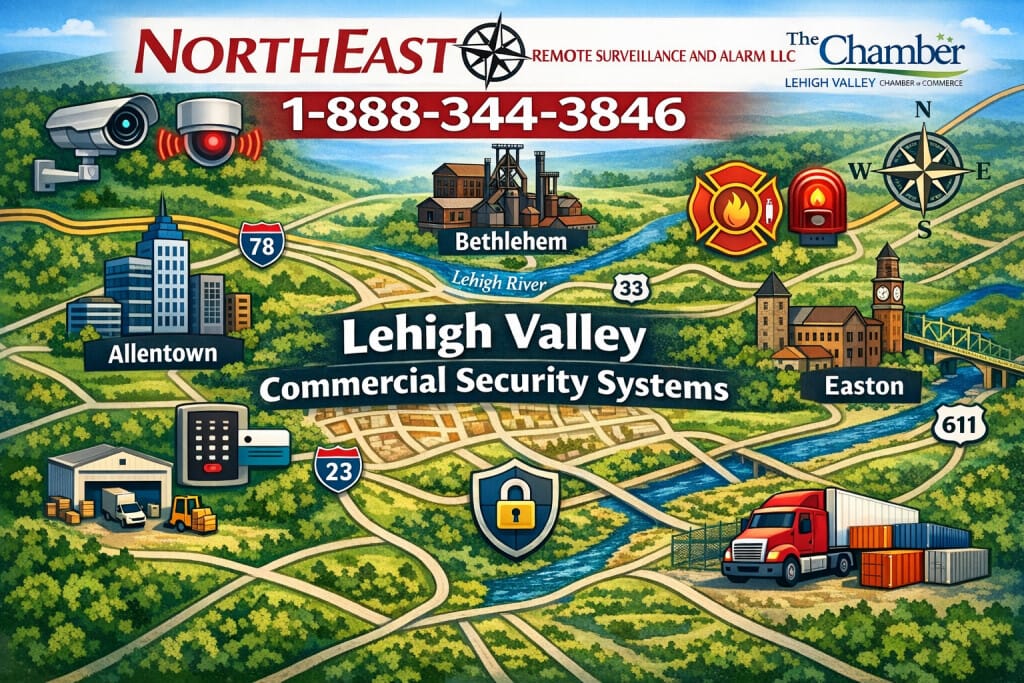
Find local service guides and planning resources for Allentown, Bethlehem, Easton, and surrounding communities, including Tatamy, Nazareth and Martins Creek in Northampton County. This regional guide is part of our Pennsylvania commercial security service area.
NERSA coordinates new security installations, system upgrades and provider transitions across Allentown, Bethlehem, Easton, Upper Macungie, Fogelsville and neighboring communities. Projects can combine video surveillance, controlled entry, intrusion alarms, commercial alarm monitoring and video verification, and supporting infrastructure for one property or several facilities along Route 22, Route 33 and I-78.
Start with the buildings you need to protect, the equipment already in place and the work your team needs the system to perform. We review coverage, compatibility, cabling, installation access, testing and handover requirements with your facilities, operations and IT staff. Use the service and city guides below for the specific system or location; this regional guide brings the wider project together.
Complete Commercial Security Installation: From Design to Monitoring
One coordinated project from start to finish: NERSA surveys commercial and industrial facilities, defines the system scope, coordinates security design and qualified third-party engineering where required, and manages installation, integration, programming, testing, documentation and customer training. We plan around occupied buildings, operations, IT requirements and applicable permits and codes rather than treating equipment delivery as a complete installation.
Integrated systems and response: NERSA installs and upgrades commercial cameras, access control, intrusion alarms, applicable commercial fire alarm systems, intercoms and controlled gates. We can integrate compatible video, alarm and access events with two-way audio communication and live talk-down, remote video review, contracted monitoring and defined response procedures. Monitoring coverage and features depend on the system and service agreement; existing equipment can be evaluated for upgrades, retrofits or takeovers before replacement is recommended.
Local Commercial Security Installation Experience
Allentown: The Arbor View Towers surveillance overview describes NERSA’s support since 2008 and coverage across 19 floors, elevators, shared spaces, mechanical areas and outdoor parking in Allentown.
The Midea warehouse managed alarm case study describes a Lehigh Valley scope covering 76 overhead doors and 27 personnel doors. The scope illustrates the different protection needs of freight openings and everyday staff entrances.
In the Easton area, the Antonian Towers project combines building access control, visitor entry, building-wide cameras, and exterior color-at-night cameras. Together, these systems address how residents, visitors and staff enter and move through a managed property.
Use these project accounts to frame questions about your own buildings, operating hours and existing equipment. The assessment should connect relevant experience to your property’s requirements and the work being proposed. Review NERSA’s Lehigh Valley Chamber membership and verified chamber and trade membership records as part of your company review.
Plan a Commercial Security Installation Across the Lehigh Valley
Businesses across Lehigh and Northampton counties often operate buildings with very different needs: an office with visitor entry, a manufacturing plant with restricted production areas, a warehouse with dozens of overhead doors, or a managed property with common-area surveillance. A regional security plan should start with those differences, not assume that every location needs the same equipment.
NERSA works with facilities, operations and IT personnel to define usable camera views, door access permissions, alarm response procedures, infrastructure and existing-system compatibility. For projects spanning Allentown, Bethlehem, Easton or the I-78 distribution corridor, agree on shared standards for administration and incident reporting while adapting each installation to its building, schedule and staff.
Whether the job is one Lehigh Valley facility or several locations, a clear proposal should identify installation and commissioning responsibilities, equipment to retain, service and subscription costs, training, and customer control of credentials and recordings. The city and service guides below provide the more specific installation detail.
Infrastructure and Deployment Tools for Challenging Lehigh Valley Sites
Family-owned and operated NERSA has served commercial and industrial properties since 2008, drawing on 25 years of security-industry experience. We handle the installation infrastructure that connects and powers a complete security system for manufacturing plants, warehouses, office buildings, truck yards and multi-building campuses across Allentown, Bethlehem, Easton and the Lehigh Valley. We choose the method for the property rather than assuming every device belongs beside an existing network closet.
- Structured copper and fiber: plan cable routes, Cat6/Cat6A, network rooms, switches, PoE capacity and building-to-building backbones. NERSA provides fiber-optic installation, maintenance, testing and certification of installed links, with labeling and documented handover.
- Conduit and physical pathways: install specified stainless-steel EMT, standard EMT, rigid metal conduit, PVC conduit and surface wire mold or raceways, with suitable supports, routing, penetrations and environmental protection for commercial security cabling. Review commercial security conduit and raceway installation for pathway details.
- Point-to-point and multipoint wireless: extend network connectivity to detached buildings, gates, yards and remote equipment when trenching is impractical, subject to a line-of-sight, interference, capacity and power survey. See commercial wireless network planning.
- Cellular connectivity: evaluate managed communications paths for suitable remote equipment, alarm signaling and supported sites without practical wired service. Confirm carrier signal, ongoing data charges, secure access and behavior during outages at the actual location.
- Solar and backup power: assess solar, battery reserve, UPS and power-management options for selected low-power remote security equipment. Design around real power draw, winter conditions, maintenance access and required uptime; off-grid power is not suitable for every system.
- Complete controlled-door openings: coordinate locks, readers, controllers, power, permissions and required egress. As part of specified access-control installation work, NERSA includes necessary hinge, latch and closer adjustments without a separate adjustment charge, then tests operation before handover.
Accountable installation closeout: NERSA defines equipment ownership, pathway and power assumptions, administrator access, communications testing, as-built labeling and the checks a facilities or IT team must witness before acceptance. For a regional low-voltage scope, see Lehigh Valley security infrastructure planning. The actual connectivity, power and system combination is established by a site survey—not an unlimited-range or uninterrupted-service promise.
Commercial and Industrial Security Services in the Lehigh Valley
- Define useful camera views at entrances, interiors, parking areas, docks, yards and gates; evaluate thermal cameras, appropriate temperature-warning applications, license plate recognition and supported AI video analytics where the site requires them. Review Lehigh Valley commercial video surveillance installation, video analytics and license plate recognition. Thermal or video alerts do not replace required listed fire detection and alarm systems.
- For a camera-specific installation scope with cabling, recording, commissioning and handover, review commercial security camera installation in the Lehigh Valley.
- Plan employee credentials, schedules, visitor entry, and restricted-area permissions. Review Lehigh Valley commercial access control installation for door hardware, readers, permissions and handover planning.
- Scope protection for perimeter openings, overhead doors, interior areas, and alarm response. Review commercial alarm installation and intrusion systems in the Lehigh Valley.
- Coordinate detection, notification, monitoring, upgrades, and inspection planning. Explore commercial fire alarm systems in the Lehigh Valley.
- Define which exterior events need review and how staff or operators should escalate them. Review Remote video monitoring.
- Assess whether compatible platforms can support a useful shared workflow. Explore Unified security systems.
- Plan structured cabling, power, network connections, cable pathways, fiber, and building connections. Review Lehigh Valley low-voltage and security infrastructure.
- Plan visitor calls, staff response, and controlled door release. Explore Intercom and visitor entry.
- Coordinate employee vehicles, deliveries, and visitor authorization. Review Commercial gate access.
Find Commercial Security Installation by Lehigh Valley Location
Choose the local guide for the city or business district where your property is located. Each city guide covers its own projects and installation needs; this regional page connects the wider Lehigh Valley service area.
- For a commercial or industrial property within Allentown city, start with our Allentown, PA commercial security installation guide for local installation, upgrades, project experience, and assessment options. Use this Lehigh Valley guide for region-wide or multi-city planning.
- Use commercial security installation in Bethlehem, PA to plan services around Bethlehem buildings and operating routines.
- Use commercial security installation in Easton, PA to choose local services for an Easton commercial property.
- Use Upper Macungie commercial and industrial security to review the needs of a property in Upper Macungie.
- Use Fogelsville commercial and industrial security installation for business and industrial properties in the Fogelsville area.
Industrial Park and Logistics Corridor Security Across the Lehigh Valley
For a Bethlehem campus within this network, review Lehigh Valley Industrial Park security planning alongside the corridor guides below.
- Use Route 22 industrial corridor to explore planning for commercial sites along Route 22.
- Use Route 33 industrial corridor to review industrial and logistics property planning along Route 33.
- Use I-78 logistics corridor to coordinate vehicle arrivals, camera evidence, controlled entry and truck-yard operations across I-78-connected facilities.
- Use Route 100 industrial corridor to review commercial property planning along Route 100.
- Use Industrial parks and logistics corridors directory to locate the relevant industrial-park or corridor guide.
Corridor-connected properties may require stronger planning for loading docks, truck courts, trailer rows, employee shift changes, temporary drivers, gate lanes, parking, and after-hours exterior activity.
Separate freight access from everyday building access
Properties serving Route 22, Route 33, I-78, and Route 100 may handle employee vehicles, delivery vans, tractor-trailers, and visitors through different approaches. Map those movements before selecting camera positions or entry equipment. Identify where a driver stops, who answers an entry request, and which areas remain accessible when the office is closed.
A wide view of a truck court may help explain vehicle movement while leaving a loading door or pedestrian entrance difficult to review. Likewise, opening a vehicle gate does not establish permission to enter a warehouse. Define the purpose of each view and access point, then check lighting, obstructions, communications, and staff responsibilities. Use the corridor guides above for more focused planning.
Lehigh Valley Security Systems by Industry and Facility Type
- Coordinate freight, inventory, loading docks, trucks, trailers, and multiple shifts. Start with Warehouses and distribution centers.
- Plan around production, tools, materials, contractors, and restricted spaces. Explore Manufacturing facilities.
- Account for shared roads, tenants, buildings, parking, gates, and infrastructure. Review Industrial parks.
- Address equipment, vehicles, exterior storage, and after-hours exposure. Explore Contractor yards and fleet facilities.
- Separate public reception, employee entrances, and tenant responsibilities with the office building security guide.
- Plan staff, visitor, parking, and controlled-area needs with the healthcare security guide.
- Prioritize essential coverage, clear permissions, and room to grow. Review Small-business security.
Plan Around the Property and Its Operations
List the entrances and services that must remain available during installation. Agree on work windows, tenant access, and temporary arrangements before taking a camera, alarm zone, or controlled opening out of service. Record differences in cable routes, door condition, and network access between buildings.
Assign an owner for each alert during business hours, overnight, and on holidays. Define escalation when that person is unavailable. Identify who may retrieve and share recordings, and include contact updates and periodic testing in the operating plan.
Upgrade Existing Systems and Preserve Customer Control
Inventory equipment, subscriptions, administrator accounts, and existing service agreements before changing platforms or providers. Classify components to retain, repair, or replace based on condition, compatibility, access, and support. A working camera or reader is not proof it can transfer to another platform.
For each retained function, specify an acceptance check and the person responsible for it. Agree on the cutover sequence and continuity of monitoring. At handoff, provide equipment names, configuration records, authorized account access, and support contacts.
Use the upgrade and takeover guide for transition planning and the maintenance guide to define ongoing support.
Multi-Site Commercial Security Installation and Standardization
A business operating facilities in Allentown, Bethlehem and Easton needs both a consistent security program and the flexibility to manage each property. NERSA can help teams evaluate common camera naming, door permissions, recording access and alarm contacts without assuming that every building has the same layouts, schedules or legacy equipment.
Start with the existing platforms, network conditions and administrator access at each site. Define how centralized staff and local managers will respond to alerts, change credentials and request service. Check licensing, infrastructure, recording and future expansion requirements before standardizing equipment across locations.
Set shared standards, then check each property
For an organization with an Allentown office, Bethlehem warehouse, and Easton branch, begin with a common list of required tasks: employee entry, visitor handling, incident review, alarm contacts, and reporting. This is a planning example, not a claimed customer project. Each site’s doors, cabling, lighting, occupancy, and installed equipment still need assessment.
- Inventory each location: record platforms, account ownership, recurring services, known faults, and local decision-makers.
- Choose a representative first phase: test the naming, permissions, recording retrieval, training, and support process before extending it to other buildings.
- Document local exceptions: keep receiving hours, tenant boundaries, alarm contacts, and installation windows specific to the property.
- Accept work site by site: record what passed, what remains unresolved, and who authorizes the next phase.
For broader coordination between systems and teams, review enterprise security systems integration. Use the city guides above for the local service choices at each address.
Budget, Installation, and Long-Term Support
Separate equipment, installation, infrastructure, programming, testing, training, and recurring charges in the proposal. Identify exclusions and assumptions about cable routes, door repairs, exterior mounting, storage, and access to occupied spaces.
For phased work, define a usable outcome, acceptance checks, and temporary limitations for each stage. Record what happens if a required check fails and who authorizes a revised scope. Include future software, monitoring, communications, and maintenance charges in the operating budget.
How to Compare Lehigh Valley Security Proposals
Compare the result each proposal will deliver, not just the device count. Ask each provider to explain the assumptions, exclusions, recurring charges, and acceptance checks for the same property. A lower equipment total may exclude cabling, door repairs, recording capacity, or the work needed to keep an occupied building operating.
Define what a successful installation looks like
- Recorded evidence: identify the activity each camera must show, then review recordings under the relevant lighting and operating conditions.
- Controlled entry: list authorized groups, schedules, visitor procedures, and who can revoke a credential.
- Alarm response: distinguish a notification to your staff from a contracted monitoring service and document the escalation responsibilities.
- System continuity: document supported behavior during a power, network, or communication interruption and how faults become visible.
- Customer handover: specify account responsibilities, equipment records, staff training, service contacts, and ongoing charges.
Clarify service terms before changing providers
Request the agreement length, renewal process, cancellation notice, equipment ownership, account-transfer steps, and any transfer or termination charges in writing. Confirm which functions continue if a subscription ends and which require an active service. A provider transition should include an agreed cutover and signal checks before the previous monitoring arrangement is ended.
Ask who receives a fault report, whether remote troubleshooting is available for the proposed system, how an on-site visit is arranged, and what service coverage is included. Confirm response expectations in the actual agreement instead of assuming that monitoring hours also describe technician availability.
Choose a platform after defining the work
Cloud management, local recording, and compatible integrations serve different operational needs. Review internet availability, existing equipment, retention objectives, permissions, and subscription costs before choosing a platform. For businesses evaluating coordinated intrusion, access, video, and environmental functions, the Alarm.com for Business guide explains the available service categories and planning questions. For other architecture choices, the security technologies and platforms overview provides the broader starting point.
Use the Lehigh Valley assessment process to turn the walkthrough and agreed acceptance checks into a written scope. Keep unresolved items and responsibility for corrections visible at handoff.
Frequently Asked Questions
What systems does NERSA install in the Lehigh Valley?
Projects may include cameras, access control, intrusion alarms, fire alarm systems, monitoring, intercoms, gates, infrastructure, integrations, and upgrades.
Do you serve individual homes?
No. NERSA serves businesses, industrial and institutional facilities, and professionally managed apartment-community shared entrances, common areas, and grounds. We do not provide security installations for individual homes or single-family residences.
Can NERSA reuse existing cameras, readers, or cabling?
Often. We first evaluate condition, purpose, compatibility, ownership, capacity, documentation, cybersecurity, and long-term supportability.
Can several systems work together?
Yes, when compatible systems and a clear workflow provide an operational, investigative, administrative, or response benefit.
Can NERSA support several Lehigh Valley facilities?
Yes. Multi-site projects may use shared equipment standards, centralized administration, consistent permissions, coordinated monitoring, and common documentation.
What should we prepare before requesting an assessment?
Prepare a site address, a brief description of the buildings, operating hours, and the problems you want to address. Available floor plans, equipment lists, photos of affected areas, and details of planned renovations are useful. Identify your facilities and IT contacts and any restrictions on installation hours.
Can we complete a regional project in phases?
Yes. Define the immediate priorities and an acceptance check for each phase. Review future capacity and compatibility early, then schedule the work around occupied areas, deliveries, production, and available budget.
What affects the installation budget?
Coverage objectives, door hardware, cable pathways, power and network availability, equipment reuse, work access, and training affect the scope. Ask for recurring software, monitoring, and support charges separately, along with exclusions and conditions that could change the price.
Plan Your Lehigh Valley Commercial Security Installation
Tell NERSA your property location, the areas you need to protect and what is missing from your current system. We can review a new installation, coordinated upgrades or a provider transition and define equipment, infrastructure, testing, training and ongoing support requirements. Request a Lehigh Valley security installation assessment or call 1-888-344-3846.
Compliance, Codes & Project Standards
NERSA plans commercial and industrial security work with applicable code, documentation, inspection and authority-having-jurisdiction requirements in mind. Requirements vary by system, property and jurisdiction. These resources support project planning; they do not establish legal compliance, certification or AHJ approval.
Related guidance: Regulatory compliance & inspection readiness · NERSA project standards · Documentation, testing & inspection readiness