
Commercial and industrial security systems along the Lehigh Valley Route 22 Industrial Corridor should be planned with life safety, electrical safety, emergency egress, fire alarm coordination, low-voltage wiring, backup power, and documentation in mind.

Physical Plant Security Assessment
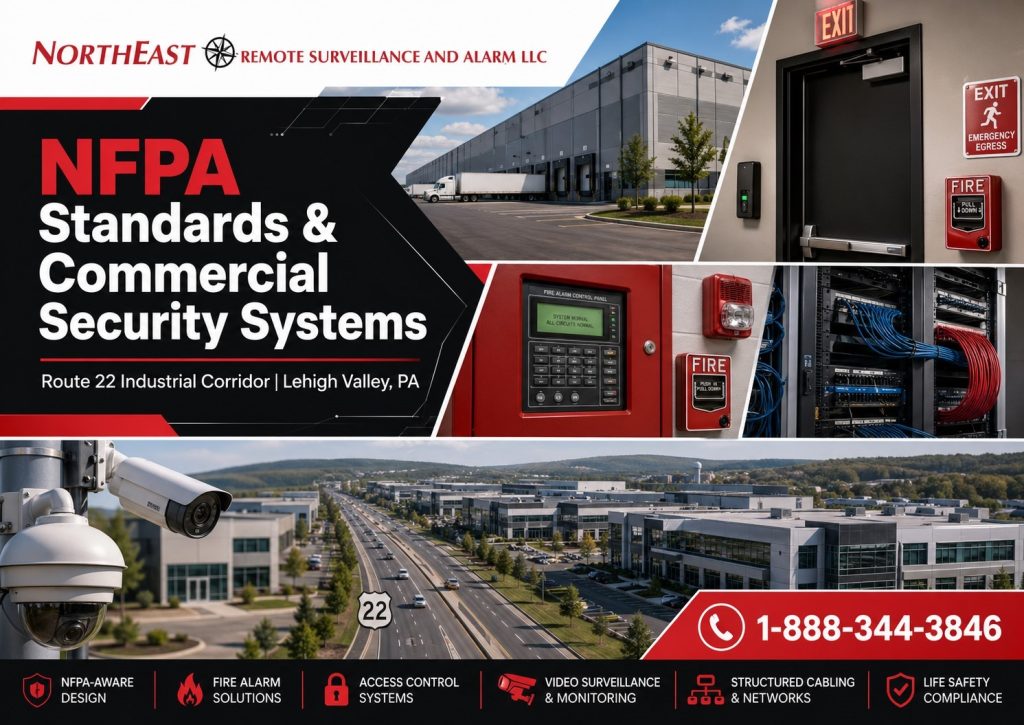
Warehouses, distribution centers, manufacturing facilities, logistics properties, offices, healthcare buildings, schools, municipal buildings, contractor yards, and multi-tenant commercial sites along Route 22 may use cameras, access control, intrusion alarms, intercoms, gates, monitoring, and integrated security platforms. When those systems connect to doors, wiring, power, fire alarm interfaces, emergency exits, or life-safety functions, NFPA-aware planning becomes important.
Northeast Remote Surveillance and Alarm, LLC helps commercial and industrial facilities along the Route 22 corridor plan security systems with practical awareness of NFPA standards, building conditions, life-safety coordination, and long-term serviceability.
For broader corridor planning, visit Route 22 Industrial Corridor Security Systems in the Lehigh Valley, PA
Why NFPA Awareness Matters Along Route 22
Route 22 properties often have active entrances, dock doors, employee doors, warehouse spaces, production areas, offices, shared tenant areas, gated sections, and after-hours operations. Security systems in these environments should not be planned as isolated devices.
A camera system may require proper cabling, power, mounting, network support, and environmental planning. An access control system may affect door hardware, emergency egress, electric locks, request-to-exit devices, and fire alarm release. An intrusion alarm system may require proper zone planning, backup power, communication paths, and monitoring documentation.
NFPA awareness helps reduce the risk of unsafe design, failed inspections, poor documentation, wiring problems, and security systems that interfere with life-safety requirements.
For broader code and standards planning, visit Regulatory and Compliance for Commercial Security, Fire Alarm and Life Safety.
For related standards and primary references, visit NFPA Standards for Commercial Security Systems.
NFPA Considerations for Security Cameras, Cabling, and Power
Video surveillance systems along Route 22 may involve exterior cameras, warehouse cameras, parking lot cameras, loading dock cameras, network video recorders, switches, power supplies, cable pathways, equipment rooms, surge protection, and building penetrations.
NFPA 70, commonly known as the National Electrical Code, can affect how low-voltage cabling, power, equipment support, grounding, separation, and installation methods are planned. Low voltage does not mean low importance. Poor cabling, weak power design, or unsupported infrastructure can create long-term reliability and service problems.
For camera-focused planning along the corridor, visit Route 22 Commercial Video Surveillance System.
Access Control and Egress Coordination
Access control is one of the most NFPA-sensitive security system categories because it can affect doors, exiting, emergency release, fire alarm coordination, electrified locks, delayed egress, request-to-exit devices, and safe movement through the building.
Route 22 warehouses, offices, healthcare properties, schools, municipal buildings, manufacturing sites, and multi-tenant commercial buildings may all need controlled entry, but secure entry must not create unsafe exit conditions. Controlled doors should be planned around the building use, door hardware, life-safety requirements, and how people exit during normal and emergency conditions.
For controlled-door planning along the corridor, visit Route 22 Access Control Systems.
NFPA Considerations for Intrusion Alarms and Monitoring
Commercial intrusion alarm systems should be designed around reliable detection, clear zone reporting, backup power, communication paths, monitoring procedures, and documentation. Route 22 properties with multiple entrances, overhead doors, offices, dock areas, restricted rooms, and after-hours activity should not be treated as one generic alarm zone.
A better alarm design identifies where an event starts, supports better response decisions, and helps the business maintain useful records for future service, review, and expansion.
Fire alarm systems, code-required fire protection, and life-safety systems should remain separate from intrusion alarm design unless a qualified design process, AHJ coordination, and proper documentation are involved.
Fire Alarm Coordination and Life-Safety Boundaries
Security systems may need to coordinate with fire alarm systems, but they should not interfere with required life-safety functions. Access-controlled doors, electrified hardware, intercoms, gates, alarm devices, power supplies, and monitoring connections should be reviewed carefully when they affect emergency egress, fire alarm response, or required building operation.
The goal is to secure the property without creating unsafe conditions or confusing responsibilities between security systems and life-safety systems.
Documentation and Inspection Readiness
NFPA-aware security planning should include documentation. Facility managers should know where devices are installed, how systems are powered, which doors are controlled, how emergency release functions work, how alarms communicate, and what equipment may require service or future inspection.
Good documentation helps owners, contractors, AHJs, service technicians, IT teams, and internal management understand how the system is supposed to operate. It also helps reduce confusion during renovations, tenant changes, system upgrades, incident reviews, inspections, and emergency service calls.
Route 22 NFPA-Aware Security Assessment
NERSA can review how security systems work with wiring, doors, exit routes, and fire alarm equipment at your Route 22 corridor property. The assessment also covers monitoring and documentation. We serve commercial, industrial, healthcare, school, and municipal facilities.
An NFPA-aware security assessment may review controlled doors, access control hardware, low-voltage cabling, camera infrastructure, alarm communication paths, power supplies, fire alarm coordination points, documentation gaps, monitoring needs, and future expansion.
To begin site-specific planning, visit Physical Plant Security Assessment.