
Find security planning guides for Lehigh Valley industrial parks and logistics corridors, organized by location, property type, and operating needs.

Request a Commercial Security Assessment
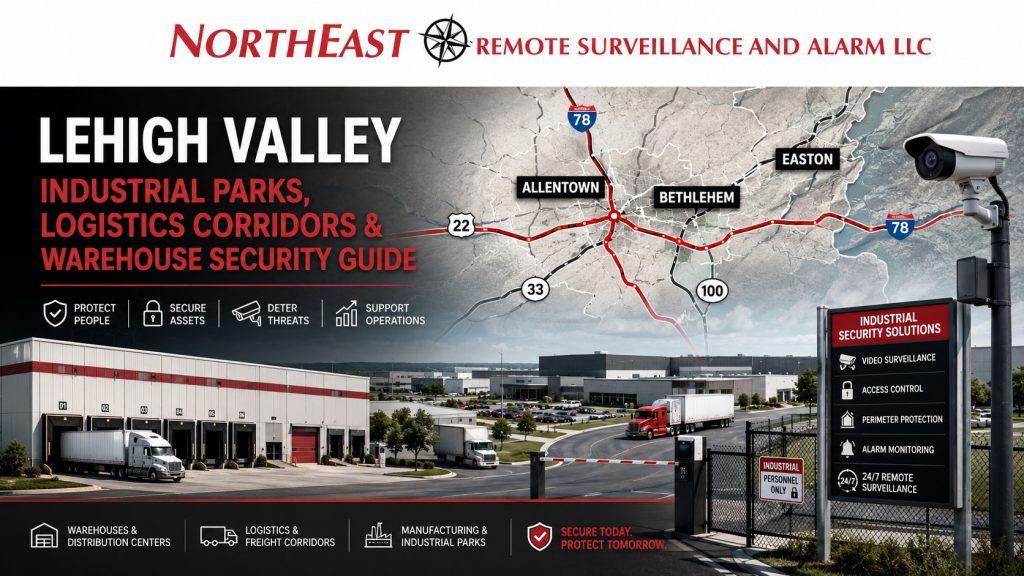
Lehigh Valley industrial properties include manufacturing, warehousing, logistics, and distribution operations.
Industrial properties extend throughout Allentown, Bethlehem, Easton, Lehigh County and Northampton County, with major concentrations surrounding I-78, Route 22, Route 33, Route 100, Lehigh Valley International Airport, Upper Macungie, Fogelsville, Bethlehem Township, Palmer Township and other established industrial areas.
These properties may include large distribution centers, manufacturing facilities, warehouse campuses, contractor operations, transportation companies, fleet properties, truck yards, multi-tenant industrial buildings and commercial facilities supporting regional freight activity.
For complete regional security-system planning, begin with Lehigh Valley Commercial & Industrial Security Systems.
Industrial and Logistics Operations Across the Lehigh Valley
The Lehigh Valley’s location gives industrial businesses direct access to major Pennsylvania and Northeast transportation routes.
I-78 provides connections toward New Jersey and the New York metropolitan market to the east and toward central Pennsylvania to the west. Route 22 serves established commercial and industrial areas across the center of the region, while Route 33 connects major Northampton County industrial markets with I-78 and surrounding communities.
Western Lehigh County adds another significant concentration of warehouse, manufacturing and distribution properties around Route 100, Fogelsville, Breinigsville and Upper Macungie.
The region also contains older industrial properties, redeveloped manufacturing sites, newer distribution facilities, industrial parks and multi-building commercial campuses.
Because those properties developed at different times and for different uses, their security requirements can vary substantially.
A newer distribution center may have extensive loading docks, trailer staging, employee parking and long exterior approaches.
An established manufacturing facility may combine production areas, office space, restricted rooms, shipping operations and older security infrastructure.
A contractor or fleet facility may depend heavily on gates, exterior storage, work vehicles and after-hours protection.
This directory helps businesses reach the NERSA resource that most closely matches the location or industrial environment of the property.
Security Planning for Large Industrial Properties
Industrial and logistics facilities often operate differently from ordinary commercial offices.
Depending on the property, daily operations may involve:
- Multiple employee shifts
- Employee and contractor entrances
- Truck and delivery traffic
- Loading and receiving operations
- Trailer staging
- Warehouse activity
- Production areas
- Exterior storage
- Parking areas
- Gates and drive lanes
- Restricted spaces
- Vendors and third-party drivers
- After-hours occupancy
- Multiple buildings
- Long distances between entrances
- Future expansion
Large properties can also create infrastructure requirements involving cabling, fiber, wireless connectivity, network equipment, power and remote communications.
Those conditions should be evaluated as part of the complete property rather than assuming every industrial facility requires the same security design.
Lehigh Valley Industrial Park Environments
Industrial parks can create operating conditions that differ from isolated commercial properties.
Several businesses may share surrounding roads, drive lanes, parking approaches and delivery traffic while each company remains responsible for its own building, employees, equipment and controlled areas.
A facility may need to distinguish between:
- Areas controlled by the business
- Areas controlled by the landlord
- Shared tenant spaces
- Common vehicle routes
- Private loading areas
- Shared parking
- Employee entrances
- Public or visitor approaches
- Exterior storage
- Property boundaries
Security planning should reflect what the organization actually controls.
A tenant should not build its security plan around the assumption that it can control a shared industrial-park roadway or neighboring property.
The building’s own entrances, docks, restricted areas, parking exposure and exterior approaches can still be evaluated according to how employees, visitors, vendors and vehicles use the property.
Existing Industrial Buildings and Security Infrastructure
Not every Lehigh Valley industrial property is a newly constructed warehouse.
Many commercial and manufacturing buildings have been expanded, renovated, subdivided or repurposed over time.
An existing property may contain:
- Older cameras
- Legacy recording equipment
- Existing alarm systems
- Older access-control equipment
- Existing door hardware
- Undocumented cabling
- Multiple security platforms
- Older communications equipment
- Existing network infrastructure
Existing equipment should be evaluated before complete replacement is recommended.
Useful components may remain serviceable when they are reliable, compatible and suitable for the completed system, while unsupported or inadequate portions can be modernized selectively.
The condition and long-term supportability of the infrastructure should determine what remains—not simply the age of the building.
Multi-Shift and After-Hours Industrial Operations
Warehouses and industrial facilities frequently operate outside ordinary office hours.
Employees may arrive before administrative staff. Second or third shifts may continue overnight. Drivers may arrive early for deliveries. Cleaning or maintenance personnel may remain after other departments close.
A large facility may have one portion operating while another portion is secured.
Security planning should account for these operating patterns so legitimate employee, vendor and delivery activity can continue without creating unnecessary alarms or making the system difficult to manage.
Planning for Industrial Growth
Industrial properties frequently change as business requirements change.
A company may expand warehouse space, increase production, add loading positions, lease another building, create additional employee entrances, enlarge an equipment yard or increase trailer storage.
Security infrastructure should provide a practical path for reasonable future expansion.
Planning ahead for cabling, network capacity, recording, controllers, communications and equipment locations can reduce the need to rebuild major portions of the system every time the property changes.
Major Lehigh Valley Industrial Corridors
I-78 Logistics Corridor
For warehouses, distribution centers, truck facilities and freight-oriented properties along one of the Lehigh Valley’s primary logistics routes, visit I-78 Logistics Corridor Security Systems.
Route 22 Industrial Corridor
For established industrial, commercial and mixed-use properties along the region’s central east-west business corridor, visit Route 22 Industrial Corridor Security Systems.
Route 100, Fogelsville and Upper Macungie
For warehouses, manufacturing facilities, contractor operations and distribution properties throughout western Lehigh County, visit Commercial & Industrial Security Installation in Fogelsville, PA.
Major Lehigh Valley Industrial Markets
Allentown Industrial Properties
For warehouses, industrial operations and other qualifying commercial properties throughout Allentown and surrounding Lehigh County, visit Allentown Commercial Security Systems.
Bethlehem and Bethlehem Township
For manufacturing, warehouse and industrial properties throughout Bethlehem and the surrounding industrial market, visit Bethlehem Manufacturing & Industrial Security Systems.
Easton, Palmer and Forks Township
For industrial and commercial properties serving Easton, eastern Northampton County and the Route 33/I-78 market, visit Commercial & Industrial Security Systems in Easton, PA.
Industrial Property Security Resources
Warehouse and Distribution Facilities
For employee entrances, warehouse operations, shipping and receiving, overhead doors, parking and broader warehouse protection, visit Lehigh Valley Warehouse Security Systems.
Loading Dock Operations
For freight, drivers, trailers, overhead doors and other security considerations around active loading areas, visit Loading Dock Security Systems.
Truck Yards and Exterior Industrial Areas
For truck courts, trailer areas, fenced storage, fleet operations and exterior industrial property, visit Truck Yard Security Systems.
Frequently Asked Questions About Lehigh Valley Industrial Parks and Logistics Corridors
What are the major industrial areas in the Lehigh Valley?
Major industrial activity is concentrated throughout Allentown, Bethlehem, Easton, Upper Macungie, Fogelsville, Breinigsville, Bethlehem Township, Palmer Township, Forks Township and areas surrounding I-78, Route 22, Route 33, Route 100 and Lehigh Valley International Airport.
Why is the Lehigh Valley important for warehouse and logistics operations?
The region provides strong access to major Northeast transportation markets while supporting a large concentration of warehouses, distribution centers, manufacturing facilities, trucking operations and other industrial businesses.
What security concerns are common at industrial properties?
Common considerations include employee entrances, loading docks, shipping and receiving, parking, gates, truck activity, trailer areas, restricted spaces, exterior storage and after-hours operations.
Are industrial security systems different from ordinary office systems?
They can be. Larger properties may involve longer distances, higher mounting positions, exterior areas, multiple shifts, industrial door conditions, truck activity and more complex infrastructure.
Can an existing industrial security system be upgraded?
Potentially. Existing cameras, access-control equipment, alarm systems, cabling, network infrastructure and other components should be evaluated for condition, compatibility and future support.
Can one system support multiple industrial buildings?
Potentially. Multi-building properties may support centralized administration when communications, network connectivity, distance, power and platform requirements are properly evaluated.
Does NERSA provide residential security systems?
No. Northeast Remote Surveillance and Alarm, LLC focuses on commercial, industrial, institutional and other qualifying nonresidential properties.
Request a Lehigh Valley Industrial Security Assessment
Industrial security planning should begin with the actual property, its operating schedule and the movement of employees, vehicles, vendors, inventory and equipment.
Northeast Remote Surveillance and Alarm, LLC can evaluate qualifying warehouse, manufacturing, distribution, logistics and industrial properties throughout the Lehigh Valley.
Request a Commercial Security Assessment.
For additional location-specific planning, review the Route 33 industrial corridor and Route 100 industrial corridor guides.