Restricted area video surveillance helps industrial facilities monitor controlled spaces where unauthorized access, safety exposure, high-value materials, equipment misuse, or operational disruption can create serious risk. Northeast Remote Surveillance and Alarm, LLC designs restricted-area camera systems for manufacturing plants, warehouses, logistics buildings, utility rooms, equipment zones, secure storage areas, production areas, and multi-building industrial properties across Pennsylvania and the Mid-Atlantic. For broader camera planning across industrial properties, start with Industrial Video Surveillance Systems.
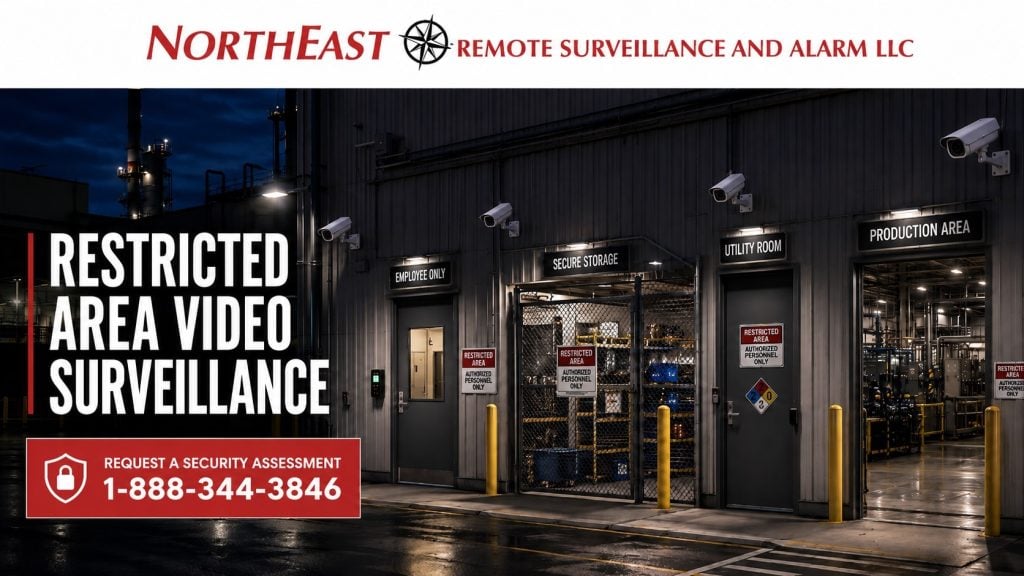
Restricted Area Video Surveillance for Controlled Industrial Areas
Restricted areas require more than general camera coverage. These spaces often contain critical equipment, sensitive inventory, hazardous materials, electrical rooms, mechanical systems, production assets, IT infrastructure, maintenance areas, or employee-only zones where unauthorized activity can create security, safety, liability, and operational problems.
A properly designed restricted-area surveillance system helps document who approached the area, when activity occurred, what happened inside or near the zone, and whether the event requires review. It can support security investigations, employee accountability, safety reviews, operational oversight, and long-term facility protection.
This page focuses specifically on video surveillance for restricted industrial areas. It should support access control, safety, compliance, and operational security without turning into a broad warehouse security or general camera system page.
What Counts as a Restricted Area?
A restricted area is any space inside or outside an industrial facility where access should be controlled, documented, or limited to authorized personnel. These areas may be restricted because of safety risk, asset value, operational sensitivity, compliance exposure, or business continuity concerns.
Common restricted areas include:
- Electrical rooms
- Mechanical rooms
- IT and network rooms
- Fire alarm and life-safety equipment rooms
- Tool rooms
- Parts cages
- Secure inventory rooms
- Chemical storage areas
- Production control areas
- Machine rooms
- Utility areas
- Maintenance shops
- Employee-only entrances
- Server and communications spaces
- High-value material storage areas
- Exterior equipment enclosures
- Fenced utility or service zones
- Restricted yard areas
- Contractor-only or employee-only access points
The camera design should match the reason the area is restricted. A secure storage cage, electrical room, hazardous material area, and production control room may each require different camera placement, retention, access permissions, and monitoring strategy.
Why Restricted Area Video Surveillance Areas Need Dedicated Camera Design
Restricted areas are often missed when camera systems are designed only around entrances, parking lots, docks, and general warehouse activity. That creates a gap between the places most visible on the property and the places that may carry the highest operational risk.
A general overview camera may show someone walking down a hallway, but it may not clearly document access to a controlled room, activity near critical equipment, or movement around a secure storage zone. Restricted-area surveillance should be designed to answer specific questions: who entered, when did they enter, what area did they access, what did they do, and was that activity authorized?
The camera system should also support practical facility workflows. It should help managers review activity without creating unnecessary surveillance clutter, poor angles, or unusable footage.
Camera Placement for Restricted Industrial Zones
Camera placement should be based on the access point, risk level, asset value, lighting, room layout, employee workflow, and privacy expectations of the area. In many cases, the most important view is not only inside the restricted area but also the approach path leading to it.
A restricted-area camera layout may include:
- Door approach views
- Interior room views where appropriate
- Secure storage cage views
- Utility equipment views
- Tool and parts room coverage
- Exterior gate or enclosure coverage
- Hallway-to-restricted-zone views
- Employee-only entrance coverage
- After-hours movement detection zones
- Camera views paired with access control events
For facilities where restricted areas are connected to broader exterior exposure, the supporting page is Industrial Yard Video Surveillance.
Pairing Cameras with Access Control Events
Restricted-area surveillance becomes stronger when it is coordinated with access control. A door event can show when a credential was used, while the camera view can help confirm what happened at the opening, whether the user entered alone, whether someone followed behind, and whether activity matched the intended access level.
This is especially important for electrical rooms, IT rooms, secure storage areas, maintenance rooms, production control areas, and other sensitive industrial spaces.
Camera and access control coordination can help document:
- Authorized entry
- Forced or propped doors
- Tailgating
- Contractor access
- Employee access after hours
- Entry into high-value storage areas
- Access to utility or equipment rooms
- Activity before and after a door event
The goal is not to overcomplicate the system. The goal is to create a clear record around the access points that matter most.
Security Risks in Restricted Areas
Restricted areas create risk because they usually contain equipment, materials, systems, or processes that should not be available to everyone on site. Unauthorized access can result in theft, tampering, safety incidents, production disruption, liability exposure, or loss of control over sensitive areas.
Restricted-area cameras can help document:
- Unauthorized entry
- Employee misuse of controlled spaces
- Contractor access concerns
- Tool or parts theft
- Equipment tampering
- Access to electrical or mechanical systems
- Movement near hazardous or sensitive materials
- After-hours activity
- Door propping or tailgating
- Inventory shrinkage
- Safety incidents in controlled spaces
- Disputes involving access to restricted areas
For restricted areas that require active alert review after hours, use Industrial Remote Video Monitoring.
AI Analytics for Restricted Area Surveillance
AI video analytics can help restricted areas generate more useful alerts when the system is properly designed. Instead of relying only on basic motion detection, analytics can help identify people entering controlled zones, loitering near restricted doors, crossing defined lines, or moving through areas during unauthorized hours.
AI analytics may support:
- Person detection near restricted doors
- After-hours movement alerts
- Line-crossing alerts around controlled zones
- Loitering alerts near utility or storage areas
- Restricted zone intrusion detection
- Alerts for exterior equipment enclosures
- Event filtering for remote monitoring teams
AI analytics work best when cameras have clear sightlines, proper lighting, realistic detection zones, and clean separation between normal operations and restricted activity.
Infrastructure and Recording Requirements
Restricted-area surveillance should be reliable, secure, and properly documented. These areas may require dedicated camera naming, user permission controls, longer retention, protected network pathways, secure recording, and coordination with IT or facility management.
Important infrastructure considerations include:
- PoE switching
- Network segmentation
- Secure recorder or cloud access permissions
- Camera naming by controlled zone
- Recording retention based on risk
- UPS backup where appropriate
- Protected cable pathways
- Tamper-resistant mounting where needed
- Door-event integration where available
- Service documentation for future support
A restricted-area camera system should not create confusion later. Facility managers should be able to understand which camera covers which controlled area and what operational purpose that camera serves.
Compliance, Safety, and Documentation Considerations
Restricted-area cameras should support security, safety, accountability, and operational documentation without interfering with emergency egress, life-safety access, workplace safety procedures, fire alarm equipment access, or required service access. Camera placement should be planned with practical facility operations in mind, especially when monitoring areas involving electrical rooms, mechanical systems, hazardous materials, employee-only spaces, or life-safety equipment.
For broader code-aware planning in warehouse and industrial environments, use Industrial and Warehouse Security Compliance.
A well-documented restricted-area surveillance system should identify camera locations, coverage intent, access permissions, retention requirements, monitoring workflow, and the reason each restricted zone is being monitored. That documentation helps ownership, safety teams, IT, operations leaders, and facility managers maintain the system over time.
Restricted Area Video Surveillance for Pennsylvania and the Mid-Atlantic
Northeast Remote Surveillance and Alarm, LLC designs restricted-area video surveillance systems for industrial and commercial facilities across Pennsylvania and the Mid-Atlantic. These systems are built for real operating environments, including manufacturing plants, warehouses, logistics properties, contractor facilities, utility areas, secure storage zones, and multi-building industrial sites.
The right design depends on the restricted area, access risk, lighting, employee workflow, asset value, infrastructure, recording needs, and whether the facility needs alerts, remote monitoring, access control coordination, or recorded evidence only.
Frequently Asked Questions
What is restricted area video surveillance?
Restricted area video surveillance is camera coverage designed to monitor controlled spaces such as electrical rooms, mechanical rooms, IT rooms, secure storage areas, equipment zones, production areas, utility spaces, and employee-only areas.
Why do industrial facilities need restricted-area cameras?
Industrial facilities need restricted-area cameras because certain spaces contain equipment, materials, systems, or operational processes that should be protected from unauthorized access, misuse, theft, tampering, or safety exposure.
What areas should be treated as restricted areas?
Restricted areas may include electrical rooms, mechanical rooms, server rooms, parts cages, tool rooms, chemical storage areas, production control areas, secure inventory rooms, utility enclosures, maintenance areas, and employee-only access points.
Should restricted-area cameras be installed inside the room or outside the door?
That depends on the area and the purpose of coverage. Some restricted zones need door approach coverage, while others may need interior views, storage cage views, utility equipment views, or both. The design should match the operational risk and privacy expectations.
Can restricted-area cameras work with access control?
Yes. Restricted-area cameras can be coordinated with access control events so managers can review credential use, door activity, tailgating, propped doors, forced access, and after-hours entry.
Are AI analytics useful for restricted areas?
AI analytics can be useful when properly configured. They can help detect people, loitering, line crossing, after-hours movement, and activity inside or near controlled zones.
Should restricted-area cameras be monitored live?
Live monitoring may be useful for restricted areas with after-hours risk, exterior exposure, high-value materials, critical equipment, or repeated unauthorized activity. Some areas may only need recorded evidence, while others may benefit from active alert review.
Can restricted-area cameras reduce theft or misuse?
Yes. Properly placed cameras can deter activity, document access, support investigations, improve accountability, and help identify unauthorized entry, equipment misuse, tool theft, parts theft, or material movement.
What infrastructure is needed for restricted-area surveillance?
Restricted-area surveillance may require PoE switching, secure network access, camera permission controls, protected cabling, UPS backup, secure recording, camera naming standards, and retention planning based on the risk level.
Who installs restricted area video surveillance in Pennsylvania and the Mid-Atlantic?
Northeast Remote Surveillance and Alarm, LLC designs and installs restricted area video surveillance systems for industrial and commercial facilities across Pennsylvania and the Mid-Atlantic, including warehouses, manufacturing plants, logistics properties, utility spaces, secure storage areas, and multi-building industrial sites.
Request a Restricted Area Security Assessment
Restricted area video surveillance should be designed around the specific access risk, equipment exposure, employee workflow, asset value, safety concerns, and operational sensitivity of each controlled zone. Northeast Remote Surveillance and Alarm, LLC helps commercial and industrial facilities plan camera systems that improve visibility, accountability, documentation, monitoring, and long-term security performance. To evaluate your restricted-area camera coverage, blind spots, infrastructure, access-control coordination, and monitoring options, request a Security Assessment.