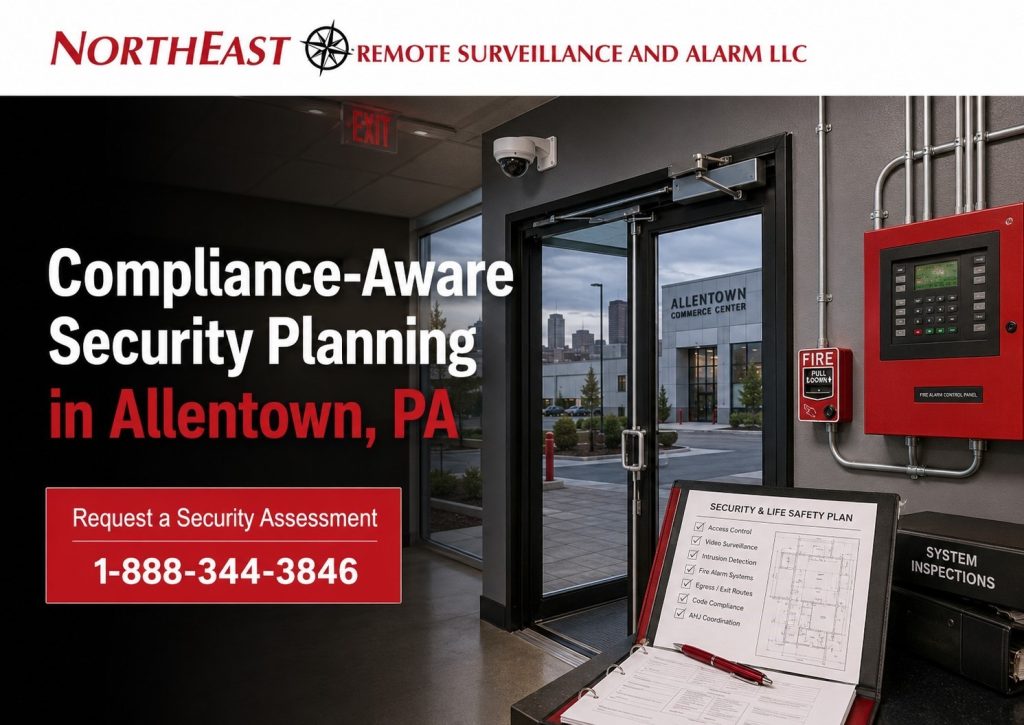
Compliance-aware security planning in Allentown, PA helps commercial and industrial facilities improve security without creating conflicts with life safety, emergency egress, accessibility, workplace safety, fire alarm coordination, documentation, or inspection-sensitive building conditions. This page focuses on how access control, video surveillance, intrusion alarms, fire alarm coordination, monitoring, low-voltage infrastructure, documentation, and security system design should be planned around real commercial facility operations. For the broader citywide security structure, start with Commercial Security Systems in Allentown, PA.

Compliance-Aware Security Planning for Allentown Facilities
Security systems should not be planned as isolated devices. Cameras, card readers, electrified locks, alarm contacts, fire alarm interfaces, intercoms, gate systems, wiring pathways, power supplies, monitoring connections, and user-management platforms all affect how a commercial property operates.
Allentown businesses may need security planning for offices, warehouses, healthcare properties, schools, municipal buildings, manufacturing facilities, retail spaces, contractor yards, logistics properties, and multi-tenant commercial buildings. Each property type can create different concerns around access, egress, documentation, inspection access, fire/life-safety coordination, and workplace accountability.
Northeast Remote Surveillance and Alarm, LLC designs commercial security systems with practical code awareness, documentation, and long-term operations in mind. The goal is not to turn every security project into a legal article. The goal is to help businesses avoid avoidable problems caused by poorly planned doors, cameras, alarms, wiring, monitoring, documentation, or system integration.
Allentown Compliance-Aware Security Planning Topics
NFPA 72 Fire Alarm Systems
Use NFPA 72 Fire Alarm Systems for fire alarm planning, signaling system coordination, monitoring, testing expectations, notification devices, documentation, inspection readiness, and life-safety support.
Pennsylvania UCC Security and Life Safety Planning
Use Pennsylvania UCC Security and Life Safety Planning for commercial security projects involving construction conditions, penetrations, low-voltage pathways, door changes, accessibility, fire/life-safety systems, inspection-sensitive work, or authority coordination.
OSHA-Aware Security System Planning
Use OSHA-Aware Security System Planning for facilities that want cameras, access control, alarms, vehicle-area review, restricted-area control, and documentation to support safer workplace operations and incident review.
NDAA-Compliant Surveillance Cameras
Use NDAA-Compliant Surveillance Cameras for commercial, municipal, government-sensitive, infrastructure, and enterprise projects where camera sourcing, network-connected equipment, and procurement expectations matter.
ADA Access Control and Security Planning
Use ADA Access Control and Security Planning for projects involving controlled entry, card readers, intercoms, door hardware, gates, access routes, user operation, and accessible building movement.
Fire Door and Access Control Coordination
Use Fire Door and Access Control Coordination for projects involving electrified hardware, fire-rated openings, delayed egress concerns, maglocks, exit devices, stair doors, emergency release, and fire alarm interaction.
Inspection Readiness for Commercial Security Systems
Use Inspection Readiness for Commercial Security Systems for device schedules, as-built documentation, labeling, service records, testing records, monitoring information, panel documentation, battery records, and long-term maintenance planning.
Low-Voltage Documentation and Labeling Standards
Use Low-Voltage Documentation and Labeling Standards for security projects involving cable pathways, panel labeling, device labeling, rack documentation, network equipment, structured cabling, fiber, and future serviceability.
Code and Compliance for Commercial Security Systems
Use Code and Compliance for Commercial Security Systems for the broader compliance hub covering commercial security systems, access control, fire alarm coordination, OSHA-aware planning, PA UCC considerations, ADA access control, NDAA camera selection, documentation, and inspection readiness.
Access Control, Doors, and Emergency Egress
Access control is one of the most important areas for compliance-aware planning because it directly affects doors. A controlled door is not just a reader and a lock. It may involve the door, frame, latch, closer, exit device, electrified strike, electrified trim, maglock, power supply, request-to-exit device, door position switch, fire alarm interaction, user flow, accessibility, and emergency release behavior.
Allentown commercial properties may need access control at employee entrances, warehouse doors, office suites, medical records areas, restricted rooms, manufacturing spaces, server rooms, utility areas, shared tenant doors, gates, and staff-only areas. Each opening should be evaluated based on how the door is used and how people need to exit during normal and emergency conditions.
NERSA does not treat access control as a shortcut around life safety. Controlled entry should improve security while preserving safe building operation, practical user movement, inspection awareness, and long-term serviceability.
Video Surveillance, Privacy, and Incident Documentation
Video surveillance can support documentation, incident review, workplace accountability, parking lot visibility, loading dock review, restricted-area monitoring, and after-hours investigation. However, camera placement should be planned carefully.
Allentown businesses should consider where cameras are useful, where they may create privacy concerns, how long footage should be retained, who can access recordings, who can export footage, and whether camera views support real incident review. A camera aimed poorly, placed casually, or installed without a retention plan may not provide the documentation the business expects.
Privacy-sensitive areas should be treated carefully. Cameras should support security and documentation without being placed in inappropriate spaces or used as a replacement for policies, training, supervision, or compliance programs.
Fire Alarm and Life-Safety Coordination
Security systems should not interfere with fire alarm systems, life-safety devices, emergency exits, fire doors, sprinkler monitoring, notification equipment, inspection access, or required emergency operation.
Fire alarm coordination may matter when a project involves access-controlled doors, maglocks, electrified hardware, delayed egress concerns, alarm interfaces, sprinkler monitoring, monitoring pathways, emergency communication, or life-safety documentation.
A security project that touches fire/life-safety conditions should be planned with the right parties involved. Depending on the work, that may include the building owner, property manager, fire alarm contractor, electrical contractor, general contractor, design professional, code official, or authority having jurisdiction.
OSHA-Aware Workplace Security Planning
Security systems do not replace an employer’s safety program, training, supervision, workplace policies, hazard controls, or regulatory obligations. They can, however, support safer operations by improving visibility, access accountability, incident review, vehicle movement documentation, restricted-area control, and after-hours event review.
For warehouses, logistics facilities, manufacturing sites, contractor yards, healthcare properties, schools, and municipal facilities, security systems can help management review what happened during an event. Cameras, alarms, access logs, panic buttons, and monitoring records can support documentation when properly planned and maintained.
The system should be built around actual operational risk. Loading docks, truck yards, employee entrances, parking lots, equipment areas, restricted rooms, production support areas, and public-facing spaces each create different security and documentation needs.
PA UCC and AHJ Coordination
Pennsylvania commercial properties may require coordination when security work affects construction conditions, door hardware, low-voltage pathways, penetrations, fire/life-safety systems, accessibility, equipment mounting, inspection-sensitive areas, or building use.
Not every camera, reader, alarm contact, or intercom creates the same issue. The scope of work matters. A simple camera replacement may be different from a new access-controlled door, a maglock installation, a gate system, a fire alarm interface, a new low-voltage pathway, or a construction-phase security upgrade.
For Allentown businesses, the safest approach is to identify code-sensitive conditions early. Proper planning reduces the risk of rework, failed inspections, unclear documentation, emergency-egress conflicts, and coordination problems with owners, contractors, or authorities.
ADA-Aware Access Control and Visitor Entry
Access control and visitor-entry systems should be planned with accessibility in mind. Readers, intercoms, door hardware, gates, release buttons, entry workflows, and user interfaces should be positioned and configured so the system supports practical building use.
ADA-aware planning may matter for main entrances, tenant entries, medical offices, municipal buildings, schools, customer-facing properties, shared commercial doors, and public access points. The goal is to improve security without creating unreasonable barriers to entry or exit.
For Allentown properties, access control should support the business while respecting accessible routes, door operation, user movement, and emergency conditions.
NDAA, Cybersecurity, and Security Technology Selection
Modern commercial security systems often include network-connected cameras, recorders, access control panels, cloud dashboards, alarm communicators, mobile apps, remote monitoring platforms, and user-management portals. That makes equipment selection, cybersecurity, and user permissions part of practical security planning.
NDAA camera selection may be important for certain commercial, municipal, government-sensitive, infrastructure, or enterprise projects. Cybersecurity considerations may include password control, firmware practices, user permissions, remote access, network segmentation, cloud access, account removal, and who is allowed to view or export data.
Security data may include video footage, access logs, alarm history, vehicle records, user credentials, and operational activity. Businesses should understand who manages the system, who has access, and how access is removed when roles change.
Documentation and Inspection Readiness
Documentation is one of the strongest ways to protect the long-term value of a commercial security system. A system may work on installation day, but poor documentation can create problems during service, inspections, ownership changes, renovations, troubleshooting, or future expansion.
Inspection-ready planning may include device schedules, cable labels, panel labels, camera schedules, door schedules, reader schedules, alarm zone lists, monitoring information, battery records, testing records, user permission records, as-built drawings, warranty documentation, service logs, and maintenance expectations.
Allentown facilities with cameras, access control, alarms, fire alarm interfaces, gate systems, monitoring, or low-voltage infrastructure should keep documentation organized so the system remains serviceable and understandable over time.
Low-Voltage Infrastructure and System Reliability
Security systems depend on infrastructure. Cameras, access control, alarms, intercoms, fire alarm interfaces, gate systems, remote monitoring, wireless bridges, and network-connected equipment may require proper cable pathways, PoE switching, power supplies, backup power, surge protection, equipment racks, fiber, conduit, labeling, and network planning.
Poor infrastructure can weaken the entire system. A well-placed camera still fails if the network is unreliable. A card reader becomes a problem if the power supply is poorly planned. A monitoring connection may not work correctly if communication paths are unstable or undocumented.
NERSA plans low-voltage infrastructure with serviceability, future expansion, and long-term dependability in mind.
Compliance-Aware Planning by Property Type
Different Allentown property types have different compliance-sensitive security concerns.
Warehouses and logistics facilities may need planning around dock doors, truck courts, trailer areas, employee entrances, fire alarm coordination, alarm zones, exterior cameras, and after-hours monitoring. Manufacturing and industrial facilities may need restricted-area control, production-adjacent cameras, contractor access, machine-area visibility, emergency movement, and industrial infrastructure support.
Healthcare properties may need privacy-aware camera placement, staff-only access, panic buttons, records-area control, parking lot visibility, and life-safety coordination. Office buildings may need tenant separation, visitor entry, server room access, parking lot cameras, stairwell awareness, and after-hours alarms.
Retail, hospitality, schools, municipal buildings, and contractor yards each create different security, documentation, and access-control concerns. A strong plan starts by understanding the property before selecting equipment.
Why Allentown Businesses Choose NERSA for Compliance-Aware Planning
Northeast Remote Surveillance and Alarm, LLC focuses on commercial and industrial security systems, not residential alarm packages. Allentown businesses choose NERSA when they need security systems planned around real buildings, real operations, real doors, real camera views, real documentation needs, and real long-term support.
NERSA helps businesses avoid common problems caused by generic security installation, including poorly placed cameras, confusing access-control behavior, incomplete documentation, weak alarm zoning, unreliable infrastructure, and security devices that conflict with facility operations.
Our goal is to help commercial and industrial properties improve security while supporting safe operation, inspection readiness, documentation, access accountability, and long-term system management.
Request a Compliance-Aware Security Assessment in Allentown
If your Allentown property needs security cameras, access control, intrusion alarms, fire alarm coordination, low-voltage infrastructure, remote monitoring, NDAA camera planning, ADA-aware access control, documentation support, or inspection-aware security planning, Northeast Remote Surveillance and Alarm, LLC can help.
Use Request a Security Assessment to review your facility, doors, cameras, alarm zones, access-control needs, fire/life-safety coordination, documentation gaps, infrastructure, and operational security goals.
Frequently Asked Questions About Compliance-Aware Security Planning in Allentown, PA
What is compliance-aware security planning?
Compliance-aware security planning means designing commercial security systems with awareness of emergency egress, fire alarm coordination, accessibility, workplace safety, documentation, inspection readiness, low-voltage infrastructure, cybersecurity, and facility operations.
Does a security system replace code compliance?
No. Security systems do not replace code compliance, workplace safety programs, fire alarm systems, emergency procedures, training, supervision, or legal obligations. Security systems can support documentation, visibility, access accountability, and operational review when properly planned.
Why does access control need compliance-aware planning?
Access control affects doors. Controlled openings may involve egress, fire alarm interaction, electrified hardware, emergency release, ADA-related usability, user flow, inspection expectations, and safe building operation.
Can cameras support workplace documentation?
Yes. Properly placed cameras can help document incidents, review parking lot activity, monitor loading areas, support investigations, verify access events, and provide useful records for internal review.
What is PA UCC coordination?
PA UCC coordination refers to planning security work with awareness of Pennsylvania building code conditions that may affect commercial construction, door changes, penetrations, pathways, accessibility, fire/life-safety systems, or inspection-sensitive work.
How does OSHA relate to security systems?
Security systems do not replace OSHA compliance, but they can support workplace review, incident documentation, restricted-area accountability, vehicle movement review, and safer operational oversight when properly designed.
What does NDAA-compliant camera planning mean?
NDAA-compliant camera planning involves selecting surveillance equipment that meets procurement expectations for certain government-sensitive, municipal, infrastructure, or enterprise projects where camera sourcing and network-connected equipment matter.
Why is ADA important for access control?
ADA-aware access control planning helps make sure readers, intercoms, door hardware, gates, and entry workflows are considered in relation to accessible routes, door operation, user movement, and safe building access.
Why is documentation important for commercial security systems?
Documentation helps facility managers, inspectors, service technicians, contractors, and future decision-makers understand system layout, device locations, wiring paths, panel locations, testing history, user permissions, monitoring information, and maintenance needs.
Can NERSA help with compliance-aware security planning in Allentown?
Yes. Northeast Remote Surveillance and Alarm, LLC can help Allentown commercial and industrial properties plan security cameras, access control, intrusion alarms, fire alarm coordination, low-voltage infrastructure, remote monitoring, documentation, and inspection-aware security systems.