
Change order and scope change standards are part of Commercial Security Trust & Project Standards because commercial security projects should remain organized when field conditions, customer needs, equipment requirements, or project details change.

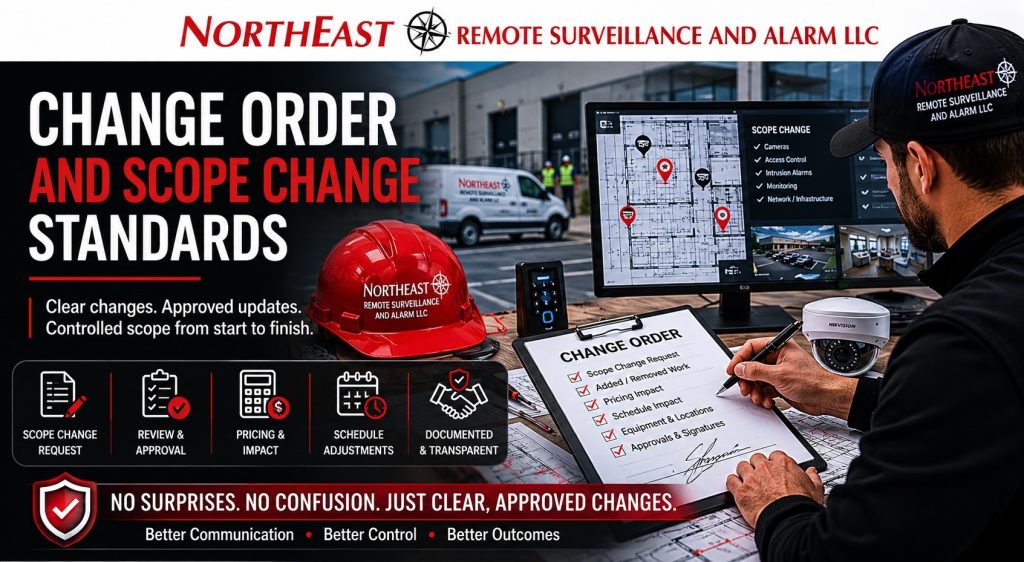
This resource explains how Northeast Remote Surveillance and Alarm, LLC approaches change orders, scope adjustments, added work, removed work, field-condition changes, approval records, and project closeout updates.
The goal is to help commercial and industrial clients understand how changes are reviewed, documented, priced, approved, and completed without creating confusion during or after the project.
What a Change Order and Scope Change Means
A change order is a documented adjustment to the original approved project scope. It may add work, remove work, modify equipment, change device locations, revise system programming, adjust labor requirements, affect scheduling, or update project responsibilities.
In commercial security work, change orders are common because buildings are active environments. A camera location may need to move after a field review. An access-controlled door may require different hardware than expected. A warehouse may add dock doors to the project. A customer may request additional mobile users, alarm zones, monitoring instructions, or camera retention changes after the original proposal is approved.
A proper change order does not mean the project is disorganized. It gives the project team a clear way to manage changing field conditions.
Why Change Order and Scope Change Standards Matter
Commercial security projects can become confusing when scope changes are handled casually. Verbal requests, handshake approvals, unclear pricing, undocumented substitutions, and last-minute additions can create disagreements, delays, billing confusion, and service problems after turnover.
Scope change standards help protect both the customer and the integrator. The customer understands what is changing, why it is changing, how it affects cost, and whether it affects the schedule. The installer understands the approved work and which changes still need authorization.
For commercial and industrial facilities, this is especially important because security systems often involve cameras, access control, intrusion alarms, monitoring paths, network infrastructure, low-voltage cabling, door hardware, building coordination, and operational scheduling. A small change in one area can affect several other parts of the project.
How This Guide Differs From Proposal Standards
This guide covers changes to an approved project scope. It does not replace the original proposal, estimate, walkthrough, or project planning process.
The supporting resource for defining the original scope is Security Proposal and Scope Development Standards.
That page explains how to describe a commercial security project before approval.
This guide covers changes to an already approved scope.
Keeping these topics separate helps prevent confusion. Proposal standards define the starting point. Change order standards define how the project is adjusted when that starting point changes.
What Can Trigger a Change Order or Scope Change
Customer requests, field conditions, building changes, operational needs, or equipment availability can trigger a scope change. Other triggers include network limitations, door hardware conditions, code-sensitive discoveries, and newly identified security concerns.
Common examples include new cameras, different camera locations, longer recording retention, additional controlled doors, new credentials, alarm zones and panic buttons. Changes may also affect monitoring instructions, remote users, equipment locations, cable routes, network hardware or the system platform.
Scope changes can also happen when a customer decides to expand the project. A business may approve the original camera system, then ask to add access control. A warehouse may request additional loading-dock coverage. A manufacturing facility may add restricted-area monitoring after seeing the initial layout.
What Should Be Documented in a Change Order and Scope Change
A change order should clearly describe what is changing. It should identify added work, removed work, substituted equipment, changed locations, programming changes, labor impacts, pricing adjustments, schedule impacts, and any assumptions that affect the revised scope.
The documentation should be understandable. A customer should not have to decode vague language such as “additional work performed” or “field changes completed.” A good change order should explain the actual change in practical terms.
For example, a change order may add two warehouse cameras to cover a new shipping area. Another may specify different lock hardware because an existing door frame cannot support the original device. Clear wording helps prevent future disputes.
Approval Before Work Proceeds – Change Order and Scope Change Standards
Whenever practical, approve change orders before starting the added or modified work. This protects the customer from surprise costs and protects the installer from completing unapproved work.
There are situations where urgent field decisions may be needed, especially when a project is in progress and delaying the decision would interrupt operations or create rework. Even then, document the change as soon as possible and confirm it with the authorized decision-maker.
Commercial security work should avoid informal approval chains. The person requesting the change may not always be the person authorized to approve cost, scope, or system design changes. A clear approval process helps keep the project controlled.
Authorized Decision-Makers
The authorized decision-maker should approve the change order. Depending on the project, that may be the business owner, facility manager, operations director, property manager, procurement contact, IT manager, general contractor, or authorized project representative.
This matters because security projects often involve multiple people. A site supervisor may request an additional camera, but the owner may control budget approval. An IT contact may request network changes, but a facilities manager may control access-control decisions. A tenant may request changes, but the property owner may need to approve building modifications.
Clear approval authority prevents confusion and helps ensure the final system reflects the customer’s actual decision-making process.
Added Work
Describe added work clearly and price it separately from the original scope. Added work may include extra cameras, added doors, additional alarm devices, longer cable routes, additional labor, added network equipment, upgraded storage, new monitoring features, additional programming, or extra training.
Avoid vague project language that hides added work. The customer should understand the added work and why the cost changed.
This is especially important for large commercial and industrial sites where small additions can affect labor, materials, lifts, access time, programming, documentation, and testing. A single added camera in a simple office may be minor. Several added cameras across a warehouse, yard, or production area may affect schedule, cable paths, switching, power, and storage.
Removed Work
A scope change can also remove work from the project. A customer may decide not to proceed with a camera, door, alarm zone, monitoring feature, or system option that was included in the original scope.
Document removed work so the customer can compare the final system with the revised scope. If a device was removed by customer decision, the closeout record should reflect that the final system was intentionally changed.
Removed work may or may not result in a direct credit depending on timing, equipment ordering, labor already performed, custom materials, restocking conditions, or contract terms. The important standard is a clear record of the change.
Equipment Substitutions Change Order and Scope Change Standards
Review equipment substitutions carefully. A substitution may be needed because of product availability, manufacturer changes, field requirements, compatibility concerns, or a better fit discovered during project execution.
The customer should understand when a substitution affects performance, warranty, platform behavior, appearance, integrations, licensing, or future service. Not all substitutions are equal. A comparable part may be acceptable, but a different product category or lower-capability device should not be treated as a simple swap without explanation.
For commercial security systems, substitutions may involve cameras, lenses, readers, credentials, locks, controllers, alarm devices, communicators, power supplies, switches, recorders, storage, intercoms, or monitoring hardware. Document the change so future support teams know which equipment the site uses.
Camera System Change Order and Scope Change Standards
Camera scope changes may add cameras, move them, adjust their field of view or specify a different camera type. Other changes affect analytics, retention, remote access, recording storage or monitoring coverage.
Review camera changes against the security purpose of each view. A camera moved from an office hallway to a loading dock is not just a location change; it may require different lighting, lens selection, mounting height, cabling, weather rating, and recording considerations.
Tie camera scope changes to the operational need at the warehouse, office, manufacturing facility, parking lot, truck yard, gate or loading dock. Explain which risk area, activity or coverage gap the change addresses.
Access Control Change Order and Scope Change Standards
Access control changes often affect more than software. Adding or changing a controlled door may require door hardware review, electrified locks, strikes, maglocks, power supplies, request-to-exit devices, door contacts, cable pathways, fire/life-safety coordination, ADA-aware operation, and schedule programming.
A customer may ask to add a card reader to a door, but the actual change may involve hardware, electrical coordination, door condition review, and user-permission planning. Explain these requirements before work proceeds.
Access control scope changes should also address user groups, administrator permissions, credential quantities, mobile credential needs, door schedules, event labels, and future service support. A door is not fully changed just because a reader is mounted.
Intrusion Alarm Change Order and Scope Change Standards
Intrusion alarm scope changes may include adding doors, motions, panic buttons, glass-break sensors, overhead-door contacts, partitions, sirens, keypads, communicators, cellular backup, notification changes, or monitoring instructions.
Alarm changes should consider how the facility operates. A warehouse with night shift employees, cleaning crews, truck deliveries, or after-hours maintenance may require different alarm behavior than a standard office. Adding a device without considering schedules and users can create false alarms or confusion.
After approval, record the updated alarm zone names, user responsibilities and monitoring expectations so the customer understands the final system.
Monitoring and Notification Change Order and Scope Change Standards
Monitoring-related changes may include updated central station instructions, video verification, remote video monitoring, mobile alerts, email notifications, escalation contacts, operator instructions, after-hours schedules, or notification recipients.
These changes can affect real response. If alerts go to the wrong people, or if monitoring instructions are outdated, the system may not support the customer properly during an event.
Document monitoring changes carefully. The customer should know who receives alerts, which events the system monitors, which instructions apply and how to request future changes.
Network and Infrastructure Change Order and Scope Change Standards
Network and infrastructure changes may include additional cabling, PoE switching, fiber, wireless bridges, UPS power, cellular communicators, remote access requirements, VLAN coordination, recorder storage, or device connectivity changes.
These changes should not be treated as minor if they affect system reliability. A camera addition may require additional PoE capacity. A recorder upgrade may require storage review. A wireless bridge may require line-of-sight conditions. A remote monitoring change may require network and bandwidth review.
Security system scope changes should account for the infrastructure needed to make the system dependable, not just the visible device being added.
Field Condition Changes
Field conditions often create legitimate scope changes. Walls may be thicker than expected. Cable paths may be blocked. Door frames may not support the planned hardware. Network rooms may be farther away than expected. Lift access may be restricted. Existing devices may be mislabeled or nonfunctional.
Explain these discoveries clearly to the customer. A field condition change is not a failure; it is a real-world project condition that must be handled professionally.
The customer should understand what was discovered, why it affects the scope, what options exist, and whether the change affects pricing or schedule.
Schedule and Labor Impacts
Some scope changes affect the project schedule. Added work may require additional labor, another site visit, special equipment, lift scheduling, after-hours access, building coordination, or product lead time.
A change order should identify schedule impact when it matters. This is especially important for active commercial buildings, warehouses, schools, medical offices, manufacturing facilities, and multi-tenant properties where access windows may be limited.
Schedule clarity helps prevent unrealistic expectations. If the scope grows, the completion date may need to move. If field conditions slow work down, the customer should understand why.
Pricing Transparency
Change order pricing should be clear enough for the customer to understand. The price may include materials, labor, programming, testing, documentation, project management, travel, lift rental, permits, specialty hardware, or other project-specific requirements.
Commercial security work should avoid unclear pricing language that creates distrust. A customer should know whether the change is a simple device addition, a labor-heavy field condition, an infrastructure adjustment, or a platform expansion.
Transparent change order pricing helps customers make informed decisions. It also protects the working relationship by reducing billing surprises.
Change Orders During Active Construction
Security projects that happen during active construction or renovation may require more change-order control because the site conditions are still changing. Walls, doors, ceilings, network rooms, power availability, and access schedules may shift during the project.
In these environments, security work may be affected by general contractors, electricians, door hardware suppliers, IT providers, property managers, tenants, and inspectors. A scope change may be caused by another trade or by a building condition that was not visible during the original walkthrough.
The change process should keep the customer informed without turning every project adjustment into confusion. Clear records help separate original scope, field changes, customer-requested additions, and construction-driven revisions.
Change Orders During Occupied Facility Work
Occupied commercial and industrial buildings require practical coordination. Work may need to happen around employees, customers, tenants, deliveries, forklifts, production schedules, medical appointments, school activity, or municipal operations.
Scope changes in occupied buildings can affect access windows, safety procedures, after-hours work, and operational disruption. A change that sounds simple on paper may require careful scheduling in a live facility.
For example, adding a camera above an active loading dock or changing access control on a main employee entrance may require coordination so the business can continue operating safely.
Avoiding Handshake Scope Changes
Handshake changes create risk. A quick verbal request may seem harmless, but it can lead to disagreements about what was approved, what was included, what it cost, and whether the finished system matches expectations.
Commercial security projects should avoid undocumented changes whenever possible. Even a short written confirmation is better than relying on memory.
The standard should be simple: if the project scope, cost, schedule, equipment, programming, monitoring, documentation, or responsibilities change, the change should be recorded.
Change Order Documentation and Project Delivery
Change orders should connect back to the project delivery process. A project that changes during installation should still finish with a clear understanding of what was completed, what was modified, and what remains outside the scope.
The supporting resource for managing installation execution is Installation and Project Delivery Standards.
That page explains how to coordinate and complete installation work.
This resource explains how to manage approved scope changes during that process.
A clean change process helps the final project remain organized even when the work evolves.
Closeout and Handoff Updates
Update the project closeout information whenever a change order affects the final system. Include added cameras, changed door names, new alarm zones, revised monitoring contacts, permission changes and equipment substitutions in the handoff records where appropriate.
If the documentation is not updated, the customer may receive closeout records that do not match the finished installation. That creates support problems later.
The supporting resource for final turnover records is Security System Documentation Handoff Standards.
Change orders should feed into those final records so the customer receives an accurate picture of the completed system.
Compliance and Inspection Relevance
Some scope changes may affect compliance, inspection readiness, or authority-having-jurisdiction coordination. This can happen when changes involve access-controlled egress, fire alarm interfaces, emergency release functions, monitored communication, life-safety pathways, restricted areas, or regulated commercial environments.
A change order should identify when a requested change may require additional review before work proceeds. The fastest answer is not always the correct answer when a security system interacts with building operation, emergency response, door hardware, or monitored signals.
This does not mean every scope change is a compliance issue. It means code-sensitive changes should be handled carefully, documented clearly, and coordinated properly when applicable.
Multi-Site Scope Change Control
Multi-site commercial systems need especially clear scope change control. A change at one location can affect standards across several offices, warehouses, branches, clinics, yards, or regional facilities.
If one site adds cameras, changes access groups, modifies monitoring instructions, or adjusts administrator permissions, the customer may need to decide whether that change applies only to that location or becomes the new standard across all locations.
Clear change order records help multi-site customers manage consistency. They also help regional managers identify changed sites, review approved work and decide whether future locations should follow the same approach.
Common Scope Change Problems to Avoid
Common problems include starting added work without approval, relying on verbal instructions, and failing to explain cost or schedule changes. Undocumented substitutions, outdated closeout records and approvals from unauthorized people can also cause disputes.
Another common issue is treating a design change as a small field adjustment when it actually affects system performance. Moving a camera, adding a controlled door, changing alarm zones, or revising monitoring instructions can affect how the entire system works.
A professional change order process helps keep the project controlled, transparent, and easier to support.
Northeast Remote Surveillance and Alarm’s Change Order Approach
Northeast Remote Surveillance and Alarm, LLC approaches change orders as part of responsible commercial project management. We understand that real buildings, active operations, and customer needs can change during a project, but those changes should be handled clearly.
Our approach may include reviewing the request, identifying operational effects, confirming equipment needs, and explaining pricing and schedule changes. It may also include obtaining approval from the authorized decision-maker and updating project and handoff records where appropriate.
The goal is to keep the project organized while giving the customer flexibility when legitimate changes are needed.
When to Request a Scope Review
Consider a scope review when the project departs from the original plan, new requests arrive, or field conditions create additional requirements. A review can also clarify costs, reconcile documentation with the finished system, and organize requests from several people.
A scope review is also useful before approving major additions. If a business wants to add cameras, doors, alarm zones, monitoring features, or infrastructure changes, the change should be reviewed in context so the customer understands the full impact.
If your commercial or industrial security project needs change order review, added work pricing, field-condition review, scope clarification, or final documentation alignment, request a security assessment.
Northeast Remote Surveillance and Alarm, LLC can help review the system scope, approved changes, operational needs, and project records so the final system remains clear and supportable.
Frequently Asked Questions
What is a security system change order?
A security system change order is a documented change to the approved project scope. It may add work, remove work, change equipment, revise locations, affect programming, adjust monitoring instructions, or change the project cost or schedule.
Why are change orders important for commercial security projects?
Change orders are important because they keep project changes clear, approved, and documented. They help prevent confusion about cost, equipment, timing, responsibilities, and what is included in the finished system.
What types of changes may require a change order?
Changes that may require a change order include added cameras, added doors, changed access-control hardware, added alarm zones, new monitoring instructions, extra cabling, equipment substitutions, additional users, changed schedules, or field conditions that affect labor or materials.
Does every small adjustment require a formal change order?
Not every minor adjustment requires a major formal document, but any change that affects scope, cost, schedule, equipment, programming, monitoring, documentation, or responsibility should be recorded clearly.
Who should approve a change order?
The authorized decision-maker for the project should approve a change order. This may be the owner, facility manager, property manager, procurement contact, operations director, IT manager, or approved project representative.
Can a verbal request create problems during a security project?
Yes. Verbal requests can create confusion about what was approved, what it costs, who authorized it, and whether it is part of the final scope. Written confirmation helps protect both the customer and the installer.
Why can access control changes affect project scope?
Access control changes can affect door hardware, wiring, locks, readers, power supplies, request-to-exit devices, fire/life-safety coordination, schedules, credentials, and user permissions. Adding a door is often more than adding a card reader.
Why can camera changes affect project cost?
Camera changes can affect equipment, mounting location, cabling, lift access, network capacity, PoE switching, recording storage, analytics, lighting, and labor. Review a camera addition against the full installation requirements.
Should change orders be reflected in final documentation?
Yes. Include approved changes in the final documentation when they affect the finished system. This helps the customer understand what was installed and helps future service technicians support the system.
Can Northeast Remote Surveillance and Alarm help review project scope changes?
Yes. Northeast Remote Surveillance and Alarm, LLC can review commercial and industrial security project changes involving cameras, access control, intrusion alarms, monitoring paths, documentation, field conditions, and support-ready closeout records.