Allentown distribution center security systems should be designed around dock doors, truck movement, employee entrances, visitor access, shipping offices, inventory staging, trailer parking, alarm response, and after-hours monitoring. Northeast Remote Surveillance and Alarm, LLC designs commercial and industrial security, video surveillance, access control, intrusion detection, remote monitoring, and low-voltage systems for distribution centers, logistics buildings, warehouse operations, and industrial facilities throughout Allentown and the Lehigh Valley. For broader warehouse and logistics planning, visit our Allentown warehouse security systems page.
Distribution centers are fast-moving facilities. Employees, drivers, vendors, contractors, forklifts, pallets, trailers, and inventory may all be moving at the same time. A security system for this type of building has to do more than record video. It should help management control access, document activity, protect product, support investigations, reduce after-hours exposure, and keep the facility easier to manage.
NERSA designs Allentown distribution center security systems around the way the building actually operates.
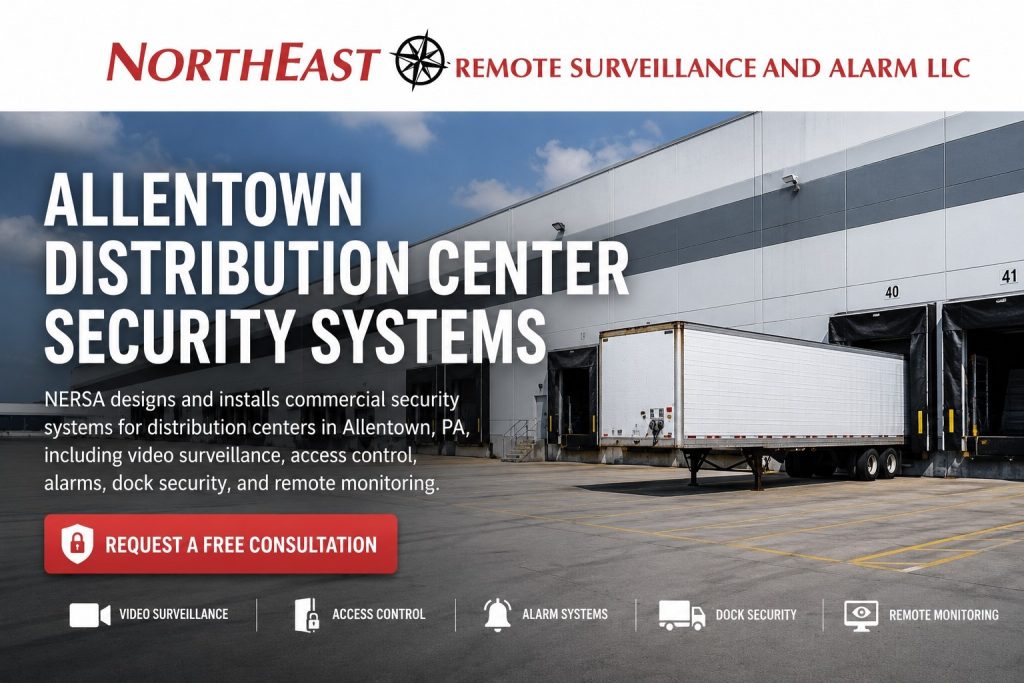
Security for Distribution Centers in Allentown, PA
Distribution centers in Allentown often support regional transportation, warehousing, fulfillment, manufacturing, shipping, receiving, and inventory movement. Many of these properties operate near major Lehigh Valley transportation corridors where truck traffic, employee shift changes, vendor visits, and after-hours activity create additional security concerns.
A proper system should account for:
- Main employee entrances
- Visitor and vendor entrances
- Shipping and receiving offices
- Loading docks
- Overhead doors
- Truck courts
- Trailer parking areas
- Employee parking lots
- Inventory staging zones
- High-value storage areas
- Warehouse aisles
- IT and electrical rooms
- Office-to-warehouse transition doors
- Exterior perimeter areas
- Gate entrances where applicable
Each area should be reviewed for visibility, access control, alarm coverage, lighting, camera angles, and monitoring needs.
Distribution Center Video Surveillance
Video surveillance is one of the most important parts of a distribution center security system. Cameras should be placed where they provide usable evidence, not just general views of the building.
Good camera placement helps document:
- Who entered the property
- Which truck or trailer arrived
- What dock door was used
- When a door opened
- Where product was staged
- Which employee or vendor accessed an area
- What happened before and after an incident
- Whether after-hours activity was authorized
Camera locations may include employee entrances, dock lanes, shipping offices, receiving offices, truck courts, trailer rows, forklift paths, inventory aisles, parking lots, and exterior corners of the building.
The goal is not just to install cameras. The goal is to create a camera layout that gives management useful views when something happens.
Loading Dock Security
Loading docks are one of the highest-risk areas in a distribution center. Product enters and exits through these areas, drivers may be present, employees are moving quickly, and dock doors may remain open during active operations.
A dock security plan may include:
- Cameras facing each dock lane
- Interior cameras covering dock activity
- Exterior cameras covering trailer approaches
- Overhead door contacts
- Dock office access control
- Alarm zoning for receiving and shipping areas
- Remote video monitoring for after-hours activity
- Lighting review for nighttime visibility
The system should help answer basic incident questions quickly: which dock was used, who was present, what vehicle was there, what product moved, and whether the activity was approved.
For dock-specific planning, see our Allentown loading dock security systems page.
Access Control for Distribution Centers
Access control helps distribution centers reduce uncontrolled entry, limit access to sensitive areas, and document who entered specific doors. This is especially important in facilities with multiple shifts, vendors, drivers, office staff, warehouse employees, managers, and contractors.
Access control can be used on:
- Employee entrance doors
- Shipping and receiving office doors
- Warehouse-to-office doors
- IT rooms
- Electrical rooms
- Inventory cages
- Management offices
- Exterior personnel doors
- Gate entrances where applicable
A properly designed access control system can reduce key control problems, improve accountability, and make it easier to deactivate credentials when employees or contractors no longer need access.
Door hardware must also be coordinated correctly. Electric strikes, electrified locksets, maglocks, request-to-exit devices, door contacts, power supplies, fire alarm interfaces, and emergency egress requirements all need to be reviewed before installation.
Intrusion Alarm Systems for Distribution Centers
Distribution center alarm systems should be designed around zones, doors, operating schedules, and the way the building is used. A small office alarm layout is not enough for a large warehouse or logistics facility.
A distribution center intrusion system may include:
- Exterior door contacts
- Overhead door contacts
- Motion detection
- Glass break detection where appropriate
- Partitioned arming
- Office and warehouse zone separation
- Cellular or dual-path communication
- Sirens and notification devices
- Open and close reporting
- Video verification where supported
- Monitoring center dispatch procedures
The alarm system should make sense for the operation. Some areas may need to stay active while others are armed. Some doors may need different reporting rules. Some buildings may need partitions for office, warehouse, dock, and secured storage areas.
Truck Yard and Trailer Parking Security
Many distribution center security issues happen outside the building. Truck courts, trailer parking rows, drive lanes, gates, and employee lots all need to be reviewed as part of the overall security design.
Exterior security may include:
- Cameras covering truck movement
- Cameras aimed at trailer parking areas
- Cameras at yard entrances
- License plate recognition where appropriate
- Gate access control
- Remote video monitoring
- Outdoor-rated cabling
- Wireless bridges or fiber where needed
- Surge protection
- Pole-mounted cameras where appropriate
Exterior camera design must consider distance, lighting, weather, mounting height, network connectivity, and the type of detail management needs to capture.
For yard-specific planning, visit our Allentown truck yard security systems page.
Remote Video Monitoring for After-Hours Protection
Remote video monitoring can help distribution centers protect vulnerable areas when the building is closed, lightly staffed, or operating with limited supervision. Instead of only reviewing recorded video after an incident, monitoring can help identify activity while it is happening.
Remote monitoring may be useful for:
- After-hours dock movement
- Unauthorized vehicles
- Trailer yard activity
- Perimeter loitering
- Gate activity
- Forced-door events
- Exterior storage areas
- High-value inventory zones
- Alarm video verification
Monitoring works best when the cameras, lighting, analytics, speaker placement, and response procedures are designed together. A monitored camera system should be planned around real risk points, not random camera views.
Low-Voltage Infrastructure for Distribution Center Security
Distribution center security systems depend on reliable low-voltage infrastructure. Cameras, access control panels, card readers, alarm devices, switches, wireless bridges, intercoms, and monitoring equipment all need clean cabling and proper planning.
NERSA can help plan:
- Network cabling
- Camera cabling
- Access control cabling
- Alarm wiring
- Conduit pathways
- PoE switch locations
- Network rack layout
- UPS backup power
- Wireless bridge placement
- Fiber connections
- Outdoor-rated cable
- Surge protection
- Expansion capacity
The infrastructure behind the system matters. Poor cabling, weak network design, overloaded switches, or bad equipment placement can create long-term service problems.
Common Security Risks in Allentown Distribution Centers
Distribution centers face a mix of internal, external, and operational security risks. The system should be designed to reduce exposure and improve documentation.
Common risks include:
- Uncontrolled employee entrances
- Shared keys
- Unmonitored dock doors
- After-hours truck movement
- Trailer theft or unauthorized trailer access
- Poor visibility in parking lots
- Blind spots around exterior corners
- Product shrinkage
- Internal theft
- Vendor access issues
- Incomplete incident evidence
- Weak alarm zoning
- Poor camera coverage at overhead doors
- Lack of remote monitoring during closed hours
A strong system helps management see what is happening, control who can enter, and respond more effectively when something goes wrong.
NERSA’s Approach to Distribution Center Security
NERSA designs commercial and industrial security systems with a practical field-first approach. We look at the building layout, dock operation, truck movement, employee flow, access points, alarm needs, network infrastructure, and the way management wants to use the system.
Our design process may include:
- Site walk-through
- Risk area review
- Camera layout planning
- Access control door review
- Alarm zone planning
- Dock and truck yard review
- Low-voltage infrastructure planning
- Monitoring needs review
- Equipment recommendations
- Expansion planning
- Service and support planning
The result is a system designed around the facility, not just an equipment list.
Systems NERSA Can Include
A distribution center security system may include:
- Commercial video surveillance
- AI camera analytics
- Access control
- Intrusion alarm detection
- Door position monitoring
- Overhead door contacts
- Remote video monitoring
- Audio talk-down where appropriate
- License plate recognition
- Gate access control
- Intercom systems
- Network switches
- Wireless bridges
- Fiber infrastructure
- UPS backup
- Cellular alarm communication
- Monitoring services
- Service documentation
Not every building needs every feature. The right system depends on the site layout, risk level, budget, operating hours, and management priorities.
Frequently Asked Questions about Allentown distribution center security systems
What should an Allentown distribution center security system include?
An Allentown distribution center security system should usually include video surveillance, access control, intrusion alarm detection, loading dock coverage, truck yard visibility, remote monitoring options, and reliable low-voltage infrastructure. The exact design should be based on the building layout, operating hours, inventory risk, employee movement, vendor access, and truck traffic.
Where should cameras be placed in a distribution center?
Cameras should be placed at employee entrances, visitor entrances, shipping and receiving offices, dock doors, truck courts, trailer parking areas, warehouse aisles, inventory staging zones, office entrances, parking lots, and exterior perimeter areas. Camera placement should focus on capturing usable details such as faces, vehicles, doors, product movement, and incident activity.
Do distribution centers need access control?
Yes. Access control helps distribution centers manage employee entry, restrict sensitive areas, reduce key problems, and document access events. It is especially useful for facilities with multiple shifts, warehouse employees, office staff, vendors, contractors, and driver access points.
Can dock doors be tied into an alarm system?
Yes. Dock doors and overhead doors can often be tied into an intrusion alarm system using door contacts and proper zone planning. This helps management and the monitoring center know when dock doors are opened, forced, or active outside normal operating hours.
Is remote video monitoring useful for distribution centers?
Remote video monitoring can be very useful for distribution centers with after-hours risk, trailer yards, dock areas, gates, exterior storage, or low-staffed periods. It allows trained monitoring personnel to review live events and follow response procedures when suspicious activity occurs.
Can NERSA design security for large logistics buildings?
Yes. Northeast Remote Surveillance and Alarm, LLC designs commercial and industrial security systems for distribution centers, warehouses, logistics buildings, manufacturing facilities, transportation properties, and multi-building commercial sites in Allentown and the surrounding Lehigh Valley.
Schedule a Distribution Center Security Review in Allentown
If you manage a distribution center, warehouse, logistics facility, fulfillment operation, or industrial building in Allentown, NERSA can help design a security system around your doors, docks, trucks, employees, vendors, inventory, and monitoring needs.
Call Northeast Remote Surveillance and Alarm, LLC at 1-888-344-3846 to discuss Allentown distribution center security systems.
Commercial | Industrial | Fire Alarm | Life Safety | Security | Low Voltage