
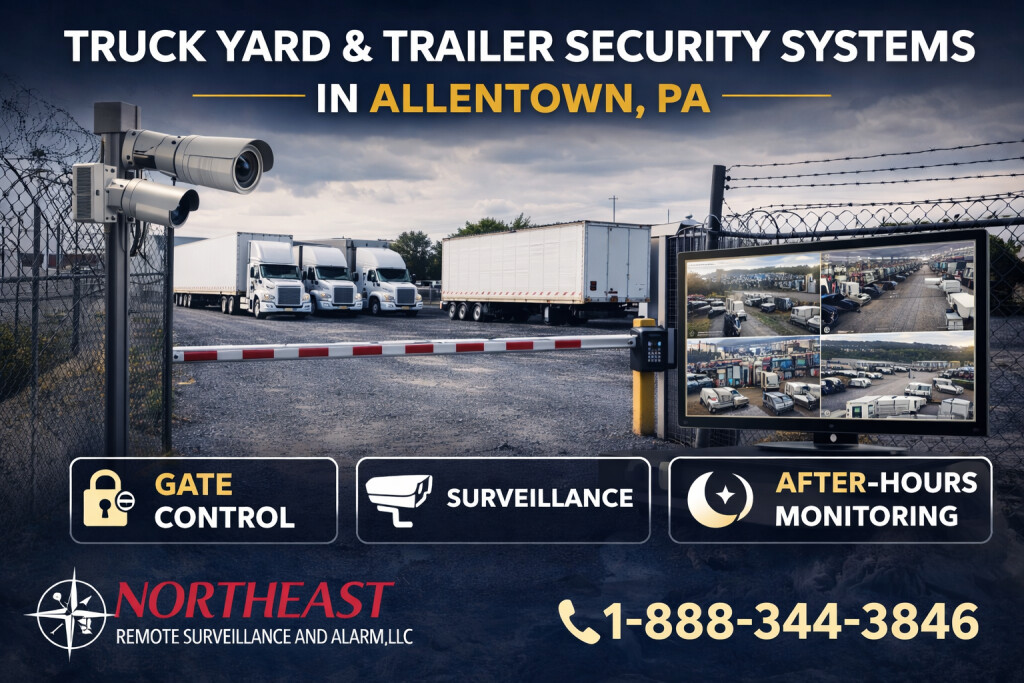
Truck yard security systems in Allentown, PA protect gates, trailers, vehicles and outdoor work areas with coordinated video, access and alerting.

Coordinate this area with the rest of the facility through Allentown warehouse security planning.
Security for Active Truck and Trailer Yards
Truck yards stay active across shifts, deliveries and changing driver schedules. First, cameras provide useful views of gates, travel lanes, trailer rows and loading approaches. Next, access controls help staff manage who enters and when.
Outdoor security must match the yard’s real traffic pattern. Therefore, NERSA reviews vehicle flow, lighting, fencing, gate operation and response procedures before defining equipment. The resulting plan supports safety, accountability and faster incident review.
Camera Coverage Across the Yard
Camera placement should capture identifying details at controlled entry points. Likewise, wider views can document trailer rows, drop lots, fuel areas and perimeter activity. Suitable lighting and mounting positions help maintain useful images after dark.
- Gate approaches and vehicle entry
- Trailer parking and drop areas
- Loading dock approaches
- Fenced boundaries and vulnerable corners
- Employee and visitor parking
- High-value equipment stored outdoors
In addition, recorded video should support quick search and export. Managers can then review a specific vehicle, time or area without searching through unrelated footage.
Gate Access and Entry Records
Commercial gate access can use credentials, intercoms or approved release procedures. For example, employees may use assigned credentials while visitors contact staff for entry. The system records each authorized event for later review.
Meanwhile, video can confirm the vehicle associated with a gate event. This coordination gives supervisors stronger context than a gate log alone. It also helps them investigate tailgating, forced entry or an open gate.
After-Hours Alerts and Monitoring
After-hours protection can combine analytics, intrusion detection and defined notification rules. Specifically, the system can watch selected zones when normal operations end. Designated staff can receive alerts based on the facility’s response plan.
However, alerts must reflect normal yard activity to reduce avoidable notifications. NERSA sets schedules and detection areas around dispatch times, late arrivals and weekend use.
Scalable for One Yard or Multiple Facilities
A local contractor yard may need one gate and a focused camera layout. By contrast, a distribution company may manage several yards and many user groups. Standardized permissions, views and alerts can support both needs.
Most importantly, each site keeps clear controls for local operations. The security program can expand as trailer capacity, traffic or locations increase.
Camera verification at truck lanes and parked trailers
Separate gate identification views from general yard overviews. A camera aimed across rows of parked trailers may show movement without showing a clear vehicle or driver at the entry lane. Document travel direction, headlight glare, night illumination, truck height, trailer occlusion and the distance to the target. At busy Allentown distribution yards, a change in trailer staging can create blind spots that should be checked after reconfiguration.
Authorized arrivals and after-hours exceptions
Define how company drivers, maintenance contractors, outside carriers and visitors are approved. Coordinate intercom or credential release with existing gate-operator safety devices, monitored entrapment protection and required emergency access. After hours, establish who reviews alarms, whether a remote operator has a usable view, and what response is authorized. A license-plate recognition match can support a record but does not replace vehicle safety or identity procedures.
Yard acceptance checklist
- Record usable day and night views of entry lanes and trailer approaches.
- Test gate request, release, closing, safety reversal and emergency procedures with the responsible trade.
- Check power, connectivity, mounting and environmental protection at remote locations.
- Confirm contact lists, video retention, event labels and recovery after a communications failure.
Truck-yard protection begins with vehicle movement
Map the paths between the roadway, gate, trailer rows, staging locations, fuel or maintenance areas and dock doors. Identify where employees walk across truck routes and where drivers stop for check-in. A system should differentiate authorized after-hours dispatch from an unexpected vehicle entering a restricted area. Mark blind corners caused by parked trailers and changes in yard stacking; those conditions can make a camera that looked suitable during an empty-site survey ineffective once operations resume.
Pair entry verification with a controlled workflow
Choose how staff and authorized carriers request entry, who approves visitors, how access expires and what happens when the office is closed. A long-range credential, keypad, intercom or license-plate recognition system may be suitable for particular duties but has different failure modes. Check shared driver PINs, lost credentials, vehicle changeovers, intercom audio quality and camera image detail. An approved vehicle should not automatically gain access to internal personnel doors or tool storage.
Define events worth alerting on
Perimeter and gate events may include an unexpected gate opening, trailer movement after hours, a person entering a protected zone or a vehicle approaching an employee-only area. Test video analytics against headlights, rain, snow, truck exhaust, shadows and typical movements. Confirm who is responsible for each alert and whether a remote operator can see enough context to decide on escalation. Detections without a named response are not an operational monitoring program.
Gate safety and installation handover
Access-control logic must not defeat gate operator safeguards or monitored entrapment protection. Document emergency vehicle access, pedestrian separation, power-loss operation and service isolation with the responsible trades. During commissioning, test a permitted carrier, an expired visitor code, a gate blocked by a vehicle and a communication outage. Deliver an annotated yard map, camera views, reader settings, alert rules, administrator accounts and a repeatable process for updating driver schedules.
Related Allentown Services
For building-wide planning, review warehouse security systems in Allentown.
Also explore commercial gate access control and after-hours warehouse monitoring.
Schedule a Truck Yard Assessment
Finally, schedule an assessment to review gate control, camera coverage, lighting and after-hours risk at your Allentown truck yard.
Compliance, Codes & Project Standards
NERSA plans commercial and industrial security work with applicable code, documentation, inspection and authority-having-jurisdiction requirements in mind. Requirements vary by system, property and jurisdiction. These resources support project planning; they do not establish legal compliance, certification or AHJ approval.
Related guidance: Regulatory compliance & inspection readiness · Warehouse & logistics compliance · NERSA project standards