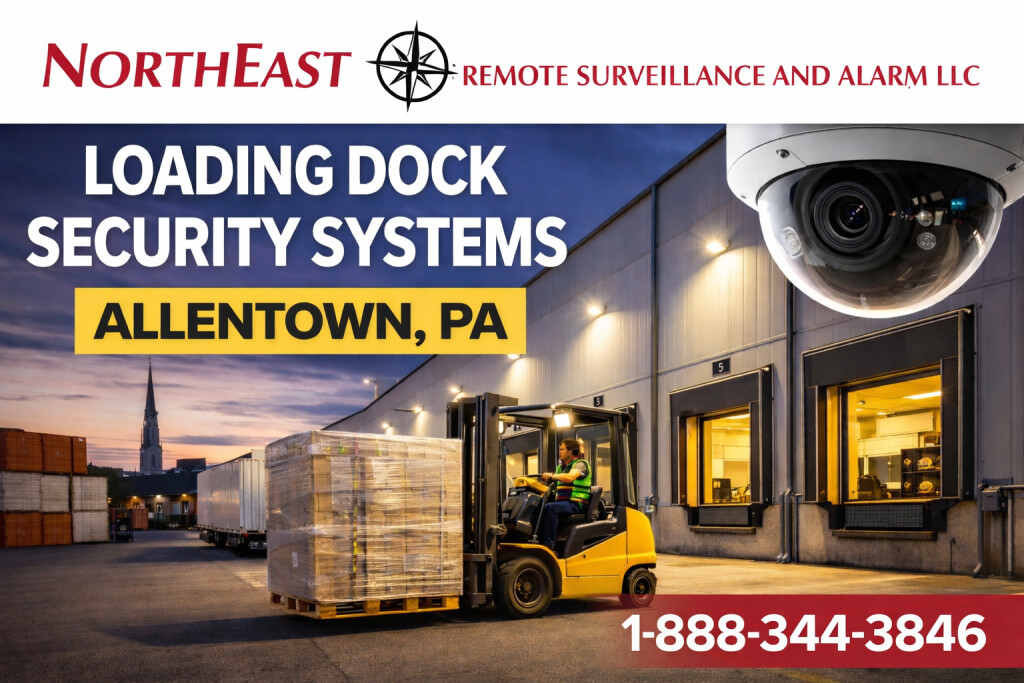
Loading Dock Security Systems in Allentown, PA

Loading dock security systems in Allentown, PA should be designed around actual shipping, receiving, freight, vehicle, employee, and driver activity—not treated as ordinary exterior camera coverage.

Northeast Remote Surveillance and Alarm, LLC designs, installs, upgrades, integrates, and supports commercial loading dock security systems for warehouses, distribution centers, manufacturing facilities, industrial buildings, logistics operations, and multi-door commercial properties throughout Allentown.

This page focuses specifically on dock doors, shipping and receiving areas, trailer positions, dock-adjacent entrances, freight movement, delivery activity, recorded incident review, controlled access, intrusion detection, and after-hours loading-area exposure.

For broader facility-wide planning involving warehouse interiors, employee entrances, truck yards, fire alarm systems, cargo-theft prevention, perimeter security, access control, and after-hours protection, begin with Warehouse Security Systems in Allentown, PA.

Commercial and industrial systems only • New installations • Security upgrades • System takeovers • Scalable long-term support

Loading dock security system in Allentown, PA, showing dock cameras, forklift activity, trailer positions, and warehouse shipping areas.

Loading Dock Security Built Around Real Shipping and Receiving Activity

Loading docks are among the busiest and most exposed parts of a commercial or industrial property.

Employees, delivery drivers, vendors, forklifts, trailers, freight, pallets, vehicles, and inventory may all move through the same area. Dock doors may remain open during loading activity, personnel entrances may be located nearby, and rear or side sections of the property may receive less supervision than the main entrance.

A properly planned loading dock security system should help the business:

  • Improve visibility around dock doors and trailer positions
  • Document shipping and receiving activity
  • Review delivery and pickup disputes
  • Control access through dock-adjacent entrances
  • Detect unauthorized entry around vulnerable openings
  • Investigate missing or damaged product
  • Review employee, vendor, and driver movement
  • Strengthen after-hours dock awareness
  • Coordinate dock activity with the broader warehouse-security plan
  • Preserve useful evidence when an incident is reported later

The objective is not simply to mount cameras above the dock. The objective is to create useful visibility, controlled access, dependable detection, and better incident documentation around one of the facility’s most active operational areas.

Loading Dock Risks That Require Dedicated Planning

Dock environments contain security conditions that may not exist elsewhere on the property.

Common concerns include:

  • Multiple dock doors opening throughout the day
  • Trailers blocking or changing camera views
  • Drivers entering through uncontrolled personnel doors
  • Freight staged near open building entrances
  • Unverified pickups and deliveries
  • Product damage during loading or unloading
  • Missing inventory discovered after a delay
  • Unauthorized access to shipping offices
  • Employees moving between dock and warehouse areas
  • Limited visibility behind trailers
  • Side and rear approaches hidden from normal supervision
  • Dock doors left open or unsecured after use
  • Late-night or early-morning shipping activity
  • Lightly staffed loading areas
  • Exterior activity after the warehouse closes

Each facility requires a site-specific design. A small warehouse with two dock doors does not have the same coverage, access-control, recording, or infrastructure needs as a large distribution center with multiple shipping lanes, trailer positions, shifts, and driver-entry points.

Camera Coverage for Dock Doors and Trailer Positions

Video surveillance is often a central part of loading dock security, but dock cameras must be positioned around the activity management needs to review.

A single wide-angle camera may show general movement while still failing to provide clear evidence of a person, trailer, pallet, vehicle, or specific dock-door event.

A stronger camera layout may include separate views for:

  • Individual dock doors
  • Trailer positions
  • Loading aprons
  • Shipping and receiving lanes
  • Pallet-staging areas
  • Driver entrances
  • Dock-adjacent personnel doors
  • Shipping-office entrances
  • Rear building approaches
  • Side vehicle lanes
  • Overhead doors
  • Exterior storage
  • Forklift routes
  • Pickup and will-call areas

Camera selection should consider mounting height, lens choice, lighting, weather exposure, target distance, trailer obstruction, nighttime conditions, recording quality, and the type of evidence the business expects to obtain.

An overview camera can show how activity developed across the dock area. A tighter identification view may be required when management needs clearer information about a doorway, person, vehicle, shipment, or specific trailer position.

Shipping and Receiving Accountability

Shipping and receiving areas often generate the incidents that are most difficult to reconstruct later.

A delivery may be disputed. Product may be reported damaged. A pallet may be missing. A pickup may occur outside the expected schedule. A driver may enter through the wrong door. Freight may be staged in an unsecured location.

A properly designed loading dock security system can help management review:

  • Delivery arrival and departure times
  • Trailer placement
  • Loading and unloading activity
  • Pallet movement
  • Driver and vendor activity
  • Employee movement around dock doors
  • Freight staging
  • Pickup procedures
  • Product-condition disputes
  • Missing-inventory reports
  • Dock-door use
  • Activity before and after an incident

The usefulness of recorded video depends on image quality, camera placement, accurate system time, recording reliability, retention, and how easily footage can be searched and exported.

Cameras support investigation and accountability, but they do not replace shipping procedures, inventory controls, employee supervision, access permissions, or documented pickup and delivery policies.

Controlling Dock-Adjacent Doors and Restricted Areas

Loading dock security often involves more than the overhead dock door itself.

Personnel entrances, shipping offices, warehouse transition doors, inventory rooms, equipment areas, cages, and restricted storage spaces may all be located near the dock.

Access control can help businesses:

  • Restrict entry to authorized employees
  • Separate driver access from employee access
  • Control shipping-office entrances
  • Manage warehouse transition doors
  • Limit access to high-value inventory
  • Create schedules for different shifts
  • Remove permissions when employment changes
  • Document who used a controlled opening
  • Coordinate door events with nearby camera footage

Door type, locking hardware, emergency egress, fire-door conditions, accessibility, power transfer, and normal operating procedures should be reviewed before access-control equipment is selected.

Facilities requiring detailed planning for credentials, readers, electrified hardware, door-position monitoring, and dock-specific controlled openings should use Loading Dock Access Control Systems in Allentown, PA.

Alarm Detection Around Dock Openings

Dock doors, personnel entrances, overhead openings, shipping offices, and nearby warehouse access points may require intrusion detection when the facility is closed or when specific areas are not in use.

Depending on the property, loading dock protection may include:

  • Door-position monitoring
  • Overhead-door contacts
  • Personnel-door contacts
  • Interior motion detection
  • Beam detection
  • Glass-break detection
  • Separate alarm partitions
  • Cellular or IP alarm communication
  • Video verification
  • User-specific opening and closing procedures

Alarm design should reflect how the dock operates.

A door that opens throughout a staffed shift requires different planning from a dock door that should remain secured overnight. A shipping office used by several shifts may require different access and alarm procedures from a restricted inventory room.

The system should provide useful detection without creating unnecessary alarms during authorized loading, cleaning, maintenance, or overnight warehouse activity.

After-Hours Loading Dock Exposure

Loading docks can become more vulnerable when the building is closed, lightly staffed, or operating with a reduced overnight crew.

Common after-hours concerns include:

  • Activity around closed dock doors
  • Unauthorized approach from rear drive lanes
  • Loitering near trailers
  • Suspicious vehicle movement
  • Attempts to enter dock-adjacent personnel doors
  • Freight or equipment left outside
  • Open or unsecured overhead doors
  • Activity in areas not visible from the main building entrance

A dock-security design may use recorded cameras, intrusion detection, appropriate lighting, door monitoring, analytic event awareness, and documented response procedures to improve after-hours visibility.

This page remains focused on security around the loading-dock environment. Active operator monitoring, live audio intervention, and warehouse-wide overnight response programs belong within the broader warehouse-security strategy.

Internal Accountability and Product-Movement Review

Not every loading dock incident begins outside the building.

Shipping and receiving areas may be involved in unauthorized product movement, unverified pickups, policy violations, incorrect freight handling, missing inventory, damaged pallets, and disagreements about when or how product changed custody.

Dock-security systems can support internal review by documenting:

  • Movement between warehouse and dock areas
  • Access to shipping offices
  • Pallet staging
  • Employee and vendor activity
  • Use of dock-adjacent doors
  • High-value freight movement
  • Pickup and delivery activity
  • Restricted-area entry
  • Events around inventory discrepancies

Security technology should support established procedures rather than replace them. Video, access records, alarms, and system events are most useful when the business also maintains clear shipping, receiving, pickup, visitor, and employee-access practices.

Coordination With Truck Courts, Gates and Trailer Areas

Loading dock activity frequently connects to truck courts, trailer staging areas, delivery gates, yard lanes, employee parking, and exterior vehicle approaches.

The dock-security design should account for how vehicles and drivers reach the loading area, where trailers wait, how visitors communicate with staff, and which areas remain exposed after the dock closes.

Planning may consider:

  • Vehicle approach views
  • Trailer-staging visibility
  • Driver check-in procedures
  • Gate-to-dock movement
  • Intercom communication
  • License plate capture
  • Fence-line visibility
  • Exterior lighting
  • Delivery-lane activity
  • Separation of employee and commercial traffic

These areas should coordinate with loading dock security, but facility-wide gate access, truck-yard protection, perimeter surveillance, and trailer-lot monitoring remain part of the broader warehouse-security plan.

Recording, Retention and Incident Review

A loading dock camera system must retain footage long enough for an incident to be discovered and investigated.

Some issues are noticed immediately. Others may not be identified until inventory is checked, a customer makes a claim, a shipment is reconciled, or management reviews the previous day’s operations.

Recording design may be influenced by:

  • Number of dock cameras
  • Camera resolution
  • Frame rate
  • Recording method
  • Delivery volume
  • Operating hours
  • Number of shifts
  • Inventory value
  • Incident-discovery time
  • Customer or insurance expectations
  • Network capacity
  • Available storage
  • Remote-review requirements

Footage should be searchable, exportable, understandable, and protected from unauthorized access.

A dock-camera system provides limited value when timestamps are inaccurate, recording stops without warning, retention is too short, cameras are improperly named, or users cannot locate the correct view when an incident occurs.

Remote Viewing for Authorized Management

Warehouse owners, shipping managers, operations teams, supervisors, and other authorized users may need to review dock activity without being physically present at the facility.

Remote access may help users:

  • Check current dock activity
  • Confirm trailer placement
  • Review a delivery
  • Investigate a reported event
  • Verify whether a dock door was used
  • Review exterior conditions
  • Confirm that cameras are operating
  • Export video for internal investigation

Remote access should use secure accounts, appropriate permissions, strong authentication practices, and role-based controls where needed.

Not every user should have administrative access. Live viewing, playback, exporting, user management, and system configuration can be separated so each employee receives only the permissions required for their role.

Infrastructure for Dependable Dock Security

Loading docks can create installation and infrastructure challenges.

Camera and security equipment may be exposed to weather, temperature changes, moisture, impact risk, long cable distances, metal construction, moving trailers, vehicle headlights, limited network pathways, and outdoor power conditions.

Planning may need to consider:

  • Outdoor-rated cameras and equipment
  • Protected mounting locations
  • Structured cabling
  • Fiber connections
  • Power-over-Ethernet capacity
  • Network switches
  • Wireless bridges
  • Equipment enclosures
  • Surge protection
  • Backup power
  • Network segmentation
  • Long-distance pathways
  • Equipment labeling
  • Recorder capacity
  • Future expansion

A dependable dock-security system requires more than correctly selected cameras or readers. Cabling, network capacity, power, recording, mounting, environmental protection, and system documentation must support the equipment over time.

Integrated Loading Dock Security Without Losing Focus

Loading dock cameras, access control, intrusion detection, intercoms, alarm communication, and event records can often work together.

Examples may include:

  • Reviewing video associated with a controlled-door event
  • Confirming activity after an overhead-door alarm
  • Checking a driver entrance after an access request
  • Reviewing trailer activity connected to a delivery dispute
  • Verifying movement around a restricted shipping area
  • Investigating after-hours activity near a dock door

Integration should make the system easier to operate and investigate. It should not create unnecessary complexity or force the facility into a platform that does not fit its actual requirements.

Cameras provide visibility and evidence. Access control manages authorized entry. Intrusion alarms detect specified conditions. Monitoring supports notification and response. Each component should retain a clearly defined role.

What This Loading Dock Security Page Covers

This page focuses specifically on loading dock security systems in Allentown, including:

  • Dock-door camera coverage
  • Trailer-position visibility
  • Shipping and receiving review
  • Dock-adjacent personnel entrances
  • Controlled access near loading areas
  • Intrusion detection around dock openings
  • Freight and pallet movement
  • After-hours dock exposure
  • Recording and evidence retention
  • Remote viewing
  • Dock-security infrastructure
  • Coordination between security-system components

This page does not replace the broader warehouse-security plan for warehouse interiors, employee entrances, truck yards, perimeter protection, cargo-theft prevention, fire alarm systems, facility-wide access control, general intrusion detection, or active remote monitoring.

Businesses requiring complete warehouse planning should begin with the warehouse-security parent page linked near the top.

Why Allentown Businesses Choose NERSA for Loading Dock Security

Northeast Remote Surveillance and Alarm, LLC focuses on commercial and industrial properties rather than residential security packages.

NERSA plans loading dock systems around:

  • Actual shipping and receiving procedures
  • Dock-door layouts
  • Trailer positions
  • Employee and driver movement
  • Camera-review requirements
  • Controlled openings
  • Alarm conditions
  • Lighting
  • Network and cabling infrastructure
  • Recording and retention
  • Existing equipment
  • Future expansion
  • Long-term serviceability

Some facilities need a completely new loading dock security system. Others need clearer camera views, additional recording, upgraded access control, better door monitoring, improved remote access, corrected blind spots, or modernization of an inherited platform.

The objective is to create a practical, dependable, manageable, and supportable system built around the way the loading area actually operates.

Loading Dock Security Installation in Allentown, PA

A professional loading dock security design begins with the facility layout, dock-door count, shipping schedule, trailer movement, employee and driver access, lighting, network conditions, recording needs, alarm procedures, existing equipment, and management’s review goals.

NERSA can evaluate:

  • Existing dock-camera locations
  • Missing dock-door views
  • Trailer obstructions
  • Personnel entrances
  • Shipping-office access
  • Alarm protection
  • Door hardware
  • Recording reliability
  • Storage capacity
  • Remote-access performance
  • Cabling and network infrastructure
  • Equipment that may be retained
  • Opportunities for phased expansion

The finished design should improve visibility, control, documentation, and after-hours awareness without interfering with normal shipping, receiving, forklift movement, emergency egress, or warehouse operation.

Request a Loading Dock Security Assessment

If your Allentown facility needs clearer dock-door visibility, stronger shipping and receiving accountability, controlled dock-adjacent access, improved incident review, dependable recording, or better protection around trailers and after-hours activity, Northeast Remote Surveillance and Alarm, LLC can evaluate the property and recommend a practical loading dock security plan.

Request a Commercial Security Assessment

Call 1-888-344-3846

Frequently Asked Questions About Loading Dock Security Systems in Allentown, PA

What is a loading dock security system?

A loading dock security system combines appropriate video surveillance, controlled access, intrusion detection, recording, remote access, and related infrastructure around dock doors, shipping and receiving areas, trailer positions, dock-adjacent entrances, and freight-movement zones.

Why do loading docks need dedicated security coverage?

Loading docks involve employees, drivers, vendors, vehicles, trailers, forklifts, open doors, staged freight, and inventory movement. Dedicated planning helps businesses review deliveries, verify pickups, investigate damage or missing product, document dock-door activity, and improve accountability around shipping and receiving.

What areas should loading dock cameras cover?

Common camera locations include dock doors, trailer positions, loading aprons, shipping and receiving lanes, pallet-staging areas, driver entrances, shipping offices, overhead doors, side approaches, rear vehicle lanes, and dock-adjacent personnel entrances. Final placement should reflect the facility layout and evidence requirements.

Can loading dock cameras help with delivery disputes?

Yes. Properly designed camera coverage may help management review delivery times, trailer placement, loading and unloading activity, driver movement, employee activity, pallet staging, product handling, and events before or after a dispute. The value depends on camera positioning, image quality, lighting, recording reliability, and retention.

Can access control be installed on loading dock doors?

Access control is commonly used on personnel entrances, shipping offices, warehouse transition doors, restricted inventory rooms, cages, and other dock-adjacent openings. Overhead dock doors may use different monitoring and control methods depending on their operation, hardware, and safety requirements.

Can loading dock security help after hours?

Yes. Recorded cameras, door monitoring, intrusion detection, lighting, analytic awareness, and documented response procedures can improve visibility around dock doors, trailer positions, personnel entrances, rear approaches, and shipping areas when staffing is limited.

Does NERSA design loading dock security for both small warehouses and large distribution facilities?

Yes. NERSA designs scalable loading dock security systems for smaller warehouse and mixed commercial properties as well as large distribution facilities, manufacturing plants, logistics operations, cross-dock buildings, and multi-door industrial sites. Camera coverage, controlled openings, recording, alarm detection, infrastructure, and expansion planning are matched to the facility.

Is loading dock security the same as warehouse security?

No. Loading dock security focuses specifically on dock doors, shipping and receiving areas, trailer positions, dock-adjacent entrances, driver movement, and freight handling. Warehouse security covers the entire facility, including interiors, employee entrances, storage areas, truck yards, perimeter protection, alarms, access control, fire alarm systems, and after-hours operations.

Can loading dock security integrate with warehouse cameras and alarms?

Yes. Video, access-control events, door monitoring, intrusion alarms, intercoms, and recording can often be coordinated to improve investigation and accountability. Each component should still be designed for its specific purpose.

Can NERSA upgrade an existing loading dock security system?

Yes. NERSA can evaluate existing cameras, recorders, door contacts, access-control equipment, cabling, networks, remote access, recording capacity, and user permissions to determine what can be retained, repositioned, repaired, expanded, integrated, or replaced.

Why should dock-security planning begin with a site assessment?

A site assessment identifies blocked camera views, trailer positions, lighting problems, access points, shipping-office exposure, alarm requirements, network limitations, recording needs, existing equipment, and future expansion requirements before the final system is selected.


Scroll to Top
1-888-344-3846