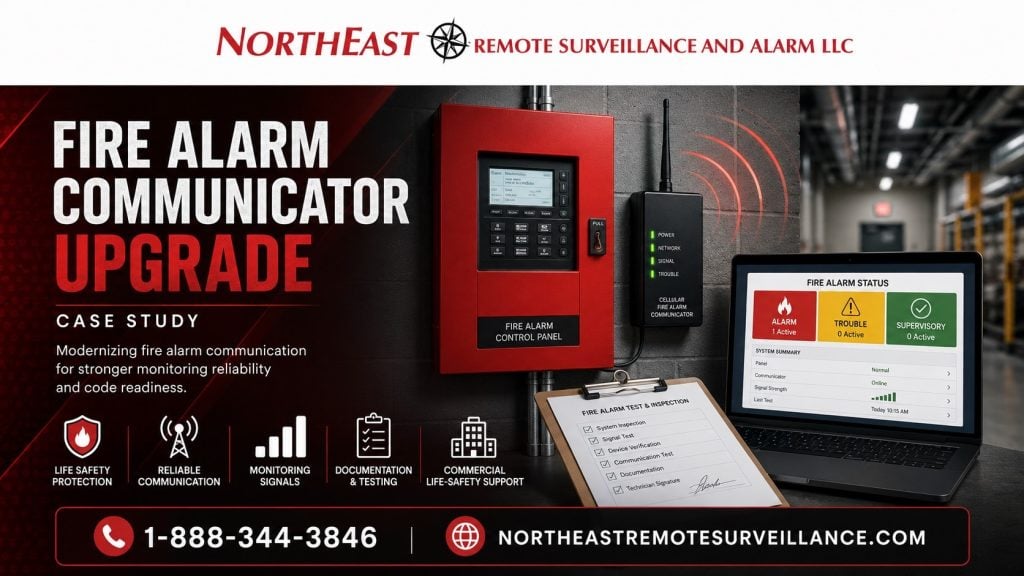
An outdated fire alarm communicator can leave a commercial building dependent on aging phone lines, weak signal reporting, or unsupported technology even when the fire alarm panel itself is still serviceable. Northeast Remote Surveillance and Alarm, LLC helps commercial and industrial facilities evaluate communicator replacement, monitoring paths, signal transmission, and inspection readiness as part of broader Commercial & Industrial Fire Alarm Installation and Life Safety planning. This case study shows how a fire alarm communicator upgrade can protect an existing fire alarm investment while improving monitoring reliability, serviceability, and documentation.
Project Snapshot
| Project Area | Details |
|---|---|
| Facility Type | Commercial / industrial facility |
| System Concern | Older fire alarm communicator tied to legacy phone-line service |
| Primary Risk | Failed signal transmission, rising telecom costs, trouble conditions, service uncertainty, and inspection concerns |
| Upgrade Path | Modern fire alarm communicator replacement with monitoring coordination and signal testing |
| Primary Goal | Improve alarm communication reliability without unnecessarily replacing the entire fire alarm system |
| Result | More dependable alarm reporting, clearer monitoring documentation, and reduced dependence on outdated communication service |
The Problem: The Fire Alarm Panel Was Still Useful, But the Communicator Was Becoming the Weak Link
Many commercial fire alarm systems remain in service for years when the panel, initiating devices, notification appliances, batteries, and wiring are properly maintained. The communication path is often a different story.
In this case, the facility relied on an older fire alarm communicator connected to legacy phone-line service. That created several problems for the property owner:
- The building depended on aging telephone infrastructure.
- Monitoring reliability was harder to verify.
- Service troubleshooting became more difficult.
- Telecom changes could affect alarm signal delivery.
- The owner needed better documentation for monitoring and inspection readiness.
- Replacing the entire fire alarm system was not the first logical step.
The issue was not simply whether the panel could sound locally. The issue was whether alarm, trouble, and supervisory signals could reliably leave the building, reach the monitoring center, and be documented properly.
Why Fire Alarm Communicator Upgrades Matter
A fire alarm system is not complete just because the horns, strobes, pull stations, smoke detectors, duct detectors, waterflow switches, or sprinkler supervisory points exist in the building. For monitored systems, the communicator is the device that helps transmit fire alarm signals from the property to the monitoring center.
When that communicator becomes outdated, unsupported, poorly documented, or dependent on old phone service, the building can develop a life-safety communication weakness.
A communicator upgrade can help commercial facilities:
- Reduce dependence on old POTS lines.
- Improve alarm signal transmission reliability.
- Support better monitoring center communication.
- Reduce nuisance communication trouble conditions.
- Improve service documentation.
- Prepare for future telecom changes.
- Extend the usable life of an existing fire alarm system when full panel replacement is not yet required.
- Improve inspection and maintenance readiness.
For broader monitoring, testing, and inspection planning, see Fire Alarm Monitoring, Testing, and Inspection Requirements.
Existing Condition
The facility had an existing fire alarm system with an older communication setup. The panel was still part of the building’s life-safety infrastructure, but the monitoring path needed to be modernized.
During the review, Northeast Remote Surveillance and Alarm, LLC evaluated the existing fire alarm panel, communicator location, available power, monitoring setup, signal reporting needs, documentation condition, and the owner’s long-term service goals.
The main concern was not cosmetic. It was operational.
If a fire alarm event occurred, the owner needed confidence that the alarm signal could be transmitted, received, identified, and acted on through the proper monitoring workflow.
Upgrade Objective
The goal of the project was to upgrade the fire alarm communication path while avoiding unnecessary system replacement.
The upgrade was designed around several practical objectives:
- Keep the existing fire alarm system in service where appropriate.
- Replace the outdated communicator with a modern communication solution.
- Confirm compatibility with the existing fire alarm panel and monitoring requirements.
- Improve alarm, trouble, and supervisory signal transmission.
- Coordinate monitoring account programming.
- Test signals with the monitoring center.
- Improve documentation for future service, inspections, and owner records.
- Minimize disruption to the facility.
Recommended Solution
Northeast Remote Surveillance and Alarm, LLC recommended a modern commercial fire alarm communicator upgrade.
Depending on the facility, fire alarm communicators may use cellular, IP, or approved dual-path communication methods. The correct approach depends on the existing fire alarm panel, local code requirements, monitoring center requirements, signal strength, network conditions, backup power, AHJ direction, and the long-term service plan for the building.
For this project, the communicator upgrade focused on dependable signal transmission, clean installation, proper supervision, account coordination, and documented testing.
Scope of Work
Northeast Remote Surveillance and Alarm, LLC completed the communicator upgrade with a practical, service-focused process.
The project scope included:
- Review of the existing fire alarm panel and communicator setup.
- Evaluation of the current monitoring communication path.
- Review of available power and installation location.
- Replacement of the outdated communicator.
- Connection of the new communicator to the existing fire alarm system as applicable.
- Coordination with the monitoring center.
- Programming of account and signal reporting information.
- Testing of alarm, trouble, and supervisory signals where applicable.
- Verification that transmitted signals were received properly.
- Labeling and basic documentation updates.
- Owner communication regarding the upgraded monitoring path.
Before and After
| Before Upgrade | After Upgrade |
|---|---|
| Older communicator tied to legacy phone service | Modern fire alarm communicator installed |
| Greater exposure to phone-line changes | Reduced dependence on outdated telecom infrastructure |
| Harder troubleshooting | Cleaner service path and clearer documentation |
| Monitoring path uncertainty | Verified signal transmission to the monitoring center |
| Potential inspection concern | Better monitoring and testing readiness |
| Possible pressure to replace more equipment than necessary | Targeted upgrade focused on the communication weakness |
Why the Entire Fire Alarm System Did Not Need to Be Replaced
Not every fire alarm problem requires a full panel replacement.
In many buildings, the fire alarm control panel, initiating devices, notification devices, and field wiring may still be serviceable. If the communication path is the outdated part of the system, a communicator upgrade can be a practical way to improve reliability without turning a focused service issue into a major capital project.
That said, a communicator upgrade is not always enough. If the fire alarm panel is obsolete, unsupported, failing inspection, missing required functionality, or no longer accepted for the building’s use, a full system review may be required.
Northeast Remote Surveillance and Alarm, LLC evaluates the actual condition of the system before recommending whether the better path is communicator replacement, monitoring correction, panel replacement, device upgrades, or a broader fire alarm modernization plan.
Monitoring Coordination
The communicator upgrade was not considered complete until signal transmission was tested and confirmed.
This is one of the most important parts of a commercial fire alarm communicator replacement. A new communicator must do more than power on. It must report the correct conditions to the monitoring center so alarm events, trouble conditions, and supervisory signals can be handled correctly.
Testing and documentation help confirm:
- Alarm signal reporting.
- Trouble signal reporting.
- Supervisory signal reporting where applicable.
- Account identification.
- Monitoring center receipt.
- Communication path supervision.
- Owner documentation.
- Future service readiness.
Compliance-Aware Fire Alarm Planning
Fire alarm communicator upgrades must be handled with code awareness. The Authority Having Jurisdiction has final authority over approval, inspection, and acceptance.
NERSA plans fire alarm communicator upgrades around the existing system, the adopted requirements for the property, monitoring expectations, manufacturer instructions, documentation needs, and the facility’s long-term life-safety responsibilities.
For broader fire alarm code planning, see NFPA 72 Fire Alarm Standards for Commercial Buildings.
Facilities That Commonly Need Fire Alarm Communicator Upgrades
Fire alarm communicator upgrades are common in commercial and industrial buildings that still rely on older monitoring paths.
These facilities may include:
- Warehouses
- Distribution centers
- Manufacturing buildings
- Industrial properties
- Office buildings
- Multi-tenant commercial buildings
- Retail centers
- Schools and institutional facilities
- Municipal buildings
- Healthcare and professional buildings
- Logistics facilities
- Buildings with sprinkler monitoring
- Properties where phone service is being changed, removed, or converted
Any commercial building with a monitored fire alarm system should know how its alarm signals leave the building and whether that communication path is still dependable.
Owner Benefits
The owner gained a stronger fire alarm monitoring path without immediately replacing the full fire alarm system.
The upgrade helped support:
- Better communication reliability.
- Less dependence on legacy phone-line service.
- Cleaner monitoring coordination.
- Better documentation for service and inspection records.
- Reduced uncertainty during telecom changes.
- More practical long-term planning.
- A clearer path for future fire alarm upgrades if needed.
Why This Project Was a Good Fit for NERSA
Northeast Remote Surveillance and Alarm, LLC works in commercial and industrial environments where fire alarm, security, monitoring, access control, video surveillance, and low-voltage infrastructure often overlap.
That matters because a fire alarm communicator upgrade is not just a device swap. It affects monitoring, signal reporting, documentation, service planning, communication pathways, and long-term reliability.
NERSA helps facility owners look at the full picture before making a decision.
Lessons From This Case Study
This project highlights several important points for commercial property owners:
- The fire alarm communicator can become outdated before the fire alarm panel fails.
- Old phone-line dependency can create hidden risk.
- Monitoring reliability should be tested, not assumed.
- Documentation matters during inspections and service calls.
- Targeted upgrades can be smarter than unnecessary system replacement.
- AHJ and code requirements should be considered before changes are made.
- A communication upgrade should include signal testing with the monitoring center.
When to Consider a Fire Alarm Communicator Upgrade
A commercial facility should consider a fire alarm communicator upgrade if:
- The building still uses traditional phone lines for fire alarm monitoring.
- Phone service is being changed, removed, or converted.
- The fire alarm panel shows communication trouble conditions.
- Monitoring signals are inconsistent.
- The communicator is obsolete or unsupported.
- The monitoring provider recommends a communication path review.
- Inspection documentation is incomplete.
- The owner wants to reduce telecom cost and improve reliability.
- The facility is preparing for renovation, tenant turnover, or system modernization.
Fire Alarm Communicator Upgrade vs. Full Fire Alarm Replacement
A communicator upgrade is focused on the alarm transmission path.
A full fire alarm replacement is broader. It may involve the fire alarm control panel, initiating devices, notification appliances, wiring, power supplies, annunciators, modules, smoke detection, duct detection, sprinkler monitoring, elevator recall coordination, documentation, acceptance testing, and AHJ inspection.
The right decision depends on the condition of the system.
NERSA can help determine whether the building needs a targeted communicator replacement, a monitoring-path correction, a panel upgrade, or a full fire alarm system modernization.
Request a Fire Alarm Communicator Review
If your commercial or industrial facility still relies on old phone lines, has fire alarm communication trouble conditions, is preparing for telecom changes, or needs better monitoring documentation, Northeast Remote Surveillance and Alarm, LLC can help review the system and recommend the right upgrade path.
Call 1-888-344-3846 or use Request a Security Assessment to schedule a commercial fire alarm communicator review.
Frequently Asked Questions About Fire Alarm Communicator Upgrades
What is a fire alarm communicator upgrade?
A fire alarm communicator upgrade replaces or modernizes the device that sends fire alarm signals from a commercial building to the monitoring center. The upgrade may involve cellular, IP, or approved dual-path communication depending on the building, system, monitoring provider, and AHJ requirements.
Why are commercial buildings replacing old fire alarm phone lines?
Many commercial buildings are moving away from older phone-line service because legacy telecom infrastructure can become expensive, unreliable, unsupported, or incompatible with modern monitoring expectations. A communicator upgrade can reduce dependence on old phone lines and improve signal transmission reliability.
Does a fire alarm communicator upgrade replace the fire alarm panel?
Not always. If the existing fire alarm panel is still serviceable and accepted for the building, a communicator upgrade may improve the monitoring path without replacing the entire fire alarm system. If the panel is obsolete, failing, unsupported, or no longer suitable, a broader fire alarm upgrade may be needed.
Can a fire alarm communicator use cellular service?
Yes, many modern fire alarm communicators use cellular communication when approved for the application. The final design depends on signal strength, equipment compatibility, monitoring center requirements, backup power, local code requirements, and AHJ acceptance.
Does the AHJ need to approve a fire alarm communicator upgrade?
The Authority Having Jurisdiction has final authority over fire alarm approval, inspection, and acceptance. Requirements vary by municipality, building type, system design, and adopted code. NERSA plans communicator upgrades with code awareness and documentation in mind.
What signals should be tested after a communicator upgrade?
Alarm, trouble, and supervisory signals should be tested where applicable. The goal is to verify that the monitoring center receives the correct signal types from the correct account and that the upgraded communication path works as intended.
Is a fire alarm communicator upgrade useful for warehouses and industrial buildings?
Yes. Warehouses, logistics properties, manufacturing facilities, and industrial buildings often rely on monitored fire alarm systems and sprinkler monitoring. A dependable communicator helps ensure that alarm events and supervisory conditions are transmitted properly.
How do I know if my fire alarm communicator is outdated?
Your communicator may be outdated if it relies on old phone lines, creates recurring communication trouble conditions, lacks documentation, is no longer supported, or becomes a concern during telecom changes or inspection preparation. A site review can determine whether the communicator should be upgraded.
Who should review a commercial fire alarm communicator?
A qualified commercial fire alarm and life-safety provider should review the existing panel, communicator, monitoring path, signal reporting, documentation, and code requirements. Northeast Remote Surveillance and Alarm, LLC can help commercial and industrial facilities evaluate the right upgrade path.
How do I request a fire alarm communicator upgrade?
Call 1-888-344-3846 or request an assessment through Northeast Remote Surveillance and Alarm, LLC. NERSA can review the fire alarm panel, monitoring path, communication method, documentation, and upgrade options for your commercial or industrial facility.