
Prepare commercial fire alarm systems for ongoing operation by defining monitoring responsibilities, required tests, inspection records, and follow-up on unresolved conditions.

schedule a commercial fire alarm monitoring, testing, and inspection readiness review
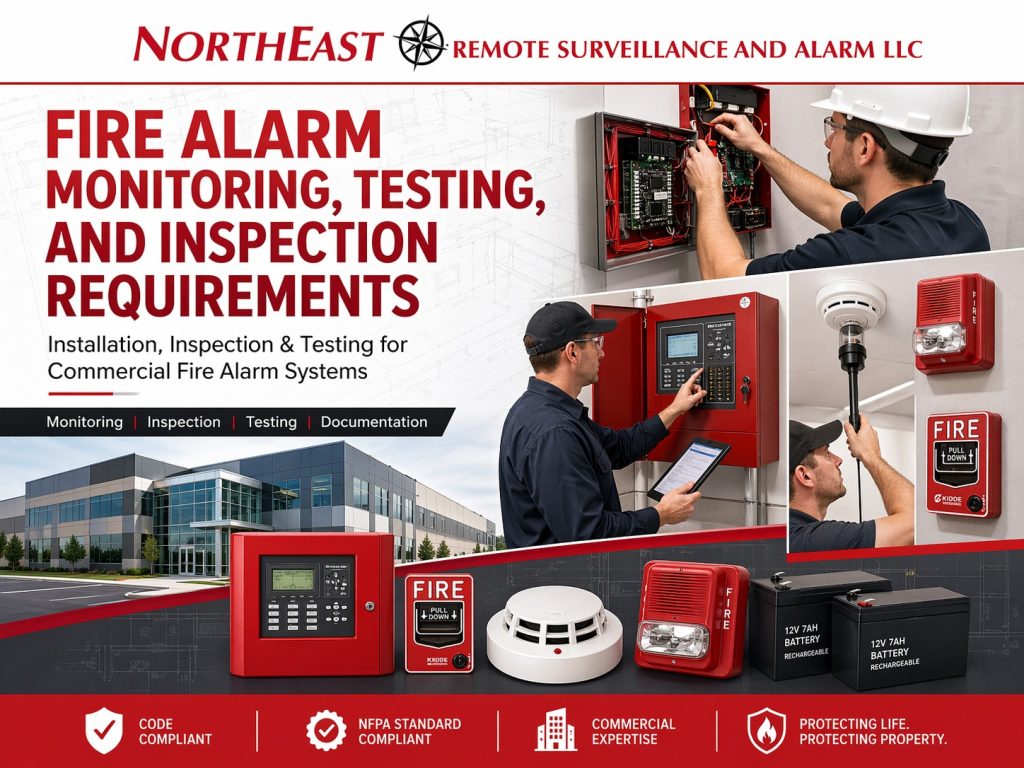
A fire alarm system also has to be monitored correctly, tested correctly, documented correctly, and kept ready for inspection, service, and emergency operation over time. Northeast Remote Surveillance and Alarm, LLC helps commercial, warehouse, industrial, logistics, office, healthcare, retail, and multi-building facilities support fire alarm monitoring, communicator replacement, signal handling, testing coordination, deficiency tracking, and inspection readiness.
This guide covers monitoring, testing, documentation, and readiness.
For a broader system overview, visit our commercial fire alarm systems page.
For replacing old phone lines or outdated communication paths, visit our fire alarm phone line replacement page.
For trouble, supervisory, and sprinkler-related signal concerns, visit our fire alarm trouble and supervisory signals page.
Keep clear records of how the fire alarm is monitored and which signals it sends. Document what was tested, any faults found, and completed repairs. Identify unresolved items before the next inspection or service visit.
Why Fire Alarm Monitoring Matters
Fire alarm monitoring is not just a communicator on the wall or a recurring line item on a monitoring invoice. Monitoring is part of how a commercial fire alarm system performs during a real event. The system has to detect a condition, process the signal, transmit it through the approved communication path, and route the correct alarm, supervisory, or trouble information to the appropriate monitoring arrangement.
For commercial buildings, that matters because a signal is only useful if it is transmitted, received, and acted on correctly. A panel can look normal on-site while the larger monitoring arrangement still has problems with communication paths, account information, signal routing, call lists, contact procedures, or documentation.
Fire alarm monitoring should be reviewed when a facility is:
- Replacing old phone lines
- Moving to cellular fire alarm communication
- Replacing or upgrading a fire alarm communicator
- Cleaning up account contacts
- Reviewing alarm, trouble, or supervisory signal handling
- Preparing for inspection
- Responding to recurring trouble conditions
- Taking over a building with an older system
- Changing service providers
- Updating documentation after a renovation or tenant change
Monitoring is not just about having a service. It is about whether the system’s signals are handled through a supportable arrangement that matches the building, the equipment, the adopted code path, and the authority having jurisdiction.
Alarm, Trouble, and Supervisory Signals
Commercial fire alarm systems may transmit different types of signals depending on the system, building, and monitored conditions. Alarm signals, trouble signals, and supervisory signals do not mean the same thing, and they should not be treated casually.
A fire alarm signal may indicate an active fire alarm condition. A trouble signal may indicate a system fault, device issue, power concern, communication problem, ground fault, battery issue, or other condition affecting the system. A supervisory signal may involve monitored fire protection equipment such as sprinkler valve tamper, low air, fire pump, or other supervised conditions.
These signals need to be understood because each one can require a different response. A facility that ignores trouble signals or does not understand supervisory conditions can slowly drift out of readiness even if the building has not had an active fire alarm event.
For a deeper signal-specific page, visit fire alarm trouble and supervisory signals.
Communicator Replacement and Monitoring Path Review
Many commercial fire alarm systems were originally connected through legacy phone lines. As businesses remove old phone service, change carriers, update internet service, or move away from copper phone lines, the fire alarm monitoring path may need to be reviewed and replaced.
A communicator change should not be treated as a simple equipment swap without a readiness review. The facility should confirm that the new communication path is appropriate, the monitoring account is active, signals are tested, contact information is correct, and documentation is updated.
Fire alarm communicator review may include:
- Existing communicator condition
- Phone line replacement needs
- Cellular communication options
- Dual-path communication where applicable
- Monitoring account information
- Alarm, trouble, and supervisory signal testing
- Contact list verification
- AHJ or inspection documentation needs
- Panel compatibility
- Power and battery considerations
- Service history review
For facilities removing old phone lines, visit fire alarm phone line replacement.
Testing Is More Than a Quick Demonstration
One of the biggest mistakes in commercial fire alarm work is confusing a quick demonstration with actual testing. A device turning on, a panel showing normal status, or a communicator sending one signal does not automatically prove that the full system is ready, documented, and supportable.
Real testing means the required functions are checked deliberately, the results are recorded, deficiencies are identified, and the system is shown to operate as intended for the scope of work being performed.
Testing may be needed during:
- New fire alarm installations
- Communicator replacements
- Panel replacements
- Device additions
- Tenant fit-outs
- Building renovations
- Fire alarm repairs
- System takeovers
- Monitoring account changes
- Reacceptance testing after modifications
- Inspection preparation
A commercial fire alarm project should not end with “the panel looks normal.” The better question is whether the correct functions were tested, whether the monitoring signals were verified, whether records were updated, and whether any deficiencies remain open.
Inspection Readiness Is an Ongoing Process
Fire alarm inspection readiness is not something that begins the morning an inspector arrives. A commercial building should be able to show that its fire alarm system is monitored, serviced, tested, maintained, and documented over time.
Inspection readiness may include:
- Monitoring account verification
- Current emergency contact information
- Alarm, trouble, and supervisory signal review
- Communicator test records
- Inspection and testing reports
- Deficiency lists
- Repair history
- Device replacement history
- Battery and power supply information
- Record of impairments
- Panel documentation
- As-built or device location information where available
- Service provider contact information
A system that passed acceptance at one point can still become harder to defend later if service records are scattered, deficiencies are not tracked, communication changes are not documented, or trouble signals are allowed to remain unresolved.
For broader inspection preparation, visit fire alarm inspection readiness.
Owner Responsibility Still Matters
A commercial property owner or facility operator can hire qualified service providers to inspect, test, maintain, monitor, repair, and document the fire alarm system. That does not remove the building’s need to stay organized and ready.
The building still needs to know:
- Who is responsible for scheduling inspection and testing
- Who receives alarm, trouble, and supervisory information
- Who responds to service calls
- Who keeps records
- Who tracks open deficiencies
- Who updates emergency contacts
- Who coordinates with the AHJ
- Who understands the current monitoring path
- Who can explain the system during an inspection or review
Outsourcing service does not mean ignoring ownership. If contacts are outdated, records are incomplete, impairments are unmanaged, or trouble conditions linger, the facility still carries the operational risk.
System Impairments Should Never Be Treated Casually
A fire alarm system impairment exists when part of the system is disabled, offline, failed, under repair, bypassed, or otherwise not operating as intended. Impairments should be documented, communicated, managed, and corrected through a clear process.
Common impairment and readiness concerns include:
- Trouble conditions left unresolved
- Disabled devices
- Communication failures
- Power supply issues
- Battery problems
- Removed or damaged devices
- Incomplete repairs
- Unclear service notes
- Temporary workarounds that become permanent
- Sprinkler supervisory issues
- Missing documentation after renovations
- Contact lists that no longer match the building
A system is not truly inspection-ready if impairments are handled casually. The building should know what is wrong, what is being done, who is responsible, and whether any temporary measures or notifications are required.
Documentation Makes the System Supportable
A monitored and tested fire alarm system is much easier to support when the records are organized. Without records, future service calls become slower, inspections become more stressful, and system history becomes harder to understand.
Useful fire alarm documentation may include:
- Monitoring account information
- Emergency contact lists
- Communicator information
- Signal test records
- Annual inspection reports
- Service tickets
- Deficiency reports
- Repair notes
- Battery replacement records
- Device replacement history
- Panel programming notes where appropriate
- Zone or point information
- As-built drawings where available
- AHJ correspondence where applicable
A sticker on the panel is not enough for long-term readiness. Commercial facilities need usable records that show what was tested, what passed, what failed, what was repaired, what remains deficient, and who is responsible for follow-up.
Common Fire Alarm Readiness Problems
Commercial fire alarm systems usually become harder to support for predictable reasons. The problem is often not one dramatic failure. It is usually slow drift over time.
Common readiness problems include:
- Assuming “monitored” means everything is compliant
- Assuming a normal panel display means the system is fully ready
- Ignoring trouble signals
- Failing to test communicator changes
- Removing phone lines without a proper replacement path
- Leaving old emergency contacts on the monitoring account
- Making small system changes without proper testing
- Failing to document deficiencies
- Losing inspection records
- Not tracking service history
- Treating supervisory signals as low priority
- Not coordinating access control and fire alarm interface issues
- Not confirming who owns follow-up after inspection
These problems can affect warehouses, industrial facilities, offices, healthcare properties, restaurants, retail buildings, churches, logistics buildings, and multi-tenant commercial properties.
Commercial and Industrial Fire Alarm Readiness
Commercial and industrial properties often have more devices, more monitored conditions, more service dependencies, and more operational exposure than smaller buildings. A warehouse, manufacturing plant, distribution center, large office, medical building, school, church, or multi-building commercial site may depend on a stable monitoring path, disciplined testing, clear records, and coordinated service response.
These facilities may have:
- Multiple notification areas
- Sprinkler monitoring
- Elevator recall interfaces
- HVAC shutdown functions
- Duct detectors
- Beam detectors
- Waterflow devices
- Valve tamper switches
- Low air supervisory signals
- Multiple tenants
- Multiple access points
- Security and access control interfaces
- Complex service history
- Renovations or phased additions
For these properties, readiness is not optional. It is part of keeping the system supportable over time.
Fire Alarm, Access Control, and Door Coordination
Fire alarm readiness can overlap with access control, door hardware, and egress. If access control doors, maglocks, electrified hardware, elevator recall, delayed egress, or emergency release functions are part of the building, they may need to be reviewed as part of the larger system condition.
The fire alarm panel, access control system, door hardware, power supplies, release functions, monitoring paths, and inspection records should not be treated as unrelated pieces when they affect life safety or emergency operation.
A readiness review may consider:
- Fire alarm interface relays
- Door release functions
- Elevator recall interfaces
- Access control power supplies
- Request-to-exit devices
- Door contacts
- Emergency egress concerns
- Fire alarm documentation
- AHJ expectations
- Service history
For wiring and infrastructure planning, visit low-voltage cabling.
When to Schedule a Fire Alarm Monitoring and Readiness Review
A facility should consider a fire alarm monitoring, testing, and inspection readiness review when:
- The fire alarm communicator is outdated
- Phone lines are being removed
- Trouble signals keep recurring
- Supervisory signals are not clearly understood
- Inspection records are incomplete
- A new property was purchased or taken over
- A tenant fit-out changed the building
- A renovation affected devices or wiring
- The monitoring account contacts are outdated
- A panel replacement or upgrade is being considered
- The system has unresolved deficiencies
- The building is preparing for an AHJ inspection
- Service history is unclear
- Multiple vendors have worked on the system
A readiness review can help identify what needs to be corrected, documented, tested, or escalated before a small problem becomes a larger issue.
NERSA’s Approach
Northeast Remote Surveillance and Alarm, LLC supports commercial fire alarm readiness with a practical field-first approach. We look at the building, the fire alarm panel, the communication path, monitored signals, inspection history, service conditions, documentation, and the owner’s operational needs.
Our process may include:
- Site walk-through
- Fire alarm panel review
- Communicator and monitoring path review
- Signal type review
- Emergency contact review
- Trouble and supervisory condition review
- Inspection record review
- Deficiency tracking discussion
- Testing coordination
- Fire alarm and access control interface review
- Low-voltage infrastructure review
- AHJ and service documentation support where applicable
The goal is to help the facility understand what it has, what is working, what needs attention, and what should be documented before the next inspection, service call, or emergency event.
FAQs
What is fire alarm monitoring?
Fire alarm monitoring is the process of transmitting fire alarm, trouble, supervisory, and related system signals from the protected building to an approved monitoring arrangement so the correct response can be initiated. Monitoring should be reviewed as part of the system, not treated as a separate afterthought.
Is a normal fire alarm panel display enough?
No. A normal panel display is important, but it does not prove that the monitoring path, signal handling, documentation, testing records, emergency contacts, and inspection readiness are all correct. Commercial systems should be reviewed as a complete life-safety program.
When should a fire alarm communicator be replaced?
A fire alarm communicator may need replacement when old phone lines are removed, the existing communicator is outdated, signal reliability is poor, monitoring requirements change, or the facility needs a more supportable communication path. Signal testing and documentation should be part of the replacement process.
What is the difference between a trouble signal and a supervisory signal?
A trouble signal usually indicates a fault or problem affecting the fire alarm system, such as power, battery, wiring, communication, or device issues. A supervisory signal often relates to monitored fire protection equipment or conditions, such as sprinkler valve tamper, low air, or other supervised equipment conditions.
Why is fire alarm testing important after modifications?
Testing is important after modifications because a change to devices, wiring, programming, communication paths, or system interfaces can affect system operation. The scope of testing should match the work performed and the requirements of the adopted code and AHJ.
What records should a commercial facility keep for fire alarm readiness?
A commercial facility should keep monitoring records, emergency contacts, inspection reports, test results, deficiency reports, repair history, communicator information, battery and power records, service tickets, device changes, and AHJ-related documentation where applicable.
Who is responsible for fire alarm inspection readiness?
Service providers can perform inspections, testing, maintenance, monitoring, repairs, and documentation support, but the building owner or responsible party still needs to make sure the system is being managed, records are available, deficiencies are tracked, and follow-up is completed.
Can NERSA help with fire alarm monitoring and inspection readiness?
Yes. NERSA helps commercial, warehouse, industrial, logistics, office, healthcare, retail, and multi-building facilities review fire alarm monitoring, communicator replacement, signal handling, testing coordination, documentation, deficiencies, and inspection readiness.
Schedule a Compliance-Focused Fire Alarm Review
If your facility is reviewing monitoring arrangements, preparing for testing, cleaning up deficiencies, replacing communicators, organizing fire alarm records, or trying to improve inspection readiness before the next service call or AHJ review, NERSA can help.
Call Northeast Remote Surveillance and Alarm, LLC at 1-888-344-3846 to schedule a commercial fire alarm monitoring, testing, and inspection readiness review.
Commercial | Industrial | Fire Alarm | Life Safety | Security | Low Voltage
Code Note
This resource is general informational content for commercial planning purposes. The adopted code edition, local amendments, authority having jurisdiction, project scope, building conditions, occupancy, and actual system configuration control the requirements for any specific project. In Pennsylvania, commercial fire alarm work may fall within the statewide Uniform Construction Code framework and the applicable local or Department enforcement path.