
Retrofitting saves money when an existing security, access control, camera, alarm, fire alarm, or low-voltage system can be upgraded without replacing every device, cable, door opening, panel, recorder, or piece of infrastructure.

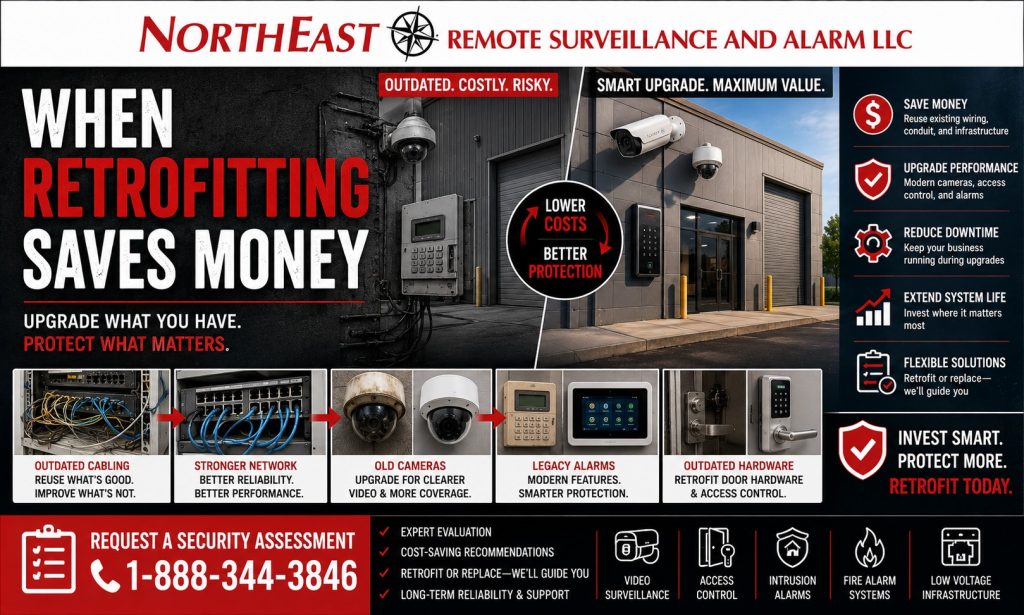
Northeast Remote Surveillance and Alarm, LLC helps commercial and industrial facilities determine when a retrofit is the smarter investment and when full replacement is the better long-term decision.
For related guidance, see our Commercial and Industrial Security Systems planning for businesses throughout Pennsylvania and selected Mid-Atlantic markets.
Security Retrofits That Reduce Cost Without Weakening Protection
Not every security upgrade requires a complete rebuild. Many businesses already have usable wiring, doors, cameras, alarm contacts, power supplies, conduit, network pathways, access control hardware, or fire alarm infrastructure that may still have value.
A good retrofit plan identifies what can stay, what should be replaced, and what must be upgraded for reliability, code awareness, security performance, and long-term serviceability.
Retrofitting can save money when the existing system has a solid foundation. It can become expensive when old equipment is unreliable, poorly documented, non-serviceable, unsupported, or not compatible with modern platforms.
NERSA helps owners make that decision clearly before money is spent.
What Retrofitting Means in Security and Low-Voltage Work
A retrofit means upgrading or modifying an existing system instead of starting from scratch. In commercial security work, that may involve keeping part of the existing infrastructure while replacing the parts that no longer meet the need.
Retrofits may apply to:
- Security camera systems
- Access control systems
- Intrusion alarm systems
- Fire alarm communicators
- Door hardware
- Low-voltage cabling
- Network switches
- PoE infrastructure
- Wireless bridges
- Monitoring communication paths
- Remote viewing systems
- Video recorders
- Existing conduit and pathways
The goal is to reuse what is still dependable while improving system performance.
When Retrofitting Usually Saves Money
Retrofitting often saves money when the existing system has reusable infrastructure and the problem is mainly equipment age, platform limitations, poor remote access, weak recording, outdated monitoring, or missing coverage.
Retrofit savings may be possible when:
- Existing cable is in good condition
- Existing conduit or pathways can be reused
- Door hardware can accept electrified upgrades
- Alarm contacts are still functional
- Camera locations are still useful
- Existing power supplies are adequate
- Network infrastructure can support new equipment
- Fire alarm panel monitoring only needs a communicator upgrade
- The current system layout is mostly correct
- The business needs expansion, not a full rebuild
In these situations, the project can focus money where it matters most instead of paying to replace everything.
When Full Replacement May Be the Better Choice
A retrofit is not always the best answer. Sometimes old equipment creates more cost than it saves. If wiring is damaged, undocumented, unreliable, or incompatible, reusing it may cause future service problems.
Full replacement may be better when:
- Existing wiring is damaged or poorly installed
- Camera cable cannot support the new system
- Door hardware is not suitable for access control
- Alarm zones are mislabeled or unreliable
- The system is unsupported or locked by another vendor
- The recorder or panel is obsolete
- Power supplies are overloaded
- The network is unstable
- The system has repeated false alarms or failures
- The existing layout does not match current operations
- Fire alarm or life-safety work requires code-driven correction
A cheaper retrofit is not a savings if it creates repeat service calls, downtime, security gaps, or future replacement work.
Retrofitting Security Camera Systems
Security camera retrofits can save money when existing camera locations, cable routes, mounts, or network infrastructure are still usable. Many businesses do not need every wire pulled again if the existing cabling is properly installed and compatible with the new camera platform.
A camera retrofit may include:
- Replacing old cameras with higher-resolution cameras
- Upgrading analog cameras to IP cameras
- Reusing existing cabling where appropriate
- Replacing the recorder
- Improving remote viewing
- Adding parking lot cameras
- Adding cameras at rear doors or loading areas
- Improving nighttime visibility
- Cleaning up network equipment
- Expanding storage for better retention
NERSA designs commercial security camera systems with practical upgrade planning so the business gets better video without unnecessary replacement costs.
Retrofitting Access Control Systems
Access control retrofits can save money when doors, frames, power pathways, readers, or existing wiring can be reused. However, access control retrofits must be reviewed carefully because the door opening, lock hardware, egress requirements, and life-safety conditions all matter.
An access control retrofit may include:
- Adding readers to existing doors
- Replacing old keypads or card readers
- Upgrading access control panels
- Adding mobile credential support
- Reusing electric strikes where appropriate
- Replacing door contacts
- Adding request-to-exit devices
- Cleaning up door hardware wiring
- Adding cloud-managed access
- Standardizing access across multiple doors or sites
NERSA designs commercial and industrial access control systems with attention to door hardware, code awareness, user management, and long-term serviceability.
Retrofitting Door Hardware and Exit Devices
Door hardware is one of the most important areas to evaluate before deciding between retrofit and replacement. Some doors can be upgraded with electrified trim, electric strikes, request-to-exit devices, door contacts, or power transfer hardware. Other doors may need full hardware replacement because the existing lockset, frame, exit device, or closer is not suitable.
A door hardware retrofit may save money when:
- The door and frame are in good condition
- The existing exit device is compatible with electrified trim
- The door closes and latches properly
- The opening can support the required hardware
- Egress remains safe and code-conscious
- Existing hardware does not need full replacement
Door hardware retrofits should never be planned as shortcuts. The system must still allow safe exit, proper latching, reliable locking, and long-term service.
Retrofitting Alarm Systems
Alarm system retrofits can save money when existing contacts, wiring, motion detectors, keypads, or panels are still serviceable. In many cases, the biggest issue is not the entire alarm system. It may be outdated communication, shared user codes, missing zones, poor documentation, or an old monitoring path.
An alarm retrofit may include:
- Replacing the alarm communicator
- Adding cellular alarm monitoring
- Updating user codes
- Replacing keypads
- Adding door contacts
- Adding overhead door contacts
- Adding glass break detection
- Adding motion detection
- Cleaning up zone labels
- Updating emergency contacts
- Adding panic protection
- Adding video verification
NERSA supports commercial alarm systems and alarm takeovers for businesses that need a more reliable system without unnecessary replacement.
Retrofitting Fire Alarm Communication Paths
Fire alarm retrofits can save money when the fire alarm panel is still functional but the monitoring path needs to be updated. Many commercial buildings are moving away from legacy phone lines and need approved communicator upgrades for fire alarm monitoring.
A fire alarm communication retrofit may include:
- Replacing old phone-line monitoring
- Adding cellular fire alarm communication
- Adding IP or dual-path communication where appropriate
- Testing signals with the monitoring center
- Updating account information
- Coordinating documentation
- Supporting inspection readiness
Fire alarm work must be coordinated with the building owner, AHJ, adopted code requirements, and inspection process. NERSA helps commercial facilities review monitoring paths and plan code-conscious upgrades.
Retrofitting Low-Voltage Cabling and Network Infrastructure
Low-voltage infrastructure can often determine whether a retrofit will succeed. If existing cable, conduit, network switches, racks, power supplies, and equipment locations are usable, the project may cost less and move faster. If the infrastructure is messy, damaged, overloaded, or undocumented, it may need correction first.
Infrastructure retrofit work may include:
- Reusing existing cable where appropriate
- Replacing damaged cable
- Adding PoE switches
- Cleaning up network equipment
- Labeling cables and devices
- Replacing power supplies
- Adding UPS backup power
- Improving equipment mounting
- Adding wireless bridges
- Creating better documentation
Good infrastructure helps reduce future service problems and makes the upgraded system easier to support.
Retrofit vs. Replacement: The Real Cost Question
The real question is not whether retrofit costs less on day one. The real question is whether the retrofit still makes sense after serviceability, reliability, performance, future expansion, and risk are considered.
A retrofit is usually smart when it lowers the project cost while still giving the business a reliable system. Replacement is usually smarter when old equipment will create ongoing failures, weak performance, or additional expense later.
NERSA reviews both options so owners can make a practical decision instead of guessing.
Signs a Retrofit May Be the Right Choice
A retrofit may be the right choice when:
- The existing wiring is clean and usable
- The system is mostly functional
- The building layout has not changed much
- Only certain devices are outdated
- The owner needs better remote access
- Recording quality or retention needs improvement
- Monitoring communication needs an upgrade
- Some doors only need hardware changes
- The business wants to expand in phases
- Budget matters, but reliability still matters
This is where a targeted upgrade can deliver strong value.
Signs Replacement May Be the Better Investment
Replacement may be the better investment when:
- The system is failing repeatedly
- Existing cables are unreliable
- Equipment is obsolete or unsupported
- The original installation was poor
- The system is locked by another vendor
- Camera views are badly placed
- Alarm zones are confusing or mislabeled
- Door hardware is not serviceable
- Network equipment is unstable
- Future expansion would be difficult
- The business has outgrown the original system
In these cases, starting fresh may cost more upfront but save money over time.
Phased Retrofit Planning
Some businesses do not need to complete every upgrade at once. A phased retrofit can spread the cost over time while still moving toward a stronger long-term system.
A phased plan may start with the highest-risk items first, such as:
- Failed cameras
- Alarm communicator upgrades
- Rear door protection
- Overhead door contacts
- Access control on employee entrances
- Recorder replacement
- Parking lot cameras
- Network cleanup
- Fire alarm monitoring path updates
Once the core issues are corrected, additional improvements can be added later.
Common Retrofit Mistakes to Avoid
Retrofitting can save money, but only when it is done correctly. Common mistakes include:
- Reusing bad cable
- Keeping poor camera angles
- Ignoring nighttime performance
- Adding access control to bad door hardware
- Failing to label alarm zones
- Keeping outdated monitoring contacts
- Overloading power supplies
- Ignoring network problems
- Mixing incompatible equipment
- Installing new devices on weak infrastructure
- Failing to document the final system
- Choosing short-term savings over long-term reliability
NERSA helps avoid these issues by evaluating the system before recommending the upgrade path.
Our Retrofit Evaluation Process
A proper retrofit starts with a site review. NERSA evaluates the existing cameras, alarm system, access control, fire alarm monitoring path, door hardware, low-voltage cabling, network equipment, power supplies, recording equipment, user needs, and future growth plans.
From there, we identify:
- What can stay
- What should be replaced
- What must be upgraded
- What creates risk
- What saves money
- What should be phased
- What needs documentation
- What needs AHJ or building owner coordination
This gives the business a clearer path forward.
Why Choose NERSA for Security Retrofits
Northeast Remote Surveillance and Alarm, LLC focuses on commercial and industrial security systems, access control, video surveillance, alarm systems, monitoring, fire alarm support, and low-voltage infrastructure. We understand that retrofits are not just about saving money. They are about making the right decision with the existing building, equipment, wiring, doors, and future needs.
NERSA can help with camera retrofits, alarm takeovers, access control upgrades, fire alarm communicator upgrades, door hardware retrofits, monitoring changes, low-voltage cleanup, and phased security planning.
Request a Retrofit Security Assessment
Before replacing everything, find out what can be reused, what should be upgraded, and what needs to be corrected.
Northeast Remote Surveillance and Alarm, LLC can help you evaluate your existing cameras, alarms, access control, fire alarm monitoring, door hardware, wiring, network equipment, and low-voltage infrastructure.
Request a Security Assessment
Call 1-888-344-3846
Related NERSA Security Resources
Commercial Security Camera Installation
Commercial Alarm Systems
Commercial & Industrial Access Control Installation
Frequently Asked Questions
When does retrofitting save money?
Retrofitting saves money when existing wiring, doors, hardware, camera locations, alarm contacts, conduit, power supplies, or network infrastructure can be reused safely and reliably. The savings come from upgrading the weak parts of the system without replacing everything.
When should a business replace the whole system instead of retrofitting?
Full replacement may be better when the existing system is obsolete, unreliable, poorly installed, unsupported, undocumented, or incompatible with modern equipment. Replacement may also be better when the existing layout no longer matches how the business operates.
Can old camera wiring be reused?
Sometimes. Existing camera wiring may be reusable if it is in good condition and compatible with the new camera system. NERSA evaluates the cable type, condition, routing, terminations, and performance before recommending reuse.
Can access control be added to existing doors?
Yes, in many cases. Existing doors may be retrofitted with readers, electric strikes, electrified trim, door contacts, request-to-exit devices, and power transfer hardware. The door, frame, lock, exit hardware, and egress requirements must be reviewed first.
Can an existing alarm system be taken over?
Yes. NERSA can review existing alarm panels, keypads, contacts, motion detectors, communicators, zone descriptions, and monitoring setup to determine whether the system can be taken over, upgraded, expanded, or replaced.
Is a retrofit always cheaper?
Not always. A retrofit can cost less upfront, but it is not a savings if old wiring, hardware, panels, or network equipment cause repeated service problems. The best option depends on condition, compatibility, reliability, and future needs.
Can retrofits be done in phases?
Yes. Many commercial security retrofits can be completed in phases. A business may start with the most urgent items, such as camera replacement, alarm communication upgrades, rear door protection, access control doors, or network cleanup, then expand later.
Does NERSA provide retrofit assessments?
Yes. NERSA can evaluate existing cameras, alarms, access control, fire alarm monitoring paths, door hardware, low-voltage cabling, and network infrastructure to determine whether retrofit, replacement, or phased upgrade planning makes the most sense.