
Allentown low-voltage security infrastructure upgrades strengthen the cabling, fiber, network, PoE, rack, pathway, power, and communications that support commercial security systems.

Request a commercial security assessment
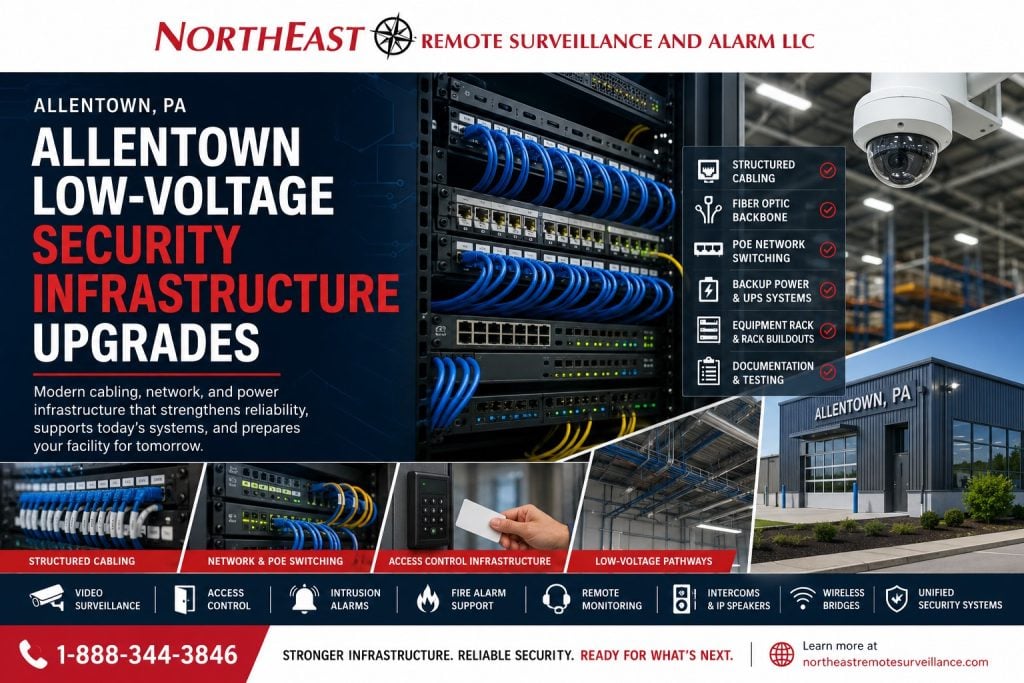
Northeast Remote Surveillance and Alarm, LLC corrects weak infrastructure behind cameras, access control, alarms, intercoms, monitoring, and unified platforms.
For complete system modernization, review Allentown Commercial Security System Upgrades and Retrofits.
Infrastructure can scale from one network closet at a small business to fiber, racks, and communication paths across an enterprise campus.
Why Security Infrastructure Matters
Cameras and controllers depend on stable power and data paths. Therefore, weak cable, overloaded PoE, poor grounding, damaged connectors, or unclear network ownership can cause failures that appear to be device problems. A reliable design starts behind the visible equipment.
- Structured copper cabling
- Fiber backbones and building links
- PoE switches and power budgets
- Racks, patch panels, and enclosures
- Equipment power and backup power
- Network, cellular, and wireless paths
- Labels, drawings, and test records
Infrastructure Assessment
NERSA first maps the installed pathways, racks, switches, power supplies, network links, and field cables. Then technicians test useful runs, review damage, check capacity, and identify unsupported equipment. As a result, the upgrade plan reflects actual conditions.
Existing infrastructure may remain when it is sound, labeled, and suitable for the required service. However, unknown cable, poor terminations, and crowded enclosures can increase downtime and service cost. The recommendation separates immediate fixes from future improvements.
Cabling and Fiber Upgrades
New cameras, readers, intercoms, and controllers need the correct cable type and route. For example, long distances or links between buildings may require fiber instead of copper. Exterior and industrial areas may also need suitable protection from weather, movement, or physical damage.
Technicians label each end and document the destination.
In addition, they test the installed path for the intended service.
For regional cabling capabilities, review Low-Voltage Cabling and Infrastructure.
PoE, Switching, and Network Capacity
PoE switches must support the number and power needs of connected devices. Therefore, NERSA reviews port count, power budget, uplink capacity, environmental conditions, and backup power. A switch with open ports may still lack enough power for added cameras.
Security traffic should also have a clear network plan. For instance, video can require more bandwidth than alarm or access events. NERSA coordinates addresses, segments, remote access, and support ownership with authorized customer technology contacts.
Racks, Power, and Equipment Rooms
Racks and enclosures should protect equipment while allowing safe service. In addition, patching, power supplies, recorders, controllers, and network devices need clear labels and reasonable access. Heat, dust, moisture, and crowded wiring can shorten equipment life.
Backup power should match the required operating period and connected load. However, batteries and UPS units need periodic review. The plan should also identify which devices will remain active during an outage.
Supporting Cameras and Access Control
Camera expansion may require new cable, PoE capacity, network uplinks, storage paths, or fiber.
Therefore, infrastructure review should occur before a major addition.
For camera-specific modernization, review Allentown Security Camera System Upgrades.
Access-control work may require lock power, reader cable, door monitoring, request-to-exit wiring, and controller communication. Likewise, remote buildings may need new pathways or links. See Access Control System Upgrades in Allentown, PA.
Documentation and Future Capacity
Clear drawings, rack labels, cable IDs, device names, and test records reduce future troubleshooting. As a result, later upgrades can start from known information. The plan should also reserve reasonable space, ports, power, and pathways for growth.
For a general wiring and compliance overview, review NFPA 70 NEC and Low-Voltage Security System Wiring.
Final methods depend on the adopted rules, equipment instructions, site conditions, and project scope.
Scalable Infrastructure for Allentown Businesses
A small office may need one rack cleaned and relabeled. By comparison, a warehouse or enterprise may need new fiber, managed switches, backup power, and consistent records across many areas. NERSA can phase the work around daily operations.
For citywide cameras, access control, alarms, monitoring, and related protection, review Commercial Security Systems in Allentown, PA.
Low-Voltage Infrastructure FAQs
Can existing cable remain?
Sometimes. Technicians should confirm the cable type, route, condition, test results, and fit for the intended service.
Should infrastructure be reviewed before adding cameras?
Yes. The network, PoE, cabling, recorder, rack, and power setup should support the planned camera load.
Can upgrades support future growth?
Yes. A planned design can reserve capacity for more devices, buildings, links, and locations.
Request an Infrastructure Upgrade Assessment
Northeast Remote Surveillance and Alarm, LLC will review cabling, fiber, racks, PoE, power, pathways, network links, records, and growth needs. Afterward, the recommendation will define practical corrections and phased options.
Request a commercial security assessment for low-voltage security infrastructure upgrades in Allentown.
Compliance, Codes & Project Standards
NERSA plans commercial and industrial security work with applicable code, documentation, inspection and authority-having-jurisdiction requirements in mind. Requirements vary by system, property and jurisdiction. These resources support project planning; they do not establish legal compliance, certification or AHJ approval.
Related guidance: Regulatory compliance & inspection readiness · Low-voltage infrastructure compliance · NERSA project standards