Allentown multi-site security standardization helps businesses with more than one office, warehouse, industrial building, logistics property, retail location, medical office, school facility, municipal site, contractor yard, or commercial building bring cameras, access control, intrusion alarms, monitoring, intercoms, gate control, and security communication workflows into a more consistent operating structure. Northeast Remote Surveillance and Alarm, LLC helps Allentown small businesses, growing companies, regional operators, multi-site commercial properties, and large commercial environments reduce confusion, improve reliability, and make security easier to manage across multiple locations. This page supports Commercial Security Systems in Allentown, PA and the Allentown Commercial Security System Upgrades and Retrofits hub while focusing specifically on standardizing existing security systems across multiple Allentown-area properties.
Many businesses grow one location at a time. Over time, each site may end up with different cameras, different access control rules, different alarm schedules, different monitoring procedures, different user codes, different vendors, different naming conventions, and different ways to review incidents. This creates unnecessary confusion for owners, operations managers, facility managers, IT teams, safety directors, and security staff.
For broader service-wide modernization, this page also supports Commercial Security System Takeovers, Upgrades, and Retrofits. This page is not a duplicate of a general security system installation page. It focuses specifically on helping multi-site Allentown businesses create consistent security standards across existing and future locations.
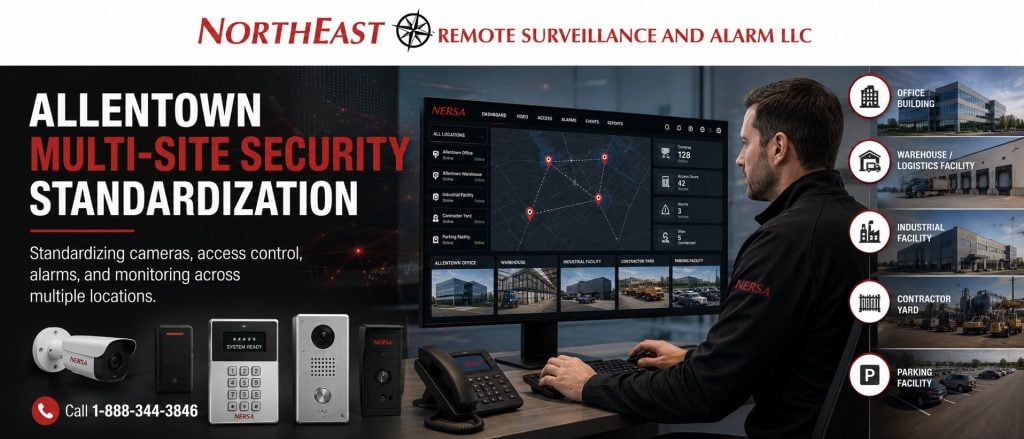
Why Multi-Site Security Standardization Matters
A single commercial property can sometimes operate with a custom security layout that only fits that building. Multi-site businesses need something stronger. When several properties are involved, every location should be easier to understand, easier to manage, easier to service, and easier to expand.
Without standardization, one location may have cameras named by hallway, another by camera number, another by recorder port, and another by old installer notes. One site may use keycards, another may use PIN codes, another may have outdated alarm schedules, and another may have no clear process for removing former employees. When an incident happens, staff may lose valuable time trying to figure out which system controls which door, which camera covers which area, or who has authority to make changes.
NERSA helps Allentown businesses reduce that confusion by building a practical standard for how security systems are organized across multiple locations.
Common Multi-Site Security Problems We Correct
Allentown businesses may need multi-site security standardization when several locations have been installed, upgraded, or serviced at different times without one consistent plan.
Common issues include different camera brands across locations, inconsistent video retention settings, mixed access control platforms, different alarm user code procedures, unclear employee access rules, undocumented door schedules, inconsistent monitoring instructions, poor site naming, weak user permission controls, different keypad layouts, different intercom workflows, unsupported legacy equipment, and inconsistent service documentation.
These problems are common for businesses that expanded quickly, acquired new locations, changed vendors, inherited old systems, moved into existing buildings, or added security equipment one project at a time.
Standardizing Cameras Across Multiple Sites
Commercial video systems are easier to manage when every site follows a consistent camera standard. This does not always mean every camera must be identical, but it does mean each location should follow a clear structure for camera placement, naming, recording, retention, remote access, permissions, and event review.
NERSA helps Allentown businesses standardize video surveillance across offices, warehouses, yards, parking areas, loading docks, industrial buildings, retail spaces, and multi-building properties. Standardization may include camera naming rules, view coverage standards, recorder organization, user permissions, retention planning, remote access cleanup, monitoring workflow alignment, and future expansion planning.
The goal is simple: when a manager opens a video system, every location should make sense.
Standardizing Access Control Across Multiple Locations
Access control becomes harder to manage when each location has different credential rules, door schedules, unlock times, user groups, administrator permissions, and employee access policies. Multi-site businesses need a cleaner way to control who can enter each building, door, department, gate, storage area, office, or restricted space.
NERSA helps Allentown businesses standardize access control across multiple properties by reviewing existing doors, readers, controllers, locks, schedules, credentials, user groups, and administrative processes. This can include standard employee access levels, management access groups, vendor access rules, termination procedures, mobile credential planning, keycard cleanup, and door schedule consistency.
A strong access control standard helps reduce security gaps when employees move between locations, roles change, or a business adds another facility.
Standardizing Intrusion Alarm Systems
Intrusion alarm systems can become confusing when each location has different arming schedules, keypad names, user codes, partitions, zones, opening and closing reports, call lists, and monitoring instructions. Multi-site businesses need alarm systems that are easier to understand and easier to manage from one location to the next.
NERSA helps Allentown businesses standardize intrusion alarm workflows across offices, warehouses, industrial buildings, logistics properties, contractor yards, retail spaces, schools, medical offices, and municipal facilities. Alarm standardization may include consistent zone naming, keypad naming, user code rules, partition planning, arming schedules, communication path review, monitoring contact lists, and false alarm reduction planning.
The purpose is to make alarm operation cleaner for staff and more reliable for management.
Standardizing Monitoring and Event Response
Monitoring becomes more effective when every site follows a consistent event response plan. If one location has clear alarm verification procedures and another has outdated call lists or missing site instructions, response quality can suffer.
NERSA helps Allentown multi-site businesses standardize monitoring procedures for alarm events, video verification, after-hours activity, access control events, intercom calls, gate events, and security notifications. This may include updated contact lists, escalation rules, after-hours procedures, video review workflows, alarm response notes, site-specific instructions, and management notification planning.
A standardized monitoring process helps businesses respond faster and reduces confusion during real events.
Standardizing User Permissions and Administration
Multi-site security systems often become difficult to manage because too many users have too many different permissions. Former employees may remain active, managers may have inconsistent access, vendors may have old credentials, and nobody may know who is responsible for system administration.
NERSA helps businesses clean up user permissions and build a stronger administrative structure. This may include user audits, role-based access levels, manager permissions, IT coordination, employee onboarding and offboarding procedures, vendor access rules, and administrative documentation.
This is especially important for growing businesses, multi-tenant commercial properties, warehouses, logistics operators, industrial sites, and companies with multiple managers across multiple locations.
Standardizing Equipment and Upgrade Planning
Multi-site standardization does not always require replacing every existing device. In many cases, NERSA can help businesses keep usable equipment while creating a better standard for what should be used going forward.
A business may decide on preferred camera types, preferred access control hardware, preferred alarm communication paths, preferred PoE switch standards, preferred wireless bridge designs, preferred intercom styles, preferred monitoring workflows, and preferred documentation practices. This makes future additions cleaner and helps reduce one-off decisions that create long-term service problems.
The goal is not to force every location into the exact same design. The goal is to create a consistent standard that still fits each site’s real layout, risk level, and operational needs.
Standardizing Security Documentation
Documentation is one of the most overlooked parts of multi-site security. Without clear records, every service call, upgrade, employee change, and incident review becomes harder than it needs to be.
NERSA helps Allentown businesses improve documentation for cameras, doors, alarm zones, panels, keypads, communicators, network equipment, intercoms, gates, access groups, monitoring contacts, device names, service notes, and future expansion plans. Good documentation helps owners, facility managers, IT teams, and service technicians understand the system faster.
For multi-site businesses, documentation is not just paperwork. It is part of the security system.
Standardizing Security Across Offices, Warehouses, Yards, and Industrial Sites
Different properties have different risks. An office does not operate the same way as a warehouse. A contractor yard does not operate the same way as a medical office. A logistics facility does not operate the same way as a municipal building. Multi-site standardization must account for those differences while still giving the business one clear security structure.
NERSA helps Allentown businesses create standards that fit different property types, including offices, warehouses, manufacturing spaces, logistics buildings, parking lots, fenced yards, employee entrances, loading docks, gates, tenant areas, restricted rooms, and customer-facing spaces.
The result is a security program that is consistent enough to manage and flexible enough to work in the real world.
When an Allentown Business Should Consider Multi-Site Standardization
A business should consider multi-site security standardization when different locations have different systems, different vendors, different camera naming structures, different alarm procedures, different access rules, different monitoring instructions, or inconsistent service records.
This service is also important when a business is opening a new location, acquiring another property, expanding a warehouse, adding more doors, upgrading monitoring, changing managers, cleaning up old user permissions, preparing for future growth, or trying to reduce service confusion across several locations.
Multi-site standardization is especially valuable before the business grows further. A clean standard now prevents the next location from becoming another disconnected system.
Our Multi-Site Security Standardization Approach
NERSA begins by reviewing the existing security systems across the business’s locations. We look at cameras, recorders, access control, intrusion alarms, monitoring workflows, intercoms, gate control, communication paths, user permissions, network infrastructure, device naming, documentation, and service history.
From there, we identify what can remain, what should be cleaned up, what should be standardized, and what should be upgraded over time. The plan may include immediate corrections, phased improvements, platform alignment, site-by-site cleanup, monitoring updates, user permission cleanup, naming standardization, and future expansion guidelines.
The focus is practical: build a security standard the business can actually manage.
Built for Small Businesses, Growing Companies, and Large Commercial Environments
Allentown multi-site security standardization is not only for large enterprise companies. A small business with two locations can benefit from consistent camera access, clear alarm procedures, and organized user permissions. A growing company with three to five locations needs a standard before expansion becomes harder to manage. A warehouse, logistics, industrial, municipal, school, medical, or large commercial environment may need a more detailed structure across many doors, cameras, users, and sites.
NERSA supports the full range of commercial clients, from small businesses and growing businesses to enterprise, industrial, multi-site, and large commercial security environments. Each standard is built around the actual property count, system condition, security risk, management structure, and long-term growth plan.
How This Page Fits the Allentown Upgrade Cluster
This page supports the Allentown security system upgrade and retrofit structure by focusing on standardization across multiple properties. It connects closely with camera upgrades, access control upgrades, alarm upgrades, integration upgrades, communication infrastructure upgrades, monitoring improvements, intercom upgrades, gate control upgrades, and full commercial security system retrofits.
The purpose of this page is narrow: to help Allentown businesses make multiple existing security systems easier to manage, easier to service, easier to monitor, and easier to expand.
FAQ
What is multi-site security standardization?
Multi-site security standardization is the process of organizing cameras, access control, alarms, monitoring, intercoms, gates, user permissions, naming conventions, and documentation so multiple business locations follow a cleaner and more consistent security structure.
Do all of our locations need the exact same equipment?
No. Standardization does not always mean every location uses identical equipment. The goal is to create consistent management, naming, access rules, monitoring procedures, documentation, and future upgrade standards while still respecting each property’s layout and security needs.
Can NERSA standardize existing systems without replacing everything?
Yes. NERSA can review existing cameras, access control, alarms, monitoring equipment, intercoms, and communication paths to determine what can remain, what should be cleaned up, and what should be upgraded over time.
Can this help when we have different systems at different locations?
Yes. Many multi-site businesses have different platforms because each location was installed or upgraded at a different time. NERSA can help clean up the structure, improve documentation, align procedures, and recommend a practical path toward stronger consistency.
Does this include access control users and employee permissions?
Yes. Multi-site standardization often includes access control user cleanup, employee permission review, management access groups, vendor access rules, onboarding procedures, offboarding procedures, and administrator permission planning.
Is this only for large companies?
No. NERSA supports small businesses, growing businesses, warehouses, industrial facilities, schools, municipal buildings, multi-site operations, and large commercial security environments. A business with two locations can benefit from standardization, and larger organizations can use it to reduce confusion across many properties.
Request Allentown Multi-Site Security Standardization Support
Call Northeast Remote Surveillance and Alarm, LLC at 1-888-344-3846 to review multi-site security standardization for your Allentown commercial properties.
“`