
A commercial security system retrofit helps your business improve protection without automatically replacing every piece of existing equipment.

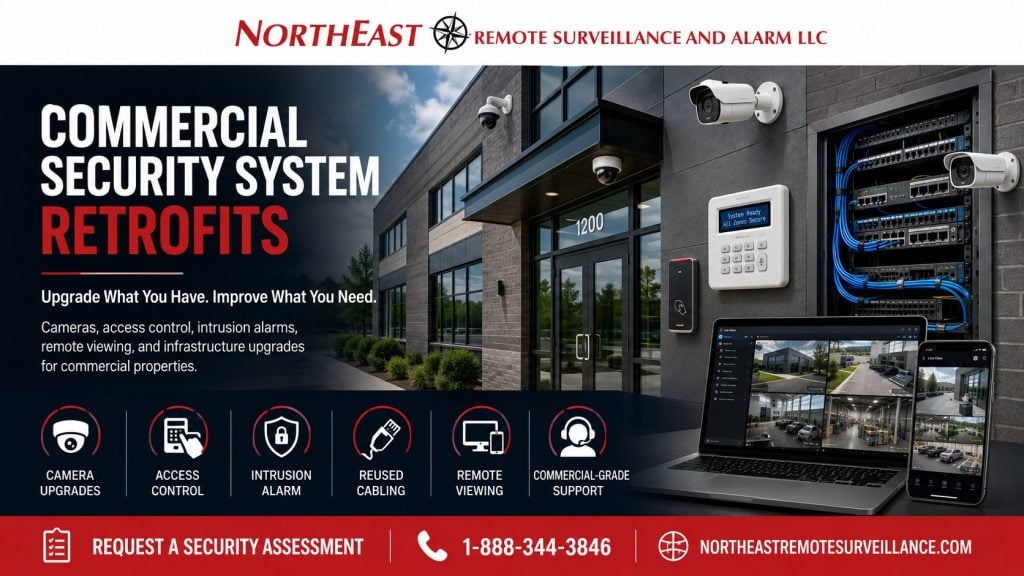
Northeast Remote Surveillance and Alarm, LLC helps commercial and industrial facilities retrofit older cameras, access control systems, intrusion alarms, cabling, network equipment, remote viewing, and monitoring paths around the way the building operates today.
If some equipment still meets your needs, Commercial Security System Upgrades, Retrofits & Takeovers explains how a retrofit can fit between a small repair and a complete replacement.
Commercial Security Retrofits for Existing Buildings
Many commercial properties already have security equipment installed, but the system no longer performs the way the business needs it to perform.
The cameras may be outdated. The access control system may have old users and unclear permissions. The alarm system may not match the current layout. The cabling may be usable in some areas but unreliable in others. The recorder may be difficult to search. The network equipment may not support modern IP cameras or remote access. The documentation may be missing.
A retrofit starts with the existing building and improves the system from there.
The goal is to determine what should stay, what should be upgraded, what should be removed, what can be reused, and what needs to be documented for long-term support.
What Is a Commercial Security System Retrofit?
A commercial security system retrofit is the process of modernizing an existing security system while reusing serviceable infrastructure where appropriate.
A retrofit may include:
- Replacing older cameras with newer IP or high-definition cameras.
- Upgrading the DVR, NVR, or video management platform.
- Reusing existing cabling where it is reliable and compatible.
- Adding cameras to cover blind spots.
- Replacing outdated access control readers or controllers.
- Cleaning up access control users, schedules, and permissions.
- Updating intrusion alarm devices to match the current building layout.
- Replacing or upgrading alarm communicators.
- Improving remote viewing for authorized users.
- Reviewing network switches, PoE capacity, and backup power.
- Labeling devices and improving system documentation.
- Building a path for future expansion.
A good retrofit is not a shortcut. It is a practical way to improve a commercial security system without wasting money on unnecessary demolition or replacement.
Retrofit vs. Full Replacement
Not every older security system needs to be fully replaced.
A full replacement may be the right decision when the equipment is obsolete, unsupported, proprietary, unreliable, poorly installed, undocumented, or unable to support the business’s current needs.
A retrofit may be the better option when some of the existing infrastructure is still useful.
A retrofit can help your business:
- Reduce unnecessary replacement cost.
- Keep usable cabling and pathways.
- Upgrade the weakest parts of the system first.
- Reduce disruption to daily operations.
- Improve system performance in phases.
- Preserve working devices where appropriate.
- Build a cleaner long-term support path.
- Prepare the system for future growth.
Northeast Remote Surveillance and Alarm, LLC evaluates the existing system before recommending whether the right path is retrofit, upgrade, takeover, or full replacement.
When a Commercial Security Retrofit Makes Sense
A retrofit may be the right option when your existing system has value but is no longer performing well enough.
Common signs include:
- Cameras are blurry, outdated, or poorly aimed.
- Video is difficult to search or export.
- Remote viewing is unreliable.
- Access control users are disorganized.
- Former employees or vendors may still have access.
- Alarm coverage does not match the current building layout.
- Old wiring may still be usable but needs testing.
- Equipment has been added over time without a clean plan.
- Multiple systems are disconnected.
- Device names and labels are confusing.
- The system is difficult to service.
- The building has expanded or changed use.
- The business wants better security without a full rip-and-replace.
A retrofit is often the right path for warehouses, offices, schools, healthcare offices, industrial buildings, retail spaces, contractor shops, logistics facilities, and multi-tenant properties with older but partially usable systems.
Existing System Review
Every retrofit should begin with a clear review of the existing system.
NERSA evaluates the current condition of:
- Security cameras
- Camera views
- Recording equipment
- Remote viewing access
- Access control readers
- Door controllers
- Door hardware
- User permissions
- Intrusion alarm panel
- Keypads
- Door contacts
- Motion detectors
- Sirens
- Alarm communicator
- Monitoring path
- Cabling and pathways
- Network switches
- PoE capacity
- Power supplies
- Backup power
- Device names and labels
- Available documentation
- Future expansion needs
This review determines which parts of the system can be reused and which parts should be replaced.
Camera System Retrofits
Camera systems are one of the most common retrofit areas.
Many older camera systems still record video, but the footage is not useful enough when something happens. The system may have poor image quality, blind spots, weak night performance, unreliable remote access, outdated recording equipment, or limited export capability.
A camera retrofit may include:
- Replacing low-resolution cameras.
- Re-aiming existing cameras.
- Adding cameras to priority areas.
- Upgrading the recorder or VMS.
- Improving remote viewing.
- Increasing storage or retention.
- Renaming cameras by location.
- Improving parking lot and exterior coverage.
- Improving loading dock or warehouse coverage.
- Reviewing low-light and after-hours performance.
Access Control Retrofits
Access control systems often need retrofitting when the building’s staff, doors, schedules, or operating needs have changed.
An access control retrofit may include:
- Replacing old readers.
- Updating door controllers.
- Adding controlled doors.
- Reviewing electric strikes or electrified locks.
- Replacing weak power supplies.
- Adding door position monitoring.
- Cleaning up user groups.
- Removing former users.
- Updating schedules.
- Organizing administrator access.
- Reviewing emergency egress and life-safety needs.
Access control should match the way the facility operates today, not the way it operated years ago.
For related planning, see Commercial & Industrial Access Control Systems.
Intrusion Alarm Retrofits
Commercial intrusion alarm systems should be reviewed when the building layout, tenant use, operating hours, or risk areas change.
An intrusion alarm retrofit may include:
- Reviewing the alarm panel.
- Replacing or adding door contacts.
- Replacing or adding motion detectors.
- Reviewing overhead door protection.
- Updating keypad locations.
- Reviewing sirens and annunciation.
- Cleaning up user codes.
- Reviewing partitions or arming areas.
- Updating zone names.
- Reviewing monitoring signals.
- Replacing outdated communicators.
- Testing alarm, trouble, and supervisory reporting where applicable.
A warehouse, office, industrial facility, or multi-tenant building may outgrow its original alarm layout. A retrofit helps bring the alarm system back in line with the current risk.
For related planning, see Commercial Burglar Alarm and Intrusion Detection Systems.
Cabling and Infrastructure Retrofits
Existing cabling can sometimes be reused, but it should never be assumed.
NERSA reviews cable condition, cable type, distance, terminations, labeling, pathways, conduit, network compatibility, PoE requirements, and long-term serviceability before recommending reuse.
A cabling and infrastructure retrofit may include:
- Testing existing cable.
- Reusing serviceable cable.
- Replacing damaged or unreliable cable.
- Cleaning up terminations.
- Improving equipment cabinet layout.
- Reviewing PoE switch capacity.
- Adding network switches where needed.
- Improving cable labeling.
- Reviewing UPS backup.
- Planning future cable pathways.
Security equipment is only as reliable as the wiring, network, and power behind it.
For related infrastructure planning, see Commercial Low Voltage and Network Infrastructure Services.
Remote Viewing and User Cleanup
Remote access is one of the biggest reasons commercial systems need retrofitting.
Older systems often have shared passwords, former employees, vendor accounts, weak permissions, unreliable apps, or no clear process for removing users.
NERSA helps organize:
- Authorized remote viewing users
- Camera access permissions
- Video playback permissions
- Clip export permissions
- Access control administrators
- Alarm users
- Mobile access
- Desktop access
- Former user removal
- Vendor access limits
- Owner and manager access
A modern security system should not give everyone the same level of control. Remote access should be useful, organized, and limited to approved users.
Monitoring and Communicator Retrofits
Some commercial systems need a retrofit because the alarm communication path is outdated.
A monitoring or communicator retrofit may involve reviewing:
- Alarm communicator condition
- Cellular or IP communication options
- Monitoring account information
- Emergency contact lists
- Signal reporting
- Trouble conditions
- Alarm signal testing
- Opening and closing reports where applicable
- Panel compatibility
- Documentation
The business should know where signals are going, who is being contacted, and whether alarm events are being reported correctly.
Network and Power Review
Modern commercial security systems depend on stable network and power design.
A retrofit may require review of:
- Network switch locations
- PoE budget
- Internet reliability
- Equipment cabinets
- Cable management
- UPS backup
- Surge protection
- Power supplies
- Device load
- Remote access requirements
- Service access
Poor network or power planning can cause camera dropouts, failed recordings, weak remote viewing, access control trouble, and alarm communication problems.
Documentation and Labeling
A retrofit should leave the system easier to support than it was before.
NERSA helps clean up documentation for:
- Camera names
- Camera views
- Recorder location
- Controlled doors
- Reader locations
- Access levels
- Alarm zones
- Keypad locations
- Network equipment
- Power supplies
- Monitoring information where applicable
- User permission structure
- Service notes
- Recommended future upgrades
Documentation is not just paperwork. It helps future service calls move faster and helps the business understand its own system.
Before and After
| Before Retrofit | After Retrofit |
|---|---|
| Older equipment with inconsistent performance | Updated equipment where needed |
| Unclear camera views | Better camera placement and naming |
| Outdated recorder | Better search, recording, retention, and export |
| Disorganized access control users | Cleaner access levels and user permissions |
| Alarm coverage did not match current use | Intrusion coverage reviewed and corrected |
| Existing cabling condition was unknown | Cabling evaluated for reuse or replacement |
| Remote access was unreliable | Remote viewing reviewed and configured for authorized users |
| Missing documentation | Better labeling, handoff, and support records |
| Reactive service | More supportable long-term security platform |
Commercial Facilities That Benefit From Security Retrofits
Commercial security retrofits are useful for many facility types, including:
- Warehouses
- Distribution centers
- Manufacturing facilities
- Office buildings
- Medical offices
- Schools and education facilities
- Retail stores
- Contractor shops
- Auto repair shops
- Laundromats
- Multi-tenant commercial buildings
- Industrial parks
- Truck yards
- Logistics properties
- Professional offices
- Municipal and institutional properties
Each retrofit should be planned around the building’s actual layout, risk areas, staff movement, access needs, operating hours, and long-term support requirements.
Why Businesses Choose NERSA for Commercial Retrofits
Northeast Remote Surveillance and Alarm, LLC focuses on commercial, industrial, institutional, and business and facility security systems.
Commercial retrofits require more than swapping out devices. They require understanding old systems, existing wiring, door hardware, camera placement, alarm coverage, user permissions, monitoring paths, network infrastructure, and business operations.
NERSA designs retrofit projects around what the building already has and what the business actually needs.
When to Request a Commercial Security Retrofit
A business should request a retrofit assessment if:
- The existing system is outdated but partly usable.
- Cameras do not provide clear review.
- Remote viewing does not work reliably.
- The recorder is hard to search.
- Access control users are disorganized.
- Old employees may still have access.
- Alarm coverage no longer matches the building.
- Existing cabling may be reusable.
- Documentation is missing.
- Service calls are taking too long.
- The building has changed layout or use.
- The business wants better security without unnecessary full replacement.
Commercial Security Retrofit Checklist
Before retrofitting a commercial security system, evaluate:
- Existing cameras
- Camera views
- Recording equipment
- Remote viewing
- Storage and retention
- Access-controlled doors
- Door hardware
- User permissions
- Credential holders
- Alarm panel
- Alarm zones
- Motion detectors
- Door contacts
- Keypad locations
- Sirens
- Communicator
- Monitoring path
- Existing cabling
- Network switches
- PoE capacity
- Power supplies
- UPS backup
- Device labels
- Documentation
- Future expansion needs
Request a Commercial Security Retrofit Assessment
Northeast Remote Surveillance and Alarm, LLC can help modernize older commercial security systems. We serve warehouses, offices, healthcare offices, schools, industrial and logistics properties, contractor yards, retail locations and multi-tenant buildings.
Frequently Asked Questions About Commercial Security System Retrofits
What is a commercial security system retrofit?
A commercial security system retrofit modernizes an existing security system by upgrading weak equipment, reusing serviceable infrastructure where appropriate, improving system organization, and creating a better long-term support path.
Is a retrofit the same as a new installation?
No. A new installation starts from scratch. A retrofit starts with the existing system and determines what can be reused, corrected, replaced, upgraded, or documented.
Is a retrofit the same as a takeover?
No. A takeover focuses on assuming support for an existing system. A retrofit focuses on modifying and modernizing the system. Many projects involve both, but they are not the same service.
Can existing camera cabling be reused?
Sometimes. Existing cable can be reused if it is in good condition, properly terminated, compatible with the upgraded equipment, and reliable enough for long-term service.
Can access control be retrofitted into an existing building?
Yes. Access control can often be added or upgraded in existing buildings. The design depends on the door hardware, frame condition, egress requirements, cable pathways, power, credentials, and user management needs.
Can an old intrusion alarm be retrofitted?
Yes. Existing alarm systems can often be reviewed, corrected, expanded, or upgraded. Door contacts, motion detectors, keypads, communicators, sirens, user codes, and monitoring paths may all need review.
Do all old security systems need full replacement?
No. Some systems can be retrofitted if parts of the infrastructure are still serviceable. Full replacement is usually recommended only when the equipment, wiring, documentation, or platform cannot support the facility’s needs.
Can a retrofit improve remote viewing?
Yes. A retrofit can improve remote viewing by upgrading recorders, correcting network issues, organizing camera names, cleaning up users, and configuring proper permissions.
Does NERSA document the retrofitted system?
Yes. Documentation and labeling are important parts of a professional retrofit because they make the system easier to manage, service, and expand.
How do we start a commercial security system retrofit?
Call 1-888-344-3846 or use Request a Security Assessment.
NERSA can review the existing system and recommend what should be reused, upgraded, replaced, or documented.
Compliance, Codes & Project Standards
NERSA plans commercial and industrial security work with applicable code, documentation, inspection and authority-having-jurisdiction requirements in mind. Requirements vary by system, property and jurisdiction. These resources support project planning; they do not establish legal compliance, certification or AHJ approval.
Related guidance: Regulatory compliance & inspection readiness · NERSA project standards · Documentation, testing & inspection readiness