Define managed fire alarm responsibilities for fault reporting, service coordination, required testing, inspection records, and follow-up on unresolved conditions.
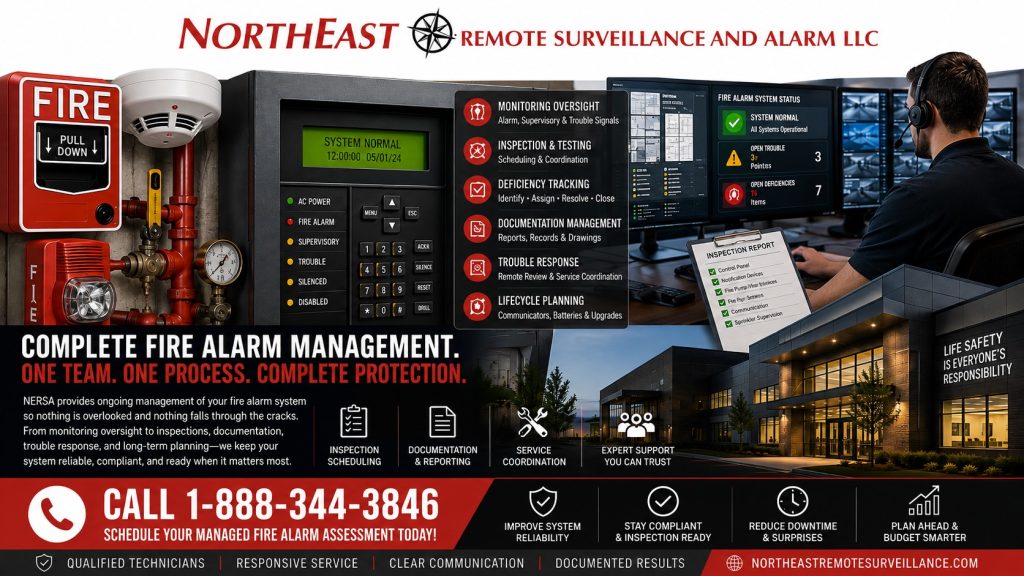
Keep fire alarm equipment and records organized throughout the system’s life. Track the panel, initiating devices, notification appliances, power supplies and backup batteries. Include the communicator, sprinkler supervisory inputs and life-safety interfaces. Maintain service records, inspection schedules, customer contacts, open deficiencies and replacement plans.
Without a defined management process, important responsibilities can become scattered among facility personnel, property managers, monitoring providers, inspectors, sprinkler contractors, elevator companies, electricians, and previous fire alarm vendors.
On this page: Service scope · Build a program · Common questions · Assessment
Northeast Remote Surveillance and Alarm, LLC provides managed fire alarm services for qualifying commercial, industrial, institutional, municipal, healthcare, educational, warehouse, manufacturing, logistics, and multi-site properties.
Our managed programs may include:
- Fire alarm monitoring oversight
- Alarm, supervisory, and trouble signal coordination
- Inspection and testing scheduling
- Deficiency tracking
- Repair coordination
- Communicator and monitoring-path management
- Customer contact administration
- Fire alarm system documentation
- Recurring trouble review
- Battery and power-supply planning
- Inspection-readiness support
- Multi-site fire alarm reporting
- System lifecycle planning
- Phased modernization recommendations
Managed fire alarm service does not replace required inspection, testing, maintenance, permitting, acceptance, emergency procedures, or authority-having-jurisdiction approval.
It creates an organized structure for keeping those responsibilities visible, documented, assigned, and moving toward completion.
For broader management across video surveillance, access control, intrusion alarms, fire alarm systems, intercoms, and integrated security platforms, visit Managed Security Systems and System Health Monitoring.
What Are Managed Fire Alarm Services?
Managed fire alarm services combine ongoing administration, monitoring oversight, inspection coordination, deficiency management, service support, documentation, and lifecycle planning for an operating commercial fire alarm system.
The precise scope depends on:
- The building and occupancy
- The installed fire alarm equipment
- The monitoring arrangement
- The communication technology
- Applicable requirements
- Authority-having-jurisdiction expectations
- Customer procedures
- Existing service agreements
- The responsibilities assigned to NERSA
A managed program may help the customer answer important questions such as:
- When is the next inspection due?
- Are there unresolved deficiencies?
- Is the monitoring account current?
- Are the emergency contacts accurate?
- Is the communicator still supported?
- Are recurring trouble conditions being investigated?
- Are batteries approaching replacement?
- Are disabled points being tracked?
- Is documentation available?
- Who is responsible for each corrective action?
- Which equipment is obsolete?
- What should be budgeted for next?
Managed service is not simply an installer retaining remote access to a panel.
It is a defined operating process that identifies responsibilities, reporting expectations, escalation procedures, service priorities, and long-term system needs.
The Purpose of a Managed Fire Alarm Program
Fire alarm systems remain in buildings for many years while the surrounding property changes continuously.
During that time:
- Tenants move
- Personnel change
- Telephone service is removed
- Internet providers change
- Cellular technology is retired
- Rooms are renovated
- Walls are added
- Warehouse storage changes
- Manufacturing equipment is relocated
- Elevators are modernized
- Access control is installed
- HVAC equipment is replaced
- Sprinkler systems are modified
- Monitoring contacts become outdated
- Inspection reports are misplaced
- Previous service providers leave
A fire alarm system can remain operational while its administrative and technical support structure gradually becomes incomplete.
Managed fire alarm services help prevent the system from becoming an undocumented collection of old equipment, recurring trouble conditions, expired contacts, missing reports, and unresolved deficiencies.
Managed Fire Alarm Services Versus Fire Alarm Installation
Fire alarm installation focuses on creating or modifying the physical life-safety system.
That may include:
- System design
- Control panels
- Detection devices
- Manual pull stations
- Notification appliances
- Sprinkler supervision
- Communicators
- Power supplies
- Wiring
- Programming
- Testing
- Acceptance
- System replacement
- Building expansion
Managed fire alarm service begins after the system is placed into operation.
It focuses on:
- Monitoring-account oversight
- Contact-list management
- Inspection scheduling
- Test coordination
- Trouble-condition follow-up
- Deficiency tracking
- Documentation
- Repair coordination
- Battery planning
- Communicator lifecycle
- System modernization planning
- Multi-site oversight
For new system design, expansion, replacement, detection, notification, and life-safety interface work, visit Commercial Fire Alarm and Life Safety Systems.
Managed Service Versus Fire Alarm Monitoring
Fire alarm monitoring and managed fire alarm service are related but different.
Fire Alarm Monitoring
Fire alarm monitoring focuses on receiving transmitted signals from the protected premises.
Depending on the system and monitoring arrangement, those signals may include:
- Alarm
- Supervisory
- Trouble
- Communication failure
- Test signals
- Restoral signals
The monitoring station follows the approved account instructions associated with each signal.
Managed Fire Alarm Services
Managed service may include monitoring oversight plus:
- Monitoring-account administration
- Contact-list updates
- Inspection scheduling
- Deficiency management
- Service coordination
- Documentation
- System-health review
- Communicator planning
- Battery replacement planning
- Recurring trouble analysis
- Lifecycle planning
Monitoring processes signals.
Managed service organizes the broader responsibilities required to maintain the fire alarm program over time.
Managed Service Versus Fire Alarm System Health Monitoring
Fire alarm system health monitoring focuses on technical conditions reported by the system or associated communication equipment.
Those conditions may include:
- Panel trouble
- AC power failure
- Battery trouble
- Ground fault
- Device communication loss
- Circuit trouble
- Communicator failure
- Disabled points
- Networked-panel communication loss
- Failure to complete an expected test signal
Managed fire alarm service is broader.
It may use available health information while also coordinating:
- Inspections
- Documentation
- Corrective service
- Deficiency closeout
- Monitoring contacts
- System records
- Communicator upgrades
- Maintenance planning
- Modernization
Fire Alarm Monitoring Oversight
A fire alarm monitoring arrangement may depend on:
- The initiating device or supervised condition
- The fire alarm control unit
- The system communicator
- One or more communication paths
- The supervising station
- The monitoring account
- Current account instructions
- Accurate contact information
- Correct signal descriptions
- Defined response procedures
A weakness anywhere in that chain can interfere with effective signal handling.
Managed monitoring oversight may include:
- Confirming monitoring-account information
- Reviewing building and system descriptions
- Maintaining customer contact lists
- Reviewing call-list order
- Coordinating test procedures
- Investigating failed communication events
- Tracking missed or late test signals
- Coordinating communicator replacement
- Documenting monitoring-provider transitions
- Reviewing recurring signal problems
- Confirming restoration after approved work
Monitoring requirements vary by property, system, occupancy, adopted requirements, and jurisdiction.
NERSA evaluates the actual fire alarm arrangement rather than assuming that every building requires the same monitoring configuration.
Alarm, Supervisory, and Trouble Signal Coordination
Fire alarm systems may generate several categories of signals.
Alarm Signals
Alarm signals may originate from:
- Smoke detectors
- Heat detectors
- Manual pull stations
- Sprinkler waterflow
- Other approved initiating devices
Alarm signals must be handled according to the monitoring instructions, emergency procedures, system design, and applicable requirements.
Supervisory Signals
Supervisory signals may indicate an off-normal condition involving supervised fire-protection equipment.
Examples may include:
- Sprinkler valve tamper
- Low air pressure
- Fire pump conditions
- Tank level or temperature conditions
- Other supervised fire-protection equipment
A supervisory signal should be investigated according to the property’s procedures.
It should not be treated as an ordinary maintenance reminder.
Trouble Signals
Trouble signals may indicate a condition affecting the fire alarm system or its communication path.
Examples may include:
- Loss of AC power
- Low battery
- Ground fault
- Device communication trouble
- Notification circuit trouble
- Signaling-line circuit trouble
- Communicator failure
- Network communication trouble
- Disabled points
- Internal panel trouble
A managed program helps define who receives each condition, who investigates it, and how corrective service is initiated.
Trouble-Condition Management
A fire alarm trouble signal should not remain unresolved simply because the building continues operating.
A managed trouble process may include:
- Identifying the system and location
- Confirming the reported condition
- Notifying the designated customer contact
- Reviewing available event information
- Determining whether remote diagnostic review is appropriate
- Scheduling on-site service when required
- Recording the condition
- Documenting corrective work
- Confirming restoration
- Reviewing whether the problem has occurred previously
Recurring trouble conditions may indicate:
- Aging batteries
- Damaged wiring
- Moisture intrusion
- Loose connections
- Intermittent ground faults
- Unstable power
- Contaminated detectors
- Failing power supplies
- Communicator problems
- Unsupported equipment
- Improper modifications
The objective is not merely to silence a trouble buzzer.
The objective is to identify the cause, complete corrective action, and reduce repeat failures.
Inspection and Testing Coordination
Commercial fire alarm systems require periodic inspection and testing based on the system, equipment, property, applicable requirements, manufacturer instructions, and authority having jurisdiction.
A managed inspection process may include:
- Tracking upcoming due dates
- Scheduling authorized service
- Confirming site contacts
- Coordinating access
- Reviewing previous reports
- Identifying open deficiencies
- Coordinating alarm-system testing procedures
- Arranging related contractor participation
- Delivering completed reports
- Tracking required retesting
- Preserving records
- Updating future schedules
The exact inspection and testing frequencies should be determined for the specific system and property.
They should not be guessed or reduced to one universal interval.
Inspection-Readiness Support
Properties often discover documentation and maintenance gaps immediately before an inspection.
A managed readiness review may help determine whether the following are available:
- Prior inspection reports
- Deficiency reports
- Repair records
- Monitoring account information
- Panel and communicator information
- System record documents
- Current contact information
- Device and zone descriptions
- Battery records
- Test procedures
- Documentation of modifications
- Records of disabled or impaired equipment
- Relevant coordination contacts
NERSA cannot guarantee approval by an inspector or authority having jurisdiction.
The purpose is to help the customer approach the inspection with an organized system, accessible records, and fewer unresolved issues.
Fire Alarm Deficiency Tracking
Inspection and service reports may identify deficiencies involving:
- Control equipment
- Devices
- Notification circuits
- Signaling circuits
- Batteries
- Power supplies
- Monitoring communication
- Documentation
- Programming
- Physical damage
- Accessibility
- Interfaces
- Unsupported equipment
A managed deficiency process may include:
- Recording the deficiency
- Identifying the responsible party
- Determining whether additional investigation is needed
- Preparing a corrective scope
- Obtaining customer authorization
- Scheduling access
- Completing corrective work
- Retesting affected functions
- Documenting completion
- Delivering closeout information
Some deficiencies may belong to another discipline, including:
- Sprinkler systems
- Elevator systems
- HVAC equipment
- Electrical systems
- Building construction
- Door hardware
- Emergency power
- Network service
- Customer-owned equipment
Those items should remain visible until transferred to the appropriate responsible party.
They should not disappear merely because they fall outside the fire alarm contractor’s direct scope.
Documentation Management
Fire alarm systems depend on accurate documentation for service, inspection, testing, expansion, and replacement.
Useful records may include:
- System record drawings
- Device lists
- Zone or point descriptions
- Sequence-of-operations information
- Battery calculations
- Voltage-drop calculations
- Product data
- Programming records
- Inspection reports
- Test reports
- Deficiency reports
- Repair documentation
- Monitoring information
- Communicator records
- Acceptance information
- Permits
- Approved plans
- Manufacturer manuals
- Software backups where applicable
- Account and password procedures
- Modification history
Records are frequently lost during ownership changes, personnel turnover, contractor transitions, renovations, or acquisitions.
Managed documentation helps organize the records that exist and improves the consistency of future records.
It does not recreate information that was never produced or retained.
Fire Alarm Communication-Path Management
Many commercial fire alarm systems originally used traditional telephone lines.
Building communication systems have changed considerably, and problems can arise when:
- Copper telephone service is removed
- Voice-over-IP service replaces traditional lines
- Internet providers change
- Network equipment is replaced
- Cellular technology is retired
- Communicator accounts lapse
- Building owners assume the alarm uses the same service as ordinary phones
- Communication changes occur without fire alarm review
Warning signs may include:
- Communication failure
- Missed test signals
- Intermittent communicator trouble
- Unknown phone-line ownership
- Poor cellular signal
- Aging communication equipment
- Unsupported network technology
- Communicator power trouble
- Unclear monitoring account ownership
A managed program helps identify the communication method, document responsibility, review recurring failures, and plan upgrades before the existing path becomes unreliable or unsupported.
Cellular and IP Communicator Management
Modern fire alarm monitoring may use cellular, IP, or approved combinations of communication technologies.
Managed communicator support may include:
- Compatibility review
- Monitoring-account coordination
- Signal-strength review
- Power and battery review
- Test-signal verification
- Firmware or service coordination
- Communication-path documentation
- Carrier-transition planning
- Replacement of obsolete equipment
- Monitoring-center coordination
- Verification after service
A communicator upgrade is not a generic network-device replacement.
The fire alarm panel, power source, enclosure, programming, monitoring account, signal transmission, documentation, applicable requirements, and approval process must be considered.
Battery and Power-Supply Planning
Fire alarm control units, communicators, remote power supplies, and notification-appliance circuit extenders may rely on rechargeable standby batteries.
Battery performance can be affected by:
- Age
- Temperature
- Charging conditions
- Frequent power failures
- Loose terminals
- Corrosion
- Incorrect capacity
- Incompatible replacement batteries
- Failed charging circuits
- Increased connected load
A battery may remain physically installed after it can no longer provide dependable standby capacity.
Managed battery planning may include:
- Documenting battery locations
- Recording battery type and capacity
- Tracking replacement dates
- Reviewing test results
- Investigating recurring battery trouble
- Scheduling approved replacement
- Confirming labeling
- Reviewing load changes
- Coordinating disposal
Remote monitoring may identify certain battery trouble conditions, but it does not replace physical inspection or required testing.
Impairment Coordination
A fire alarm system may become partially or completely impaired because of:
- Planned renovations
- Testing
- Device replacement
- Panel replacement
- Communication failure
- Damaged wiring
- Power loss
- Water damage
- Construction activity
- Equipment failure
Impairment procedures may require:
- Responsible-party notification
- Temporary precautions
- Fire watch
- Authority notification
- Documentation
- Restoration testing
- Confirmation that protection has returned
The exact procedure depends on the property, system, applicable requirements, customer procedures, and authority having jurisdiction.
Managed service can help establish communication and documentation responsibilities, but the building owner and designated personnel remain responsible for following the required impairment procedure.
No fire alarm function should be disabled or bypassed without appropriate authorization and safeguards.
Disabled and Bypassed Point Management
Devices or system functions may be disabled temporarily during:
- Testing
- Construction
- Renovation
- Service
- Device replacement
- Approved operational procedures
Problems occur when temporary disablements remain in place because no one tracks them.
A managed review may identify:
- Disabled initiating devices
- Disabled notification functions
- Bypassed supervisory inputs
- Disabled outputs
- Suppressed trouble conditions
- Temporary programming changes
- Zones left out of service
- Incomplete restoration after work
Every disabled point should have:
- A documented reason
- An authorized responsible party
- A restoration plan
- A completion record
The level of remote visibility depends on the panel, communicator, network architecture, programming, and service arrangement.
Remote Diagnostic Support
Certain fire alarm conditions may be reviewed remotely when the installed equipment supports secure diagnostic access or reporting.
Remote review may include:
- Reviewing event history
- Confirming communicator status
- Checking whether expected signals were received
- Reviewing recurring trouble reports
- Confirming monitoring information
- Coordinating a controlled test
- Reviewing network or cellular status
- Determining whether on-site service is required
- Providing history to the dispatched technician
Remote diagnostics do not replace physical inspection or testing.
A control panel may report normal while a detector is obstructed, a notification appliance is damaged, a manual pull station is inaccessible, or another physical condition exists.
Remote review should improve service coordination—not create a false impression that the entire system has been tested remotely.
Corrective Fire Alarm Service
Conditions requiring on-site service may include:
- Ground faults
- Device communication trouble
- Notification circuit trouble
- Signaling circuit trouble
- Failed batteries
- Damaged detectors
- Contaminated detectors
- Failed modules
- Damaged pull stations
- Failed power supplies
- Communicator replacement
- Water or moisture damage
- Wiring faults
- Panel hardware failure
- Display failure
- Programming corrections
- Construction damage
- Unexplained recurring alarm or trouble conditions
Whenever practical, the technician should receive:
- The reported condition
- Available event history
- Previous service information
- System details
- Open deficiency information
- Site access requirements
This allows the service visit to focus on diagnosis and correction rather than starting without context.
Fire Alarm System Takeovers
A property owner may need a new fire alarm service provider after:
- Purchasing a building
- Changing facility managers
- Acquiring another company
- Ending a previous contractor relationship
- Discovering missing records
- Receiving an inspection deficiency
- Experiencing recurring trouble
- Losing access to monitoring accounts
- Finding obsolete equipment
NERSA can evaluate existing commercial fire alarm systems for possible takeover and long-term support.
The assessment may review:
- Control panel manufacturer and model
- Annunciators
- Initiating devices
- Notification appliances
- Remote power supplies
- Batteries
- Communicator
- Monitoring account
- Signal transmission
- Programming access
- Point descriptions
- Sprinkler supervision
- Elevator interfaces
- HVAC interfaces
- Access-control interfaces
- Inspection records
- Open deficiencies
- Documentation
- Manufacturer support
- Replacement-part availability
A system is not automatically eligible for takeover simply because the panel currently displays normal.
Unsupported, undocumented, inaccessible, improperly modified, or severely deficient systems may require additional testing, corrective work, communicator replacement, or system modernization before a managed agreement can be established.
Fire Alarm System Lifecycle Planning
Commercial fire alarm systems may remain in service for many years, but no platform remains supportable indefinitely.
Lifecycle warning signs may include:
- Discontinued control panels
- Unsupported programming software
- Unavailable replacement devices
- Obsolete communicators
- Unsupported cellular technology
- Aging power supplies
- Repeated hardware failures
- Missing programming access
- Damaged displays
- Chronic ground faults
- Expansion limitations
- Incomplete documentation
- Lack of manufacturer support
- Excessive repair costs
Managed lifecycle planning helps distinguish between:
Serviceable Equipment
Equipment that remains reliable, supported, and appropriate for continued use.
Corrective Repair Needs
Components that require repair, testing, programming correction, or replacement.
Communication Upgrades
Communicators or monitoring paths that are obsolete, unreliable, or no longer appropriate.
Phased Modernization
Systems that can remain operational while selected areas or components are upgraded over time.
Full Replacement
Systems that can no longer be supported reliably or expanded appropriately.
Planning allows the organization to budget for modernization before an emergency failure forces a rushed decision.
For broader upgrade, retrofit, and takeover planning, visit Commercial Security System Upgrades, Retrofits and Takeovers.
Coordination With Sprinkler Systems
Fire alarm systems frequently supervise sprinkler-system conditions through:
- Waterflow switches
- Valve tamper switches
- Low-pressure switches
- Fire pump signals
- Tank supervision
- Other approved supervisory devices
The sprinkler system and fire alarm system remain separate scopes that must be coordinated.
A supervisory or alarm signal may originate from sprinkler equipment requiring a sprinkler contractor. A wiring, module, or programming problem may require a fire alarm technician.
Managed service helps identify the responsible party and track the condition through restoration.
It does not replace sprinkler-system inspection, testing, or maintenance.
Coordination With Elevator Systems
Commercial fire alarm systems may interface with elevator equipment for:
- Primary recall
- Alternate-floor recall
- Machine-room or hoistway detection
- Shunt-trip coordination
- Status indication
- Other required operations
Testing and modification may require coordination among:
- Fire alarm contractor
- Elevator contractor
- Electrical contractor
- Building management
- Inspector
- Authority having jurisdiction
Managed service can coordinate the fire alarm portion of the process while preserving the separate responsibilities of the elevator contractor and other trades.
Coordination With HVAC and Smoke-Control Functions
Fire alarm systems may interface with:
- Air-handling equipment
- Duct smoke detectors
- Fan shutdown
- Smoke dampers
- Smoke-control systems
- Building automation
- Dedicated control equipment
A managed process should document:
- Which system initiates the action
- Which contractor maintains each component
- How the sequence is tested
- How failures are assigned
- Who confirms restoration
- Whether changes require acceptance testing
Programming should not be altered simply to eliminate an unwanted condition when the change may affect required system operation.
Coordination With Access Control and Door Release
Fire alarm systems may interact with:
- Magnetic locks
- Access-controlled doors
- Stairwell doors
- Emergency-release equipment
- Door operators
- Egress-related locking arrangements
These interfaces require coordination among fire alarm equipment, access control, locking hardware, emergency release devices, building power, and required egress functions.
Managed fire alarm service should preserve the approved fire alarm sequence while directing door hardware or access-control problems to the appropriate discipline.
Multi-Site Managed Fire Alarm Services
Organizations with several facilities may face:
- Different fire alarm platforms
- Separate monitoring accounts
- Inconsistent inspection schedules
- Different service providers
- Outdated contact lists
- Missing reports
- Multiple communicator technologies
- Uncoordinated replacement planning
- Separate deficiency lists
- Incomplete equipment inventories
A multi-site program may help establish:
- A current facility inventory
- Panel and communicator records
- Monitoring-account documentation
- Consistent site naming
- Standard escalation procedures
- Inspection calendars
- Central deficiency tracking
- Common reporting practices
- Battery replacement planning
- Communicator lifecycle planning
- Recurring trouble reports
- Site-specific contacts
- Modernization priorities
- Capital-planning information
Every property does not need the same fire alarm platform.
The objective is consistent oversight while respecting the specific system, occupancy, jurisdiction, and life-safety requirements at each facility.
Managed Fire Alarm Services for Warehouses and Distribution Facilities
Warehouse and logistics properties may involve:
- Large floor areas
- High storage
- Changing rack layouts
- Loading docks
- Cold-storage areas
- Dust
- Vehicle exhaust
- High ceilings
- Multiple tenant spaces
- Sprinkler supervision
- Mezzanines
- Battery-charging areas
- Conveyor systems
- Frequent construction changes
A managed program can help coordinate inspection schedules, sprinkler supervisory functions, communicator status, documentation, open deficiencies, and facility changes.
System modifications should be reviewed when storage arrangements, occupancy, walls, equipment, or operational processes change in ways that may affect the approved fire alarm design.
Managed Fire Alarm Services for Manufacturing Facilities
Manufacturing environments may involve:
- Production equipment
- Dust
- Heat
- Vibration
- Chemicals
- Specialized hazards
- Multiple shifts
- Contractor activity
- Shutdown restrictions
- Frequent equipment relocation
Managed service can help coordinate testing and repair around operating schedules while preserving required system operation and documentation.
The system must be evaluated based on the actual occupancy and hazards rather than managed through a generic program.
Managed Fire Alarm Services for Healthcare and Institutional Properties
Healthcare and institutional buildings may remain occupied during testing, repairs, renovations, and impairments.
Coordination may involve:
- Facility management
- Clinical or operational leadership
- Security personnel
- Maintenance departments
- Monitoring providers
- Inspectors
- Fire watch procedures
- Contractors
- Occupant notification
- Phased testing
Managed service helps define who must be notified, when work may occur, how affected areas are handled, and how restoration is confirmed.
Managed Fire Alarm Services for Offices and Commercial Properties
Office and commercial properties frequently experience:
- Tenant turnover
- Interior renovations
- Property-management changes
- Contact-list changes
- Monitoring-provider transitions
- Elevator modernization
- HVAC changes
- Access-control additions
- Missing documentation
- Multiple service vendors
Managed fire alarm service provides continuity when tenants, managers, contractors, or ownership change.
Managed Fire Alarm Services for Schools and Municipal Facilities
Schools, municipal properties, and public buildings may require coordination among:
- Administrators
- Facility personnel
- Maintenance teams
- Security staff
- Contractors
- Monitoring providers
- Inspectors
- Public officials
A managed program may support:
- Inspection scheduling
- Testing coordination
- Documentation
- Deficiency tracking
- Monitoring administration
- Contact updates
- Communicator planning
- Multi-building oversight
- Capital upgrade planning
Testing and service should be coordinated around occupancy and facility procedures without delaying necessary corrective work.
What Managed Fire Alarm Services Do Not Guarantee
Managed fire alarm services can improve organization, documentation, visibility, and service coordination, but they cannot eliminate every possible failure or guarantee an inspection outcome.
Limitations may include:
- Equipment failure without advance warning
- Conditions not reported by the system
- Utility outages
- Carrier outages
- Internet outages
- Construction damage
- Physical damage
- Water intrusion
- Unsupported equipment
- Missing documentation
- Unauthorized customer changes
- Third-party system failures
- Inaccessible areas
- Delayed customer authorization
- Incorrect contact information
- Manufacturer delays
- Contractor scheduling limitations
- Authority decisions
- Changes in applicable requirements
- Conditions occurring between inspections
No fire alarm system or service provider can guarantee that every fire will be detected, every signal will be transmitted, every occupant will respond, or every property loss will be prevented.
The service agreement should clearly identify included services, customer responsibilities, exclusions, notification procedures, response expectations, and corrective-service terms.
Building a Managed Fire Alarm Program
NERSA begins with an assessment of the existing property and system.
The process may include:
- Identifying the building and occupancy
- Documenting the control panel and major equipment
- Confirming monitoring-account ownership
- Reviewing communication paths
- Confirming alarm, supervisory, and trouble routing
- Reviewing inspection and testing records
- Identifying open deficiencies
- Reviewing recurring trouble history
- Confirming responsible contacts
- Reviewing available documentation
- Identifying batteries and power supplies
- Reviewing sprinkler and other system interfaces
- Identifying disabled or impaired functions
- Evaluating manufacturer support
- Establishing escalation procedures
- Creating a lifecycle plan
The result should be a defined operating structure—not merely another recurring service charge.
Why Businesses Choose Northeast Remote Surveillance and Alarm
Northeast Remote Surveillance and Alarm, LLC focuses on commercial and industrial systems.
We understand that long-term fire alarm reliability requires coordination among:
- Control equipment
- Detection
- Notification
- Monitoring
- Communication paths
- Power supplies
- Batteries
- Sprinkler supervision
- System interfaces
- Documentation
- Inspections
- Testing
- Repairs
- Responsible personnel
Our commercial capabilities include:
- Managed fire alarm services
- Commercial fire alarm installation
- Monitoring coordination
- Cellular and IP communicator upgrades
- Inspection and testing coordination
- Deficiency tracking
- Corrective service
- Documentation support
- Existing-system evaluations
- Fire alarm system takeovers
- Communicator lifecycle planning
- Panel replacement planning
- Multi-site fire alarm management
- Sprinkler supervisory coordination
- Elevator and HVAC interface coordination
- Fire alarm and access-control coordination
NERSA supports qualifying commercial and industrial properties throughout Pennsylvania and selected projects across New Jersey, Delaware, Maryland, and the surrounding Mid-Atlantic region.
Frequently Asked Questions About Managed Fire Alarm Services
What are managed fire alarm services?
Managed fire alarm services organize ongoing monitoring administration, inspection scheduling, testing coordination, documentation, deficiency tracking, trouble response, corrective service, and lifecycle planning for an operating commercial fire alarm system.
Is managed fire alarm service the same as fire alarm monitoring?
No. Monitoring receives and processes transmitted signals. Managed service may include monitoring oversight plus inspections, documentation, repairs, contact administration, deficiency management, and lifecycle planning.
Does managed service replace required fire alarm inspections?
No. Managed service helps schedule, coordinate, document, and track required inspections and testing. It does not replace the required physical work.
Can NERSA manage a system installed by another company?
Possibly. NERSA must evaluate the panel, devices, monitoring account, communication path, programming access, documentation, deficiencies, manufacturer support, and general system condition.
Can NERSA take over an existing monitoring account?
A takeover may be possible after reviewing account ownership, communicator compatibility, programming access, contractual obligations, customer authorization, and monitoring requirements.
Can NERSA replace old fire alarm telephone lines?
NERSA can evaluate existing telephone-line communication and recommend a compatible cellular, IP, or other approved solution where appropriate.
What happens when a trouble signal is received?
The response depends on the signal, system, monitoring arrangement, service agreement, customer procedure, and applicable requirements. The responsible party may need to investigate, request service, or begin an impairment procedure.
Does a trouble signal mean there is a fire?
No. A trouble signal generally indicates a technical or operating condition affecting the system. It is different from an alarm signal.
What is a fire alarm supervisory signal?
A supervisory signal generally indicates an off-normal condition involving supervised fire-protection equipment, such as certain sprinkler valve, pressure, pump, or tank conditions.
Can NERSA track open fire alarm deficiencies?
Yes. A managed program may track reported deficiencies, responsible parties, proposals, authorizations, repairs, retesting, and closeout documentation.
Can fire alarm systems be checked remotely?
Certain panel, communicator, or monitoring conditions may be reviewed remotely when supported. Remote review does not replace physical inspection, testing, or required on-site service.
Does managed service include every repair?
Not necessarily. Included labor, parts, emergency response, inspections, testing, and corrective repairs depend on the written service agreement.
Can NERSA manage multiple commercial properties?
Yes. NERSA can help organizations coordinate inspection schedules, monitoring accounts, contacts, deficiencies, reports, communicator status, and lifecycle priorities across multiple facilities.
Can managed services support both small and enterprise customers?
Yes. A managed program can support a small commercial building, large warehouse, manufacturing plant, institutional property, campus, or multi-site enterprise.
Does NERSA provide single-family home fire alarm services?
No. NERSA does not provide security installations for individual homes or single-family residences. We serve businesses, industrial and institutional facilities, and professionally managed apartment communities, including shared entrances, common areas, and grounds.
Request a Managed Fire Alarm Assessment
Do not allow inspection schedules, communicator problems, recurring trouble conditions, aging batteries, missing records, disabled points, or unresolved deficiencies to remain scattered among employees and contractors.
Northeast Remote Surveillance and Alarm, LLC can evaluate your existing commercial fire alarm system and develop a defined managed-service program for:
- Monitoring oversight
- Inspection scheduling
- Testing coordination
- Documentation
- Trouble response
- Corrective service
- Deficiency tracking
- Communicator planning
- System lifecycle management
Call 1-888-344-3846 to schedule a managed commercial fire alarm assessment.
For complete system design, installation, expansion, replacement, detection, notification, sprinkler supervision, and life-safety interface planning, continue to Commercial Fire Alarm and Life Safety Systems.
Plan Your Next Security Improvement
Tell NERSA about your commercial facility, existing systems, and project priorities. We can help you plan an installation, evaluate an upgrade, or coordinate security across multiple locations.
Compliance, Codes & Project Standards
NERSA plans commercial and industrial security work with applicable code, documentation, inspection and authority-having-jurisdiction requirements in mind. Requirements vary by system, property and jurisdiction. These resources support project planning; they do not establish legal compliance, certification or AHJ approval.
Related guidance: Regulatory compliance & inspection readiness · Fire alarm inspection readiness · NFPA 72 fire-alarm planning