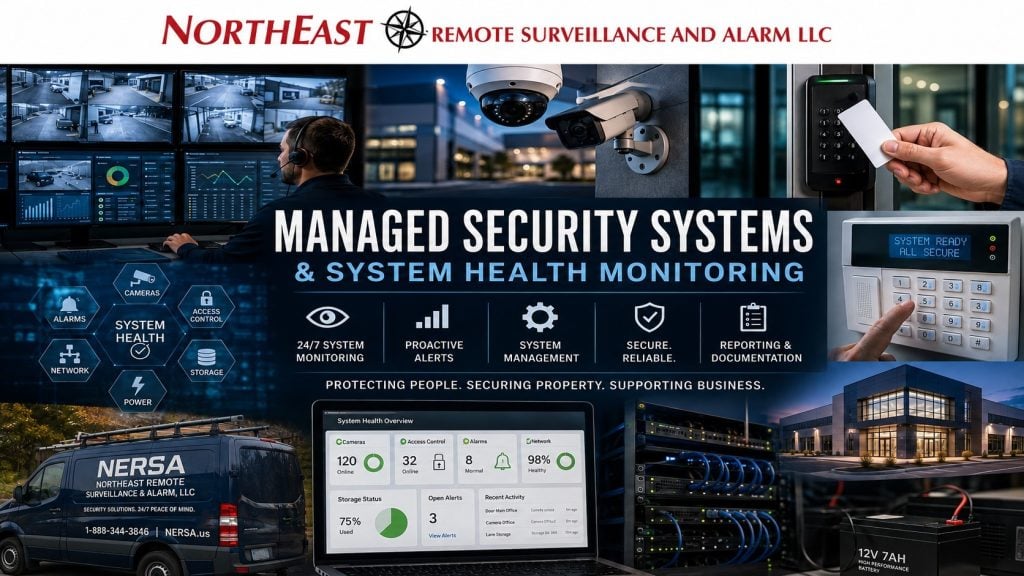
Managed security systems and system health monitoring support small businesses, growing companies, and enterprise operations.
Define how equipment and communication faults are detected, who follows up, and how restored functions are checked.
For a local property, connect the support plan to your small-business security needs.
For shared administration across buildings or locations, start with Enterprise Security Systems Integration, then define the managed-service scope your team needs.
Northeast Remote Surveillance and Alarm, LLC provides managed security, system health monitoring and remote administration.
Services also include coordination, reporting and support over the system’s life.
We serve commercial, industrial, institutional and municipal sites.
Other customers include healthcare, education, warehouse, manufacturing, logistics, office and multi-site organizations.
Our managed physical-security programs can support:
- Commercial video surveillance
- Access control
- Intrusion alarms
- Fire alarm communication
- Intercom and controlled-entry systems
- Remote video monitoring
- Alarm monitoring accounts
- Security servers and recorders
- Video storage
- Cloud-managed platforms
- On-premises systems
- Network-connected security equipment
- Power supplies and backup batteries
- Multi-location security environments
- Related low-voltage infrastructure
Managed services establish an ongoing operational layer around the security system.
Managed support can help identify problems before they become apparent during an alarm, investigation, or request for video. Support may include system administration, service coordination, documentation, performance reviews, and planning corrective work.
The goal is not simply to install more equipment or provide another software dashboard.
The goal is to establish clear responsibility for:
- System availability
- User and account administration
- Device-health oversight
- Alarm and monitoring information
- Service coordination
- Documentation
- Reporting
- Preventive maintenance
- Recurring-failure tracking
- Upgrade planning
- Equipment lifecycle management
- Multi-site consistency
For broader planning across new systems, upgrades, monitoring, integration, and infrastructure, visit Commercial and Industrial Security Services.
Call 1-888-344-3846 or request a managed security system assessment.
What Is a Managed Security System?
A managed security system receives ongoing supervision, administration and technical support. It may include cameras, access control, intrusion alarms, fire alarm communication, intercoms or integrated physical security. The service can combine reporting, records and maintenance coordination.
Traditional security installation establishes the field equipment, software, wiring, communication paths, and infrastructure.
Commercial security monitoring receives and processes designated alarm, video, access-control, environmental, and technical events according to established instructions.
Managed security service goes further by helping oversee the continuing condition, administration, organization, supportability, and operational life of the system itself.
Depending on the equipment and written service agreement, managed support may include:
Recurring Security Service Agreements
NERSA can structure recurring commercial and industrial security service agreements around the systems, facilities and response requirements of the customer. Depending on the written scope, an agreement may combine scheduled preventive maintenance, system-health review, remote technical support, service coordination, documentation, reporting, lifecycle planning and priority service. Coverage is defined around the actual equipment, locations and support requirements rather than forcing every customer into the same package.
For larger plants, distribution campuses and multi-site organizations, recurring support can also include scheduled on-site technical coverage when appropriate. This can help coordinate system administration, device checks, user and credential changes, documentation, service activity and planning with facility, IT and operations teams.
- Reviewing connected-device status
- Identifying offline cameras, recorders, panels, or servers
- Reviewing recording and storage conditions
- Managing users, credentials, permissions, and schedules
- Maintaining monitoring contacts and notification lists
- Reviewing recurring communication or equipment trouble
- Coordinating remote diagnostics and field service
- Maintaining system inventories and service histories
- Tracking open deficiencies
- Standardizing procedures across several locations
- Producing health, exception, activity, and lifecycle reports
- Supporting managed alarm and incident-response workflows
- Planning repairs and replacements before unsupported systems fail
The appropriate level of management should reflect the property, equipment, system architecture, risk, staffing, compliance responsibilities, operating schedule, and desired response procedures.
Explore Managed Security Services
Each service below addresses a different part of the managed physical-security environment.
Managed Video Surveillance and Camera System Health Monitoring
Managed video surveillance health monitoring helps identify camera outages, recorder failures, storage problems, recording interruptions, low retention, image degradation, connectivity issues, licensing concerns, and other conditions that may prevent usable video from being available.
Managed Access Control Systems
Managed access control provides continuing support for users, credentials, permissions, schedules, panel communication, door conditions, administrator accounts, reporting, software, and controlled-entry system service.
Managed Commercial Alarm Systems
Managed commercial alarm service coordinates panel communication, user codes, monitoring contacts, opening and closing schedules, response instructions, recurring trouble conditions, false-alarm reduction, reporting, testing, and account administration.
Managed Fire Alarm Services
Managed fire alarm services help coordinate communication paths, monitoring records, inspection schedules, deficiencies, recurring trouble conditions, service documentation, authorized contacts, communicator planning, and system lifecycle priorities.
Commercial Security System Health Monitoring
Commercial security system health monitoring provides broad oversight for cameras, recorders, access panels, alarm communicators, servers, storage, networks, power supplies, batteries, cloud gateways, and other connected security infrastructure.
Multi-Site Security System Management
Multi-site security system management centralizes system inventories, account ownership, administration, health reporting, documentation, service coordination, preventive maintenance, and lifecycle planning across multiple commercial properties.
Related Managed Security Resources
Managed services often overlap with monitoring, system integration, takeovers, upgrades, infrastructure, and enterprise planning without replacing those dedicated services.
Commercial and Industrial Security Monitoring
Commercial security monitoring receives, verifies, documents, and escalates approved alarm, video, access-control, environmental, and system events according to established procedures.
Security Operations Center and Managed Security Response
Security operations and managed response address what happens after an approved event is received, including operator review, verification, notification, escalation, documentation, and response coordination.
Commercial and Enterprise Unified Security Systems
Unified security systems connect video surveillance, access control, intrusion alarms, intercoms, monitoring, analytics, and reporting into a coordinated physical-security environment.
Multi-Site Commercial Security Systems
Multi-site commercial security planning addresses system architecture, platform selection, standardization, installation, integration, migration, and expansion across several locations.
Commercial Security System Takeovers
Commercial security system takeover services help organizations regain administrative control, establish account ownership, document inherited equipment, change providers, and retain serviceable systems where practical.
Commercial Security System Upgrades, Retrofits, and Takeovers
Commercial security system upgrades and retrofits provide a structured path for correcting unreliable equipment, expanding capacity, improving health visibility, modernizing communication, and replacing unsupported components.
Phased Security System Upgrades
Phased security upgrades help organizations prioritize critical risks, retain usable equipment, spread capital costs, and migrate older systems without requiring immediate total replacement.
Commercial and Industrial Infrastructure and Cabling
Commercial infrastructure services address structured cabling, fiber, network pathways, switches, wireless links, power, enclosures, and communication components that connected security systems depend on.
Network Segmentation for Commercial Security Systems
Network segmentation planning helps separate physical-security equipment from unrelated network traffic and supports more organized access, administration, troubleshooting, and cybersecurity coordination.
Managed Physical Security Versus Cybersecurity
The phrase “managed security services” is frequently associated with outsourced cybersecurity.
NERSA’s managed services focus on physical and electronic building-security systems, including:
- Video surveillance
- Access control
- Intrusion alarms
- Fire alarm communication
- Intercoms
- Gate systems
- Remote monitoring
- Recording servers
- Video storage
- Cellular and internet communication
- Power supplies
- Security-related networks
- Unified physical-security platforms
NERSA may coordinate with the customer’s information-technology department or managed IT provider when network architecture, server administration, user accounts, remote access, or cybersecurity policies affect the physical-security environment.
Managed physical-security service does not replace:
- A cybersecurity provider
- The customer’s IT department
- Required fire alarm inspections
- Code compliance
- Employee training
- Emergency procedures
- Responsible customer representatives
For account ownership, access, network, and data-handling considerations, review NERSA’s Cybersecurity and Data-Protection Standards.
Why Security System Health Matters
Many security-system failures remain unnoticed until someone needs the system.
A camera may appear powered while no longer recording.
A recorder may show live video while failed storage has reduced retention.
An access-control panel may continue making local door decisions while no longer communicating with the management software.
An alarm system may remain armed while its cellular or internet communication path is unstable.
A cloud application may appear available even though a remote gateway or local network device has stopped communicating.
Common health conditions include:
- Cameras offline
- Cameras repeatedly disconnecting
- Blocked or degraded camera views
- Failed or failing hard drives
- Low recording retention
- Recording interruptions
- Recorder or server failure
- Incorrect date and time
- Access-control panels offline
- Failed readers
- Doors repeatedly held or forced open
- Alarm communicator trouble
- Fire alarm communicator trouble
- Failed backup batteries
- AC power loss
- Expired software licenses
- Full databases
- Unsupported software
- Lost cloud connectivity
- Failed switches or PoE ports
- Changed network settings
- Remote sites that stop reporting
- Outdated monitoring contacts
- Former employees with active access
System health monitoring helps identify these conditions before they interfere with an investigation, alarm response, access decision, employee-safety procedure, fire alarm communication, or business operation.
Managed Video Surveillance
Video surveillance is valuable only when the required cameras are online, producing usable images, recording properly, and retaining video for the expected period.
Managed video support may address:
- Camera availability
- Recorder and server status
- Recording continuity
- Hard-drive and storage condition
- Available retention
- Camera image quality
- Obstruction or tampering
- Video analytics
- Remote access
- Software licensing
- Firmware planning
- User accounts
- Time synchronization
- Critical-camera priorities
- Multi-site camera health
- Service coordination
- Replacement planning
A health dashboard can provide important technical information, but it may not confirm that every camera has the correct field of view, focus, lighting, physical condition, and evidence-export capability.
Scheduled local inspection and recording verification may still be required.
Organizations needing active event review can also explore Remote Video Monitoring and Live Talk-Down.
For complete camera and recording-health support, continue to Managed Video Surveillance and Camera System Health Monitoring.
Managed Access Control
Access control requires continuing administration as employees, departments, vendors, contractors, schedules, and operating responsibilities change.
Without a defined process, organizations may accumulate:
- Former employees with active credentials
- Shared administrator accounts
- Unnecessary access privileges
- Expired contractors who still have access
- Inconsistent door schedules
- Unidentified mobile credentials
- Doors with recurring hardware problems
- Controllers that no longer communicate
- Different permission structures at separate facilities
Managed access-control support may include:
- Adding and removing users
- Issuing and disabling credentials
- Managing access levels
- Coordinating employee transfers
- Supporting employee offboarding
- Updating schedules and holidays
- Managing temporary access
- Reviewing administrator accounts
- Monitoring panel and controller communication
- Reviewing forced-door and held-door activity
- Coordinating database backups
- Maintaining door and controller inventories
- Supporting mobile credentials
- Coordinating door-hardware service
- Reviewing platform supportability
- Planning system expansion or migration
The customer should designate who is authorized to request changes and should retain appropriate ownership of system accounts, credentials, permissions, employee data, and administrative authority.
For focused access administration and health support, continue to Managed Access Control Systems.
Managed Commercial Alarm Systems
Alarm monitoring and managed alarm service are related but different.
Alarm monitoring receives signals and follows established response instructions.
Managed alarm service addresses the broader condition, administration, documentation, and continuing operation of the alarm environment.
Managed alarm support may include:
- Panel and communicator status
- Monitoring-account information
- Authorized contact lists
- User-code management
- Opening and closing schedules
- Late-to-open notifications
- Late-to-close notifications
- Partition administration
- Alarm-response instructions
- Recurring false-alarm review
- Low-battery conditions
- Communication trouble
- Zone descriptions
- Signal-test coordination
- Video-verification coordination
- Multi-site account consistency
- Service-history documentation
- Cellular and IP communicator planning
Monitoring information should be reviewed whenever employees leave, managers change, operating hours change, a facility closes, a new location opens, or the organization updates its emergency procedures.
For focused alarm-system management, continue to Managed Commercial Alarm Systems.
Managed Fire Alarm Services
Fire alarm systems require careful coordination among the building owner, responsible personnel, monitoring provider, inspection company, service technicians, and authority having jurisdiction.
Managed fire alarm support may assist with:
- Panel and communicator inventories
- Monitoring-account records
- Responsible contact information
- Communication-path status
- Inspection scheduling
- Testing coordination
- Recurring trouble review
- Open deficiency tracking
- Corrective-service status
- Service-call documentation
- Battery planning
- Communicator lifecycle planning
- Panel modernization priorities
- Multi-location record consistency
Remote supervision and service coordination do not replace required inspection, testing, maintenance, documentation, licensed work, code compliance, or authority approval.
For dedicated fire alarm coordination and lifecycle support, continue to Managed Fire Alarm Services.
Security System Administration
System administration is one of the most frequently overlooked parts of commercial physical security.
Equipment may be installed correctly while passwords, accounts, user permissions, contact lists, schedules, device names, licensing, and system records become increasingly disorganized.
Managed administration may address:
- Customer-owned primary accounts
- Individual administrator accounts
- Role-based permissions
- Multi-factor authentication where supported
- Authorized change procedures
- User onboarding
- Employee transfers
- Employee offboarding
- Password recovery
- Former employee removal
- Vendor and contractor access
- Alarm notification lists
- Monitoring contacts
- Device and site naming
- Software subscriptions
- Database backups
- Configuration records
- Cloud account ownership
- Remote-access permissions
A managed-service relationship should improve customer ownership and control.
It should not leave the organization dependent on unknown passwords, shared accounts, unidentified administrators, provider-owned cloud registrations, or undocumented system settings.
Security System Documentation
Security-system information is commonly lost during employee turnover, acquisitions, renovations, provider changes, and platform upgrades.
Managed documentation may include:
- Equipment inventories
- Manufacturer and model information
- Installation dates
- Camera schedules
- Camera names and locations
- Recorder and storage records
- Controlled-door lists
- Reader and controller records
- Credential formats
- Alarm zone descriptions
- Fire alarm panel and communicator information
- Monitoring account numbers
- User and administrator lists
- Network dependencies
- Software and licensing records
- System drawings
- Service reports
- Inspection reports
- Deficiency records
- Warranty information
- Emergency contacts
- Escalation instructions
- System modification histories
Documentation should be maintained through a controlled process rather than scattered across employee email accounts, paper folders, provider portals, and unidentified local computers.
Managed Security Reporting
A managed-service program should produce useful information rather than an overwhelming stream of alerts.
Reports may include:
- System availability
- Offline devices
- Camera and recorder health
- Storage and retention exceptions
- Access-control communication conditions
- Forced-door and held-door events
- Opening and closing exceptions
- Alarm communication problems
- Fire alarm service conditions
- Open service tickets
- Recurring failures
- Equipment inventory changes
- Software and licensing concerns
- Outstanding deficiencies
- Completed repairs
- Upcoming maintenance
- Unsupported equipment
- Upgrade priorities
- Lifecycle recommendations
Reports should distinguish between:
- Urgent operational issues
- Corrective maintenance
- Administrative cleanup
- Planned upgrades
- Long-term capital needs
The reporting plan should identify what is reviewed, how often it is reviewed, who receives the information, what requires immediate escalation, and who may authorize corrective work.
Remote Diagnostics and Service Coordination
Remote diagnostics can help determine whether a problem involves:
- A camera
- A recorder
- A server
- Storage
- An access-control controller
- A reader
- Door hardware
- An alarm panel
- A communicator
- A power supply
- A network switch
- Internet service
- Software
- Licensing
- A cloud account
- User permissions
- A local workstation
- A mobile application
Some problems may be corrected remotely.
Other conditions require:
- On-site security service
- Customer IT assistance
- Electrical work
- Door-hardware repair
- Sprinkler service
- Elevator service
- Internet-provider assistance
- Manufacturer support
- Complete equipment replacement
Remote review helps route the issue to the proper party and provides better information before field personnel arrive.
Recurring-Failure Tracking
Repeated problems should not be treated as unrelated service calls.
Examples include:
- The same camera disconnecting every week
- Repeated hard-drive trouble
- A remote property frequently losing communication
- A door repeatedly failing to latch
- An alarm communicator reporting intermittent trouble
- Repeated low-battery conditions
- An unstable wireless bridge
- A server repeatedly running out of storage
- Several users experiencing the same login problem
Recurring-failure analysis may reveal:
- Failing equipment
- Damaged cabling
- Unstable electrical power
- Network congestion
- Environmental exposure
- Insufficient storage
- Incorrect configuration
- Unsupported software
- Inadequate wireless connectivity
- A platform that is no longer supportable
The objective is not merely to close individual service tickets.
The objective is to reduce repeated downtime and improve long-term reliability.
Preventive Security System Maintenance
Remote health information does not replace physical inspection, testing, and preventive maintenance.
A preventive maintenance program may include:
- Camera cleaning
- Field-of-view verification
- Recording and retrieval testing
- Recorder inspection
- Storage review
- Controlled-door testing
- Lock and door-contact testing
- Request-to-exit testing
- Power-supply inspection
- Battery testing
- Alarm-device testing
- Communicator review
- Fire alarm inspection coordination
- Intercom testing
- Network-enclosure inspection
- Documentation updates
Maintenance frequency should reflect:
- Equipment type
- Property environment
- Device usage
- Service history
- Facility risk
- Manufacturer guidance
- Customer operations
- Applicable requirements
A high-traffic distribution center may require a different maintenance schedule than a lightly occupied professional office.
Security System Lifecycle Management
Cameras, recorders, servers, controllers, alarm panels, communicators, batteries, software, network devices, and power equipment have finite operational lives.
Lifecycle planning may evaluate:
- Discontinued cameras
- Obsolete recorders
- Unsupported access-control controllers
- Aging alarm panels
- Retired cellular technologies
- Expired software support
- Unsupported operating systems
- Limited storage
- Lack of replacement parts
- Capacity restrictions
- Proprietary account limitations
- Cybersecurity concerns
- Repeated failures
- Manufacturer support changes
Equipment can be classified as:
Retain: Equipment that remains supported, reliable, secure, and appropriate.
Correct: Equipment requiring repair, reprogramming, documentation, or limited modernization.
Integrate: Serviceable systems that can remain while being connected to a more consistent operating structure.
Migrate: Platforms that should be replaced gradually through phased modernization.
Replace: Equipment that is unsupported, unreliable, inaccessible, or no longer suitable.
Lifecycle planning helps organizations budget around known conditions instead of reacting to emergency failures.
Existing Security System Takeovers
A managed-service relationship does not always require complete system replacement.
NERSA can evaluate equipment installed by another provider to determine what may be retained, supported, corrected, integrated, upgraded, or replaced.
A takeover assessment may review:
- Equipment identification
- Current system condition
- Administrative access
- Account ownership
- Monitoring arrangements
- User databases
- Open deficiencies
- Software and licensing
- Communication paths
- Network dependencies
- Manufacturer support
- Service history
- Warranty status
- Reusable equipment
- Immediate risks
- Upgrade priorities
Some systems can be adopted with limited changes.
Others may require password recovery, account transfers, communicator replacement, programming corrections, software updates, database cleanup, network work, documentation, or phased modernization.
NERSA does not recommend replacing serviceable equipment solely to establish a managed-services agreement.
Recommendations should reflect reliability, supportability, security, compatibility, business requirements, and total lifecycle cost.
Multi-Site Security System Management
Organizations with several facilities often accumulate different camera systems, access-control databases, alarm panels, monitoring providers, account structures, service histories, network conditions, and replacement priorities.
A managed multi-site program may establish:
- Central system inventories
- Standard site and device naming
- Customer account ownership
- Consistent administrator policies
- Coordinated user and credential management
- Site-specific system-health reporting
- Central service-ticket coordination
- Standard escalation procedures
- Monitoring-account oversight
- Documentation control
- Preventive maintenance schedules
- Recurring-failure tracking
- Upgrade prioritization
- Lifecycle planning
- Standards for future properties
Not every location must use identical equipment.
Mixed legacy systems may be managed while the organization develops a phased standardization, integration, or platform-migration plan.
For ongoing operational management, continue to Multi-Site Security System Management.
For architecture, installation, platform selection, and enterprise-wide standardization, continue to Multi-Site Commercial Security Systems.
Managed Services for New Security Systems
Managed-service planning is most effective when it begins during system design.
New systems can be designed with:
- Remote health visibility
- Customer-owned accounts
- Standard device naming
- Appropriate user roles
- Documented escalation procedures
- Sufficient video storage
- Network and power supervision
- Maintainable equipment locations
- Software and licensing plans
- Secure remote access
- Multi-site scalability
- Service access
- Lifecycle documentation
Building these requirements into a project reduces future confusion and makes the system easier to operate, maintain, expand, and support.
Industries Supported
NERSA managed security programs may be designed for:
- Warehouses and distribution centers
- Manufacturing facilities
- Logistics operations
- Industrial properties
- Commercial offices
- Healthcare facilities
- Schools and educational properties
- Municipal buildings
- Contractor yards
- Trucking and fleet facilities
- Commercial campuses
- Multi-tenant buildings
- Property-management portfolios
- Retail and service businesses
- Small commercial properties
- Regional organizations
- Enterprise organizations
A single commercial facility may require basic health oversight, account administration, and periodic reporting.
A regional or enterprise organization may require centralized administration, location-specific permissions, system inventories, service coordination, preventive maintenance, lifecycle forecasting, and consolidated reporting across many locations.
Explore the complete Industries NERSA Serves.
Service Coverage
NERSA provides commercial and industrial managed security support throughout Pennsylvania. We also support selected projects in New Jersey, Delaware, Maryland and nearby Mid-Atlantic markets. Availability depends on project scope, system requirements, licensing, scheduling and long-term service needs.
Primary Pennsylvania markets include:
- Allentown
- Bethlehem
- Easton
- The Lehigh Valley
- Reading and Berks County
- Scranton
- Wilkes-Barre
- Hazleton
- Harrisburg and Central Pennsylvania
- King of Prussia and Montgomery County
- Greater Philadelphia
Visit the NERSA Service Area Directory for regional and local commercial-security resources.
What Managed Security Services Do Not Guarantee
Managed oversight can improve system visibility, administration, documentation, reporting, and service coordination, but it cannot prevent every security incident or technical failure.
Limitations may include:
- Sudden equipment failure
- Utility outages
- Internet interruptions
- Customer network changes
- Physical damage
- Deliberate equipment destruction
- Unsupported third-party systems
- Conditions not reported by the platform
- Blocked camera views
- Propped doors
- Shared credentials
- Unauthorized local changes
- Incorrect customer information
- Delayed service authorization
- Manufacturer or cloud outages
- Events outside system coverage
- Failures occurring between inspections
The written agreement should identify:
- Included locations
- Included systems
- Available health-monitoring functions
- Administrative responsibilities
- Notification procedures
- Response priorities
- Reporting expectations
- Corrective-service terms
- Customer responsibilities
- Exclusions
Why Choose Northeast Remote Surveillance and Alarm?
NERSA provides more than a monitoring subscription or software dashboard.
Our team understands the field equipment, communication paths, servers, networks, wiring, power, door hardware, recording systems, monitoring arrangements, service requirements, and operating procedures that determine whether a commercial security system performs as expected.
NERSA capabilities include:
- Managed physical-security services
- System health monitoring
- Enterprise video surveillance
- Managed access control
- Managed commercial alarm systems
- Managed fire alarm coordination
- Remote video monitoring
- Security-system administration
- User and credential management
- Multi-site management
- Security-system takeovers
- Remote diagnostics
- Preventive maintenance
- Service coordination
- Documentation management
- Platform migration
- Lifecycle planning
- Field repair
- System modernization
This connection between remote visibility and field service allows NERSA to help identify a problem, understand its operational impact, coordinate the proper response, and plan the long-term correction.
Frequently Asked Questions
Is managed security service the same as alarm monitoring?
No. Alarm monitoring receives and processes signals according to established instructions, while managed service may also include system-health oversight, administration, reporting, documentation, maintenance coordination, and lifecycle planning.
Can NERSA manage systems installed by another company?
Possibly. NERSA must evaluate the equipment, administrative access, account ownership, licensing, condition, documentation, network requirements, and manufacturer support before confirming the available service scope.
Does every system support remote health monitoring?
No. Available information depends on the manufacturer, model, age, programming, network connection, cloud services, software, and licensing.
Can NERSA determine whether cameras are recording?
Compatible systems may provide information about camera communication, recorder availability, storage, recording interruptions, retention, network conditions, and related health concerns.
Can NERSA manage employee credentials?
Yes. Compatible access-control systems may support managed credential issuance, revocation, permission groups, schedules, temporary access, mobile credentials, employee transfers, and offboarding.
Does managed video surveillance mean someone watches every camera continuously?
No. Camera health monitoring, event-based verification, remote video monitoring, and continuous observation are different services and must be defined separately.
Does managed fire alarm service replace inspections?
No. Managed coordination does not replace required inspection, testing, maintenance, documentation, licensed service, code compliance, or authority requirements.
Do all company locations need the same security platform?
No. Mixed systems can be managed while a phased integration, standardization, upgrade, or migration plan is developed.
Does every detected problem require an on-site visit?
No. Some conditions can be reviewed or corrected remotely, while others require field security service, customer IT assistance, electrical work, door-hardware service, manufacturer support, or equipment replacement.
Does managed service include every repair and replacement?
Not automatically. Included labor, subscriptions, parts, inspections, emergency service, and corrective work depend on the written service agreement.
Can managed services support both small businesses and enterprise organizations?
Yes. Services can scale from a single commercial property needing basic health oversight to an enterprise organization requiring centralized management across many locations.
Who should own the security system accounts?
NERSA recommends that customers retain appropriate ownership and administrative authority whenever the system permits it.
Discuss a Managed Security Service Agreement
Do not wait until an incident reveals that:
- A critical camera was not recording
- Video retention was shorter than expected
- A former employee still had access
- An alarm contact list was outdated
- A communicator had stopped reporting
- A recorder had failed
- No one knew the system password
- A cloud account belonged to a former provider
- A recurring problem had never been corrected
- Unsupported equipment had no replacement plan
NERSA can evaluate:
- Existing equipment
- Platform condition
- System-health capabilities
- Account ownership
- Administrators and users
- Monitoring arrangements
- Camera and recorder condition
- Access-control administration
- Alarm communication
- Fire alarm coordination
- Open deficiencies
- Documentation
- Service history
- Network dependencies
- Software and licensing
- Preventive maintenance needs
- Multi-site requirements
- Upgrade priorities
- Lifecycle risks
Call Northeast Remote Surveillance and Alarm, LLC at 1-888-344-3846 or request a managed security system assessment.
We can define preventive maintenance, system health reviews, technical support, service coordination and scheduled site visits for your facility or portfolio.
Plan Your Next Security Improvement
Tell NERSA about your commercial facility, existing systems, and project priorities. We can help you plan an installation, evaluate an upgrade, or coordinate security across multiple locations.
Enterprise planning resources
For the wider enterprise framework, see Enterprise Security Systems Integration.
- Define ownership and day-to-day platform administration with Enterprise Security Administration.
- System Health and Lifecycle Management
Administration tasks for an established system
Keep account reviews, backups, and changes within the agreed support scope.
- Document approvals, testing, and rollback responsibilities with Enterprise Security System Change Control.
- Keep administrator and user access aligned with current responsibilities through Enterprise Security Permission Reviews.
- Define configuration recovery and restore checks with Enterprise Security Configuration Backup and Restore.
Compliance, Codes & Project Standards
NERSA plans commercial and industrial security work with applicable code, documentation, inspection and authority-having-jurisdiction requirements in mind. Requirements vary by system, property and jurisdiction. These resources support project planning; they do not establish legal compliance, certification or AHJ approval.
Related guidance: Regulatory compliance & inspection readiness · NERSA project standards · Documentation, testing & inspection readiness