Commercial alarm installation in Easton, PA should be designed around the property, the openings that need protection, interior risk areas, operating schedules, employee activity, communication paths, monitoring requirements, and the specific events the business needs to detect.
Northeast Remote Surveillance and Alarm, LLC designs and installs commercial intrusion alarm systems in Easton, Pennsylvania for qualifying offices, warehouses, manufacturing facilities, healthcare properties, contractor facilities, commercial buildings, industrial sites, retail businesses, and other non-residential properties.
For broader Easton intrusion-alarm planning, visit Easton Commercial & Industrial Intrusion Alarm Systems.
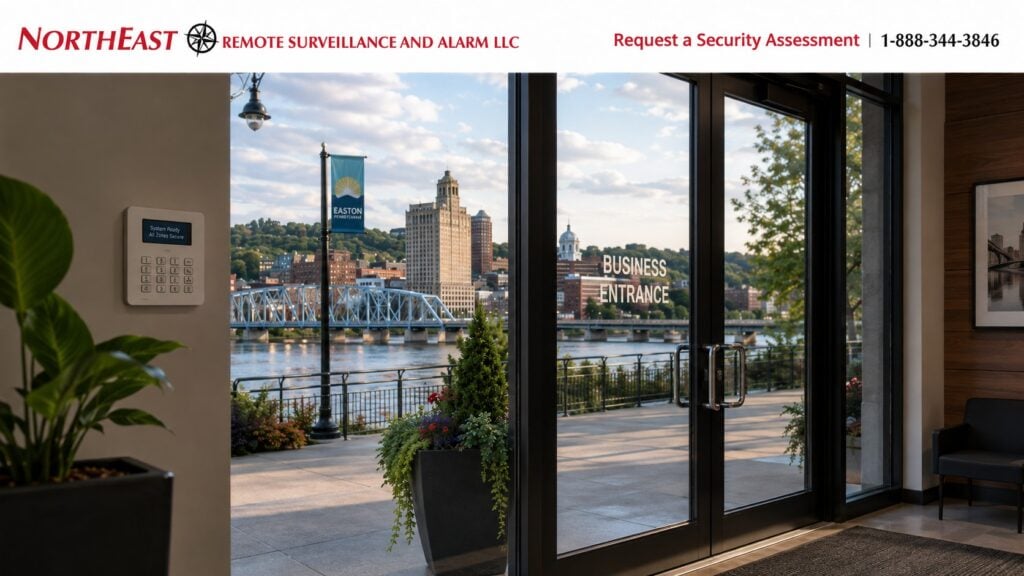
Commercial Alarm Planning
A new commercial alarm system should begin with the property rather than with a generic sensor package.
Planning should consider:
- Exterior doors
- Employee entrances
- Rear doors
- Overhead doors
- Selected windows
- Warehouse areas
- Offices
- Restricted rooms
- Interior motion zones
- Equipment areas
- After-hours occupancy
- Multiple shifts
- Cleaning crews
- Contractors
- Monitoring requirements
- Existing communication infrastructure
The objective is not to install the greatest possible number of devices.
The objective is to create dependable intrusion detection around the areas that matter most while keeping the system practical for authorized users.
Door and Opening Protection
Exterior openings are usually one of the first areas reviewed during a commercial alarm installation.
Potential protected openings may include:
- Main entrances
- Employee entrances
- Rear doors
- Side doors
- Service entrances
- Warehouse personnel doors
- Overhead doors
- Selected windows
- Roof access
Each opening should be evaluated around how it is used and whether it presents a realistic intrusion path.
A commercial alarm system should not treat every opening identically when the operating conditions are different.
Interior Intrusion Detection
Interior detection can provide another layer of protection when unauthorized movement occurs after the perimeter has been breached.
Planning may consider:
- Motion detectors
- Interior zones
- Hallways
- Warehouse interiors
- Restricted rooms
- Office areas
- Storage areas
- Equipment spaces
Interior detection should be selected around the environment.
Large warehouses, high ceilings, changing inventory, temperature conditions, and equipment movement may require a different approach from a conventional office.
Overhead Door Protection
Commercial and industrial properties may have overhead doors that are used for deliveries, vehicles, service activity, or warehouse operations.
These openings may require special planning because they can be:
- Large
- Frequently used
- Exposed to vibration
- Operated on different schedules
- Used after normal office hours
The alarm system should account for how the overhead door actually operates rather than treating it like a standard personnel door.
Alarm Zones and Partitions
Some Easton commercial properties may need different areas of the building to operate independently.
For example:
- A warehouse may remain occupied while the office is armed.
- One department may close earlier than another.
- A multi-tenant building may require separate alarm areas.
- A manufacturing facility may have different shift schedules.
Compatible systems may support partitions or separately managed areas.
Partitions should be designed deliberately because unnecessary complexity can make a commercial alarm system harder for employees to use.
Employee and User Management
Commercial alarm systems should make it possible to manage authorized users without relying entirely on one shared code.
User planning may include:
- Owners
- Managers
- Employees
- Maintenance staff
- Cleaning crews
- Contractors
- Temporary workers
- After-hours personnel
Individual user codes or credentials can provide better accountability and make it easier to remove a person who no longer requires access.
The system should be configured around actual job responsibilities.
Opening and Closing Procedures
A commercial alarm system should support clear opening and closing procedures.
Planning may include:
- Who is authorized to disarm
- Who is responsible for arming
- What time the property normally opens
- What time it normally closes
- Which areas remain occupied
- What happens on weekends
- What happens on holidays
- How contractors are handled
Good alarm design supports normal business operation rather than forcing employees into confusing procedures.
After-Hours Protection
Commercial intrusion risk often increases when the property is closed or lightly staffed.
After-hours planning may focus on:
- Exterior doors
- Rear entrances
- Overhead doors
- Warehouse areas
- Restricted storage
- Equipment rooms
- Interior motion zones
- Selected perimeter areas
The system should provide dependable detection during the actual hours when the building is most exposed.
Alarm Communication
A professionally installed commercial alarm system depends on reliable communication.
The communication method should be selected around the compatible equipment, monitoring arrangement, internet availability, cellular coverage, and business requirements.
Planning may consider:
- Primary communication path
- Backup communication
- Cellular service
- Network communication
- Power
- Battery backup
- Monitoring-station connectivity
Communication should be treated as part of the complete alarm design rather than as an isolated accessory.
Professional Monitoring
A commercial intrusion system may be professionally monitored so qualifying alarm signals can be received and processed according to the customer’s approved response procedures.
Monitoring planning should identify:
- Emergency contacts
- After-hours contacts
- Authorized responders
- Call-list order
- Verification procedures
- Escalation instructions
Contact information should be reviewed periodically so former employees and outdated numbers are removed.
The quality of the response process depends on both the installed system and the information maintained with the monitoring service.
Alarm Notifications
Compatible commercial alarm systems may also provide notifications to authorized users.
Potential notifications may include:
- Alarm activity
- Arming
- Disarming
- Selected sensor events
- System status
- Communication conditions
Notifications should be configured around the events management actually needs to know about.
Too many unnecessary alerts can reduce the value of the system.
Power and Battery Backup
Commercial alarm systems require dependable power.
Planning should consider:
- Alarm panel power
- Auxiliary power
- Device power requirements
- Communication equipment
- Battery backup
- Expected standby duration
- Existing electrical conditions
Battery backup should be sized and maintained according to the installed equipment and monitoring requirements.
Alarm Keypads and User Interfaces
The user interface should be located where authorized employees can operate the system efficiently.
Potential keypad locations may include:
- Main employee entrance
- Office entry
- Warehouse entrance
- Manager area
- Other approved opening/closing points
The goal is to make normal arming and disarming practical without placing controls where they can be easily misused.
Alarm System Testing
A new commercial alarm installation should be tested before turnover.
Testing may include:
- Door contacts
- Motion detection
- Overhead-door devices
- Partitions
- User codes
- Arming and disarming
- Alarm communication
- Monitoring signals
- Notifications
- Battery backup
- Keypads
- Time and date
- System labels
The customer should not receive a system that has been installed but not fully verified.
System Naming and Documentation
Clear system naming makes future service and administration easier.
Useful zone names may include:
- Main Entrance
- Rear Door
- Warehouse Overhead Door 1
- Office Motion
- Tool Room
- Shipping Entrance
Generic labels such as Zone 5 or Zone 12 are less useful during alarm review.
The completed system should be documented well enough for future service and customer administration.
Customer Turnover
A new alarm installation is not complete when the final device is mounted.
Authorized customer personnel should understand:
- How to arm
- How to disarm
- How users are managed
- How alerts are handled
- Who has administrator access
- What happens during an alarm
- Who receives monitoring calls
- How to request service
Clear turnover reduces confusion after installation.
New Alarm Installation vs. Existing-System Upgrade
This page owns new commercial alarm installation in Easton, PA.
A property with an existing intrusion system that needs repair, communication modernization, provider takeover, expansion, reprogramming, or phased replacement belongs to a different intent.
For broader existing-system modernization, use the dedicated Easton commercial alarm upgrade/takeover resource.
Alarm Installation vs. Alarm Monitoring
Installation and monitoring are related but different.
This page owns the design and installation of the physical intrusion system.
The monitoring process, monitoring-station administration, and ongoing response workflow remain supporting functions rather than the primary intent of this page.
Easton Commercial Alarm Applications
NERSA provides qualifying new commercial alarm installations for Easton-area:
- Offices
- Warehouses
- Manufacturing facilities
- Healthcare properties
- Contractor facilities
- Commercial buildings
- Industrial sites
- Retail businesses
- Multi-tenant properties
- Other non-residential operations
The system should be designed around the individual property rather than a standard alarm package.
Frequently Asked Questions
What should a commercial alarm system protect?
Common areas include exterior doors, rear entrances, overhead doors, selected windows, warehouse spaces, offices, restricted rooms, and other areas where unauthorized entry needs to be detected.
Are commercial alarm systems different from residential alarms?
Yes. Commercial properties may involve larger buildings, multiple shifts, overhead doors, partitions, warehouses, contractors, multiple user groups, and more complex monitoring procedures.
Can commercial alarm systems use separate user codes?
Yes. Compatible systems can support individual user codes or credentials so access can be managed more cleanly.
Can different parts of a building be armed separately?
Sometimes. Compatible systems may support partitions or separately managed areas depending on the property and equipment.
Can overhead doors be protected?
Yes. Overhead doors can be incorporated into a commercial intrusion design when appropriate devices and operating procedures are used.
Does a commercial alarm installation include monitoring?
Monitoring can be included where appropriate, but the physical installation and the monitoring service are separate parts of the complete system.
Can an existing alarm system be upgraded instead of replaced?
Often, yes, depending on the existing panel, sensors, wiring, communication equipment, condition, and supportability.
Is this page for residential alarm installation?
No. Northeast Remote Surveillance and Alarm, LLC focuses on commercial and industrial properties.
Request an Easton Commercial Alarm Installation Assessment
If your Easton commercial or industrial property needs a completely new intrusion alarm system, Northeast Remote Surveillance and Alarm, LLC can evaluate the building, openings, interior risk areas, operating schedules, communication requirements, and monitoring needs before developing the alarm design.
Request a Security Assessment or call 1-888-344-3846.