
Humboldt Industrial Park security planning should start with the exact facility, its operating responsibilities and the movement of people and freight across its boundaries.

Request a commercial security assessment
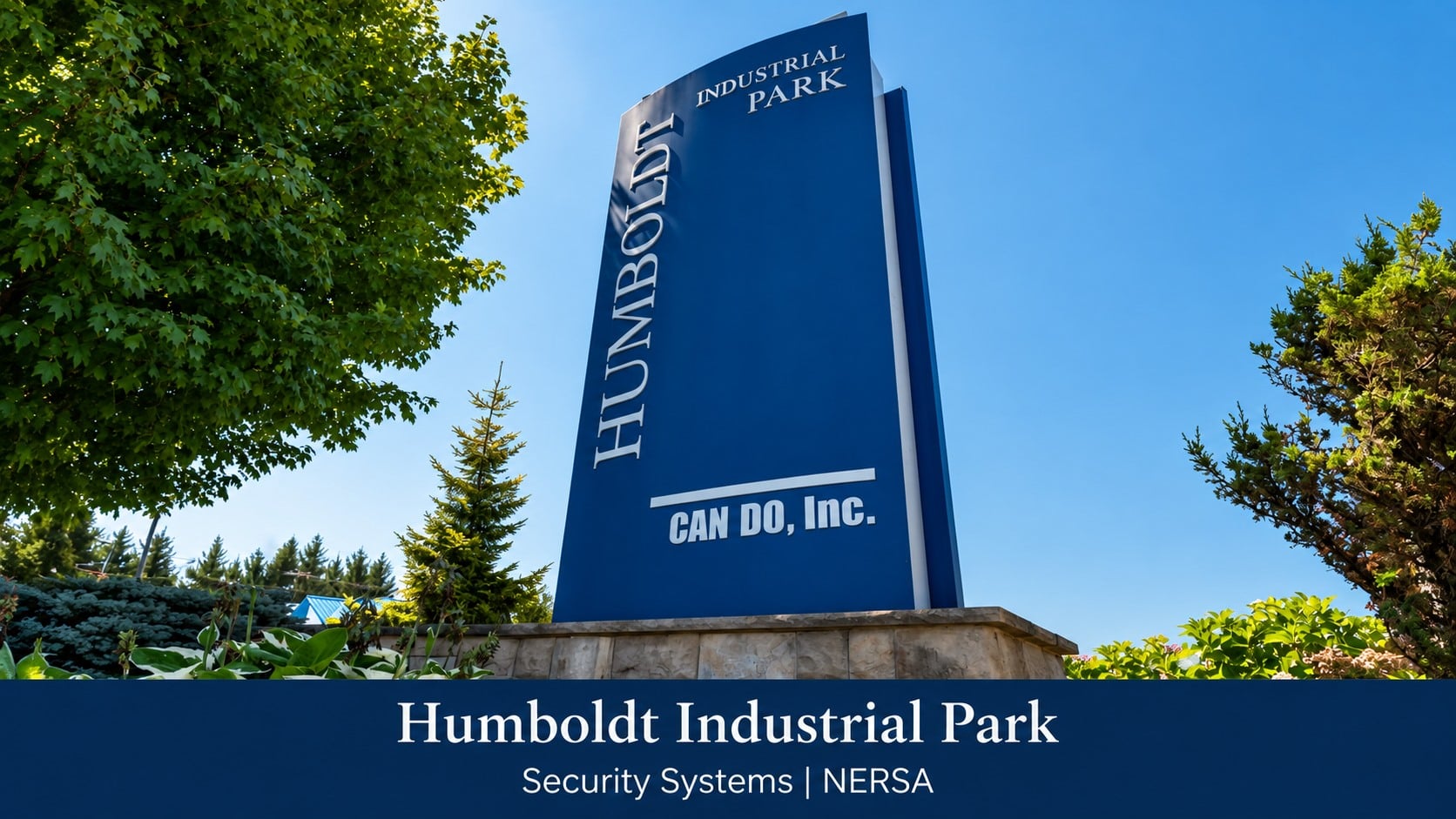
For cameras, controlled entry, alarms and supporting infrastructure across the area, see commercial and industrial security systems in Hazleton.
Start with the facility, not the park name alone
CAN DO describes Humboldt Industrial Park as extending along Route 924 near Interstate 81 Exit 143, with manufacturing, distribution and other commercial uses across several development areas.
Its official Humboldt Industrial Park information includes the original area, West, North, East and Northwest.
Confirm the specific property and current site information with the owner or development representative.
That geography provides context, not a ready-made security design. Two properties in the same development can have different owners, entrances, operating hours and equipment. A facility assessment should establish those details before selecting cameras, readers or a response service.
Identify the development area and exact entrance
Include the street address, building identifier and the entrance staff or contractors should use. If the property has separate office, employee and freight access, mark each on a current drawing. Directions that say only “Humboldt” are not enough for a service visit or an incident handoff.
Use the same location names in camera labels, door records and staff instructions. A supervisor reviewing a loading question should not have to translate an informal yard nickname into a different equipment label. Consistent names are especially useful when one management team supports more than one building.
Review existing conditions in the original area and West
For an occupied facility, begin with an equipment and responsibility review. Identify cameras, recording systems, controlled openings, communication paths and the people who administer them. The age of the surrounding development does not establish the condition of an individual building’s system.
If the property has expanded or changed occupants, compare the current layout with the original coverage. An old entrance may now serve a different function, and an added storage area may fall outside useful views. Evaluate retained equipment for condition, compatibility and supportability before deciding between a focused improvement and a broader replacement.
Connect production and distribution needs in North
CAN DO identifies manufacturing, food processing and distribution among the uses in Humboldt North. For a facility combining activities, the useful question is how responsibility changes between receiving, controlled work areas, finished goods and dispatch. Do not assume the same permissions suit every room.
Where environmental conditions affect equipment, involve the people responsible for the process.
Cleaning practices, temperature, moisture and vibration need appropriate evaluation.
Security access does not authorize work on machinery or replace safety procedures.
For detailed production-area decisions, review Hazleton manufacturing plant security planning.
Check occupancy and expansion requirements in East and Northwest
For a move-in, expansion or phased construction project, establish which areas will operate first and which will remain under construction. Separate permanent requirements from temporary coverage. A proposed future layout should not be treated as an accurate description of today’s entrances or storage locations.
Coordinate the owner, occupant, general contractor and IT team before equipment decisions become difficult to change. Identify who supplies power and connections, who approves mounting locations and who owns the finished system. Current development availability is a matter for the property representative; a security proposal should not imply a parcel or building is available.
Separate private facilities from shared infrastructure
Confirm the boundary of the customer’s authority. A business may control its own building and yard without controlling neighboring property, public approaches or shared facilities. Camera placement, cabling and any proposed gate work should be limited to appropriately authorized areas.
Where responsibilities are shared, document who approves changes and who supports the equipment. Avoid assuming one tenant may administer another tenant’s access or recordings. A clear boundary is more useful than a proposal that simply calls for park-wide coverage without identifying permission and ownership.
Follow freight through the relevant handoffs
For a facility handling trucks and trailers, review check-in, waiting, staging, loading and departure as separate decisions. Identify the staff who authorize movement and the records used to investigate a question. A camera at the entrance does not necessarily explain what happened at the dock.
The detailed Hazleton truck yard and loading dock security page explains those handoffs.
Within the Humboldt facility assessment, use that process to identify the actual areas and responsibilities rather than assuming every property needs the same camera arrangement.
Distinguish road and rail responsibilities where relevant
CAN DO identifies rail-served sections within Humboldt. If a particular facility uses rail, include the responsible operator and property personnel when defining the work area and installation restrictions. Do not infer that every parcel has the same access or that a security contractor controls railway operations.
Any camera or cable work near operational infrastructure requires the appropriate coordination and permissions. The initial assessment should record the boundary and refer specialized requirements to qualified parties, rather than offering an unsupported installation detail from a general site description.
Choose a first phase that stands on its own
Rank the problems management needs to resolve: an unreviewable entrance, unclear access ownership, inadequate recording retrieval or a changing work area. A first phase should deliver a usable result and identify any remaining gap explicitly. Later equipment should not be required to make the initial promise meaningful.
For short-term gaps, evaluate temporary surveillance in Hazleton with a defined duration and removal plan.
For existing buildings, ask what can be retained and what prevents the current system from meeting the agreed outcome.
Accept the system using your own operating examples
Test a known arrival, a permission change and retrieval of a representative event. Involve facilities, operations and IT so ownership of faults and future changes is clear. Confirm useful image detail under realistic conditions, not only an attractive empty-site view.
Bring a current drawing, equipment list, operating schedule and one unresolved operational question to the assessment. Park information does not establish a NERSA relationship with any named occupant or the park operator; the proposed work and service availability are determined for the individual facility.
Discuss your facility
Request a commercial security assessment with the property address, existing equipment and the decisions your team needs help making.
For other locations, explore the Northeastern Pennsylvania industrial park and business center directory.