Commercial and industrial intrusion alarm systems in Easton, PA should be designed around how a facility actually operates when it is closed, lightly staffed, partially occupied, or accessed outside normal business hours.
Northeast Remote Surveillance and Alarm, LLC designs, installs, monitors, upgrades, expands, and supports intrusion alarm systems for Easton warehouses, logistics facilities, manufacturing buildings, industrial properties, offices, healthcare facilities, schools, municipal buildings, contractor operations, multi-tenant properties, and commercial campuses.
This page is NERSA’s primary Easton intrusion-alarm sub-hub beneath Commercial and Industrial Security Systems in Easton, PA. It focuses on protected doors, alarm zones, partitions, users, schedules, detection, monitoring, communication paths, video verification, access-control coordination, and system upgrades.
Request an Easton Intrusion Alarm Assessment or call 1-888-344-3846.
Authorized Alarm.com Service Provider, backed by professional monitoring through COPS Monitoring—a UL-listed, FM-approved, IQ-certified and TMA Five Diamond monitoring provider.
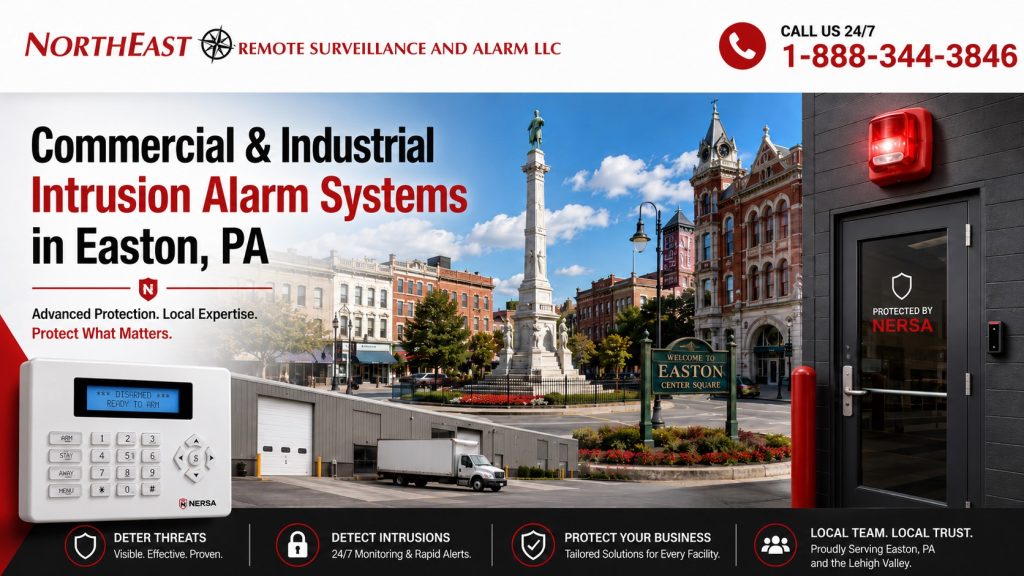
Intrusion Alarm Systems Built Around the Property
A commercial intrusion alarm system should not be designed by simply adding door contacts and motion detectors throughout a building.
Effective protection begins by understanding how the property is used, which areas are occupied at different times, where unauthorized entry is most likely to occur, and how employees, contractors, cleaning crews, delivery personnel, and managers move through the facility.
Easton commercial properties may require protection for:
- Exterior entrances
- Employee entrances
- Rear and service doors
- Loading dock doors
- Overhead doors
- Warehouse interiors
- Office areas
- Restricted rooms
- Inventory and storage areas
- Utility and equipment rooms
- Detached buildings
- Contractor yards
- Interior transitions between departments
The objective is dependable detection, straightforward operation, clear event information, and a response process appropriate for the facility.
Explore Easton Intrusion Alarm Options
Different properties require different approaches to intrusion detection and after-hours protection.
Commercial Alarm Installation Easton PA
New commercial intrusion alarm system design, installation, user setup, communication, monitoring, testing, and client turnove.
Learn more at Commercial Alarm Installation in Easton, PAmercial Alarm Installation in Easton, PA.
Warehouse Intrusion Alarm Systems
Warehouses frequently require protection for multiple overhead doors, loading areas, employee entrances, office sections, storage areas, and large interior spaces.
Learn more about Warehouse Intrusion Alarms in Easton, PA.
Video-Verified Alarm Systems
Video can provide additional context when an alarm event occurs and may help authorized personnel evaluate activity before deciding how to respond.
Learn more about Video-Verified Alarm Systems in Easton, PA.
Panic and Duress Alarm Systems
Commercial panic and duress devices can provide employees with a way to request assistance during specific emergency situations.
Learn more about Duress and Panic Buttons in Easton, PA.
Intrusion Alarm Maintenance and Repair
Existing alarm systems require periodic service to address detector problems, damaged devices, communication issues, battery conditions, changes to doors, and evolving building use.
Learn more about Intrusion Alarm Maintenance and Repair in Easton, PA.
Alarm System Takeovers and Monitoring Transitions
A commercial property does not always need to replace an existing alarm system simply because it needs a new service provider, updated monitoring, additional protection, or improved system management.
Learn more about Alarm System Takeovers and Monitoring Transitions in Easton, PA.
Commercial Alarm Monitoring in Easton
Professional monitoring can support faster recognition and escalation of alarm events while giving businesses a defined process for notifications and response.
Learn more about Commercial Alarm Monitoring Services.
Industrial and Manufacturing Intrusion Protection
Manufacturing plants and industrial properties may have multiple shifts, production areas, equipment rooms, employee entrances, loading areas, outdoor assets, and portions of the facility that must remain accessible while other areas are protected.
Learn more about the Industrial and Manufacturing Intrusion Protection
New Commercial Alarm System Planning and Design
New systems should be planned around the building layout, operating schedule, expected users, future expansion, monitoring requirements, communication paths, and coordination with other security systems.
Discover more information about New Commercial Alarm System Planning and Design
Alarm Zones and Clear Event Descriptions
Alarm zones identify individual doors, devices, rooms, or protected areas.
A properly programmed system should provide descriptions that immediately communicate where an event occurred.
Examples may include:
- Rear warehouse entrance
- Receiving overhead door 4
- Main office entrance
- Second-floor storage room
- Shipping office motion detector
- Maintenance building rear door
Descriptions such as “Zone 1,” “Door 2,” or “Motion 5” provide very little useful information during an alarm event.
Clear descriptions can improve troubleshooting, monitoring response, maintenance, and communication with facility personnel.
Partitions for Complex Commercial Facilities
Partitions allow different areas of a building or property to be armed and disarmed independently.
This can be especially important in facilities where the entire building does not operate on the same schedule.
Partitions may be used to separate:
- Office and warehouse areas
- Multiple departments
- Individual tenants
- Manufacturing and administrative areas
- Restricted rooms
- Detached buildings
- Shipping and receiving areas
- Employee-only sections
A facility may therefore keep one portion operating while other areas remain protected.
User Codes and Accountability
Commercial alarm systems often support individual user codes so employees do not need to share the same credential.
Individual codes can help identify:
- Who armed the system
- Who disarmed the system
- When the activity occurred
- Which area was accessed
- Whether access occurred outside an expected schedule
User access should be updated when employees change positions, leave the company, or no longer require access to specific areas.
Shared codes may be convenient initially but can make accountability much more difficult.
Detection Layers
Commercial intrusion systems may combine several types of detection depending on the building and the risks being addressed.
Door and Opening Protection
Door contacts can monitor:
- Exterior doors
- Employee entrances
- Emergency exits
- Overhead doors
- Storage areas
- Restricted rooms
Special consideration may be required for large overhead doors, high-use entrances, or openings subject to vibration and movement.
Interior Motion Detection
Interior motion detection can provide an additional layer of protection after an intruder has entered a protected space.
Detector selection and placement should account for:
- Ceiling height
- Warehouse racking
- Equipment
- Temperature conditions
- Air movement
- Normal after-hours activity
Specialty Detection
Certain facilities may benefit from additional detection technologies depending on the property and operating environment.
These can include:
- Glass-break detection
- Specialty perimeter detection
- Restricted-room protection
- Equipment-area detection
- Panic and duress devices
The technology should match the actual condition being monitored rather than being installed simply because it is available.
Commercial Alarm Monitoring and Response
An intrusion alarm should be supported by a clearly defined response process.
Facility management should determine:
- Who receives notifications
- Which events require immediate escalation
- Who has authority to make decisions
- Which contacts should be called and in what order
- How false or accidental alarms are handled
- How after-hours employees are managed
- How changes to the call list are maintained
Professional Commercial Security Monitoring can support the alarm system, but monitoring should work together with the organization’s internal security procedures.
Video Verification
Video surveillance can provide valuable context when an alarm event occurs.
Depending on the system and property, video may help authorized personnel determine:
- What occurred before an alarm
- Whether activity is continuing
- Which direction someone traveled
- Whether vehicles were involved
- Whether an alarm appears consistent with unauthorized activity
Video provides additional information but should not be treated as absolute proof of identity or intent.
Easton businesses considering broader visual security can also review Commercial Video Surveillance Systems in Easton, PA.
Access Control and Intrusion Alarm Coordination
Access control and intrusion alarms can work together to improve how a commercial property handles authorized entry.
For example, properly coordinated systems may help facility managers compare:
- Alarm activity
- Credential activity
- Door status
- Entry schedules
- Video associated with an event
Access-control records identify which credential was used but do not necessarily establish who physically used the credential.
Businesses evaluating electronic door security can learn more about Commercial Access Control Systems in Easton, PA.
Communication Paths and System Reliability
Modern commercial alarm systems can use several communication methods to transmit alarm events.
Depending on the application, communication may include:
- Internet-based communication
- Cellular communication
- Multiple communication paths
- Backup communication methods
Communication reliability is only one part of overall system reliability.
A dependable installation should also consider:
- Primary power
- Battery backup
- Panel condition
- Device condition
- Cable integrity
- Communication supervision
- Environmental conditions
- Periodic maintenance
Reducing Nuisance and Preventable Alarms
Repeated nuisance alarms can create frustration for employees, monitoring personnel, managers, and responding authorities.
Common causes may include:
- Misaligned door contacts
- Loose or damaged devices
- Poor detector placement
- Air movement
- Environmental changes
- Incorrect schedules
- Employee errors
- Shared user codes
- Doors that do not consistently close
- Changes to building operations
A well-designed system should reduce avoidable alarms without weakening legitimate intrusion protection.
Proper maintenance and user management are equally important as the system ages.
Commercial Alarm System Upgrades
Many Easton businesses operate alarm systems that were installed years ago and no longer match the way the facility operates today.
An upgrade does not necessarily require replacing every device.
Depending on the existing equipment, improvements may include:
- New alarm control equipment
- Additional zones
- Improved detector placement
- New communication technology
- Updated user management
- Additional partitions
- Improved alarm descriptions
- Replacement keypads
- New panic or duress devices
- Integration with video or access control
- Expansion into previously unprotected areas
Businesses evaluating broader security improvements can review Commercial Security System Upgrades and Retrofits in Easton, PA.
Intrusion Protection for Working Easton Facilities
Commercial buildings rarely operate on a simple open-and-closed schedule.
Employees may arrive before normal business hours. Cleaning crews may remain after offices close. Warehouse personnel may use separate entrances. Manufacturing operations may run multiple shifts. Drivers may access loading areas while administrative offices remain closed.
A properly planned intrusion system should accommodate these conditions without forcing the entire property to operate as one security zone.
Partitions, individual user codes, schedules, access-control coordination, and carefully selected detection can allow security protection to match the way the facility actually functions.
Easton Commercial and Industrial Applications
NERSA provides intrusion-alarm solutions for commercial and industrial properties throughout Easton and surrounding areas, including facilities along the Route 33 corridor and commercial and industrial properties in Easton, Palmer Township, Forks Township, Williams Township, and nearby Northampton County communities.
Applications may include:
- Warehouses
- Distribution facilities
- Manufacturing plants
- Industrial buildings
- Professional offices
- Healthcare facilities
- Schools
- Municipal buildings
- Contractor facilities
- Equipment yards
- Multi-tenant commercial buildings
- Commercial campuses
- Storage facilities
- Logistics operations
The appropriate system depends on the property’s layout, operating hours, staffing, risk areas, and existing infrastructure.
Why Easton Businesses Choose NERSA
Northeast Remote Surveillance and Alarm, LLC focuses on commercial and industrial security systems rather than residential alarm installations.
Businesses work with NERSA for:
- Commercial and industrial system design
- New alarm installations
- Existing-system upgrades
- Alarm system takeovers
- Monitoring transitions
- Multi-area and partitioned systems
- Warehouse and industrial applications
- Integration with video surveillance
- Integration with access control
- Expansion of existing systems
- Long-term service and support
- Solutions that can grow with the facility
The goal is not simply to install alarm devices. It is to provide a system that remains understandable, manageable, and useful as the property and organization change.
Request an Easton Intrusion Alarm Assessment
If your Easton property needs improved intrusion detection, better after-hours protection, additional alarm zones, upgraded communications, monitoring, or a system designed around real commercial operations, Northeast Remote Surveillance and Alarm, LLC can help.
Request a Security Assessment or call 1-888-344-3846.
Frequently Asked Questions
What is a commercial intrusion alarm system?
A commercial intrusion alarm system detects unauthorized entry or activity within protected areas of a business, industrial property, institution, or other non-residential facility.
How is a commercial alarm different from a residential alarm?
Commercial systems may need to support larger buildings, multiple users, multiple departments, partitions, overhead doors, complex operating schedules, specialized detection, monitoring procedures, and integration with other security systems.
What areas of a commercial building should be protected?
Protection commonly includes exterior doors, employee entrances, overhead doors, warehouse areas, offices, restricted rooms, storage spaces, and other locations where unauthorized entry could occur.
Can different parts of a building be armed separately?
Yes. Alarm partitions can allow individual areas, departments, tenants, buildings, or sections of a facility to be controlled independently.
Should employees have individual alarm codes?
Individual user codes are generally preferable to shared codes because they provide better accountability and make it easier to add, change, or remove user permissions.
Can an intrusion alarm integrate with video surveillance?
Yes. Video can provide additional context surrounding an alarm event and may help authorized personnel better understand what occurred.
Can intrusion alarms integrate with access control?
Yes. Alarm and access-control systems can be coordinated so security personnel have additional information about credential activity, door conditions, schedules, and alarm events.
Can an existing commercial alarm system be upgraded?
Yes. Many systems can be expanded, modernized, reprogrammed, or taken over without replacing every existing component.
Can NERSA take over an existing alarm system?
In many cases, yes. Existing equipment must first be evaluated for compatibility, condition, programming access, communication requirements, and suitability for continued use.
Does NERSA provide alarm monitoring?
NERSA supports monitored commercial and industrial alarm systems and can evaluate the appropriate monitoring and communication approach for the property.
Does NERSA work with small businesses and large industrial facilities?
Yes. NERSA provides commercial security solutions for properties ranging from smaller offices and commercial buildings to warehouses, industrial facilities, manufacturing operations, multi-building sites, and larger commercial campuses.
Does NERSA install residential alarm systems?
No. Northeast Remote Surveillance and Alarm, LLC focuses on commercial and industrial properties.—
Find the Right Easton Intrusion Alarm Resource
- Warehouse Intrusion Alarms in Easton, PA
- Video-Verified Alarm Systems in Easton, PA
- Alarm System Upgrades in Easton, PA
- Commercial Security Monitoring
- Access Control Systems in Easton, PA
- Video Surveillance Systems in Easton, PA
- Duress and Panic Buttons in Easton, PA
- Intrusion Alarm Maintenance and Repair in Easton, PA
- Alarm System Takeovers and Monitoring Transitions in Easton, PA
—
Alarm Zones and Clear Descriptions
Alarm zones identify specific doors, rooms, or areas. Clear zone names help determine exactly where an event occurred.
- Rear warehouse door
- Receiving overhead door 4
- Main office entrance
- Second-floor storage room
Generic labels like “Zone 1” or “Door 2” make events harder to understand and respond to.
—
Partitions, Users, and Schedules
Partitions allow different parts of a building to be controlled independently.
This may include:
- Offices vs warehouse areas
- Departments or tenants
- Restricted rooms
- Detached buildings
User-specific codes improve accountability and help track who armed or disarmed the system and when.
—
Detection Layers
A complete intrusion system may include:
- Door contacts
- Overhead door detection
- Interior motion detection
- Glass-break or specialty detection
- Restricted-room protection
- Panic or duress devices
Each detection method should match the environment and building conditions.
—
Monitoring and Response
A commercial intrusion alarm should support a clear response process.
- Who receives alerts
- How events are verified
- When escalation occurs
- What actions are taken
Monitoring supports the system but does not replace internal security procedures.
—
Video Verification and Access Control Integration
Alarm events can be supported by video and access-control data.
This may help determine:
- Who approached a door
- Whether access was authorized
- What occurred before and after an event
Video provides context, not certainty. Access-control records identify credentials, not necessarily the person using them.
—
Communication and Reliability
Alarm communication should be reliable and appropriate for the facility.
- Internet-based communication
- Cellular communication
- Backup communication paths
System reliability also depends on power, battery backup, and proper installation.
—
Reducing Nuisance Alarms
Nuisance alarms are often caused by:
- Misaligned door contacts
- Poor detector placement
- Incorrect schedules
- Shared user codes
- Environmental movement
Proper setup, maintenance, and user management help reduce these issues.
—
Upgrades and Existing Systems
Many Easton businesses have alarm systems that no longer match their needs.
Upgrades may include:
- New panels
- Additional zones
- Better detection placement
- Improved communication
- Updated user management
A properly upgraded system should be easier to use and more reliable.
—
Easton Commercial and Industrial Applications
Intrusion alarm systems in Easton may be installed in:
- Route 33 warehouse and logistics facilities
- Industrial parks and manufacturing buildings
- Downtown commercial properties
- Contractor yards and service facilities
- Multi-tenant buildings
Each property requires a different approach based on layout and operations.
—
Why Easton Businesses Choose NERSA
- Commercial and industrial focus
- Facility-based design
- Scalable systems
- Integration with other security systems
- Long-term support
—
Request an Easton Intrusion Alarm Assessment
If your Easton property needs better intrusion detection, improved after-hours protection, or a system designed around real operations, Northeast Remote Surveillance and Alarm, LLC can help.
Request a Security Assessment or call 1-888-344-3846.
—
Frequently Asked Questions
What is a commercial intrusion alarm system?
A system that detects unauthorized entry or activity in a business property.
How is it different from a residential alarm?
Commercial systems are designed for larger buildings, multiple users, and complex operations.
What areas should be protected?
Exterior doors, overhead doors, offices, warehouse areas, and restricted spaces.
Can systems use partitions?
Yes. Partitions allow different areas to be controlled independently.
Can alarms integrate with cameras?
Yes. Video can provide additional context for alarm events.
Can alarms integrate with access control?
Yes. Access control can help identify credential activity tied to alarm events.
Can existing systems be upgraded?
Yes. Many systems can be improved without full replacement.
Does NERSA install residential systems?
No. NERSA focuses on commercial and industrial properties only.