
Plan commercial security monitoring setup, account transitions, and ongoing administration around the signals, contacts, and response instructions for each property.

Request a commercial monitoring assessment
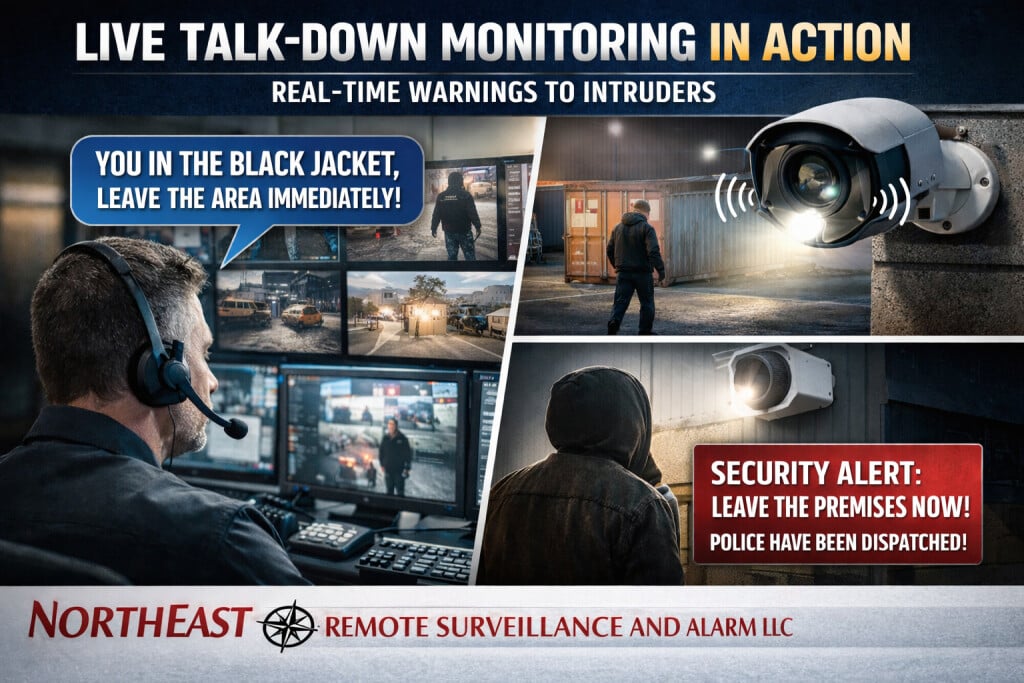
Use the commercial security monitoring overview to compare monitoring applications before defining the account setup and administration work below.
Build Monitoring Around the Required Response
Northeast Remote Surveillance and Alarm, LLC configures, coordinates, upgrades, takes over, and supports qualifying monitoring services for business and facility alarms, panic devices, supported facility conditions, video-assisted events, and multi-site organizations.
Monitoring should answer five questions: what happened, where it happened, how the event is verified, who should be contacted, and what action is authorized. A generic call list cannot replace site-specific signal descriptions, schedules, passcodes, responsible parties, escalation instructions, and regular account review.
What Commercial Monitoring May Include
- Intrusion alarm, perimeter, panic, duress, tamper, power, battery, and communication signals
- Supported temperature, water, high-water, refrigeration, or equipment-status inputs with defined thresholds
- Opening, closing, failure-to-arm, schedule, and user-related exceptions on compatible systems
- Video-assisted alarm verification for selected events with suitable camera views and platform support
- Remote video monitoring for selected exterior events under a separate operator-response plan
- Coordinated account standards, contacts, permissions, reporting, and administration for multiple locations
Exact functions depend on installed equipment, communications, software, licensing, account configuration, monitoring agreement, and customer instructions.
Define Verification, Contacts, and Escalation
Each transmitted event should have an understandable signal description and documented response. An intrusion alarm may use a verification and dispatch procedure. A panic signal may require different handling. A temperature condition may need a facilities manager, while water or communication trouble may need maintenance or technical service.
Call lists should identify who is contacted, the order, available numbers, passcode procedures, dispatch instructions, and authorization for account changes. Customers should review personnel changes, schedules, phone numbers, closed locations, and special instructions regularly.
Separate Recorded Video, Verification, and Live Monitoring
| Service | What it does |
|---|---|
| Recorded video | Stores footage for later review; it does not automatically mean anyone is watching |
| Video-assisted alarm verification | Associates a defined alarm event with a relevant camera view or clip when supported |
| Remote video monitoring | Adds operator review for selected events under documented hours, rules, and escalation steps |
Analytics, camera placement, lighting, network availability, recording health, time synchronization, platform compatibility, and operator access affect video-assisted services. No system or monitoring workflow can guarantee detection, intervention, prevention, dispatch, or a particular response time.
Match Monitoring to the Property
- Warehouses and logistics facilities may use separate schedules, dock and overhead-door signals, gate events, video verification, and after-hours contacts.
- Manufacturing properties may need partitions, multiple shifts, restricted areas, facility-condition inputs, and maintenance escalation.
- Offices, healthcare, schools, municipalities, and institutions may require public-area, staff, duress, visitor, and life-safety coordination.
- Contractor yards and exterior properties may combine building alarms, perimeter detection, cameras, gates, and defined overnight response.
- Multi-site organizations may standardize signal names, call lists, reports, permissions, and account-review procedures while retaining site-specific instructions.
Take Over Existing Accounts and Communication Paths Carefully
A monitoring transition should identify the panel, communicator, signals, zones, partitions, users, passcodes, contacts, schedules, account ownership, current provider, testing status, and available documentation. Old call lists and generic zone names should not be copied without review.
Communication may use cellular, internet, radio, dual-path, or another approved method depending on the system.
Reliability also depends on power, batteries, coverage, customer networks, supervision, firewalls, telecommunications, and maintenance.
Review monitoring takeovers and system upgrades.
Keep Monitoring Accounts Under Customer Control
Authorized customers should understand account numbers, site names, signal descriptions, call lists, passcodes, test procedures, schedules, administrator roles, billing, renewal terms, and how to request changes. Monitoring records should align with the installed system and customer documentation.
Account reviews should also confirm communication health, nuisance alarms, outdated users, former employees, missing contacts, recurring trouble signals, unsupported equipment, and changes in building operations. Fire alarm monitoring remains a separate regulated scope with distinct signal, documentation, testing, and authority requirements.
Prepare an Account Change Record
Before requesting a monitoring change, identify the site, the authorized requester, the affected signals, and the desired effective date. Record the current instruction and its approved replacement. Keep confidential passcodes in the agreed secure channel rather than a general project email or shared floor plan.
Next, confirm who will acknowledge the request and who will verify the result. A change to a contact list should include a review of the contact order and availability. A change involving installed equipment should include the provider’s testing procedure. Keep the confirmation with the account records so the next administrator can understand what changed.
Review the First Operating Period
After a new setup or transition, review actual account activity with the responsible manager. Look for unclear signal names, outdated contacts, repeated trouble events, and schedule exceptions that staff cannot explain. Assign each follow-up item to the owner, facilities team, IT team, or service provider as appropriate.
Close the review with a dated record of corrections and remaining limitations. Confirm the support contact and the process for future changes. This gives the customer a practical handover record instead of leaving account administration dependent on one person’s memory.
Frequently Asked Questions
Does every monitoring account include live video?
No. Alarm monitoring, video-assisted verification, and operator-reviewed remote video monitoring are different services. The agreement should identify the included functions, hours, rules, and response steps.
Can monitoring include temperature or water alerts?
Compatible systems may transmit selected facility conditions when sensors, thresholds, delays, recipients, escalation, testing, and maintenance responsibilities are defined.
Can NERSA take over an existing monitoring account?
Often. The system, communicator, signals, ownership, programming access, contacts, documentation, compatibility, and testing requirements must be evaluated first.
Can several locations use one monitoring structure?
Yes. Multi-site organizations may standardize signal names, contacts, permissions, reports, and review procedures while preserving the instructions required by each property.
Commercial & Industrial Security Services
Request a Commercial Monitoring Assessment
Tell us which systems are installed, what events should be monitored, how they should be verified, who should be contacted, and what is not working today.