
After-hours warehouse monitoring in Allentown, PA provides useful visual awareness around docks, trailers, entrances and exterior approaches when staffing decreases.

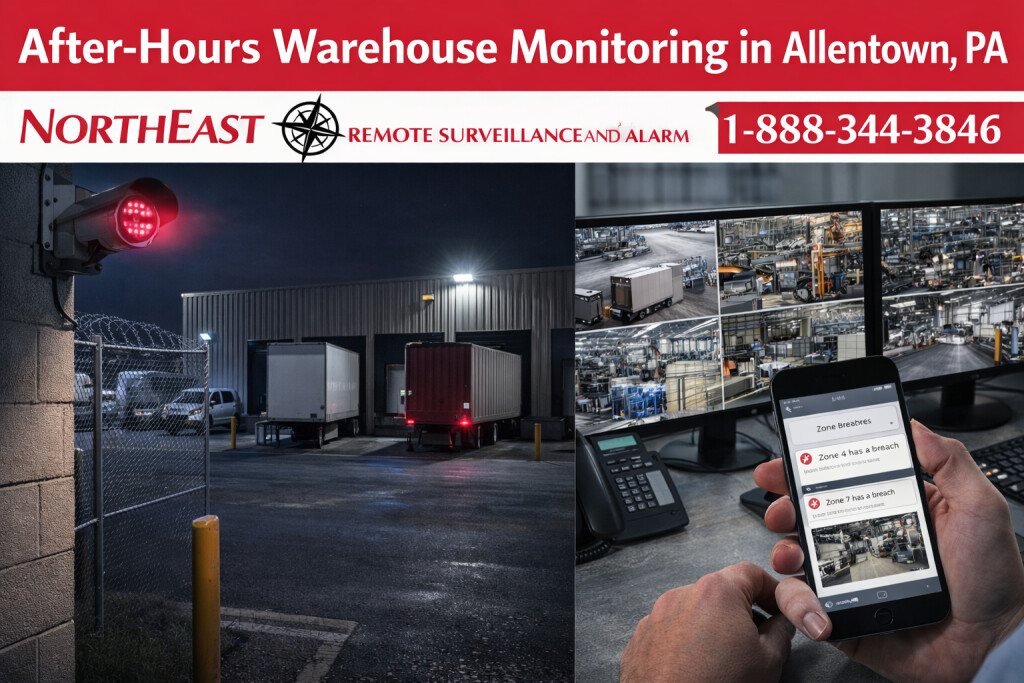
Compare event review and response options in Allentown remote video monitoring.
Visual Awareness After Normal Operations
NERSA reviews operating hours, late deliveries, cleaning schedules, and approved overnight access to identify areas where unexpected movement requires attention.
Document normal site activity so the people reviewing an event can compare it with the approved schedule and response instructions. Monitoring cannot reliably judge authorization from movement alone.
Priority After-Hours Views
- Loading dock doors and dock approaches
- Trailer rows and drop areas
- Employee and service entrances
- Side and rear building approaches
- Fenced equipment or storage zones
- Parking edges and vehicle routes
Dock views can show activity near closed overhead doors, while trailer-area cameras provide context for movement after dispatch ends. Check that parked equipment does not obscure the areas staff need to review.
Monitoring for Closed and Reduced-Staff Periods
Some warehouses close completely overnight. Others keep a small team on site or accept scheduled arrivals. The monitoring schedule should match each operating model.
Different zones can follow different schedules. A busy dock may remain active while a rear storage area enters after-hours monitoring.
Useful Video in Overnight Conditions
Nighttime visibility depends on lighting, camera position and clear sight lines. Trailers or equipment should not block critical views. NERSA reviews actual overnight conditions before defining coverage.
Secure remote access can help authorized staff review an event. Clear camera names and layouts speed that process.
Alerts and Response Procedures
Selected platforms can support event alerts or live monitoring workflows. However, the response path must identify who receives information and what happens next. NERSA configures the system around those instructions.
Test representative events with the responsible staff or monitoring team during agreed overnight conditions, confirming the received image and escalation path. Assign who handles camera or communication faults and updates temporary schedule exceptions.
Scalable for One Warehouse or Many
A smaller property may monitor one entrance and a rear dock. An enterprise may manage overnight views across several facilities. Common reporting standards can support both while each site retains its actual schedules and response contacts.
Over time, the program can expand as buildings, trailers or operating hours change.
Set the monitoring window to the warehouse’s real operating schedule
In a 24-hour or staggered-shift warehouse, the building may never be completely empty. Define which loading doors, yards, parking areas and employee entrances should be monitored for unexpected activity during each time period. Create approved exceptions for late carriers, cleaning crews and maintenance vendors so operators can distinguish normal work from an event that requires attention.
Specify what the remote operator can actually do
Document whether the service provides event review, recorded clip verification, live audio talk-down, escalation to designated contacts or another response. Confirm coverage hours, callback procedures and the difference between notifications delivered to an owner and an actively staffed monitoring service. Avoid implying that a person watches every camera continuously unless that is explicitly included in the agreement.
Test difficult overnight conditions
- Verify useful images with dock lights off and trucks headlights on.
- Test alarms caused by a person, vehicle and representative environmental movement.
- Check video retention, network outage behavior and how missed notifications are discovered.
- Confirm authorized escalation contacts and a periodic review of schedules and camera health.
Define what after-hours monitoring actually covers
An occupied distribution center may run late shifts, scheduled loading, custodial work and occasional emergency maintenance. Establish the exact hours each zone is treated as unoccupied, the authorized people who may remain, and the conditions worth reviewing. Monitoring a shipping door at midnight is different from watching a normally empty trailer yard. A simple always-on motion rule can generate nuisance alarms whenever scheduled operations change; detection logic should follow a written site activity calendar.
Make camera views and alarms mutually understandable
For each monitored event, identify the camera, door or detector, expected field of view, alert label and primary operator. Verify night lighting, backlighting from dock doors, trailers blocking views, and potential confusion between movement in public space and movement within the protected yard. Alarm points and camera names must be consistent so a person responding remotely can understand what happened. Video verification can support decisions, but it does not remove the need for defined call lists and on-site escalation.
Write dispatch, talk-down and exception procedures
Define whether operators will call a keyholder, send a site guard, use an approved talk-down speaker or escalate to public authorities. Identify what footage or other evidence is required before an escalation and who can cancel a known legitimate event. Maintain an updated list of authorized truck arrivals, weather-related activity and temporary contractors. Where audible warnings are contemplated, confirm property boundaries, noise considerations and approved wording; a speaker system should not be treated as a substitute for emergency communications.
Test representative after-hours incidents
Run an approved test using a scheduled employee, an unexpected entrance event, a trailer obscuring a camera and a temporary communications interruption. Check whether alerts are delivered in the expected order and who acknowledges or closes them. Confirm that recording, time synchronization and evidence export continue as intended. Retain written coverage hours, exception contacts, retention settings and corrective work, then update those records as warehouse shifts and tenants change.
Related Warehouse Planning
For facility-wide planning, review warehouse security systems in Allentown.
For monitoring options and related guidance, return to Remote Video Monitoring in Allentown.
Schedule an After-Hours Assessment
Schedule an assessment to review overnight activity, camera views, alerts and response procedures at your Allentown warehouse.
Compliance, Codes & Project Standards
NERSA plans commercial and industrial security work with applicable code, documentation, inspection and authority-having-jurisdiction requirements in mind. Requirements vary by system, property and jurisdiction. These resources support project planning; they do not establish legal compliance, certification or AHJ approval.
Related guidance: Regulatory compliance & inspection readiness · Warehouse & logistics compliance · NERSA project standards