Allentown Low-Voltage Security Infrastructure Upgrades

Allentown low-voltage security infrastructure upgrades help commercial and industrial properties modernize the cabling, fiber, network, PoE, rack, pathway, power, and communications backbone that supports security cameras, access control, intrusion alarms, fire alarm interfaces, intercoms, monitoring, and unified security systems. Northeast Remote Surveillance and Alarm, LLC provides these upgrades as part of NERSA’s Allentown retrofits and services program for facilities that need stronger reliability, cleaner documentation, better expansion capacity, and fewer weak points behind the equipment. For broader citywide planning, start with Allentown Commercial Security Systems; for existing-system modernization, use Commercial Security System Upgrades, Retrofits, and Takeovers; for full service planning, visit Commercial & Industrial Security Services and Commercial & Industrial Infrastructure and Cabling.

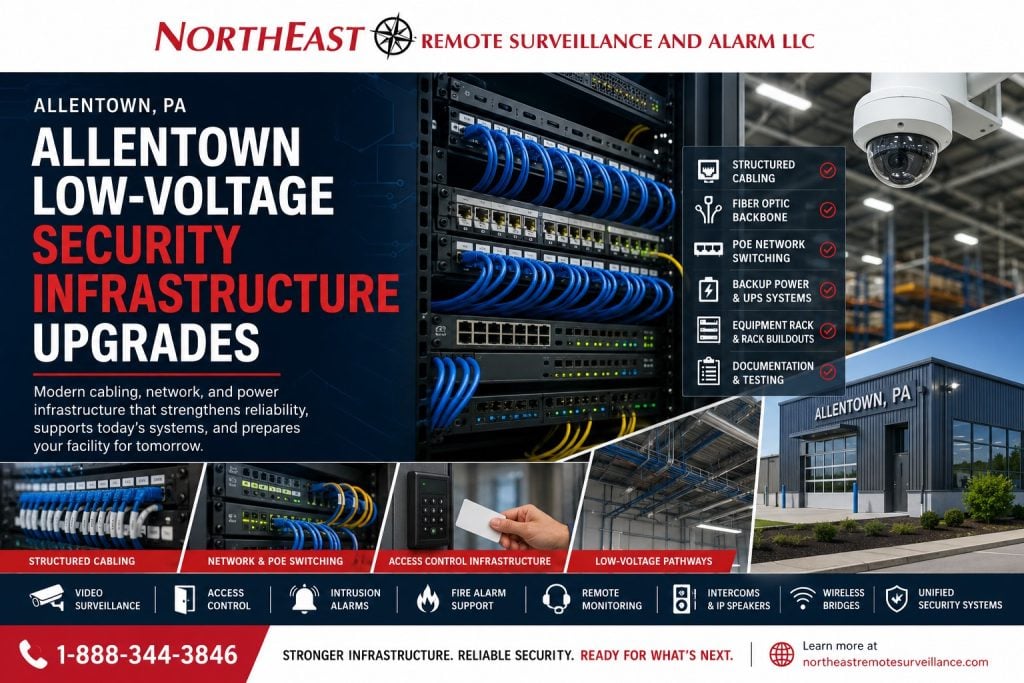
Allentown low-voltage security infrastructure upgrades with NERSA logo, structured cabling, PoE network rack, fiber backbone, access control, cameras, and commercial facility systems.

Low-Voltage Infrastructure Upgrades for Allentown Commercial Properties

Modern commercial security systems depend on more than cameras, readers, sensors, and alarm panels. They depend on the infrastructure behind those devices.

A facility may have good equipment but still suffer from unreliable performance because the cabling is aging, the PoE switches are undersized, the racks are undocumented, the fiber backbone is missing, the network is flat, the power strategy is weak, or the system was expanded too many times without a clean infrastructure plan.

NERSA helps Allentown businesses upgrade the low-voltage foundation that supports commercial security, life safety, monitoring, and future technology growth. This includes structured cabling, Cat6 and Cat6A, fiber optic backbone, network racks, IDF and MDF cleanup, PoE switching, UPS support, wireless bridge infrastructure, access control cabling, camera cabling, alarm wiring support, and documentation.

For broader service-level infrastructure planning, visit Commercial & Industrial Infrastructure and Cabling.

What This Page Covers

This page is focused specifically on low-voltage security infrastructure upgrades in Allentown, PA.

It is not the main Allentown commercial security page. It is not a general camera installation page. It is not a full access control hub. It is not a fire alarm design page. It is not a general IT networking page.

This page owns the infrastructure upgrade intent: the cabling, network, power, pathway, rack, communications, and documentation improvements that allow commercial security systems to operate reliably.

Use this page when your facility needs:

  • Security camera cabling upgrades
  • Cat6 or Cat6A replacement
  • Fiber optic backbone planning
  • PoE switch upgrades
  • IDF or MDF cleanup
  • Rack buildouts
  • Patch panel organization
  • Cable labeling and testing
  • Wireless bridge infrastructure
  • Access control cabling improvements
  • Alarm communication path upgrades
  • UPS and backup power improvements
  • Security network segmentation
  • Infrastructure documentation
  • Expansion planning for future cameras, doors, alarms, and monitoring

For complete security system planning across cameras, access control, alarms, monitoring, fire alarm coordination, and integrated systems, use Allentown Commercial Security Systems.

Why Infrastructure Matters More Than Most Businesses Realize

A security system can only perform as well as the infrastructure supporting it.

A camera may fail because of a weak cable run. An access control door may act unreliable because of poor power or bad labeling. A recorder may lose connection because the network switch is overloaded. A remote building may be difficult to secure because there is no fiber or wireless bridge path. A monitoring issue may trace back to an old phone line, weak internet path, or undocumented network equipment.

When the infrastructure is weak, every connected system becomes harder to trust.

A proper low-voltage upgrade helps improve reliability across:

  • Video surveillance
  • Access control
  • Intrusion alarms
  • Fire alarm communication support
  • Intercoms
  • IP speakers
  • Remote video monitoring
  • License plate recognition
  • Gate systems
  • Wireless bridges
  • Networked security devices
  • Unified security platforms

For systems that connect multiple layers together, visit Unified Security Systems.

Common Low-Voltage Problems in Allentown Facilities

Many Allentown commercial buildings have security infrastructure that was built in phases. A business may have added cameras one year, access control later, an alarm expansion after that, and a network closet cleanup only when something stopped working.

Over time, that creates problems.

Common infrastructure issues include unlabeled cable, unsupported wire, mixed cable types, old Cat5, damaged terminations, abandoned wiring, overloaded PoE switches, weak UPS support, messy equipment closets, limited rack capacity, no fiber backbone, poor outdoor cable protection, no network segmentation, undocumented IP devices, and limited room for expansion.

These problems may not be obvious during normal operation. They usually appear during outages, upgrades, troubleshooting, service calls, recorder failures, network changes, or expansion projects.

NERSA’s goal is to make the infrastructure cleaner, stronger, more serviceable, and better prepared for the next phase of the facility.

Security Camera Infrastructure Upgrades

Commercial camera systems depend on stable cabling, PoE power, switch capacity, storage design, network health, and clean documentation.

A camera upgrade may require more than replacing the camera head. Older infrastructure may not support higher-resolution cameras, AI analytics, longer retention, remote access, multi-sensor cameras, PTZ cameras, LPR cameras, or cloud-connected video platforms.

NERSA evaluates camera infrastructure around bandwidth, PoE load, cable condition, switch capacity, recorder location, rack organization, outdoor exposure, pathway protection, and future camera expansion.

For Allentown camera modernization, visit Allentown Security Camera System Upgrades.

For service-level video surveillance planning, visit Commercial & Industrial Video Surveillance Systems.

Access Control Infrastructure Upgrades

Access control depends on dependable cabling, clean power, properly located controllers, door hardware coordination, battery backup, reader wiring, request-to-exit wiring, door position wiring, and serviceable panel organization.

A facility may need access control upgrades because the doors are expanding, credentials are changing, users need remote management, the system needs better event history, or the existing controller layout is hard to service.

Low-voltage infrastructure upgrades may support:

  • Reader replacement
  • Controller upgrades
  • Door expansion
  • Electrified hardware power
  • Door position monitoring
  • Request-to-exit wiring
  • Power supply replacement
  • Battery backup
  • Panel cleanup
  • Network connectivity
  • Multi-door expansion
  • Cloud or hybrid platform migration

For Allentown access control modernization, visit Access Control System Upgrades in Allentown, PA.

For full access control service planning, visit Commercial & Industrial Access Control Systems.

Structured Cabling Upgrades

Structured cabling is the organized low-voltage cabling system that supports cameras, access control panels, intercoms, network devices, wireless access points, alarm communications, and connected commercial systems.

A clean structured cabling upgrade may include Cat6, Cat6A, plenum cable where appropriate, outdoor-rated cable, patch panels, proper labeling, rack organization, certified testing, cable documentation, and removal of abandoned or confusing wiring.

Commercial cabling should not be treated like temporary wire. Unsupported cable, poor pathways, messy terminations, weak labeling, and undocumented runs create long-term service problems.

The goal is to build cabling that can be serviced, expanded, and understood later.

Fiber Optic Backbone Upgrades

Fiber optic infrastructure is often the right answer when Allentown facilities have large footprints, remote equipment rooms, multiple buildings, long warehouse runs, gate locations, trailer yards, outdoor security devices, industrial campuses, or high camera counts.

Fiber may support:

  • Building-to-building security connectivity
  • Remote IDF closets
  • Warehouse camera networks
  • Industrial security backbones
  • Gate access systems
  • LPR camera locations
  • Parking lot camera networks
  • Long-distance network extensions
  • High-bandwidth surveillance systems
  • Electrical isolation between areas

A fiber upgrade should be planned around distance, environment, termination points, rack space, network design, protection, testing, documentation, and future expansion.

PoE Switch and Network Upgrades

Many modern security devices rely on Power over Ethernet. Cameras, intercoms, IP speakers, access control controllers, wireless bridges, and some edge devices may all depend on PoE switching.

An older switch may not have enough power budget, port capacity, management capability, uplink speed, or network segmentation support.

A PoE and network upgrade may include managed switches, PoE budget planning, VLAN planning, uplink design, switch replacement, rack-mounted UPS support, patch panel cleanup, and device documentation.

This is especially important when upgrading to AI cameras, multi-sensor cameras, PTZ cameras, cloud video, remote monitoring, LPR, or multi-building systems.

IDF and MDF Rack Modernization

Equipment closets are where many security systems become either serviceable or difficult to manage.

A proper rack upgrade may include wall racks, floor cabinets, patch panels, cable management, managed switches, UPS systems, lockable enclosures, power distribution, labeling, rack diagrams, and cleaner separation between systems.

Allentown businesses with messy closets, unlabeled wires, stacked equipment, aging switches, unsupported power strips, or undocumented connections often benefit from a rack modernization project before adding more devices.

A clean rack reduces service time, supports troubleshooting, improves airflow, protects equipment, and makes future expansion easier.

Backup Power and UPS Improvements

Security infrastructure should be planned around power reliability. Cameras, access control controllers, PoE switches, recorders, network gear, communicators, and monitoring equipment can all be affected by power interruptions.

UPS and backup power planning may include:

  • Rack-mounted UPS systems
  • Access control power supplies
  • Battery backup
  • PoE switch backup
  • Recorder backup
  • Communications backup
  • Surge protection
  • Power distribution
  • Runtime planning
  • Generator coordination where applicable

Power planning should match the systems that need to remain online during a power event.

Communications Infrastructure Upgrades

Many commercial systems still depend on old communication paths. Alarm panels, fire alarm communicators, monitoring equipment, gate systems, elevator-related communication paths, or remote devices may still rely on outdated phone service or unstable internet connections.

A communications infrastructure upgrade may include cellular communicators, IP communication paths, network cleanup, carrier handoff coordination, backup connectivity, secure remote access planning, or replacement of aging telephone infrastructure.

For service-level planning around older phone-line replacement, visit Commercial & Industrial Security Services.

Low-Voltage Wiring and Code-Aware Planning

Low-voltage security wiring still needs to be planned professionally. Cable type, pathway, separation, building conditions, power source, fire alarm relationship, environmental air spaces, penetrations, and documentation can all matter depending on the project.

This is especially important when infrastructure upgrades touch access control, fire alarm interfaces, powered devices, above-ceiling cable, outdoor pathways, or inspection-sensitive environments.

For compliance-aware wiring guidance, visit NFPA 70 NEC and Low-Voltage Security System Wiring.

For broader compliance planning across fire alarm, access control, wiring, backup power, documentation, and inspection-sensitive projects, visit Regulatory & Compliance.

Infrastructure Upgrades for Warehouses and Logistics Facilities

Warehouses and logistics facilities often need stronger infrastructure because of large footprints, long cable paths, high ceilings, dock areas, truck yards, trailer lots, exterior exposure, office-to-warehouse transitions, and high camera counts.

A warehouse infrastructure upgrade may include fiber backbone, dock camera cabling, trailer yard connectivity, wireless bridges, PoE switch upgrades, access control cabling, rack cleanup, UPS support, and documentation.

The infrastructure should be built around the way the building operates, including shipping, receiving, employee movement, driver activity, exterior yards, restricted spaces, and after-hours security.

Infrastructure Upgrades for Manufacturing and Industrial Properties

Manufacturing and industrial buildings create harsher conditions than standard office environments. Dust, vibration, machinery, electrical interference, heat, long distances, production layouts, and restricted areas can affect security infrastructure.

A manufacturing infrastructure upgrade may require protected pathways, industrial-rated enclosures, fiber between production areas, shielded cable where appropriate, hardened network equipment, cleaner rack planning, and better documentation.

The goal is not just to connect the devices. The goal is to build infrastructure that holds up inside the real operating environment.

Infrastructure Upgrades for Offices, Healthcare, Schools, and Municipal Buildings

Office buildings, healthcare spaces, schools, and municipal facilities may need cleaner infrastructure to support controlled doors, cameras, intercoms, emergency communication, visitor entry, monitoring, and future expansion.

These environments often need better organization, documentation, network separation, equipment room security, and planning around public-facing spaces, staff-only areas, records rooms, IT closets, restricted rooms, and shared entrances.

Infrastructure upgrades help these buildings modernize without creating unnecessary disruption or replacing every connected system at once.

Why Upgrade Infrastructure Before Adding More Equipment

Adding more equipment to weak infrastructure often creates more problems.

Before expanding cameras, doors, intercoms, alarms, monitoring, or AI analytics, a facility should understand whether the backbone can support the added load.

Infrastructure upgrades can improve:

  • System uptime
  • Troubleshooting speed
  • Camera reliability
  • Access control performance
  • Alarm communication
  • Remote access
  • Monitoring reliability
  • Network security
  • Future expansion
  • Documentation
  • Long-term serviceability

In many cases, the best upgrade is not a new device. It is the infrastructure that allows existing and future devices to perform correctly.

How NERSA Evaluates an Allentown Infrastructure Upgrade

NERSA reviews the existing security system and the infrastructure behind it.

That may include:

  • Cabling condition
  • Cable type and pathway
  • Patch panel organization
  • Rack layout
  • Switch capacity
  • PoE budget
  • UPS support
  • Fiber needs
  • Wireless bridge needs
  • Access control panel locations
  • Alarm communication paths
  • Camera bandwidth
  • Recorder placement
  • Network segmentation
  • Outdoor cable exposure
  • Documentation quality
  • Expansion capacity

The result is a practical upgrade plan based on the property, the existing system, the risk areas, the budget, and the long-term direction of the facility.

For citywide commercial security planning in Allentown, visit Allentown Commercial Security Systems.

For service-level infrastructure and cabling planning, visit Commercial & Industrial Infrastructure and Cabling.

For existing system modernization, retrofits, and takeovers, visit Commercial Security System Upgrades, Retrofits, and Takeovers.

For camera modernization in Allentown, visit Allentown Security Camera System Upgrades.

For access control modernization in Allentown, visit Access Control System Upgrades in Allentown, PA.

For broader access control system planning, visit Commercial & Industrial Access Control Systems.

For full NERSA service planning, visit Commercial & Industrial Security Services.

For wiring and code-aware infrastructure planning, visit NFPA 70 NEC and Low-Voltage Security System Wiring.

Request an Allentown Low-Voltage Security Infrastructure Assessment

If your Allentown commercial or industrial facility has aging cabling, unreliable cameras, overloaded switches, undocumented racks, weak PoE capacity, limited fiber, poor wireless links, access control wiring problems, alarm communication issues, or upcoming expansion plans, Northeast Remote Surveillance and Alarm, LLC can help evaluate the infrastructure.

NERSA can review the existing system, identify weak points, recommend upgrades, and design a cleaner low-voltage backbone for cameras, access control, alarms, monitoring, intercoms, and future security expansion.

Call 1-888-344-3846 or use Request a Commercial Security Assessment to schedule an Allentown low-voltage security infrastructure review.

Frequently Asked Questions About Allentown Low-Voltage Security Infrastructure Upgrades

What is a low-voltage security infrastructure upgrade?

A low-voltage security infrastructure upgrade improves the cabling, fiber, switches, racks, power, pathways, wireless bridges, communications, and documentation that support cameras, access control, alarms, monitoring, intercoms, and other connected security systems.

Can existing security cabling be reused?

Sometimes. Existing cabling may be reused if it is the right type, in good condition, properly terminated, correctly routed, labeled, tested, and capable of supporting the current system. Older or undocumented cabling may need to be replaced, cleaned up, or retested.

When should a business upgrade from Cat5 to Cat6 or Cat6A?

A business should consider upgrading when older cabling cannot reliably support newer cameras, network devices, higher bandwidth, PoE requirements, longer-term expansion, or structured cabling documentation needs.

When is fiber optic cabling needed for a security system?

Fiber is often needed for long-distance runs, multiple buildings, large warehouses, remote IDF closets, gate systems, high camera counts, industrial environments, or locations where copper cabling is not practical.

Why do PoE switches matter for security cameras?

PoE switches provide both data and power to many IP security devices. If the switch is undersized, overloaded, unmanaged, or poorly documented, cameras and connected devices may become unreliable.

Can low-voltage upgrades improve access control reliability?

Yes. Access control depends on proper cabling, panel organization, lock power, reader wiring, request-to-exit wiring, door position monitoring, battery backup, and network connectivity. Infrastructure problems can create access control failures.

Do low-voltage upgrades help with remote video monitoring?

Yes. Remote video monitoring depends on reliable camera connectivity, bandwidth, switching, power, recording, and network paths. Weak infrastructure can reduce the effectiveness of monitoring and event review.

Can NERSA clean up old racks and wiring closets?

Yes. NERSA can help organize racks, label cables, replace old patching, improve cable management, install patch panels, upgrade switches, add UPS protection, and document the infrastructure.

Is low-voltage wiring still a code-aware issue?

Yes. Low-voltage wiring still needs proper cable type, pathway planning, support, separation, protection, power-source coordination, and installation discipline depending on the system and building conditions.

Should infrastructure be upgraded before adding more cameras?

Often, yes. If the existing network, cabling, PoE switches, recorder, rack, or power setup is already strained, adding more cameras may create more problems. Infrastructure review should come before major expansion.

Can low-voltage upgrades support future security expansion?

Yes. A strong infrastructure plan can leave room for additional cameras, doors, alarm points, intercoms, wireless links, fiber extensions, remote buildings, monitoring platforms, and future system upgrades.

Who provides low-voltage security infrastructure upgrades in Allentown, PA?

Northeast Remote Surveillance and Alarm, LLC provides commercial and industrial low-voltage security infrastructure upgrades in Allentown, PA, including cabling, fiber, racks, PoE switching, access control infrastructure, camera infrastructure, communications, and documentation.

Scroll to Top
1-888-344-3846