Biometric access control systems in Allentown, PA use measurable physical characteristics to help verify a person before allowing entry through a controlled commercial door or into a restricted area.
Northeast Remote Surveillance and Alarm, LLC designs, installs, upgrades, and integrates biometric access control for selected commercial, industrial, institutional, healthcare, warehouse, manufacturing, office, laboratory, data, and multi-site facilities in Allentown.
This supporting spindle focuses specifically on fingerprint recognition, facial recognition, iris recognition, palm-vein recognition, hand-geometry systems, biometric enrollment, identity verification, multi-factor access, reader selection, privacy-sensitive administration, and integration with commercial doors.
For complete planning involving cards, key fobs, mobile credentials, readers, controllers, schedules, permissions, door hardware, gates, visitor entry, and system management, start with Commercial Access Control Systems in Allentown, PA.
Commercial and industrial systems only • Selected restricted-area applications • New installations and upgrades • Single-door through multi-site systems
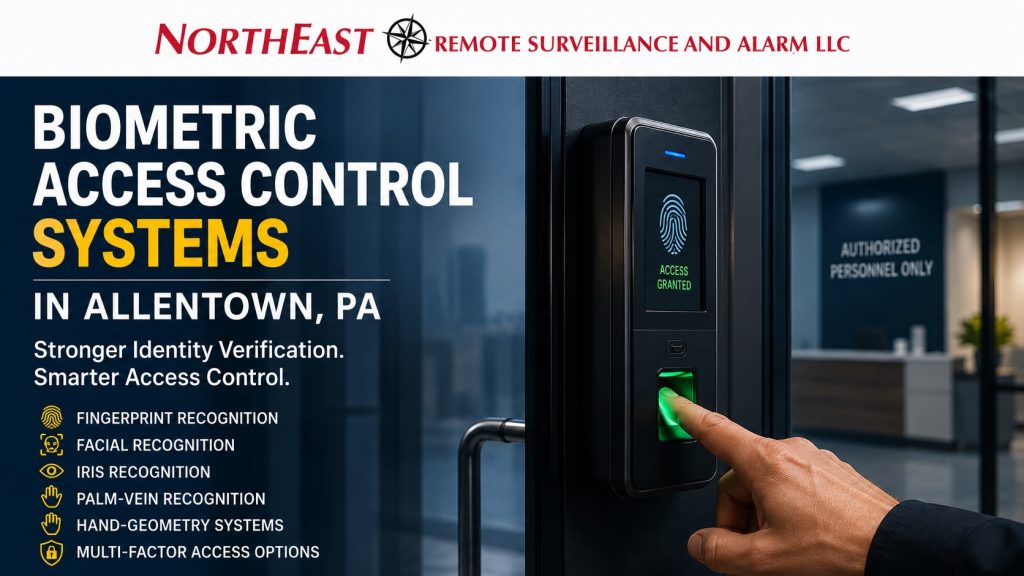
Commercial Biometric Access Control for Allentown Facilities
Biometric access control ties an access decision more closely to the enrolled person than a transferable card, key fob, mobile credential, or PIN used by itself.
Instead of presenting only something the person carries or something the person knows, the user presents a measurable physical characteristic to a compatible biometric reader. The system compares the presentation with an enrolled biometric reference before granting or denying access.
Depending on the application, biometric access control may be used as:
- The primary credential at a controlled opening
- A second factor used with a card, fob, mobile credential, or PIN
- Additional verification for a restricted room
- A method of reducing credential sharing
- A controlled-entry option for selected high-accountability areas
- Part of a broader multi-door or multi-site access control system
Biometric technology should not automatically be installed at every door. It is most useful when the security objective, operating environment, user population, administrative process, and value of the protected area justify the additional complexity.
When Biometric Access Control May Be Appropriate
Biometric access control may be considered when a business needs stronger assurance that the person requesting access is the person who was enrolled.
Possible Allentown applications include:
- Tool cribs and controlled equipment rooms
- Medication or records areas
- Laboratories and testing spaces
- Data rooms and network facilities
- High-value inventory areas
- Manufacturing quality-control rooms
- Restricted production areas
- Research and development spaces
- Cash-handling or accounting rooms
- Executive or management areas
- Critical infrastructure rooms
- Sensitive warehouse storage
- Employee entrances requiring multi-factor verification
- Multi-site facilities seeking standardized identity verification
The decision should be based on actual operational need rather than the assumption that biometric technology is automatically the best solution.
A conventional card, fob, or mobile credential may remain more practical for normal employee entrances. Biometrics may then be reserved for the smaller number of openings where stronger identity verification is justified.
Biometrics Are Not a Universal Replacement for Cards or Mobile Credentials
Cards, key fobs, mobile credentials, PINs, and biometric readers solve different access-control problems.
A card or fob is usually fast to issue and simple to replace. A mobile credential may support remote administration and reduce physical badge handling. A PIN provides something the user knows. A biometric provides a measurable characteristic associated with the enrolled person.
Some organizations use biometrics by themselves. Others use a biometric reader with another credential to create multi-factor access.
A biometric system may not be appropriate when:
- The opening has very low security exposure
- Employee enrollment cannot be managed consistently
- The environment interferes with reliable capture
- Users regularly wear gloves, masks, eye protection, or other personal protective equipment
- The expected traffic volume exceeds the reader workflow
- A practical alternate entry method cannot be established
- The organization is not prepared to manage biometric information responsibly
- Existing controllers or software cannot support the required integration
- The door itself has unresolved hardware or egress problems
The correct credential strategy may use biometrics at selected restricted doors while continuing to use cards, fobs, or mobile credentials throughout the rest of the facility.
How a Biometric Access Control System Works
A biometric access control system normally begins with enrollment.
During enrollment, the system captures information from the authorized user and creates a reference record associated with that person. Depending on the platform, the system may store a biometric template, image, reference data, or a combination of information.
When the user later presents a fingerprint, face, iris, palm, or hand at the reader, the system compares the new presentation with the enrolled reference.
The access control platform then applies the user’s permissions, including:
- Authorized doors
- Permitted schedules
- Restricted areas
- Holiday schedules
- Multi-factor requirements
- Anti-passback rules where used
- Temporary access conditions
- Department or role assignments
When the user meets the biometric and permission requirements, the controller can activate the appropriate locking hardware and record the event.
The biometric reader does not replace the controller, door contact, request-to-exit device, power supply, locking hardware, or safe operation of the door. It is one part of the complete controlled opening.
Biometric Verification and Biometric Identification
Biometric verification and biometric identification are related but different processes.
Biometric Verification
Verification asks whether the person presenting the biometric matches a specific enrolled identity.
This is sometimes described as a one-to-one comparison. The user may first present a card, fob, mobile credential, or identification number. The biometric reader then compares the person with the reference associated with that credential.
This method can be useful when the organization wants to confirm that the credential is being used by the enrolled person.
Biometric Identification
Identification asks which enrolled person matches the biometric presentation.
This is sometimes described as a one-to-many comparison because the system searches multiple enrolled records to determine the user’s identity.
Identification may provide a credential-free experience, but it can create different performance, enrollment, privacy, database, and administrative requirements than one-to-one verification.
The appropriate method depends on the number of users, expected traffic, system architecture, security objective, response time, matching performance, and organizational policy.
Fingerprint Recognition Access Control Systems
Fingerprint access control uses a compatible reader to capture and evaluate fingerprint characteristics presented by an enrolled user.
Fingerprint readers may be considered for:
- Interior restricted rooms
- Tool and equipment storage
- Records areas
- Data rooms
- Controlled manufacturing spaces
- Small groups of authorized employees
- Multi-factor access with a card or PIN
Fingerprint systems can be compact and familiar to users, but performance depends on the reader, enrollment quality, finger placement, working conditions, skin condition, cleanliness, moisture, dust, and environmental exposure.
Facilities where employees regularly wear gloves, handle abrasive materials, work with chemicals, or experience dirty or wet conditions may need a different biometric method or a reliable alternate credential process.
Fingerprint recognition should be tested with the actual user population and operating conditions before it is selected for a critical entrance.
Facial Recognition Access Control Systems
Facial recognition access control uses a dedicated entry reader or terminal to compare the person at the door with an enrolled facial reference.
Possible benefits include contactless presentation and reduced dependence on a physical card at selected openings.
Facial access control may be considered for:
- Controlled office entrances
- Interior restricted rooms
- Data and technology facilities
- Management areas
- Selected healthcare-support spaces
- Multi-factor identity verification
- Facilities seeking a contactless user experience
Reader placement, lighting, camera angle, user height, traffic flow, eyewear, face coverings, background conditions, presentation-attack protection, and enrollment quality can affect system performance.
Facial recognition at an access-controlled door should not be confused with general facial-recognition video surveillance. This page focuses on enrolled users intentionally presenting themselves to a controlled-entry device for authentication.
It does not focus on searching recorded surveillance footage or identifying unknown people in public or general building areas.
Iris Recognition Access Control Systems
Iris recognition evaluates patterns in the visible colored portion of the eye using a compatible biometric reader.
It may be considered for selected applications requiring contactless identity verification and a controlled user-presentation process.
Potential applications include:
- Sensitive research spaces
- Data and communications rooms
- Controlled institutional areas
- Selected healthcare or laboratory spaces
- Critical infrastructure rooms
- Higher-accountability interior openings
Iris systems require careful reader placement, user positioning, enrollment, lighting review, accessibility planning, and evaluation of eyewear or protective-equipment conditions.
The technology should be tested around the people and workflow expected at the actual opening rather than selected only from published equipment specifications.
Palm-Vein Recognition Access Control Systems
Palm-vein recognition uses a compatible sensor to evaluate vascular patterns within a person’s hand or palm.
It may provide a contactless or near-contact user experience, depending on the selected equipment and presentation method.
Palm-vein access control may be considered for:
- Restricted interior rooms
- Healthcare-support environments
- Laboratories
- Data facilities
- Controlled manufacturing areas
- High-value storage
- Applications where fingerprint condition may create difficulty
Planning should account for reader position, user guidance, hand placement, enrollment quality, expected traffic, environmental conditions, accessibility, and the availability of an alternate access method.
Palm-vein systems should also be evaluated for compatibility with the proposed access control controller, software, credential database, and reporting requirements.
Hand-Geometry Access Control Systems
Hand-geometry systems evaluate the shape and physical dimensions of a user’s hand.
These systems have historically been used in selected commercial, institutional, industrial, and workforce-management applications.
A hand-geometry reader may be considered when the organization has:
- A defined group of regular users
- A controlled enrollment process
- Sufficient mounting space
- A consistent user workflow
- Existing compatible equipment
- A specific operational reason to retain or modernize the technology
Hand-geometry equipment can require more reader space and a more deliberate presentation process than some newer biometric options.
When an existing hand-geometry system is being replaced, the assessment should review the current user database, controller integration, wiring, software, door hardware, workflow, and migration path before a replacement technology is selected.
Single-Factor and Multi-Factor Biometric Access
A biometric may be used as a single factor or as part of a multi-factor process.
Biometric-Only Access
The person presents the biometric without first presenting a card, mobile credential, or PIN.
This may simplify the user experience at some openings, but the system must search or identify the correct enrolled record. Database size, matching time, system architecture, and privacy-sensitive administration become important considerations.
Card Plus Biometric
The person first presents a card or fob and then completes biometric verification.
The card identifies the user record, while the biometric helps confirm that the person presenting the credential matches the enrolled user.
This can reduce the value of a borrowed or shared credential at a sensitive opening.
Mobile Credential Plus Biometric
A mobile credential may be combined with biometric verification when the selected platform, reader, controller, and administrative workflow support the required process.
The exact operation depends on whether the biometric is processed by the access reader, the mobile device, the access platform, or another integrated component.
PIN Plus Biometric
A PIN may be used with biometric verification where the organization wants the user to present both something known and a physical characteristic.
PIN administration, failed-attempt limits, observation risk, user training, and offboarding procedures should be considered as part of the design.
Accuracy, Matching Thresholds, and Real-World Performance
Biometric systems do not make perfect decisions under every condition.
A legitimate user may occasionally fail to match the enrolled reference. A system may also incorrectly determine that two presentations match. Reader quality, enrollment, matching thresholds, environmental conditions, user behavior, software, sensor placement, and biometric modality can all affect results.
The system should be evaluated around:
- False-match risk
- False-nonmatch or rejection rates
- Enrollment quality
- Presentation-attack detection
- User throughput
- Reader response time
- Environmental exposure
- Lighting conditions
- Gloves or protective equipment
- User height and accessibility
- Alternate credential procedures
- Failed-attempt handling
- Administrator override procedures
- Event reporting
- System availability during network interruptions
A lower-security office room and a critical restricted area may require different matching thresholds and credential workflows.
The system should be configured around the consequences of an incorrect acceptance, the operational impact of an incorrect rejection, and the ability of authorized users to obtain assistance.
Presentation Attacks and Liveness Detection
A presentation attack occurs when someone attempts to interfere with a biometric reader by presenting an imitation, reproduction, altered characteristic, photograph, display, artificial fingerprint, mask, or other material intended to fool the system.
Available countermeasures vary by manufacturer and biometric modality.
Depending on the application, system review may include:
- Liveness detection
- Presentation-attack detection
- Depth sensing
- Infrared capture
- Challenge-response behavior
- Multi-factor credentials
- Anti-passback rules
- Failed-attempt alerts
- Video coverage at the controlled opening
- Guard or receptionist verification
- Door-position monitoring
- Administrative review of unusual events
No single feature should be assumed to eliminate every form of attempted deception.
The level of protection should be matched to the risk at the opening and evaluated as part of the complete access control system.
What Biometric Readers Do Not Fix
Biometric readers can strengthen identity verification, but they do not correct every security weakness.
Biometric access control does not automatically prevent:
- Tailgating behind an authorized person
- A door being propped open
- Poorly aligned or damaged door hardware
- Incorrect user permissions
- Inactive employees remaining in the database
- Shared administrator accounts
- Weak enrollment procedures
- Unprotected network communication
- Unauthorized software access
- Improper emergency-release operation
- Missing door contacts
- Unmonitored forced-door conditions
- Poor visitor procedures
- Inadequate offboarding
The effectiveness of the system depends on the reader, controller, software, door hardware, permissions, administrative process, user training, and physical operation of the opening.
Biometric Enrollment and User Administration
Enrollment is one of the most important parts of a biometric access control program.
Poor enrollment can create repeated user failures, inaccurate matches, service calls, and frustration at the door.
The organization should establish procedures covering:
- Who may enroll users
- How identity is confirmed before enrollment
- Which biometric method is collected
- Whether more than one finger, face image, eye, or hand presentation is enrolled
- How enrollment quality is checked
- Who approves access permissions
- How temporary users are handled
- How users are removed
- What happens when a person changes roles
- How administrators are authenticated
- How alternate access is issued
- How failed enrollments are addressed
- How records are retained or deleted
- How system exports and backups are controlled
Biometric enrollment should not be treated as an informal task performed without documented responsibility.
The organization should also determine how users who cannot reliably enroll or use the selected modality will receive authorized access.
Privacy, Retention, and Biometric Information
Biometric information requires deliberate administrative and cybersecurity planning because a fingerprint, face, iris, palm, or hand characteristic is associated with a person rather than a replaceable badge number.
Before deployment, the organization should review:
- What information the system captures
- Whether it stores templates, images, or other reference data
- Where the information is stored
- Whether storage is local, cloud-based, or hybrid
- How information is encrypted
- Who can view, export, or administer the records
- How long records are retained
- How records are deleted after employment or authorization ends
- Whether the manufacturer or service provider can access the information
- How backups are protected
- What notices, acknowledgements, policies, or consent procedures may be appropriate
- What contractual, employment, industry, or jurisdictional requirements may apply
Security-system planning does not replace legal, employment, privacy, cybersecurity, or regulatory advice.
The organization should involve the appropriate decision-makers and advisors before collecting or retaining biometric information.
Biometric Access Control and Commercial Door Hardware
A biometric reader can approve a person, but the physical opening still depends on properly selected and installed door hardware.
The complete opening may include:
- An electric strike
- Electrified trim
- An electrified lockset
- Exit-device-compatible hardware
- A door-position contact
- A request-to-exit device
- Power-transfer hardware
- An access control power supply
- Backup batteries
- A controller or intelligent door module
- Emergency-release interfaces
- Network and low-voltage cabling
The door, frame, latch, closer, traffic level, fire rating, exit device, environmental exposure, and required emergency operation must be reviewed before the locking method is selected.
For opening-specific planning, use Access Control Door Hardware in Allentown, PA.
Biometric technology should never be used as a shortcut around safe egress, fire-alarm interfaces, accessibility, emergency release, or required door operation.
Biometric Access Control for Manufacturing Facilities
Manufacturing facilities may use biometric access at selected openings where transferable credentials do not provide enough accountability.
Possible locations include:
- Tool cribs
- Quality-control rooms
- Engineering areas
- Restricted production spaces
- Maintenance shops
- Chemical or material storage
- High-value component rooms
- Research areas
- Utility and control rooms
- Office-to-production transition doors
The selected biometric method should account for gloves, dust, oils, chemicals, protective eyewear, face coverings, shift changes, temporary labor, contractors, environmental conditions, and employee throughput.
A biometric reader that performs well in a clean office may not perform the same way near an active production area.
Biometric Access Control for Warehouses and Distribution Facilities
Warehouses and distribution centers may use biometrics at specific restricted areas rather than at every employee entrance.
Possible applications include:
- High-value inventory cages
- Controlled shipping offices
- IT and network rooms
- Pharmaceutical or regulated storage
- Records areas
- Management spaces
- Restricted receiving areas
- Equipment rooms
- Cash or document storage
- Controlled internal transitions
Planning should account for shift changes, employee turnover, temporary workers, gloves, dust, cold-storage conditions, loading-area traffic, and the need for rapid entry during operational peaks.
Biometric access does not replace physical barriers, door monitoring, inventory controls, video surveillance, or employee offboarding.
Biometric Access Control for Healthcare and Laboratory Spaces
Healthcare-support properties, laboratories, clinics, and research environments may require stronger identity verification for selected staff-only areas.
Potential applications include:
- Medication rooms
- Records storage
- Laboratories
- Specimen areas
- Data and communications rooms
- Controlled supply storage
- Research spaces
- Staff-only interior areas
The design should account for hygiene practices, gloves, masks, protective eyewear, public and patient movement, emergency procedures, privacy-sensitive administration, alternate access, and the need to avoid delaying authorized staff.
The selected modality should be tested in the actual operating environment before it is relied upon for a critical workflow.
Biometric Access Control for Offices and Enterprise Properties
Office buildings, corporate properties, data environments, and multi-site organizations may use biometrics for restricted interior areas, executive spaces, technology rooms, sensitive records, or high-accountability employee entrances.
Enterprise planning may also require:
- Centralized enrollment
- Multiple administrators
- Role-based permissions
- Standardized reader deployment
- Multi-site reporting
- Directory or identity-platform integration
- Credential migration
- Remote system-health review
- Administrator audit records
- Consistent deletion and retention procedures
- Documented fallback access
The organization should determine whether biometric records remain within each building or are centrally managed across multiple locations.
Adding Biometrics to an Existing Access Control System
Biometric readers can sometimes be added to an existing access control system, but compatibility should be confirmed before equipment is selected.
The assessment should review:
- Existing controllers
- Reader communication
- Available inputs and outputs
- Credential formats
- Software compatibility
- Licensing requirements
- Database architecture
- User synchronization
- Network connectivity
- Power requirements
- Wiring pathways
- Door hardware
- Event reporting
- Enrollment workstations
- Cloud or server requirements
- Future manufacturer support
A reader should not be assumed to work correctly merely because it can activate a relay.
The stronger solution is one that preserves user permissions, records meaningful access events, supports reliable administration, reports reader conditions, and remains serviceable over time.
Planning an Alternate Access Method
A biometric access control system should include a defined procedure for users who cannot complete enrollment or who experience repeated recognition problems.
Alternate access may involve:
- A supervised card or fob
- A mobile credential
- A temporary credential
- A PIN with appropriate controls
- Reception or security verification
- A secondary biometric modality
- An administrator-approved exception
- Access through another controlled opening
The fallback method should not be improvised after the system has been installed.
It should be planned around security, accessibility, staffing, emergency operation, privacy, and the organization’s responsibility to provide authorized users with dependable entry.
Why Allentown Businesses Choose NERSA
Northeast Remote Surveillance and Alarm, LLC focuses on commercial and industrial security systems rather than residential biometric locks or consumer entry products.
NERSA evaluates biometric access around the complete operating environment, including:
- The reason stronger identity verification is needed
- The users who will be enrolled
- The opening being controlled
- The selected biometric modality
- Cards, mobile credentials, or PINs used as additional factors
- Reader placement
- Enrollment and offboarding
- Privacy-sensitive administration
- Controller and software compatibility
- Door hardware
- Request-to-exit operation
- Door-position monitoring
- Emergency egress
- Network and power requirements
- Event history
- Alternate access
- Future expansion
The objective is not to install biometric readers at the greatest possible number of doors.
The objective is to use biometric verification where it provides a practical security or accountability benefit and to integrate it into a controlled opening that remains reliable, manageable, safe, and serviceable.
Request Biometric Access Control Systems in Allentown, PA
If your Allentown facility is considering fingerprint recognition, facial recognition, iris recognition, palm-vein recognition, hand geometry, card-plus-biometric entry, mobile-plus-biometric access, or another identity-verification system, Northeast Remote Surveillance and Alarm, LLC can help determine whether biometrics are appropriate for the property.
A commercial biometric access control assessment may review the protected area, user population, required level of verification, operating environment, enrollment process, existing controllers, credential strategy, door hardware, privacy-sensitive administration, system integration, alternate access, and future expansion.
Request a Commercial Security Assessment
Call 1-888-344-3846
Frequently Asked Questions About Biometric Access Control Systems in Allentown, PA
What is a biometric access control system?
A biometric access control system uses a measurable physical characteristic, such as a fingerprint, face, iris, palm-vein pattern, or hand geometry, to help verify or identify a person before allowing access through a controlled opening.
Are biometric access control systems more secure than keycards?
Biometrics can provide stronger identity verification because the decision can be tied more closely to the enrolled person. However, overall security still depends on the reader, matching configuration, enrollment, controller, software, door hardware, administration, network protection, and physical operation of the opening.
Can someone use a biometric reader without a card or fob?
Some systems support biometric-only identification. Others require a card, fob, mobile credential, or PIN before biometric verification. The correct method depends on the security objective, number of users, platform, response time, privacy requirements, and operating workflow.
Can biometrics be combined with a keycard or mobile credential?
Yes. A biometric can be used as a second factor with a card, fob, mobile credential, or PIN when the selected reader and access control platform support that workflow.
Which type of biometric access control is best?
There is no single biometric method that is best for every property. Fingerprint, facial, iris, palm-vein, and hand-geometry systems have different reader, enrollment, environmental, workflow, accessibility, and administrative considerations.
Does a biometric system store an actual fingerprint or photograph?
Storage methods vary by manufacturer and platform. Some systems create and store biometric templates, while others may retain images or additional reference information. The organization should confirm exactly what is captured, where it is stored, who can access it, and how it is deleted.
Can biometric access control work in manufacturing environments?
Yes, but the selected modality must be evaluated around gloves, dust, moisture, oils, chemicals, protective equipment, employee traffic, reader placement, and environmental exposure. A method that works in an office may not be suitable for an active production area.
What happens if an employee cannot use the biometric reader?
The organization should establish an alternate authorized-access method before deployment. Options may include a supervised card, mobile credential, PIN, secondary modality, administrator-approved exception, or another controlled entrance.
Can biometric access control be added to an existing system?
Sometimes. Existing controllers, software, reader communication, licensing, databases, wiring, power, door hardware, event reporting, and manufacturer compatibility should be reviewed before biometric readers are added.
Does facial recognition access control use the building’s surveillance cameras?
Not necessarily. Door-entry facial recognition usually uses a dedicated biometric terminal and an enrolled user database. It should not be confused with general facial-recognition analytics applied to security-camera footage.
Can biometric readers prevent tailgating?
No. A biometric reader can verify the person requesting access, but it does not automatically stop another person from following through the door. Tailgating requires separate planning involving door design, user procedures, monitoring, turnstiles, vestibules, guards, or other controls.
Does biometric access control eliminate the need for commercial door hardware?
No. The reader makes or supports an identity decision. The electric strike, electrified trim, lockset, exit device, door contact, request-to-exit device, controller, and power supply still control and monitor the physical opening.
Can NERSA install biometric access control for small businesses and enterprise facilities?
Yes. NERSA can plan biometric access for a single restricted room, a growing commercial property, a warehouse, a manufacturing facility, a healthcare-support space, an institutional building, an enterprise campus, or a multi-site organization.
The system should be scaled around the actual number of openings, enrolled users, administrators, locations, security requirements, and future expansion needs.
Are biometric access control systems appropriate for every commercial door?
No. Biometrics are usually most valuable at selected openings where stronger identity verification, reduced credential sharing, or greater accountability justifies the additional enrollment, administration, privacy, and technology requirements.
What should an Allentown business review before installing biometric access control?
The business should review the security objective, user population, biometric modality, enrollment, matching performance, environmental conditions, privacy-sensitive administration, retention, alternate access, controller compatibility, network requirements, door hardware, egress, reporting, serviceability, and long-term support.