Commercial door access control systems help Allentown businesses manage employee entrances, tenant doors, service entrances, restricted rooms, interior transition points, and other controlled commercial openings. Northeast Remote Surveillance and Alarm, LLC designs, installs, expands, upgrades, and supports these systems for commercial and industrial properties. Request a Commercial Security Assessment or call 1-888-344-3846 to discuss your Allentown facility.
A dependable controlled door requires more than a reader mounted beside an entrance. Credentials, readers, controllers, permissions, schedules, locking hardware, request-to-exit operation, door monitoring, power, wiring, programming, and administration must work together as one system. For broader planning across access-control technologies and facility applications, visit Commercial Access Control Systems in Allentown, PA.
This page is limited to pedestrian and interior building doors. Vehicle gates, video surveillance, intrusion alarm coverage, and broader facility-security planning require separate evaluations.
Commercial & Industrial Systems • Employee, Tenant and Restricted-Area Doors • Single-Door Through Enterprise Access Control System
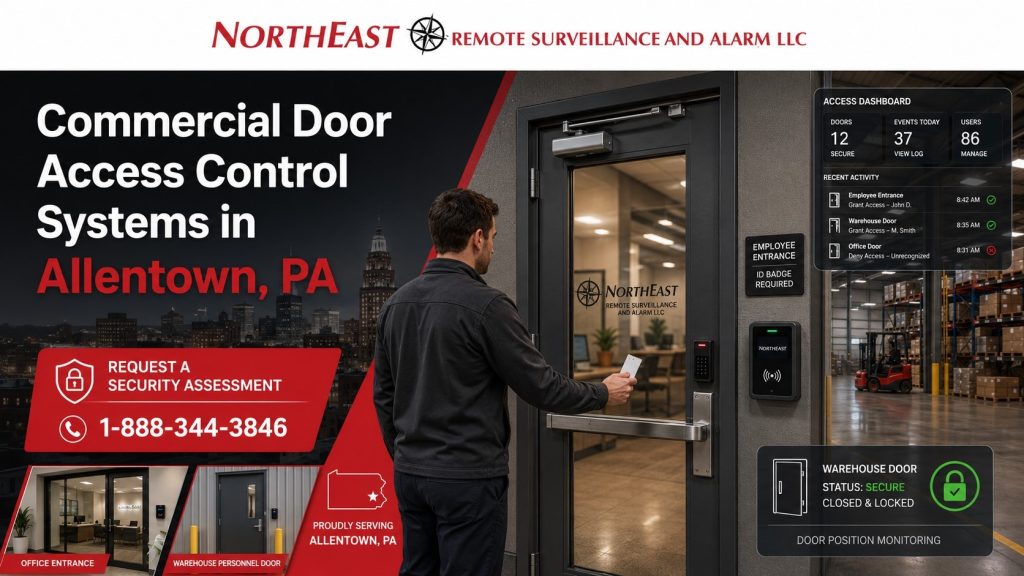
A Controlled Door Is a Complete Operating System
When an authorized person presents a card, fob, mobile credential, PIN, or supported biometric credential, the system must process more than a simple unlock command. It should confirm the user, apply the correct permission and schedule, release the appropriate locking hardware, recognize the authorized entry or exit, and verify that the door closes and returns to a secure condition.
A complete controlled opening may include:
- Card, fob, mobile, PIN, or supported biometric credential
- Credential reader or keypad
- Access control controller and software
- Electric locking or compatible exit-device hardware
- Door-position monitoring
- Request-to-exit equipment
- Power supply and backup battery
- Protected wiring and network communication
- User permissions and access schedules
- Door-held and door-forced event reporting
- Administrative records and system documentation
Each part affects the operation of the opening. A capable reader cannot correct a door that does not latch, and reliable locking hardware cannot correct disorganized permissions or former employees whose credentials remain active.
Commercial Doors Commonly Placed Under Access Control
Allentown commercial properties range from offices and medical suites to multi-tenant buildings, warehouses, manufacturing facilities, institutional properties, and municipal operations. Their doors may serve very different users, traffic patterns, schedules, and security requirements.
Common controlled openings include:
- Main, rear, and side employee entrances
- Office and tenant-suite entrances
- Shared commercial-building entrances
- Office-to-warehouse transition doors
- Warehouse personnel doors
- Shipping and receiving offices
- Manufacturing and production entrances
- Service and contractor entrances
- IT and telecommunications rooms
- Inventory, records, tool, and equipment rooms
- Medication and supply rooms
- Management offices
- Mechanical and electrical rooms
- Other restricted interior spaces
Not every opening should receive the same reader, credential, lock, schedule, monitoring, or permission structure. The design should reflect the door’s purpose, traffic, users, physical condition, and required emergency behavior.
Employee and Shift Entrances
Employee entrances are often the busiest controlled doors in a commercial facility. The system may need to process repeated daily use, shift changes, temporary labor, deliveries, cleaning personnel, contractors, and approved after-hours entry.
A properly planned employee entrance can help an organization:
- Reduce uncontrolled key distribution
- Add or remove employees without rekeying the building
- Separate access by role, department, or shift
- Restrict nights, weekends, and holidays
- Issue time-limited contractor credentials
- Review credential and door activity
- Identify held-open or forced-door conditions
The door itself must also withstand the expected traffic and close reliably after each use.
Tenant and Shared-Building Doors
Multi-tenant properties may need access control at exterior entrances, common areas, stairwell doors, shared amenities, individual suites, and management spaces. The system should clearly separate property-management authority from tenant-level administration.
A property manager may need control over shared entrances while each tenant manages only its own suite and authorized users. Cleaning, maintenance, visitor, and temporary-occupant access should be limited to the correct doors and schedules without creating unnecessary building-wide permissions.
Restricted Interior Rooms
Commercial access control is not limited to exterior entrances. Interior doors may protect IT rooms, records, inventory, tools, medication, cash-handling areas, mechanical spaces, management offices, laboratories, and production-support rooms.
These openings may use different hardware and permission rules than exterior doors. The decision should be based on who needs access, when entry is required, whether an activity record is useful, and how the room must operate during an emergency.
Credentials, Permissions, and Daily Administration
The credential strategy should be secure enough for the organization while remaining practical to administer. Available options may include cards, key fobs, mobile credentials, individual PINs, or supported biometric technologies.
Selection should consider:
- Number of users and locations
- Employee turnover and temporary labor
- Department and shift structure
- Vendor and contractor access
- Credential security
- Existing reader technology
- Platform compatibility
- Administrative workload
- Future expansion plans
Some organizations use one credential type throughout the property. Others may issue cards or fobs to employees, mobile credentials to selected managers, and temporary credentials to contractors or vendors. The goal is a manageable system—not an unnecessary collection of credential types and disconnected administrative processes.
Permissions and Access Schedules
Not every credential holder should be able to use every controlled door. Permissions may be organized by employee, role, department, shift, building, tenant, restricted area, contractor assignment, or approved after-hours responsibility.
Schedules may limit access to:
- Normal business hours
- Specific work shifts
- Nights and weekends
- Holiday periods
- Cleaning or maintenance windows
- Delivery periods
- Temporary projects
- Approved after-hours entry
A warehouse employee may need an employee entrance and selected operational areas. An office employee may need the main entrance and one department. A manager may need several buildings or restricted rooms. A contractor may need one door for a limited period. Each person should receive the access required for the assignment without unnecessary building-wide authority.
Onboarding, Temporary Access, and Offboarding
The value of electronic access control depends on disciplined administration. New users should receive the correct credential, doors, schedules, and expiration conditions. Temporary access should end automatically or be reviewed promptly. When an employee, contractor, or tenant leaves, authorized administrators should deactivate access without delay.
Naming conventions, permission groups, administrator roles, and offboarding responsibilities should be documented so the system remains understandable as personnel and facilities change.
Door Status, Exceptions, and Activity Records
A credential event shows that someone requested access. Door monitoring helps show what happened at the opening afterward.
Depending on the equipment and programming, the system may record or report:
- Access granted or denied
- Door opened and closed
- Door forced open
- Door held open beyond an allowed period
- Authorized request to exit
- Schedule-related denial
- Controller communication trouble
- Selected power or system conditions
Door-position contacts and request-to-exit devices help distinguish a valid credential event from the actual movement and condition of the door. This is especially important at entrances that are frequently propped open, used for deliveries, or expected to relatch after heavy traffic.
Alerts should be assigned to people who understand the condition and are responsible for responding. Repeated events that no one reviews do not improve control of the building.
Matching the System to the Physical Opening
Access control equipment must be selected around the actual door, frame, lock, exit device, closer, traffic, exposure, and required operation. Existing conditions should be reviewed before readers, controllers, or locking hardware are ordered.
The evaluation may include:
- Door and frame construction
- Existing lock, latch, and exit device
- Door alignment and closing performance
- Fire rating and required release operation
- Exterior exposure and traffic volume
- Accessible entry requirements
- Automatic door operators
- Reader and device placement
- Wiring pathways and power transfer
- Door-position and request-to-exit monitoring
The reader authorizes entry, but the physical opening must release, close, and relatch correctly. Electronic equipment should not be expected to compensate for worn hinges, a weak closer, frame movement, latch binding, threshold interference, damaged hardware, or a door that is routinely propped open.
For detailed planning involving electric strikes, electrified trim, electrified locksets, exit devices, request-to-exit equipment, door contacts, power transfer, and access-control power supplies, visit Access Control Door Hardware in Allentown, PA.
Safe Exit and Accessible Entry
People must be able to leave a controlled area as required for the opening and building. Locking hardware, request-to-exit operation, emergency release, fire alarm interfaces, accessible-entry devices, and automatic operators must be coordinated rather than treated as unrelated components.
The correct arrangement depends on the door function, locking method, building use, and applicable requirements. Final equipment and release operation should be coordinated with the project team and the authorities responsible for the property.
Power, Wiring, Network, and System Resilience
A controlled door depends on supporting infrastructure that is often hidden after installation. Reader wiring, lock power, controller communication, door contacts, request-to-exit devices, network connectivity, equipment enclosures, output protection, and backup batteries must be planned as part of the opening.
Power supplies should be sized for the actual connected load and required operation. Wiring should be protected, labeled, documented, and accessible for future service. Network-connected controllers should be coordinated with the organization’s authorized IT personnel, including addressing, communication pathways, and remote administration.
The design should also account for practical expansion. Spare capacity, equipment locations, licensing, network availability, and cable pathways can determine whether adding future doors is straightforward or unnecessarily disruptive.
Single-Door, Multi-Door, and Enterprise Systems
A smaller business may need one employee entrance, a limited credential population, basic schedules, door-position monitoring, and straightforward administration.
A larger commercial or industrial facility may require multiple controllers, several employee groups, restricted interior areas, shift-based permissions, temporary labor management, contractor access, centralized reporting, and additional buildings.
An enterprise or multi-site organization may need:
- Central credential management
- Location-specific permissions
- Regional or site-level administrators
- Standardized readers and controllers
- Consistent door naming
- Coordinated employee offboarding
- Central event review
- Scalable licensing and documentation
The platform should fit the current operation while preserving a practical path for additional users, doors, buildings, and locations. A one-door project should not be overbuilt, but it should not be placed on a platform that prevents reasonable growth.
New Installations, Existing-Door Retrofits, and System Expansion
Commercial door access control may be installed during new construction, renovations, tenant improvements, office expansions, warehouse additions, existing-door conversions, or replacement of mechanical-key access.
Existing openings should be evaluated before equipment is reused or added. The condition of the door, frame, latch, closer, exit device, wiring pathway, power, and installed hardware may determine whether a retrofit is practical. Existing readers, controllers, credentials, and software should also be reviewed for compatibility, support status, licensing, and expansion capacity.
The objective is a dependable controlled opening and a supportable system—not simply the fastest way to mount a reader beside a door.
NERSA’s Commercial Door Access Control Process
Facility and Opening Review
NERSA reviews the proposed doors, user movement, traffic, restricted areas, schedules, administrative responsibilities, and required operating conditions.
System and Credential Planning
Readers, credentials, controllers, software, permission groups, schedules, event reporting, and expansion requirements are selected around the organization’s actual operation.
Door and Infrastructure Evaluation
The door, frame, lock, exit device, closer, wiring, power, network, monitoring devices, and emergency behavior are reviewed as one controlled opening.
Installation and Programming
Approved equipment is installed and programmed around authorized users, doors, schedules, access levels, event conditions, and administrator roles.
Functional Testing
Each opening is tested for credential response, locking, release, closing, relatching, request-to-exit operation, door-position reporting, and programmed abnormal-door events.
Documentation and Administrative Turnover
Controlled-door names, controller assignments, permission groups, schedules, equipment locations, and relevant system information are documented. Authorized administrators receive instruction on the functions included in the project.
Why Allentown Organizations Choose NERSA
Northeast Remote Surveillance and Alarm, LLC focuses on commercial and industrial security systems rather than residential alarm packages or consumer smart-lock products. NERSA serves Allentown and the surrounding Lehigh Valley with systems designed around business operations.
The company evaluates the complete controlled-door environment: credentials, readers, controllers, software, permissions, schedules, locking operation, door condition, request-to-exit operation, monitoring, power, wiring, network communication, documentation, and future expansion.
This approach supports single-door small businesses, multi-tenant commercial buildings, warehouses, manufacturing facilities, medical and institutional properties, municipal facilities, enterprise campuses, and multi-location organizations without treating every property as the same project.
Request a Commercial Door Access Control Assessment in Allentown, PA
NERSA can evaluate employee entrances, tenant doors, service entrances, warehouse personnel doors, restricted interior rooms, and other commercial openings at your Allentown property. The assessment can identify the users, schedules, hardware conditions, monitoring requirements, infrastructure, administrative responsibilities, and expansion needs that should guide the system design.
Request a Commercial Security Assessment or call 1-888-344-3846.
Frequently Asked Questions About Commercial Door Access Control in Allentown, PA
What is a commercial door access control system?
A commercial door access control system uses credentials, readers, controllers, software, locking hardware, permissions, schedules, and monitoring devices to manage entry through selected business doors.
What types of commercial doors can be controlled?
Common openings include employee entrances, tenant and office-suite doors, warehouse personnel doors, service entrances, shared-building entrances, IT rooms, records rooms, inventory areas, and other restricted interior spaces.
Can access control be installed on an existing door?
Often, yes. The door, frame, latch, closer, exit device, fire rating, wiring pathway, locking hardware, power, and required emergency operation should be evaluated before equipment is selected.
Can different employees access different doors?
Yes. Permissions may be assigned by employee, role, department, shift, building, tenant, restricted area, or approved schedule.
Can access be limited by time?
Yes. Credentials may be limited to business hours, work shifts, delivery periods, temporary assignments, cleaning schedules, or approved after-hours access.
What happens when an employee or contractor leaves?
An authorized administrator can deactivate the electronic credential. The organization should maintain a prompt offboarding process so access is removed as soon as it is no longer required.
Can contractors and vendors receive temporary access?
Supported systems can provide credentials limited by door, schedule, site, assignment, or expiration date. Temporary permissions should be reviewed and removed when the work is complete.
Can the system report a door that is propped open?
A properly installed door-position contact can help report when a door remains open beyond its programmed period. The facility should assign responsibility for reviewing and responding to the event.
Can tenant and shared-building doors be administered separately?
Yes. A properly planned system can separate property-management authority, shared exterior access, tenant-suite permissions, maintenance access, and other approved responsibilities without giving every administrator control over the entire building.
Does electronic access control eliminate mechanical keys?
It can reduce dependence on traditional keys, but some openings may retain a mechanical override or another authorized access method based on the door and facility requirements.
Do controlled doors still allow emergency exit?
They must be planned to preserve required egress and emergency operation. The locking hardware, release method, request-to-exit arrangement, and applicable interfaces should be selected around the specific opening.
Can access control work with an automatic door operator?
Possibly. The access control system, operator, locking hardware, accessible-entry devices, power, and emergency operation must be coordinated as one opening.
Can a single-door system be expanded later?
Many commercial platforms can support additional doors, but controller capacity, licensing, power, communication, credential compatibility, and system architecture should be considered during the initial design.
Does NERSA support both small businesses and enterprise facilities?
Yes. NERSA supports single-door small-business systems, multi-door commercial buildings, warehouses, manufacturing facilities, institutional properties, enterprise campuses, and multi-location organizations.