Northeast Remote Surveillance and Alarm, LLC designs and installs hospitality security systems for hotels, restaurants, bars, event venues, banquet halls, mixed-use hospitality properties, and customer-facing commercial spaces in Allentown, PA. This page focuses on privacy-aware camera placement, parking lot visibility, access control, intrusion alarms, panic buttons, guest and employee safety, back-of-house protection, monitoring, and practical security planning for hospitality environments. For the broader citywide security structure, start with Commercial Security Systems in Allentown, PA.
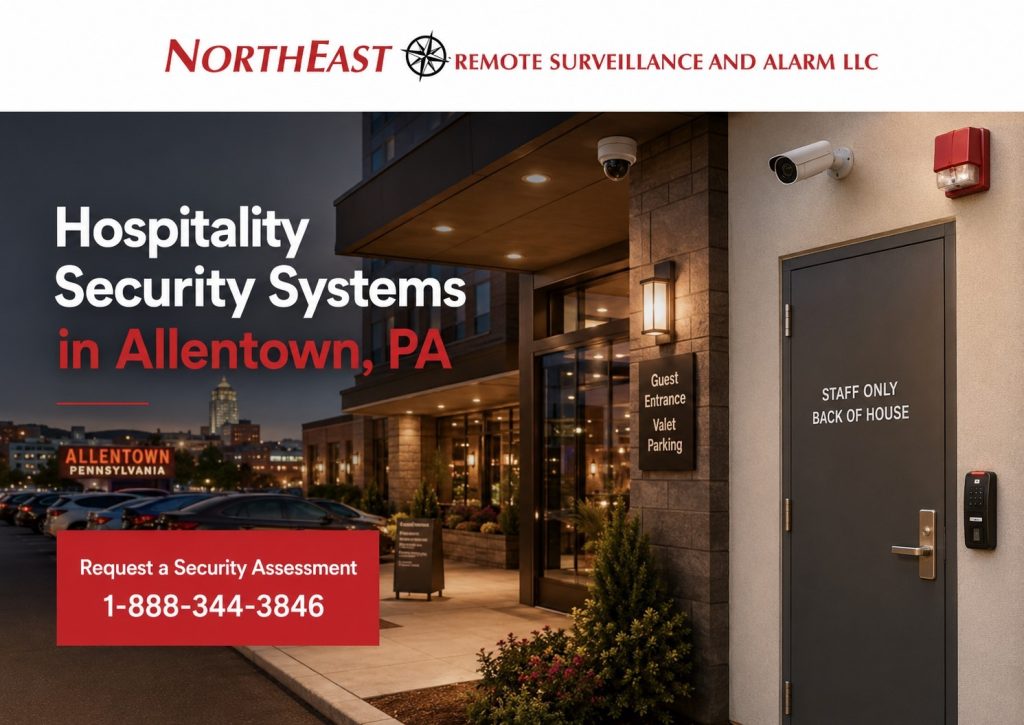
Hospitality Security Systems in Allentown, PA – Planning for Allentown Properties
Hospitality properties need security systems that support public access without weakening control over staff areas, cash-handling points, storage rooms, kitchens, offices, parking lots, entrances, and after-hours spaces. A hotel, restaurant, bar, event venue, banquet hall, and mixed-use hospitality property will not require the same security layout.
The right system should help the business improve visibility, document incidents, support employee safety, manage restricted areas, protect guests, reduce after-hours exposure, and review activity when something happens on the property.
NERSA designs hospitality security systems around how the business actually operates. That includes guest movement, employee flow, open and close procedures, deliveries, parking exposure, public entrances, back-of-house areas, cash points, alarm zones, camera placement, access-control needs, monitoring expectations, and long-term support.
Hospitality Security Systems in Allentown, PA – Planning Topics in Allentown
Hotel Security Systems in Allentown, PA
Use [Hotel Security Systems in Allentown, PA] for properties that need camera coverage, staff access control, parking lot visibility, guest-area awareness, back-office protection, intrusion alarms, and after-hours monitoring.
Restaurant Security Systems in Allentown, PA
Use [Restaurant Security Systems in Allentown, PA] for dining rooms, kitchens, back-of-house areas, employee entrances, delivery doors, cash points, liquor or inventory storage, and after-hours alarm protection.
Bar and Nightlife Security Systems in Allentown, PA
Use [Bar and Nightlife Security Systems in Allentown, PA] for customer-facing properties that need entrance cameras, staff safety planning, cash-area visibility, panic buttons, controlled storage, and incident documentation.
Event Venue and Banquet Hall Security Systems in Allentown, PA
Use [Event Venue and Banquet Hall Security Systems in Allentown, PA] for venues that need visitor flow visibility, access control, parking lot coverage, staff-only area protection, alarm systems, and event-related incident review.
Hospitality Parking Lot Security Cameras in Allentown, PA
Use [Hospitality Parking Lot Security Cameras in Allentown, PA] for guest parking, employee parking, exterior walkways, vehicle incidents, lighting concerns, entry approaches, and after-hours exterior activity.
Back-of-House Access Control in Allentown, PA
Use [Back-of-House Access Control in Allentown, PA] for kitchens, offices, storage rooms, employee-only corridors, delivery entrances, utility spaces, and restricted hospitality operations areas.
Panic Button Systems for Hospitality Staff in Allentown, PA
Use [Panic Button Systems for Hospitality Staff in Allentown, PA] for front desks, reception areas, bars, cash-handling areas, manager offices, late-night staff areas, and locations where discreet duress notification may be needed.
Commercial Video Surveillance Systems in Allentown, PA
Use Commercial Video Surveillance Systems in Allentown, PA when a hospitality property needs camera planning for entrances, parking lots, dining areas, corridors, lobbies, exterior doors, and incident documentation.
Commercial Intrusion Alarm Systems in Allentown, PA
Use Commercial Intrusion Alarm Systems in Allentown, PA for after-hours protection, door contacts, motion detection, glass-break protection, stockroom alarms, panic buttons, and monitored alarm response.
Camera Coverage for Public and Guest Areas
Hospitality camera coverage should be planned carefully because these properties include public spaces, employee-only spaces, guest-facing areas, parking lots, and privacy-sensitive zones. Cameras should support safety, documentation, and incident review without creating unnecessary or inappropriate coverage.
Common camera locations may include entrances, lobbies, host stands, reception areas, dining-room approaches, corridors, parking areas, exterior doors, delivery points, cash-handling areas, and back-of-house transition points. Camera placement should avoid private areas, restrooms, changing areas, guest rooms, and other spaces where privacy expectations are high.
The goal is useful visibility, not excessive recording. A properly designed hospitality camera system should help management understand what happened, where it happened, when it happened, and what response may be needed.
Parking Lot and Exterior Hospitality Security
Parking lots and exterior areas are major exposure points for hospitality properties. Guests, employees, vendors, delivery drivers, service vehicles, rideshare pickups, event traffic, and after-hours activity may all move through the same exterior spaces.
Parking lot camera planning should account for lighting, pedestrian paths, vehicle movement, guest entrances, staff parking, delivery areas, side doors, dumpster areas, rear approaches, and blind spots. Some properties need general overview coverage, while others need more detailed views near entrances, walkways, cash-drop areas, or vehicle approaches.
Exterior security may also include intrusion alarms, remote video monitoring, lighting review, gate control, access control, or license plate recognition depending on the property and risk level.
Access Control for Staff-Only and Back-of-House Areas
Hospitality properties often need to separate public-facing areas from staff-only spaces. Kitchens, storage rooms, offices, liquor storage, utility rooms, mechanical spaces, employee entrances, server areas, and back-of-house corridors may need stronger control.
Traditional keys can create problems when employees change roles, leave the business, share keys, or lose access devices. Access control gives management a cleaner way to assign credentials, remove users, control schedules, and review door activity.
A hospitality access control system may include card readers, key fobs, mobile credentials, keypad access, electrified hardware, door position monitoring, and controlled entry workflows. The system should support the operation without slowing down staff movement or creating unsafe conditions.
Intrusion Alarms and After-Hours Protection
Hospitality properties often have irregular schedules, late-night activity, deliveries, cleaning crews, vendors, and back-of-house access needs. The alarm system should be planned around how the business opens, closes, and operates after normal customer hours.
A commercial intrusion alarm system may include door contacts, glass-break detection, motion detection, keypad control, panic buttons, duress devices, monitoring, video verification, and separate zones for public areas, back offices, storage spaces, and restricted rooms.
The right alarm layout depends on the property type. A hotel, restaurant, banquet hall, and bar may each need different zoning, monitoring, and response procedures.
Panic Buttons, Duress, and Employee Safety
Hospitality staff may work at front desks, bars, reception areas, late-night service counters, cash-handling points, and public-facing spaces where discreet alerting may be useful.
Panic button planning should consider where staff are located, who receives alerts, whether monitoring is involved, how alerts are verified, and what response process follows. A panic button without a defined response plan can create confusion.
Panic and duress devices can support staff safety, but they should be part of a broader plan that may include cameras, alarms, access control, procedures, monitoring, and training.
Cash Handling, Storage, and Inventory Protection
Restaurants, bars, event venues, and hotels may have cash drawers, safes, manager offices, liquor storage, inventory rooms, stock areas, equipment storage, and delivery zones that need stronger visibility or restricted access.
Camera placement around cash-handling areas should be practical and detailed enough to support review without interfering with daily operations. Storage and inventory areas may need access control, intrusion detection, camera coverage, or alarm zoning depending on the value and sensitivity of the materials being protected.
Security systems support accountability, but they do not replace employee procedures, inventory controls, supervision, or management policy.
Visitor Entry, Deliveries, and Vendor Access
Hospitality properties often receive deliveries, vendors, service providers, event staff, contractors, and temporary workers. These access patterns can create risk if rear doors, delivery doors, kitchen entrances, storage rooms, or service corridors are not controlled.
Visitor and vendor access may be supported with intercoms, access control, camera coverage, door-release workflows, scheduled credentials, or management review depending on the property.
The right approach should balance convenience, safety, accountability, and operational flow. A delivery entrance for a restaurant is different from a hotel service corridor or an event venue loading area.
Remote Access and Multi-Location Hospitality Management
Owners, operators, managers, and approved staff may need remote access to cameras, alarm notifications, access-control activity, and event review. Remote access can help hospitality businesses review incidents, check exterior areas, manage staff entry, and support operations across more than one location.
Remote access should be controlled with proper permissions. Not every employee needs the same level of system access, and user access should be removed when roles change.
For multi-location hospitality groups, consistency matters. Cameras, alarms, access-control permissions, remote access, user roles, monitoring, and service standards should be planned so each property can be managed clearly.
Fire Alarm, Life Safety, and Hospitality Operations
Hospitality properties must be planned with life safety in mind. Security systems should not interfere with required egress, fire alarm systems, emergency exits, fire doors, accessibility, inspection access, or emergency procedures.
Access control, maglocks, electrified hardware, alarm devices, cameras, intercoms, panic buttons, and low-voltage pathways should be installed with awareness of the building’s use and occupancy conditions.
Security systems do not replace fire alarm systems, emergency plans, employee training, or life-safety procedures. They should support safer and more accountable operations without creating conflicts with emergency movement or inspection-sensitive conditions.
Compliance-Aware Hospitality Security Planning
Hospitality security systems can support incident documentation, employee safety review, access accountability, after-hours event review, and operational security when designed correctly. Camera placement, access control, alarm zones, panic buttons, wiring pathways, user permissions, and remote access should be planned around the actual property.
For code-sensitive planning involving security systems, access control, documentation, emergency egress, fire/life-safety coordination, OSHA-aware planning, ADA access control, and Pennsylvania UCC considerations, use [Compliance-Aware Security Planning in Allentown, PA].
A strong hospitality security plan should help the business improve visibility, control restricted areas, document incidents, support staff safety, protect guests, and secure the property after hours.
Why Allentown Hospitality Businesses Choose NERSA
Northeast Remote Surveillance and Alarm, LLC focuses on commercial and industrial security systems, not residential alarm packages. Hospitality businesses choose NERSA when they need security planning that accounts for guest movement, employee safety, parking lots, cash areas, back-of-house spaces, intrusion alarms, cameras, access control, and long-term support.
NERSA designs systems around real operations. A hotel, restaurant, bar, event venue, banquet hall, and multi-location hospitality business will not require the same security design.
Our goal is to help Allentown hospitality properties improve visibility, reduce security gaps, protect staff and guests, manage access, document incidents, strengthen after-hours protection, and build a security system that can be maintained over time.
Request a Hospitality Security Assessment in Allentown
If your Allentown hospitality property needs security cameras, intrusion alarms, access control, panic buttons, parking lot cameras, guest-area visibility, back-of-house protection, remote access, monitoring, or low-voltage infrastructure support, Northeast Remote Surveillance and Alarm, LLC can help.
Use Request a Security Assessment to review your property, entrances, parking areas, guest spaces, staff areas, back-of-house doors, cash points, alarm zones, camera views, monitoring requirements, and hospitality security goals.
Frequently Asked Questions About Hospitality Security Systems in Allentown, PA
What is a hospitality security system?
A hospitality security system uses cameras, intrusion alarms, access control, panic buttons, monitoring, remote access, intercoms, and system design to help protect hotels, restaurants, bars, event venues, guests, employees, parking areas, cash points, and back-of-house spaces.
Does NERSA install hospitality security systems in Allentown?
Yes. Northeast Remote Surveillance and Alarm, LLC installs hospitality security systems for hotels, restaurants, bars, event venues, banquet halls, mixed-use hospitality properties, and customer-facing commercial spaces in Allentown, PA.
What areas should hospitality cameras cover?
Common camera areas include entrances, lobbies, reception areas, dining-room approaches, corridors, parking lots, exterior doors, delivery points, cash-handling areas, employee entrances, and back-of-house transition areas.
Are cameras allowed in every hospitality area?
No. Camera placement should be planned carefully. Cameras should not be placed in private areas, restrooms, changing areas, guest rooms, or other privacy-sensitive locations.
Do restaurants and bars need intrusion alarms?
Many restaurants and bars benefit from intrusion alarms because rear doors, glass openings, cash areas, storage rooms, kitchens, offices, and liquor or inventory areas may need after-hours protection.
Can hospitality businesses use access control?
Yes. Hospitality businesses can use access control for staff-only doors, kitchens, storage rooms, offices, liquor storage, utility rooms, delivery entrances, employee entrances, and back-of-house corridors.
Are panic buttons useful in hospitality environments?
Yes. Panic buttons and duress devices can support staff safety at front desks, reception areas, bars, registers, manager offices, cash rooms, and late-night service areas.
Do hospitality properties need parking lot cameras?
Many hospitality properties benefit from parking lot cameras because guests, employees, vendors, delivery drivers, rideshare vehicles, and after-hours activity all create exterior security concerns.
Can NERSA support multi-location hospitality businesses?
Yes. NERSA can help multi-location hospitality businesses plan consistent cameras, alarms, access control, remote access, user permissions, monitoring, and service standards across multiple properties.
Can NERSA upgrade an existing hospitality security system?
Yes. NERSA can review existing cameras, alarms, access control, panic buttons, monitoring, remote access, network conditions, user permissions, and coverage gaps to determine whether the system should be repaired, upgraded, expanded, or replaced.