
Warehouse fire alarm systems in Allentown, PA support early detection, clear occupant notification and reliable monitoring across large facilities.


Review the broader project scope and coordination needs in Allentown commercial fire alarm planning.
Fire Detection for Warehouse Environments
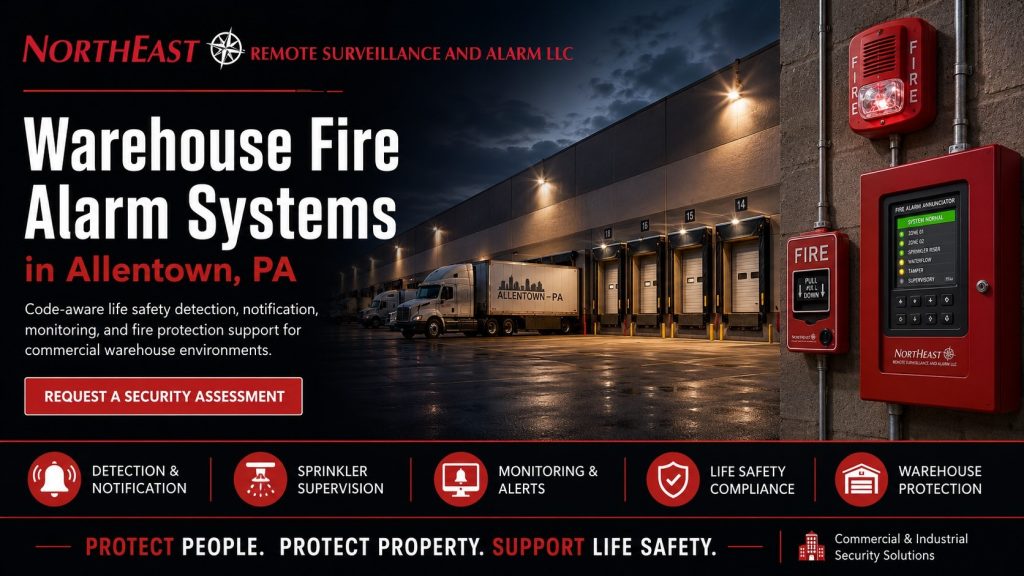
NERSA reviews the warehouse layout, building use, occupancy and existing fire protection before defining the work. High ceilings, storage changes and large open areas affect project planning. Identify whether you need a new installation, changes to an existing system or a monitoring review so the assessment covers the right scope.
Final requirements depend on adopted codes and the authority having jurisdiction. Therefore, the project should coordinate design, permits, inspections and documentation with the applicable parties.
System Components and Supervision
- Fire alarm control equipment
- Smoke, heat or other approved detection
- Manual pull stations where required
- Horn, strobe and speaker notification
- Sprinkler supervisory and waterflow connections
- Communicator and monitoring connections
- Power supplies and backup batteries
For example, a supervised sprinkler valve can report an off-normal condition. Waterflow equipment can also initiate the required alarm response. Meanwhile, notification appliances alert occupants according to the approved design.
Coverage for Large and Changing Spaces
Storage height, racking and environmental conditions can affect device selection. In addition, warehouse renovations may change notification or detection needs. NERSA reviews those conditions before defining device locations.
Loading docks, office areas, mechanical rooms and storage zones may require different approaches. Likewise, the design should support safe testing and future service access.
Monitoring, Testing and Service Records
A monitored system communicates alarm, supervisory and trouble signals according to the response plan. Specifically, authorized contacts need clear notification procedures. The communication path must also remain dependable.
Inspection and service records support ongoing system management. As a result, facility teams can track testing, corrections and equipment changes over time. Regular review also helps identify issues before a scheduled inspection.
Scalable for One Facility or Many
A smaller warehouse may use one control panel and a focused device layout. By contrast, an enterprise may manage several buildings or interconnected systems. Consistent documentation and service procedures can support both.
Most importantly, each facility keeps requirements that match its occupancy and approved design. The program can expand as buildings or operations change.
Warehouse changes that can affect fire alarm design
Storage heights, rack arrangements, commodity classifications, dust, airflow, temperature variation, dock openings and ceiling obstructions can influence a warehouse fire-alarm project. Document the actual occupancy and existing protection system, and coordinate with the owner, fire-protection professionals and authority having jurisdiction before assuming an office-style detector layout or notification approach will work. The correct fire-detection, sprinkler monitoring and occupant notification requirements depend on the approved design and adopted rules.
Panel, communicator and interface review
Identify the existing fire-alarm control unit, initiating circuits or addressable devices, notification appliances, supervising station connection, standby power and required building interfaces. Upgrades may need coordination with sprinkler supervisory signals, elevator recall or access-controlled door releases when applicable. These functions require listed, compatible equipment and approved sequences; an ordinary intrusion-alarm communicator or a general-purpose relay should not be treated as an automatic substitute for listed fire-alarm functions.
Warehouse fire-alarm acceptance and ongoing records
- Review current drawings, panel inventory, monitoring documentation and known trouble conditions.
- Confirm detection and notification coverage against the engineered scope after rack or tenant changes.
- Coordinate required functional tests, alarm transmission and interface witnessing with the responsible parties.
- Document panel programming, battery calculations, device locations, test records and unresolved deficiencies.
- Retain an inspection and maintenance schedule consistent with applicable requirements.
Identify warehouse fire-protection changes that affect alarms
Storage use, rack height, commodity types, partition walls, tenant improvements and occupancy changes can alter how a warehouse fire-alarm system is designed and reviewed. Begin with existing approved drawings, the current control panel model, device list, monitoring arrangement and recent inspection reports. Determine who is responsible for any engineering, electrical, sprinkler, fire-protection or alarm work. A generic warehouse security package does not establish whether a new initiating device, notification appliance or special interface is required.
Keep functions and responsibilities separate
Fire detection, occupant notification, sprinkler monitoring, supervisory signals, equipment shutdown and approved interface operations may have distinct design and inspection requirements. Record which system owns each signal and who must witness its operation. An intrusion sensor or video analytic is not a substitute for a listed fire detector. Access-controlled doors, elevator recall and other interfaces require their own approved sequence; do not claim every electrically locked door should respond identically to an alarm.
Review communication and system support
Confirm that panel firmware, device compatibility, power supplies, batteries and communication paths remain supported. Where an old telephone communicator is to be replaced, verify that the proposed cellular, IP or dual-path device meets the actual panel and governing requirements. Coordinate any monitoring change with the existing service provider and appropriate authority before disconnecting the legacy path. Record power calculations, supervision, backup runtime and signal destinations without making site-specific compliance promises from general website content.
Document acceptance and ongoing inspection
Required testing must follow the applicable adopted code, approved drawings and authority procedures. Keep results for alarm, supervisory and trouble signaling; notification functions; required interfaces; power and communication fault; and restoration. Record device addresses, labels, deficiencies, correction dates and customer handover responsibilities. Warehouses frequently reconfigure racking and partitions, so the owner should revisit alarm coverage during building alterations rather than waiting for a recurring inspection to reveal changes.
Related Allentown Services
For the citywide fire category, review commercial fire alarm systems in Allentown.
For wider facility protection, see warehouse security systems.
Schedule a Warehouse Assessment
Finally, schedule an assessment to review fire alarm needs, existing equipment, monitoring and next steps for your Allentown warehouse.
Compliance, Codes & Project Standards
NERSA plans commercial and industrial security work with applicable code, documentation, inspection and authority-having-jurisdiction requirements in mind. Requirements vary by system, property and jurisdiction. These resources support project planning; they do not establish legal compliance, certification or AHJ approval.
Related guidance: Regulatory compliance & inspection readiness · Fire alarm inspection readiness · NFPA 72 fire-alarm planning