
Remote video monitoring vs self-monitoring in Easton, PA compares professional event response with owner-managed alerts so Easton businesses can choose a clear monitoring model.

For camera coverage and recording requirements, start with Easton video surveillance services.
Choose the response model before choosing features
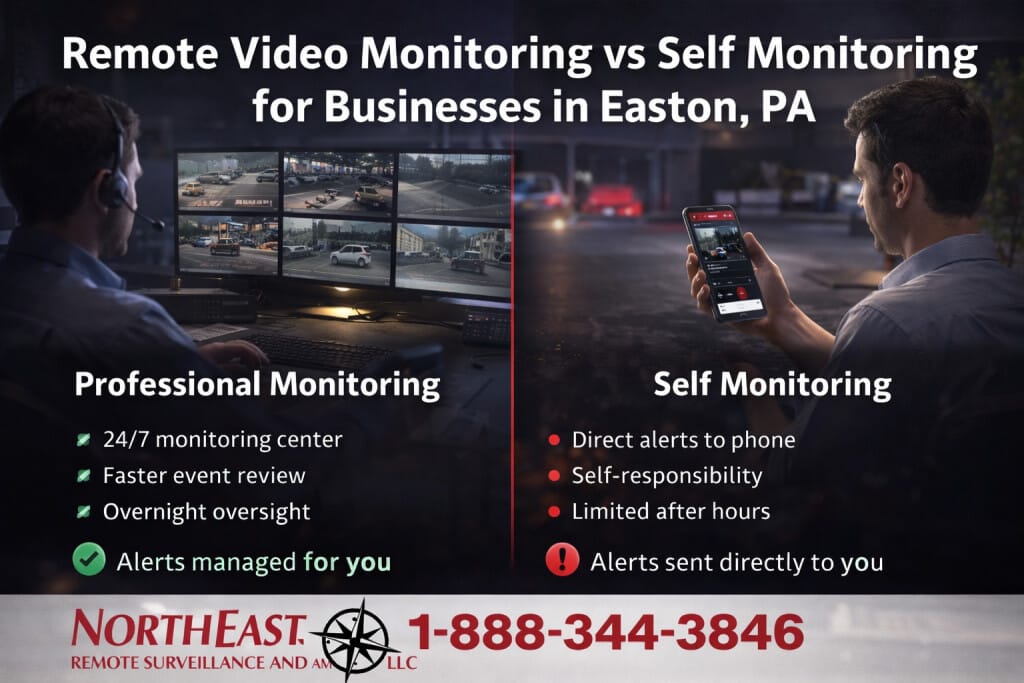
First, decide who must receive an alert and who can act on it. Self-monitoring sends notifications to selected owners or staff. Professional monitoring, however, routes defined events to trained operators who follow an agreed response plan.
Next, compare coverage hours, staffing, live verification, talk-down, and escalation. Review how each model handles missed calls, false alerts, evidence, privacy, and a network or power loss. The choice reflects daily operations instead of a feature list.
What the assessment covers
- Who receives alerts and who has authority to respond
- Coverage hours, backup contacts, and missed-notification procedures
- Live video verification, talk-down, and dispatch rules
- False-alert review, event clips, audit history, and evidence exports
- Privacy limits, user roles, and secure mobile access
- Network and power failure behavior, testing, maintenance, and cost
Both models need written rules. For example, the team should define priority events, contact order, site access, and when emergency services may be called. Every user should know how to test alerts and report a change in staffing.
Test the Alert and Response Procedure
Begin with a short response workshop. Then list the events that matter, the people who can act, and the hours that need coverage. Finally, test a sample alert from detection through resolution and record the result.
For related alarm, access-control, and fire-alarm services, see Easton commercial security services.
Compare the People and Hours Behind Each Option
With self-monitoring, selected owners, managers or employees receive alerts and decide whether to investigate or respond. This can fit a small commercial property with staff who are routinely available, but it relies on their willingness and ability to review messages at night, on weekends and during vacations. Missed notifications, staff turnover and changes in contact information are operational risks that should be addressed before using alerts as the primary response plan.
Professional remote video monitoring, where separately contracted, assigns defined events to a staffed service following written procedures. Coverage hours, video review, live talk-down, keyholder calls, escalation and event documentation depend on the scope. A quote for cloud video or mobile notifications is not necessarily a staffed monitoring agreement. Ask for the operator’s role, excluded events, verification method and response chain in writing rather than comparing products by the number of alerts they can send.
Create an Event-Handling Plan That Can Be Tested
Select the incidents that justify attention, such as an intruder in a closed yard, activity at a loading dock after hours or unauthorized vehicle movement. Decide which cameras or analytics rules provide sufficient context and which are likely to create nuisance events. Review whether the site has reliable internet connectivity, local recording, power backup and a way to recover after an outage. Monitoring software cannot compensate for an unreadable view or disconnected camera.
Test sample events in business hours and after hours. Record who received the alert, how they confirmed the incident, which contact was called and what event history remains accessible to the customer. Put privacy rules and data access in the agreement, and reassess the plan when opening hours, staffing or facility risks change. For a complete comparison, include the annual service fees and management responsibilities, not only initial camera costs.
Monitoring choice questions
Is a push notification equivalent to 24/7 monitoring?
No. A push notification asks the recipient to act; contracted staffed monitoring requires a defined service, event coverage and response procedure.
Which option is better for an unattended warehouse?
It depends on the response needed and available staff. Compare operator coverage, event verification, expected incidents, site connectivity and recurring service costs before selecting the model.
Request an Easton assessment
NERSA can review your Easton property and help compare professional remote video monitoring with self-monitoring based on your staffing and response needs.
Request a security assessment.
Compliance, Codes & Project Standards
NERSA plans commercial and industrial security work with applicable code, documentation, inspection and authority-having-jurisdiction requirements in mind. Requirements vary by system, property and jurisdiction. These resources support project planning; they do not establish legal compliance, certification or AHJ approval.
Related guidance: Regulatory compliance & inspection readiness · NERSA project standards · Documentation, testing & inspection readiness