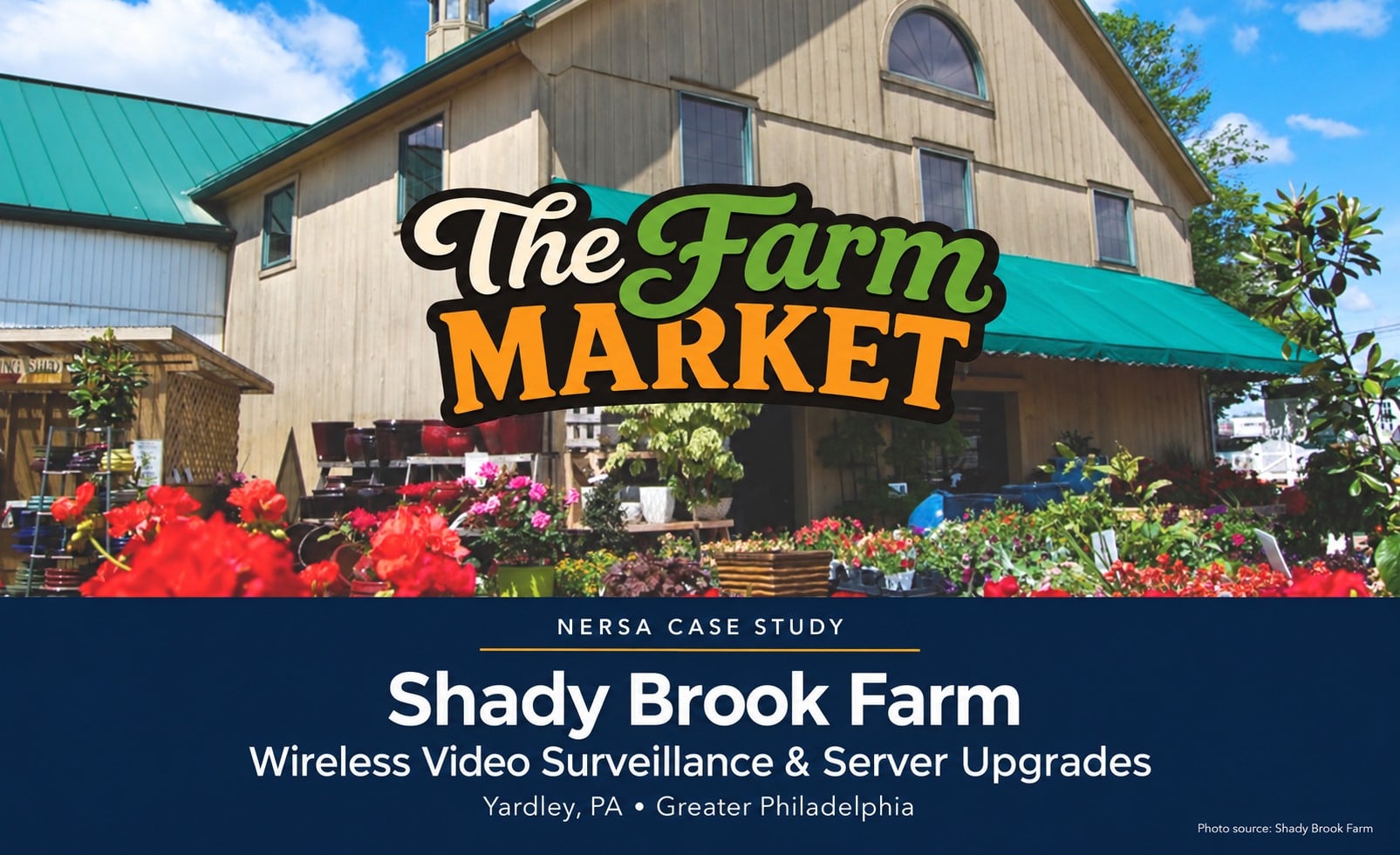
At Shady Brook Farm in Yardley, Pennsylvania, video supports security and daily operations.
Request a wireless surveillance assessment
Connecting Security with Daily Operations
A visual record can help management review missing products, undocumented activity, staffing needs, employee activity and customer interactions.
Northeast Remote Surveillance and Alarm, LLC (NERSA) addressed these priorities through video surveillance connected by point-to-point and point-to-multipoint wireless bridges, server upgrades, and AI-enabled cameras. The project brought together camera technology, network connectivity, and supporting server infrastructure to support motion-based recording, incident searches, and video review.
For this Greater Philadelphia property, the focus was practical: connect surveillance across the site and make recorded activity more useful to the people responsible for security and daily operations.
The Challenge: Missing Information When It Matters
When products go missing, management needs more than assumptions. Understanding the circumstances may require reviewing movement through an area, establishing a timeline, or comparing observed activity with available business records. Video can contribute to that process without automatically establishing why an item is missing or who is responsible.
An event may happen outside a manager’s view, and later accounts may be incomplete. Recordings give authorized staff another source to review. They can help clarify a concern or identify questions that need further investigation.
Staffing and customer interactions add operational considerations. Managers may need to understand when activity increases, where employees are working, and how a particular interaction unfolded. The surveillance project addressed these needs alongside the broader responsibility to protect the property and document security events.
Wireless Bridges Connect the Surveillance System
NERSA connected video surveillance through a combination of point-to-point and point-to-multipoint wireless bridges.
These connections provide network paths between surveillance equipment and the systems used to receive, record, or manage video.
A point-to-point wireless bridge links two locations. Within a surveillance network, this approach can connect a camera location or a group of devices to another network endpoint. It provides a focused connection where the design calls for communication between two defined points.
Point-to-multipoint connectivity supports multiple remote endpoints communicating with a central location. This arrangement can serve a distributed camera layout where several viewing positions need connectivity within the same overall surveillance system.
Using both wireless approaches lets the network design fit the camera locations and supporting infrastructure. Each connection must carry the required video traffic.
Wireless connectivity still requires planning around distance, obstructions, mounting, interference, capacity, and power at each endpoint. A wireless bridge provides a data connection; it does not eliminate the need to account for those installation conditions.
Server Upgrades Support the Broader System
The Shady Brook Farm project also included server upgrades.
Camera improvements and network connections form only part of a surveillance solution.
Supporting servers and network infrastructure must be considered alongside the video workload and the functions expected from the system.
Recording, storage, playback, and video management requirements can place different demands on infrastructure. Their relationship matters when planning an upgrade: adding cameras or changing recording settings can affect the resources needed to support the complete system.
The server work was part of the project’s broader modernization effort. It complemented the wireless surveillance connections and AI-enabled cameras, addressing the infrastructure behind the views that staff use.
For a similar project, start server planning with three questions: Which video functions are needed? How will authorized users access recordings? How much storage and system capacity will the chosen setup require?
AI-Enabled Cameras for Motion Recording and Review
NERSA included AI-enabled cameras to support more accurate motion-based recording and more efficient incident search and review. The objective was to make the surveillance system more useful when management needs to find activity associated with a particular concern.
Motion-based recording depends on how the camera and recording system are configured. AI capabilities can help distinguish relevant activity from other changes in a scene, subject to the features supported by the equipment and the conditions at each location.
That distinction matters in daily use. A recording system should help staff focus their attention on events worth reviewing. Appropriate detection settings can support that objective, while camera positioning and scene conditions remain essential to useful results.
Incident review also requires context. An alert or search result provides a starting point for examination, not a complete explanation. Authorized staff should review the relevant footage and surrounding sequence before reaching conclusions about an event.
Documenting Products, Employees, and Customer Interactions
For missing-product concerns, surveillance provides a way to examine recorded activity within the areas covered by cameras. Management can use relevant footage to help establish timing and understand visible movement, alongside inventory information and other available records.
Recordings give authorized reviewers a visual reference for activity that was not otherwise documented. Staff can check the footage instead of relying only on memory, then identify what else they need to know.
Employee activity and staffing requirements introduce another use for that record. Video may help managers understand activity patterns, review coverage during a particular period, or assess the circumstances surrounding an operational issue. Staffing decisions still require consideration of workload, schedules, responsibilities, and information beyond the camera view.
Customer interaction documentation can similarly support a balanced review of concerns. Relevant footage may help clarify the visible sequence of an encounter, subject to camera coverage and recording quality. Reviewing the surrounding activity helps management consider the context of each interaction and identify appropriate follow-up steps.
A Coordinated Approach to Security
The project combines several functions that depend on one another. Cameras capture activity, wireless bridges carry video across network connections, and server infrastructure supports the selected system functions. AI-enabled features assist with identifying and locating activity for review.
The strength of this approach is coordination. A useful camera view needs an appropriate connection, and a recorded event needs an accessible review process. Considering those elements together keeps the project focused on how management will actually use the system.
At Shady Brook Farm, the documented scope addresses security and operational visibility through that combination of technologies. It provides a practical example of surveillance modernization organized around business concerns rather than equipment alone.
Planning a Similar Surveillance Upgrade
Businesses facing missing products, gaps in documentation, or difficult incident searches can begin by identifying the questions their current system cannot answer. Those questions help define camera coverage, connectivity, recording, and review priorities.
Agree on the project scope with management and the installation team. Define what each camera should capture, who may access recordings and how staff request a review. Revisit these decisions as operations, staffing and camera needs change.
NERSA develops surveillance solutions around the property, existing infrastructure, and operational requirements.
For businesses in Yardley, Bucks County, and Greater Philadelphia, a coordinated assessment can identify where wireless connections, server improvements, and AI-enabled cameras may support a more useful security system.
Explore our commercial and industrial security case studies, Greater Philadelphia security services, commercial video surveillance systems, and security system upgrades.
Request a wireless surveillance assessment to discuss camera coverage, connectivity, and upgrades for your property.
Compliance, Codes & Project Standards
NERSA plans commercial and industrial security work with applicable code, documentation, inspection and authority-having-jurisdiction requirements in mind. Requirements vary by system, property and jurisdiction. These resources support project planning; they do not establish legal compliance, certification or AHJ approval.
Related guidance: Regulatory compliance & inspection readiness · Video surveillance compliance · NERSA project standards