Employee entrance surveillance for industrial facilities helps document worker movement, shift changes, badge areas, parking transitions, access-controlled doors, visitor activity, and incidents near plant entry points. This page focuses specifically on video surveillance planning for employee entrances and shift-change areas in manufacturing plants, production facilities, warehouses connected to industrial operations, and commercial-industrial buildings. For the broader industrial camera planning structure, start with Industrial Video Surveillance Systems.
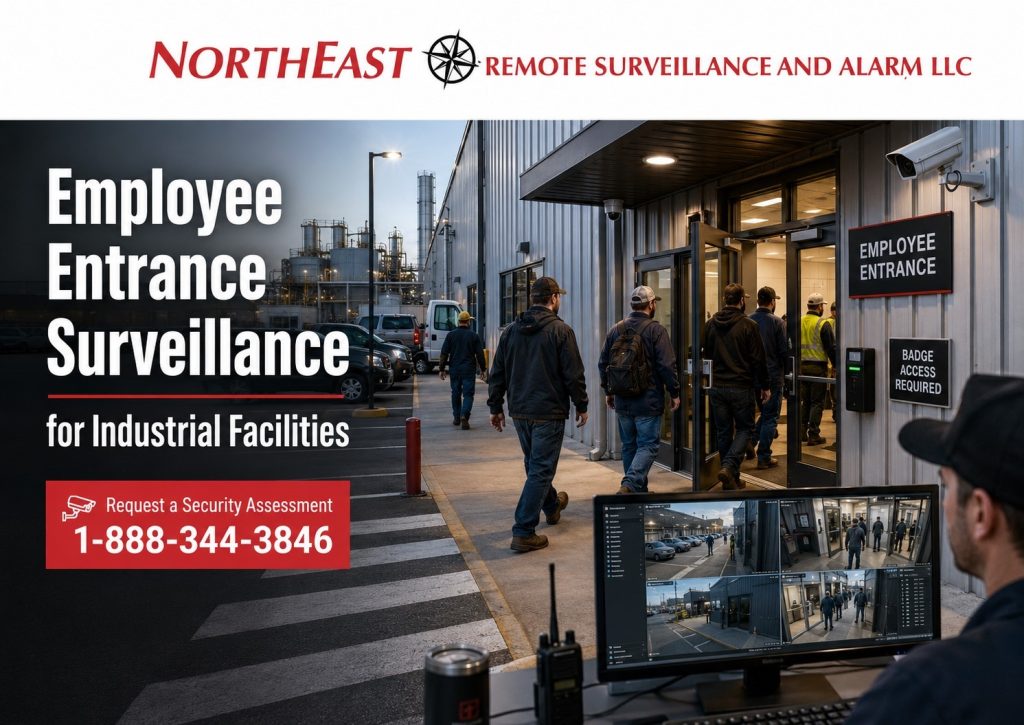
Employee Entrance Surveillance for Industrial Facility Shift Change Areas
Employee entrances are some of the busiest and most important camera locations in an industrial facility. During shift changes, a single doorway, vestibule, time clock area, badge reader, or parking-lot transition can see heavy movement in a short period of time.
That activity creates a need for clear, dependable video. Cameras may need to document who entered, who exited, when movement occurred, whether an incident happened near the door, and how people moved between the parking area, entrance, locker room, production floor, or office area.
A strong employee entrance surveillance design should not rely on one generic camera pointed at a doorway. It should account for approach angles, lighting, door swing, glare, crowding, badge-reader placement, camera height, recording quality, and whether footage may be needed for investigation or management review.
Why Employee Entrance Cameras Matter in Industrial Facilities
Industrial sites often operate on shifts, use multiple employee entrances, manage contractor access, and separate office areas from production spaces. When cameras are planned correctly, they can help document activity around controlled doors, shift-change congestion, employee parking transitions, and incidents near entry points.
Employee entrance surveillance may support:
- Shift change documentation
- Badge-area video review
- Employee parking-to-building movement
- Time clock and vestibule visibility
- Access-controlled door activity
- After-hours entry review
- Incident investigation near entrances
- Unauthorized tailgating review
- Slip, trip, or workplace incident review
- Contractor and temporary worker movement near employee doors
The goal is not to over-monitor employees. The goal is to create usable video coverage at high-traffic industrial entry points where incidents, disputes, unauthorized access, and operational questions are most likely to occur.
Camera Placement Around Employee Entrances
Camera placement is critical around employee doors. A camera mounted too high may show movement but fail to capture usable detail. A camera aimed directly into glass may be affected by glare. A camera placed only inside the doorway may miss the exterior approach, while a camera placed only outside may miss activity inside the vestibule or badge area.
Common camera views may include:
- Exterior approach to the employee entrance
- Parking lot walkway or sidewalk leading to the door
- Badge reader or credential point
- Vestibule or lobby area
- Time clock area, where appropriate
- Interior transition into the plant or warehouse
- Doorway view for access-control event verification
- Adjacent side or rear approaches
The camera plan should be built around how employees actually enter and leave the facility.
Shift Change Surveillance Planning
Shift changes create unique surveillance challenges. Employee entrances may become crowded, doors may remain open longer, badge readers may be used repeatedly, and vehicle movement may increase in nearby parking areas.
Industrial facilities should plan camera coverage around peak movement times, not just quiet conditions. A camera view that looks clear during the middle of the day may be blocked during a shift change by people, carts, vehicles, doors, glare, or congestion.
For multi-shift operations, camera planning should consider early morning, evening, overnight, weekend, and low-light conditions. Outdoor entrances may need better lighting, weather-rated cameras, or additional views between the parking area and the building.
Badge Areas and Access-Controlled Doors
Employee entrance cameras are especially useful when they support access control events. A badge reader can show that a credential was used, but video can help show what happened at the door.
Video may help review whether the authorized person entered, whether someone followed behind them, whether the door was held open, whether a forced-door or held-door event occurred, or whether an incident happened near the access point.
For broader coordination between doors, credentials, cameras, and event review, use Commercial and Industrial Security System Integration to plan how video surveillance, access control, alarms, monitoring, and reporting should work together.
Exterior Parking Transitions and Walkway Coverage
Employee entrances often connect directly to parking lots, sidewalks, side yards, or rear approaches. Cameras should not only document the doorway itself. They may also need to cover the path employees use between vehicles and the building.
This is especially important for industrial facilities with early morning shifts, overnight workers, large parking areas, dark exterior approaches, contractor parking, or employee entrances away from the main public entrance.
Exterior views may help document vehicle movement, suspicious activity, after-hours approach points, incidents near employee parking, and movement toward side or rear doors.
Interior Transition Areas
Employee entrance surveillance may also include the first interior transition after the door. Depending on the facility layout, this could include a vestibule, lobby, security desk, locker room approach, time clock wall, break room corridor, or entry point into the production area.
Interior cameras should be positioned carefully. They should support investigation and access review without creating unnecessary privacy concerns or poor camera angles. Camera views should be focused on entry paths, credentialed movement, doors, and operational transition areas rather than private spaces.
AI Analytics for Employee Entrance Areas
AI video analytics may help industrial facilities review activity around employee entrances, especially during after-hours periods or low-traffic windows. Analytics can support people detection, line crossing, door-area activity, loitering alerts, and after-hours movement review.
Analytics should be used carefully around busy shift-change areas. During normal shift movement, a high-traffic entrance may generate too much activity for alerting. A better approach is often to use analytics for after-hours detection, restricted schedule alerts, or unusual movement around entrances when the facility should be closed or lightly staffed.
For broader analytics planning in industrial environments, use AI Video Analytics for Industrial Facilities.
Recording and Retention for Entrance Footage
Employee entrance footage can become important for incident review, access-control investigations, workplace documentation, parking-lot transition events, and after-hours activity. Retention should be planned around the facility’s actual risk, management needs, incident history, and investigation workflow.
Important questions include:
- How long should employee entrance footage be retained?
- Who can review entrance video?
- Can footage be searched by time, door event, or camera?
- Can video clips be exported for investigation?
- Are entrance cameras tied to access-control events?
- Are after-hours alerts reviewed differently than normal shift activity?
For industrial facilities with higher documentation needs, use Industrial Video Retention and Evidence Planning to plan storage, export procedures, permissions, and investigation workflows.
Compliance-Aware Planning for Employee Entrance Cameras
Employee entrance cameras should be planned with attention to workplace operations, access-controlled doors, life-safety conditions, documentation needs, and privacy expectations. Cameras can support incident review, access accountability, and workplace documentation, but they do not replace safety policies, employee training, supervision, or compliance programs.
Industrial facilities should avoid placing cameras in private areas and should keep views focused on operational entry points, doors, corridors, access-control locations, parking transitions, and security-relevant movement. If cameras are installed near access-controlled doors, the security design should not interfere with safe egress, emergency exit function, door hardware operation, or fire/life-safety requirements.
For broader industrial security compliance planning, use Industrial and Warehouse Security Compliance to understand how cameras, access control, alarms, documentation, and inspection readiness work together in commercial-industrial environments.
Where Employee Entrance Surveillance Is Most Useful
Employee entrance surveillance may be useful for many types of industrial and commercial-industrial properties, including:
- Manufacturing plants
- Production facilities
- Industrial buildings
- Warehouses connected to plant operations
- Multi-shift facilities
- Contractor-heavy industrial sites
- Distribution and logistics buildings
- Utility and equipment facilities
- Multi-building industrial properties
- Facilities with side or rear employee entrances
- Properties with large employee parking areas
- Buildings with access-controlled employee doors
The camera design should be based on the actual entry pattern, not a generic doorway camera package.
Request an Employee Entrance Surveillance Assessment
If your industrial facility needs better visibility around employee entrances, shift changes, badge areas, parking transitions, access-controlled doors, contractor movement, or after-hours entry points, Northeast Remote Surveillance and Alarm, LLC can help design the camera coverage around the way your property actually operates.
Call 1-888-344-3846 or use the Request a Security Assessment page to begin an industrial video surveillance review.
Frequently Asked Questions
What is employee entrance surveillance for industrial facilities?
Employee entrance surveillance is camera coverage designed around worker entry points, badge areas, shift-change movement, parking transitions, access-controlled doors, vestibules, and industrial building entrances. It helps document activity where employees enter, exit, and move between parking areas, offices, and production spaces.
Why do industrial facilities need cameras at employee entrances?
Industrial facilities often have heavy employee movement, multiple shifts, contractor access, side entrances, rear doors, parking-lot transitions, and access-controlled doors. Cameras at employee entrances can support incident review, access event verification, after-hours review, and documentation around high-traffic entry points.
Should employee entrance cameras face the door or the parking lot?
Many facilities need both views. A doorway camera can document entry activity, while an exterior approach camera can show movement from the parking lot, sidewalk, gate, or side yard. The right design depends on the layout, lighting, entrance location, and what the facility needs to document.
Can employee entrance cameras work with access control?
Yes. Employee entrance cameras can be paired with access control so managers can compare credential events with video footage. This helps review badge use, tailgating, held-door events, forced-door events, and activity near controlled doors.
Are cameras useful during shift changes?
Yes. Shift changes are high-activity periods where cameras may help document movement, congestion, incidents, parking transitions, and entry patterns. Camera placement should be planned for peak movement times, not just quiet conditions.
Can AI analytics be used around employee entrances?
Yes, but analytics should be used carefully. Employee entrances can be too active during normal shift changes, so analytics may be more useful for after-hours detection, restricted schedule alerts, loitering review, or unusual movement when the facility should be closed or lightly staffed.
How long should employee entrance video be retained?
Retention depends on the facility’s risk, incident review needs, management policy, camera count, storage capacity, and investigation workflow. Industrial sites with frequent incidents, access-control review needs, or higher documentation requirements may need longer retention than low-risk areas.
Should employee entrance cameras be used near time clocks?
They can be used when the goal is to document general entry movement, access-control activity, or incident conditions near the time clock area. Camera placement should avoid unnecessary privacy concerns and should focus on operational movement rather than private spaces.
Do employee entrance cameras make a facility OSHA compliant?
No. Cameras do not make a facility OSHA compliant by themselves. They can support incident documentation and workplace review, but compliance depends on safety programs, training, hazard controls, supervision, procedures, and applicable standards.
What is the next step for planning employee entrance surveillance?
The next step is a site-specific review of the entrance layout, shift-change movement, parking transitions, lighting, access-controlled doors, existing cameras, recording needs, and investigation goals. NERSA designs the system around the actual facility instead of using a generic camera package.