
Commercial and industrial security system integration connects cameras, access control, intrusion alarms, intercoms, monitoring, analytics, and infrastructure so facility security works as one coordinated system.

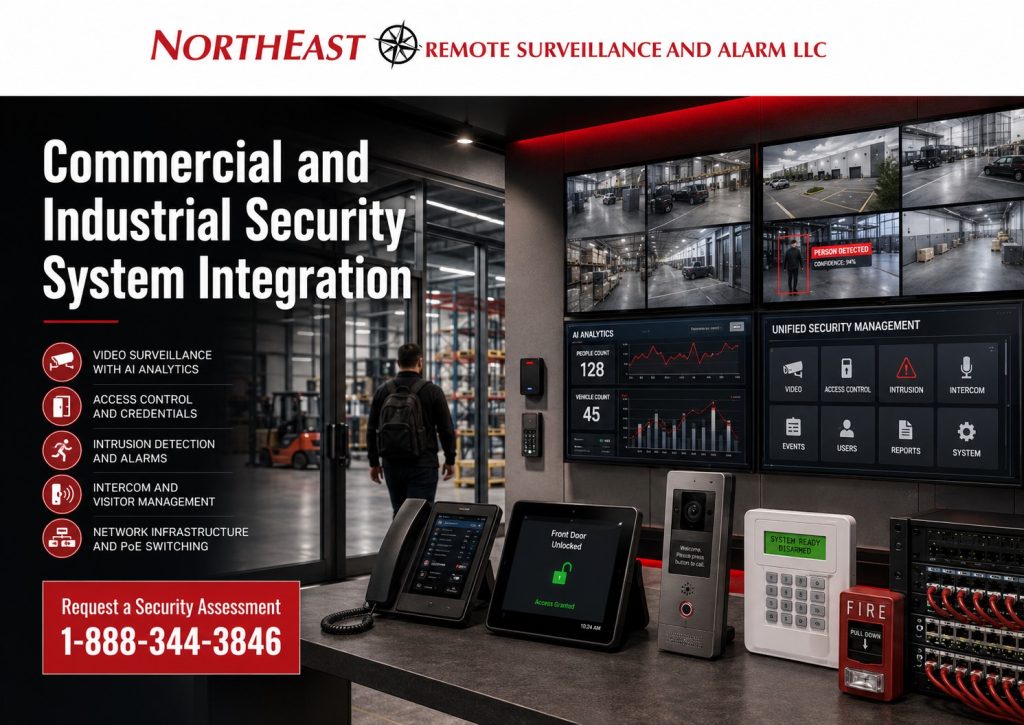
Integrating compatible systems can help staff review related events, manage access, and coordinate monitoring; the useful connections depend on how the property operates.
Security System Integration for Commercial and Industrial Facilities
A commercial security system should not be a collection of disconnected devices. Cameras, card readers, alarm panels, door contacts, intercoms, gate controls, monitoring alerts, and reporting tools all become more useful when they are planned to work together.
For warehouses, manufacturing plants, logistics facilities, office buildings, healthcare properties, schools, municipal buildings, contractor yards, truck yards, and multi-site businesses, integration helps security teams understand what happened, where it happened, who was involved, and what response is needed.
Northeast Remote Surveillance and Alarm, LLC designs integrated commercial and industrial security systems around the way each facility operates. The goal is not just to install equipment. The goal is to build a coordinated system that improves visibility, access control, alarm response, monitoring readiness, documentation, and long-term security management.
What Security System Integration Means
Security system integration means connecting separate security functions into a more coordinated environment. That may include video surveillance tied to access control events, intrusion alarms verified by camera footage, intercom calls connected to door release, gate activity recorded by cameras, AI alerts routed to monitoring, or system events organized through a unified platform.
Integration can help businesses reduce blind spots between systems. Instead of checking one platform for access events, another for cameras, another for alarms, and another for monitoring notes, an integrated design helps create a clearer operational picture.
A properly integrated system may connect:
- Video surveillance systems
- Access control systems
- Intrusion alarm systems
- Intercom and visitor entry systems
- Gate and vehicle access systems
- Remote video monitoring
- AI video analytics
- Alarm verification workflows
- License plate recognition cameras
- Fire alarm monitoring coordination
- Security network infrastructure
- System reporting and documentation
Integration should be planned carefully. Not every system needs to be merged into one screen, and not every device should trigger alerts the same way. A strong design connects the systems that actually improve security outcomes.
Video Surveillance and Access Control Integration
Video surveillance and access control integration is one of the most useful combinations for commercial facilities. Access control shows who used a door, gate, or credential. Video shows what happened at that location.
This can help management review badge activity, tailgating, held-door events, forced-door alarms, employee entrance activity, contractor movement, visitor access, and restricted-area entry.
For broader camera planning, use Commercial Video Surveillance Systems.
For credentialed doors, employee access, restricted areas, and multi-door control, use Commercial Access Control Systems.
Intrusion Alarm and Video Verification Integration
Intrusion alarms are more useful when the business can verify what triggered the event. A door contact, motion detector, glass-break sensor, gate alarm, or perimeter device can identify activity, but video can help determine whether the event is a real threat, employee activity, weather, an animal, a delivery, or a false alarm.
Video verification can support faster decision-making for commercial properties with after-hours risk, exterior yards, storage areas, parking lots, loading docks, and remote buildings.
For alarm planning, use Commercial Intrusion Alarm Systems.
For monitored camera response, event review, and live talk-down planning, use Remote Video Monitoring and Live Talk-Down.
Intercom, Door Release, and Visitor Entry Integration
Intercoms are often part of the access-control workflow. A visitor, vendor, delivery driver, contractor, or employee may request entry at a front door, gate, receiving entrance, office lobby, or restricted area. When intercoms integrate with cameras and access control, the facility can better verify who is requesting entry and decide whether the door or gate should be released.
This is especially useful for multi-tenant commercial buildings, industrial facilities, municipal buildings, schools, healthcare properties, contractor yards, logistics sites, and properties with controlled visitor access.
A good design should consider where calls are answered, who can unlock doors, which cameras show the entry point, whether events are recorded, and how after-hours entry requests are handled.
Gate, Yard, and Vehicle Access Integration
Commercial and industrial facilities often need security beyond the building doors. Gates, truck yards, trailer areas, parking lots, employee lots, contractor yards, and vehicle entrances can all create security exposure.
Integrated systems can connect gate controls, cameras, intercoms, access credentials, vehicle detection, license plate recognition, and monitoring workflows. This helps the facility review vehicle movement, after-hours gate activity, truck entrance events, visitor access, and incidents near exterior access points.
For properties that need searchable vehicle documentation, use License Plate Recognition Camera Systems as a supporting planning resource.
AI Video Analytics and Monitoring Integration
AI video analytics can help identify people, vehicles, zone activity, line crossing, loitering, and after-hours movement. When analytics are integrated with monitoring workflows, they can help reduce noise and focus attention on events that matter.
The key is designing analytics around real security outcomes. A warehouse may need after-hours person detection near dock doors. A contractor yard may need vehicle detection near the gate. A manufacturing plant may need restricted-area alerts near exterior yards or utility spaces. An office building may need after-hours activity review near entrances and parking areas.
For analytics planning, use AI Video Analytics.
For monitored camera response and live verification, use Remote Video Monitoring and Live Talk-Down.
Unified Security Platforms and Event Review
Unified security platforms can help commercial facilities manage video, access control, alarms, intercoms, reporting, and monitoring workflows in a more organized way. The benefit is not just convenience. The real value is faster event review, clearer accountability, better reporting, and fewer disconnected systems.
A unified design can help users search video tied to access events, review alarms with nearby camera footage, manage permissions by role, and understand what happened across multiple systems.
This is especially important for multi-site businesses, warehouses, manufacturing facilities, schools, healthcare properties, municipal operations, and larger commercial buildings where multiple teams may need controlled access to different parts of the system.
Infrastructure Behind Integrated Security Systems
Integration depends on infrastructure. Cameras, access control panels, alarm communicators, intercoms, gate devices, monitoring platforms, and cloud-connected systems all need reliable power, cabling, networking, bandwidth, backup, and documentation.
A weak infrastructure layer can cause camera dropouts, failed access events, unreliable remote access, delayed alerts, poor monitoring performance, and difficult troubleshooting.
For infrastructure planning, use Commercial Security Infrastructure Planning to plan PoE switching, structured cabling, fiber, network segmentation, UPS backup, recording equipment, wireless links, and long-term system support.
Cybersecurity and User Permissions
Integrated systems need strong user-permission planning. The more systems that work together, the more important it becomes to control who can view cameras, unlock doors, export footage, change schedules, review alarm events, manage credentials, or adjust system settings.
Commercial facilities should define user roles clearly. A receptionist, plant manager, school administrator, security supervisor, IT manager, facilities director, and business owner may all need different access levels.
Security integration should also account for remote access, password management, network segmentation, software updates, cloud access, vendor access, and device lifecycle planning.
Documentation and Long-Term Support
Integrated systems need clear documentation. Without proper records, it becomes harder to troubleshoot, expand, inspect, service, or train new users.
A strong documentation package may include camera schedules, access control door lists, alarm zones, intercom locations, network diagrams, IP addressing, device names, credential groups, monitoring procedures, battery information, service records, and as-built notes.
For documentation standards, use Security System Documentation Standards to plan records that support service, expansion, inspection readiness, and long-term system management.
Where Integrated Security Systems Are Most Useful
Integrated commercial security systems are valuable anywhere disconnected systems would create operational gaps.
Common environments include:
- Warehouses and logistics facilities
- Manufacturing plants
- Industrial buildings
- Office buildings
- Multi-tenant commercial properties
- Healthcare and medical office facilities
- Schools and educational buildings
- Municipal and public-sector facilities
- Contractor yards and fleet yards
- Truck yards and trailer storage areas
- Distribution centers
- Industrial parks
- Multi-building campuses
- Multi-site commercial organizations
The system should be designed around the property’s actual movement patterns, access points, restricted areas, risk zones, operating hours, and management needs.
Integrated Security for Warehouses and Logistics Facilities
Warehouses and logistics facilities often need cameras, access control, intrusion alarms, truck yard coverage, dock visibility, employee entrance control, after-hours monitoring, and vehicle documentation to work together.
An integrated design can help review dock activity, employee access, trailer yard movement, gate events, forced doors, after-hours alarms, and monitoring events from a more complete perspective.
Integrated Security for Manufacturing and Industrial Facilities
Manufacturing plants and industrial facilities may need integrated systems around production areas, restricted rooms, contractor entrances, machine areas, exterior yards, utility spaces, employee doors, loading areas, and after-hours conditions.
Video surveillance, access control, alarms, and monitoring can help document events and support operational review when systems are designed together.
Integrated Security for Offices and Multi-Tenant Buildings
Office buildings and multi-tenant commercial properties often need access control, lobby cameras, elevator-area coverage, visitor entry, parking lot cameras, intrusion alarms, and user permissions coordinated across tenants, managers, and property owners.
Integration helps create cleaner management of doors, users, video review, visitor movement, and after-hours access.
Integrated Security for Schools, Healthcare, and Municipal Properties
Schools, healthcare facilities, and municipal buildings often need controlled access, incident review, visitor management, video documentation, alarm response, and life-safety awareness. These environments require careful planning so security systems support safety and operations without interfering with egress, privacy expectations, or facility procedures.
Security integration should be planned around the building’s real use, administrative requirements, public access, staff movement, emergency procedures, and documentation needs.
Compliance-Aware Integration Planning
Commercial and industrial security system integration should be planned with attention to life-safety coordination, door hardware, emergency egress, fire alarm interaction, monitoring procedures, documentation, privacy expectations, and inspection readiness.
Integration does not make a facility compliant by itself. However, it can support documentation, incident review, access accountability, alarm verification, service records, and operational readiness when designed properly.
Security integration should never compromise safe egress, fire alarm operation, required door function, emergency procedures, or AHJ expectations.
For broader compliance planning, use Security Compliance and Standards as the supporting resource.
Request a Security Integration Assessment
If your facility has cameras, access control, alarms, monitoring, intercoms, gates, or security infrastructure that do not work together cleanly, Northeast Remote Surveillance and Alarm, LLC can help review the system and design a better integration plan.
Call 1-888-344-3846 or use the Request a Security Assessment page to begin a commercial and industrial security system integration review.
Frequently Asked Questions
What is commercial and industrial security system integration?
Commercial and industrial security system integration connects systems such as video surveillance, access control, intrusion alarms, intercoms, monitoring, AI analytics, gates, and reporting tools so they work together more effectively. The goal is better event review, access accountability, alarm verification, monitoring response, and long-term system management.
Why should cameras and access control be integrated?
Cameras show what happened at a door, while access control shows who used a credential. When the two systems are connected, managers can review badge events, tailgating, forced-door events, held-door alarms, employee entrances, restricted rooms, and visitor access with stronger context.
Can intrusion alarms be integrated with video surveillance?
Yes. Intrusion alarms can be tied to video verification so a triggered door, motion detector, glass-break sensor, or protected area can be reviewed with nearby camera footage. This can help reduce false alarm confusion and improve after-hours event review.
Can intercoms integrate with access control?
Yes. Intercoms can be integrated with access control so authorized users can verify a visitor, vendor, driver, or contractor before releasing a door or gate. Cameras can also be used to confirm who is requesting entry.
What systems can be part of an integrated commercial security system?
An integrated system may include video surveillance, access control, intrusion alarms, intercoms, gate controls, license plate recognition cameras, AI analytics, remote video monitoring, alarm communication, user management, reporting, and supporting network infrastructure.
Do integrated security systems require new equipment?
Not always. Some existing systems can be integrated, upgraded, or partially reused depending on age, compatibility, manufacturer support, network condition, and system goals. A site assessment helps determine what can stay, what should be upgraded, and what should be replaced.
Can integrated security systems support remote monitoring?
Yes. Integrated systems can support remote monitoring by connecting camera alerts, alarm events, AI analytics, live video review, and response procedures. This is useful for warehouses, industrial facilities, truck yards, contractor yards, parking lots, and after-hours commercial properties.
Is security system integration useful for multi-site businesses?
Yes. Multi-site businesses often benefit from centralized management, consistent user permissions, shared reporting, remote video access, standardized door schedules, and coordinated monitoring workflows across multiple locations.
Does security integration affect fire alarm or life-safety systems?
It can, so planning must be handled carefully. Security systems should never interfere with required egress, fire alarm operation, emergency procedures, or AHJ expectations. Access control, door hardware, monitoring, and life-safety coordination should be reviewed during system design.
What is the next step for integrating commercial security systems?
The next step is a site-specific assessment. NERSA reviews the existing cameras, access control, alarms, intercoms, gates, monitoring, infrastructure, user permissions, and operational workflows before recommending an integration plan.