
Explosion-protected and hazardous-area camera compliance matters when video surveillance equipment may be installed near flammable gases, vapors, liquids, combustible dusts, ignitable fibers, or other classified industrial hazards.

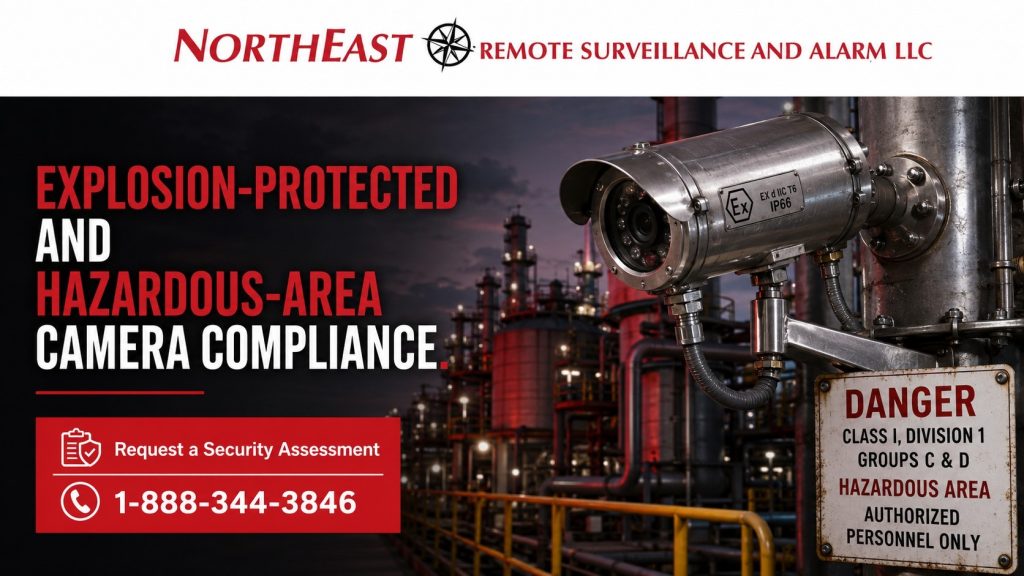
This resource explains how hazardous-area camera planning should be approached for commercial and industrial facilities that need video visibility without creating ignition, inspection, or code-coordination problems.
For the broader compliance structure, start with Security Compliance and Standards.
Explosion-Protected and Hazardous-Area Camera Compliance – Hazardous-Area Camera Compliance Starts With the Location
Explosion-protected camera planning should never begin with a generic camera model. It should begin with the classified location, the materials present, the likelihood that an ignitable atmosphere may exist, and the required protection method for electrical equipment in that area.
OSHA’s hazardous-location rules apply to electrical equipment and wiring where flammable vapors, liquids, gases, combustible dusts, or fibers may be present, and OSHA states that equipment must be approved for both the location class and the specific ignitable or combustible properties present. (OSHA)
For security planning, that means a standard commercial camera should not be assumed suitable for a hazardous area. The camera, enclosure, wiring method, power supply, network pathway, mounting method, and any related equipment must be reviewed against the classified environment.
Explosion-Protected Cameras Are Not Standard Security Cameras
A standard commercial surveillance camera may be appropriate for offices, warehouses, parking lots, loading docks, and general industrial areas, but hazardous locations require a different level of review. Explosion-protected, explosionproof, dust-ignitionproof, flameproof, purged, pressurized, nonincendive, or intrinsically safe protection methods may be relevant depending on the classification and application.
The correct term depends on the environment and the approved protection technique.
OSHA identifies acceptable protection techniques for hazardous classified locations, including explosionproof apparatus, dust-ignitionproof equipment, dust-tight equipment, purged and pressurized systems, nonincendive circuits, flameproof protection, intrinsic safety, increased safety, encapsulation, and other methods depending on the classification system used. (OSHA)
The important point for buyers is simple: the camera must match the classified area. A camera that is durable, weatherproof, vandal-resistant, or industrial-looking is not automatically suitable for a hazardous classified location.
Class, Division, Group, Zone, and Temperature Rating Planning
Hazardous-area camera compliance depends on more than whether a product is marketed as “explosion-proof.” The site may need equipment selected around Class, Division, Group, Zone, temperature rating, environmental exposure, corrosion conditions, and the specific gas, vapor, dust, or fiber hazard.
NFPA 70, the National Electrical Code, is the benchmark for safe electrical design, installation, and inspection, and NFPA notes that Chapter 5 addresses special occupancies and locations including hazardous classified locations. (NFPA)
In practical terms, a facility needs to know what classification applies before equipment is selected. A camera suitable for one hazardous area may not be suitable for another if the material group, temperature limit, division, zone, enclosure rating, or installation method is different.
Flammable Vapors, Gases, and Chemical Process Areas
Facilities that process, store, dispense, or handle flammable liquids, gases, or vapors may require classified-area review before cameras are installed. These environments may include chemical processing areas, fuel handling areas, paint-related areas, solvent storage areas, petroleum operations, industrial mixing spaces, and similar process-related locations.
NFPA 497 provides criteria for determining ignitability hazards in chemical process areas using flammable liquids, gases, or vapors. (NFPA)
For camera planning, this means the placement of the camera matters as much as the camera itself. The mounting location, wiring route, enclosure, seal requirements, power source, and maintenance access should be coordinated with the site’s hazardous-location documentation and qualified electrical or engineering professionals.
Combustible Dust and Industrial Camera Planning
Combustible dust can create serious fire, flash-fire, deflagration, and explosion hazards when dust is produced, processed, handled, or allowed to accumulate in industrial environments. This may affect facilities such as grain handling, food processing, woodworking, plastics, powder handling, metal dust environments, and other dust-producing operations.
NFPA 499 provides criteria for classifying areas where combustible dusts are produced, processed, or handled, and OSHA’s combustible dust guidance recognizes fire, flash fire or deflagration, and explosion as major dust-hazard forms. (NFPA)
For camera systems, dust-related hazards should not be treated like ordinary dirt or harsh-environment exposure. A camera may need to be reviewed for dust-ignitionproof suitability, dust-tight construction, cleaning access, heat limits, surface temperature, cable routing, and the way the surrounding process creates or accumulates dust.
Explosion-Protected and Hazardous-Area Camera Compliance – Camera Placement Without Increasing Risk
Hazardous-area video surveillance should improve visibility without introducing new ignition, access, or maintenance concerns. Camera locations should be selected to document important activity while respecting classified boundaries, equipment ratings, wiring methods, cleaning needs, maintenance procedures, and plant operations.
A camera placed inside a classified area may require a very different design than a camera placed outside the classified boundary looking into the area. In some cases, safer and more maintainable coverage may come from camera placement outside the highest-risk zone, using lens selection, mounting height, lighting, or protected viewing angles to achieve the required visibility.
The goal is not to force cameras into every hazardous zone. The goal is to create useful video coverage while respecting the area classification and the facility’s safety requirements.
Wiring, Power, Network, and Low-Voltage Coordination
Hazardous-area camera compliance is not only about the visible camera housing. Power supplies, network switches, fiber converters, junction boxes, conduit, seals, cable entries, wireless equipment, edge devices, and other connected components may also affect the compliant design.
Camera wiring and network pathways should be coordinated with the facility’s electrical team, engineering resources, safety personnel, and authority having jurisdiction when required. Security equipment should not be installed in a way that bypasses classified-area requirements, creates unapproved penetrations, compromises enclosures, or makes maintenance unsafe.
For Pennsylvania projects, PA Uniform Construction Code considerations may also apply when security work affects construction conditions, penetrations, equipment mounting, low-voltage pathways, fire-stopping, inspection expectations, or coordination with a building owner, design professional, contractor, or authority having jurisdiction.
Documentation, Labeling, and Inspection Readiness
Hazardous-area camera work should be documented clearly. The facility should be able to identify the classified area, the required equipment rating, the installed camera model, wiring method, power source, enclosure details, maintenance expectations, and who approved the installation approach.
Documentation helps avoid confusion later when equipment is serviced, replaced, cleaned, expanded, or inspected. A replacement camera should not be selected only because it fits the mount or connects to the recorder. It must still match the hazardous-area requirements.
Security system documentation should support the owner, safety team, electrical contractor, maintenance personnel, and authority having jurisdiction with clear records of what was installed and why.
Hazardous-Area Cameras and Operational Visibility
Explosion-protected cameras may be used to improve visibility in areas where personnel access is limited, activity is hazardous, or incidents require careful review. These cameras can support process visibility, restricted-area awareness, vehicle movement review, loading area documentation, safety investigation support, and security monitoring.
However, hazardous-area cameras should not be positioned as a replacement for safety procedures, ventilation, housekeeping, process controls, hazardous-location classification, emergency planning, or qualified electrical design. They are one part of a broader industrial security and safety-support strategy.
The system should provide usable footage while supporting safe operation, maintenance access, and long-term reliability.
Who Should Be Involved in Hazardous-Area Camera Planning
Hazardous-area camera planning should involve the right stakeholders before equipment is selected. That may include the facility owner, safety manager, plant manager, electrical contractor, design professional, hazardous-location specialist, insurance representative, maintenance team, and authority having jurisdiction.
NERSA’s role is to help plan the security camera side of the project around visibility, coverage, recording, monitoring, network support, and integration while respecting the hazardous-location requirements identified by qualified professionals.
This coordination protects the project from common mistakes such as using the wrong camera rating, placing equipment in the wrong zone, ignoring dust conditions, overlooking cable entries, or treating hazardous-area video like ordinary commercial surveillance.
What a Hazardous-Area Camera Assessment Should Review
A hazardous-area camera assessment should begin with the facility’s existing classification information, safety documentation, and operational goals. The review should identify what areas need visibility, whether the camera must be installed inside or outside the classified area, what materials create the hazard, and what equipment rating may be required.
The assessment should also review camera views, mounting locations, lighting, cleaning access, cable routes, power sources, network infrastructure, recording needs, monitoring needs, environmental exposure, and long-term service access.
The final design should be based on the classified location, the required protection method, and the facility’s real security and operational needs.
Why Industrial Facilities Choose NERSA for Explosion-Protected and Hazardous-Area Camera Compliance
Northeast Remote Surveillance and Alarm, LLC focuses on commercial and industrial security systems. We understand that hazardous-area camera projects require more than general video surveillance knowledge.
NERSA helps industrial facilities plan camera coverage, recording, monitoring, remote access, network support, and integration while coordinating with the facility’s safety, electrical, and compliance requirements. The goal is to improve visibility without creating avoidable code, inspection, ignition, or maintenance problems.
A properly planned hazardous-area camera system should support security, documentation, operational review, and long-term maintainability.
Request a Explosion-Protected and Hazardous-Area Camera Compliance Assessment
If your facility needs explosion-protected cameras, hazardous-area video surveillance, combustible-dust camera planning, chemical-area camera coverage, process-area visibility, or classified-location camera coordination, Northeast Remote Surveillance and Alarm, LLC can help.
A site-specific assessment can review the camera coverage goals, classified-area documentation, mounting locations, power and network pathways, recording needs, monitoring options, equipment requirements, and coordination needs with qualified electrical and safety professionals.
Request a Security Assessment.
Frequently Asked Questions About Explosion-Protected and Hazardous-Area Camera Compliance
What is a Explosion-Protected and Hazardous-Area Camera?
A hazardous-area camera is a camera selected and installed for use in a location where flammable gases, vapors, liquids, combustible dusts, or ignitable fibers may create a classified hazard. The camera and related equipment must match the classification and protection requirements of the area.
Is an explosion-proof camera the same as an explosion-protected camera?
Not always. “Explosion-proof” is often used casually, but hazardous-area protection may involve different approved techniques depending on the classification. The correct equipment may be explosionproof, dust-ignitionproof, flameproof, purged and pressurized, nonincendive, intrinsically safe, or another approved method depending on the area.
Can a standard security camera be installed in a hazardous area?
A standard commercial security camera should not be assumed suitable for a hazardous classified location. The camera, enclosure, wiring, power, network equipment, and installation method must be reviewed against the classified-area requirements.
Who determines the hazardous-area classification?
The hazardous-area classification should be determined by qualified personnel familiar with the facility, materials, process conditions, applicable codes, and authority-having-jurisdiction requirements. Security equipment should be selected after that classification is understood.
Does combustible dust affect camera selection?
Yes. Combustible dust can affect camera selection, enclosure requirements, surface temperature, wiring methods, cleaning access, and long-term maintenance. Dust-producing facilities should not treat hazardous-area camera planning like ordinary warehouse video surveillance.
What standards may apply to hazardous-area camera planning?
Relevant standards and references may include OSHA hazardous-location requirements, NFPA 70 National Electrical Code provisions for hazardous classified locations, NFPA 497 for flammable liquids, gases, and vapors, and NFPA 499 for combustible dust areas. The exact requirements depend on the facility and the classified location.
Can hazardous-area cameras support remote monitoring?
Yes. Hazardous-area cameras can support remote viewing, event review, process visibility, incident documentation, and monitoring when they are properly selected, installed, and integrated. Monitoring should still follow the facility’s safety procedures and response rules.
What should be reviewed before installing Explosion-Protected and Hazardous-Area Cameras?
The review should include the classified-area documentation, material hazard, camera location, equipment rating, wiring method, mounting approach, environmental exposure, cleaning access, recording needs, network path, service access, and coordination with qualified electrical and safety professionals.