
Northeast Remote Surveillance and Alarm, LLC designs and installs commercial video surveillance systems in Harrisburg, PA for warehouses, manufacturers, offices, healthcare facilities, schools, municipal properties, multi-tenant buildings, parking areas, and other nonresidential sites.

request a commercial security assessment
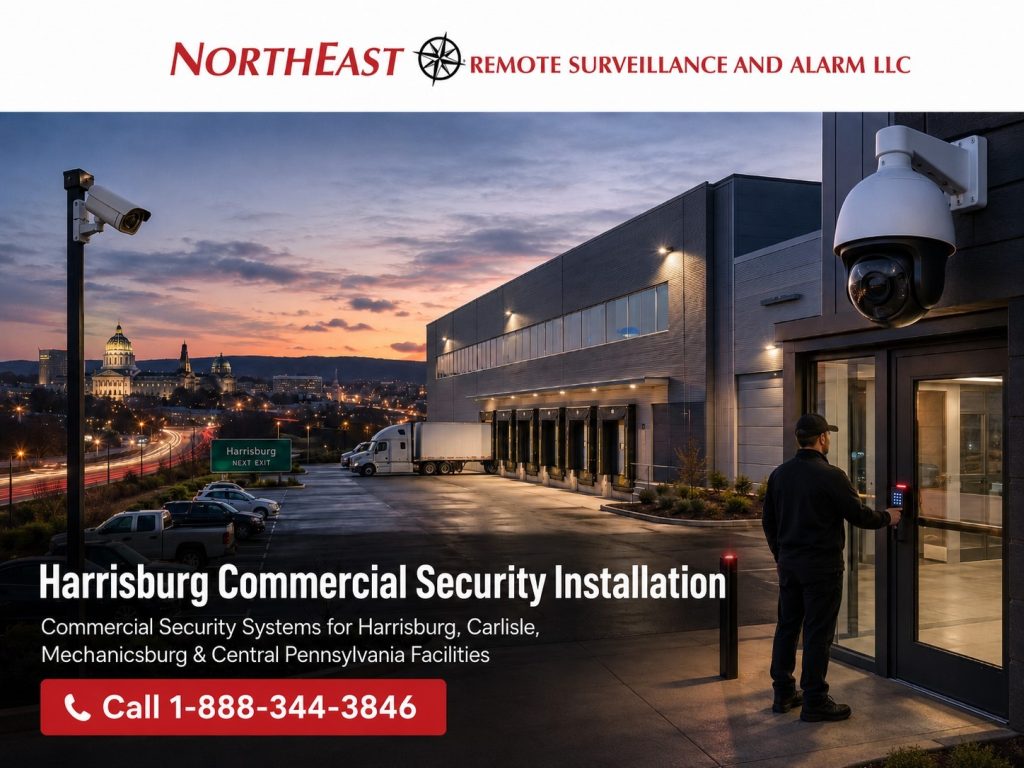
This page focuses on camera-system design and installation.
For access control, alarms, intercoms, monitoring, and broader project planning, start with our Harrisburg commercial security installation guide.
Start With the View You Need, Not the Camera Count
A useful camera system begins with the event the customer needs to see later. An entrance camera, loading-dock view, parking-lot camera, and production-area camera solve different problems, so each location should have a defined purpose.
We review viewing distance, lighting, mounting position, obstructions, network capacity, recording requirements, and the level of image detail needed for the task before selecting equipment.
Commercial Security Camera Installation
NERSA installs cameras, recorders, network connections, PoE switching, power, mounting hardware, and supporting infrastructure as part of complete commercial projects. Systems can be designed for new facilities, additions to existing coverage, or phased upgrades.
Typical Harrisburg-area applications include employee entrances, reception areas, loading docks, shipping and receiving, warehouse aisles, parking lots, gates, truck yards, building approaches, and restricted operational areas.
Recording, Retention, and Evidence Retrieval
A camera system is only useful if authorized staff can find and export the footage they need. We plan recording capacity, retention, naming, user access, remote viewing, and evidence export around the facility’s actual needs.
During handoff, the person responsible for the system should be able to locate a representative event, review it, and export it without depending on guesswork.
Existing Camera System Upgrades and Takeovers
Older systems do not always need to be replaced all at once. We can assess cameras, recorders, cabling, switches, network capacity, account ownership, and remote access to determine what remains useful.
Upgrades may include replacing failed or low-value views, moving from DVR to NVR equipment, increasing storage, improving remote access, adding cameras, correcting network issues, or standardizing a mixed system.
Video Analytics and Remote Monitoring
Compatible systems can support analytics for selected events and faster video review. Remote video monitoring and live talk-down can also be added where the property needs active after-hours review around yards, gates, parking areas, or other exposed spaces.
These features work best when the camera views, lighting, detection rules, and response procedure are designed together.
Explore remote video monitoring in Harrisburg for after-hours event review, audio intervention and response planning.
Lighting, Nighttime Performance, and Exterior Views
Exterior video should be evaluated for the scene that exists after dark, not only for the daytime image. Vehicle headlights, building lights, dark backgrounds, reflective surfaces, weather, mounting height, and the distance to the activity can all affect recorded detail. Test representative nighttime views when exterior identification or incident review is important.
Network, PoE, and System Health
IP camera performance depends on reliable cabling, switching, PoE capacity, bandwidth, time synchronization, storage, and secure account ownership. A camera that intermittently drops offline can create an evidence gap even when the live system appears normal most of the time.
For larger sites, document camera names, switch locations, recorder capacity, network responsibilities, and the process for identifying an offline or failed device. These records make future service and expansion more efficient.
Harrisburg Camera Coverage for Logistics and Commercial Properties
A camera aimed across a parking lot will not necessarily capture a readable face at an entrance or the side of a trailer at a loading dock. Define each view by the event that must be reviewed and the practical viewing distance. Survey likely obstructions such as parked trucks, dock shelters, shelving, equipment and landscaping. Check the scene in daylight and after dark, especially where headlights and contrasting illumination may affect image quality.
For multi-building facilities, review the cable path from each camera to its PoE switch, recorder and network connection. Plan network capacity, appropriate surge protection, remote access permissions and backup power according to the customer’s operating needs. Where a licensed plate or close-up identification task is required, specify the appropriate camera and mounting position separately from a wide overview.
Retention and Incident Export Are Part of the Design
Ask the Harrisburg facility team which incidents it expects to investigate, who can access video, whether footage must be retained for a defined period, and how evidence should be exported. Estimate storage from actual recording settings rather than camera count alone. Discuss the operating differences among local, hosted and hybrid recording where relevant, including what remains available when the site loses internet service.
At handoff, the customer should locate an example recording, search a time range, export footage, understand permission levels and know who is responsible for recorder and camera health. This is a more reliable acceptance test than viewing live images only.
Commissioning and Customer Handoff
At completion, verify representative live and recorded views, search and playback, retention expectations, user permissions, remote access, and evidence export. The responsible customer should be able to retrieve and export a representative event without depending on guesswork.
Harrisburg and Central Pennsylvania Service Area
NERSA supports qualified commercial and industrial video-surveillance projects in Harrisburg and surrounding Central Pennsylvania communities, including Camp Hill, Mechanicsburg, Carlisle, and nearby commercial and industrial areas.
Request a Video Surveillance Assessment
If your Harrisburg-area property needs a new camera system, an expansion, a recorder replacement, or a takeover of an inherited surveillance system, call 1-888-344-3846 or request a commercial security assessment.
Frequently Asked Questions
Can NERSA add cameras to an existing system?
Often, yes. We first confirm compatibility, recorder capacity, network conditions, power, and whether the existing platform can support the added devices.
Can you improve poor camera coverage without replacing everything?
Sometimes. Repositioning, replacing selected cameras, correcting lighting or network problems, and changing recording settings can improve a usable system without a complete replacement.
Do you install cameras for single-family homes?
No. NERSA focuses on commercial, industrial, institutional, and professionally managed properties.
Compliance, Codes & Project Standards
NERSA plans commercial and industrial security work with applicable code, documentation, inspection and authority-having-jurisdiction requirements in mind. Requirements vary by system, property and jurisdiction. These resources support project planning; they do not establish legal compliance, certification or AHJ approval.
Related guidance: Regulatory compliance & inspection readiness · Video surveillance compliance · NERSA project standards