
Commercial video surveillance in Lancaster should be designed around what people need to see, record, retrieve and manage.

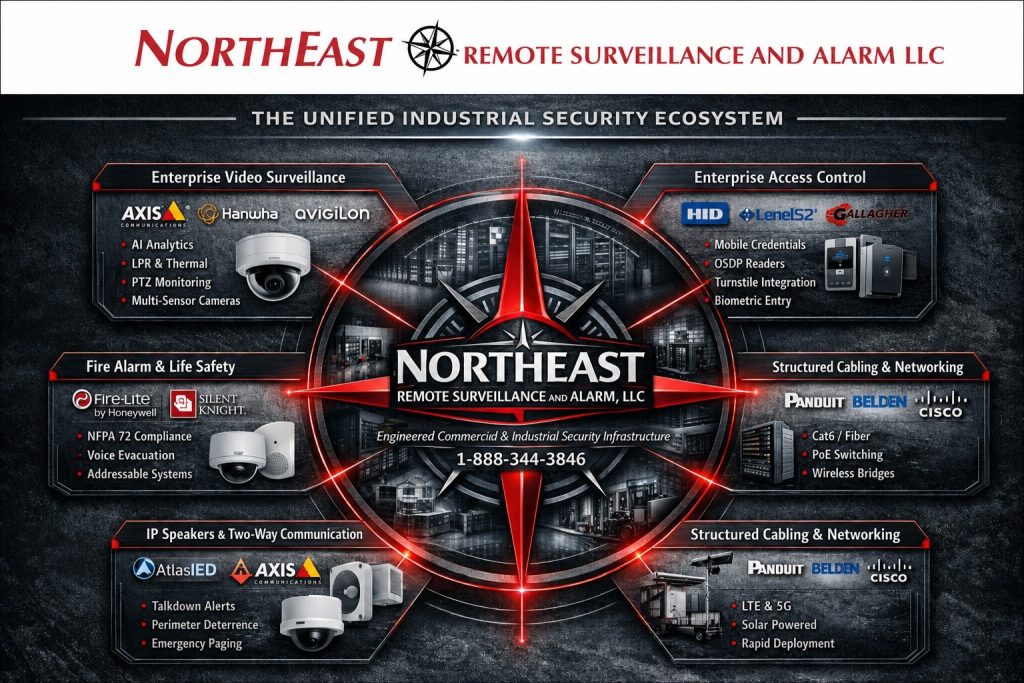
Camera purpose, lighting, lens selection, mounting, recording, storage, retention, permissions and evidence export all affect the finished system.
Explore related commercial security services in Lancaster and security planning across Central Pennsylvania.
Applications
Planning may include loading docks, parking, vehicle gates, entrances, production areas, restricted rooms, visitor routes and after-hours activity. A wide overview view and a focused identification view serve different purposes, so camera count alone is not a design standard.
Infrastructure and lifecycle
Reliable video depends on cabling, PoE, bandwidth, storage, power and secure account ownership.
Existing cameras and recorders can be evaluated for safe reuse, repositioning, integration or phased replacement.
Use the commercial video surveillance guide for platform and evidence-planning detail.
Plan Camera Views Around the Event
A useful surveillance design starts with the question the customer may need to answer later. At an employee entrance, the goal may be recognizing a person entering. At a loading dock, it may be documenting a trailer position, freight movement, or activity around a door. In a parking area, the useful view may need to show vehicle movement and pedestrian routes rather than simply cover the largest possible area.
Wide overview views and focused identification views serve different purposes. Camera placement should account for distance, mounting height, lighting, glare, weather, obstructions, changing inventory, and the direction people or vehicles normally travel.
Recording, Retention, and Evidence Retrieval
Recorder capacity should be planned around camera count, resolution, frame rate, recording method, retention goals, and future expansion. Authorized staff should be able to find a representative event, review it, and export it without relying on an installer for every incident.
Define who administers the system, who receives remote access, how accounts are protected, and how exported evidence will be handled. For multi-building properties, consistent camera naming and location labels make incident review substantially easier.
Warehouse, Manufacturing, Office, and Exterior Applications
Lancaster warehouses and distribution facilities may need views at docks, employee entrances, trailer areas, shipping offices, aisles, and exterior approaches. Manufacturing sites may need coverage around production support areas, restricted rooms, material movement, and employee access points. Offices and multi-tenant properties often benefit from clearly planned entrances, common areas, parking, and visitor routes.
Exterior cameras should be designed with the nighttime scene in mind. Available light, vehicle headlights, building lighting, weather exposure, and the distance to the activity all affect whether recorded video will be useful after dark.
Upgrades and Existing Camera Systems
An older system does not automatically require complete replacement. Review the existing cameras, recorder, storage, cabling, PoE switching, network capacity, account ownership, remote access, and the actual value of each current view. Selected cameras may be repositioned or replaced while useful infrastructure remains in service.
Document what is being retained and why. If a phased upgrade is appropriate, identify recorder and network limits early so the first phase does not block later expansion.
Commissioning the Lancaster Camera System
Before handoff, verify representative daytime and nighttime views, live video, recorded playback, search, retention expectations, user permissions, remote access, time synchronization, and evidence export. Camera names should match real locations so staff can find an event without translating installer shorthand.
Document recorder and switch locations, customer administrator accounts, retained equipment, known limitations, and any future expansion assumptions. A clear handoff reduces dependence on the installer for routine review and makes later service easier.
Assessment
A documented security assessment can map views, recording requirements and future expansion before equipment is selected.