Northeast Remote Surveillance and Alarm, LLC follows service and support standards designed to keep commercial security systems usable, maintainable, documented, and expandable after installation.
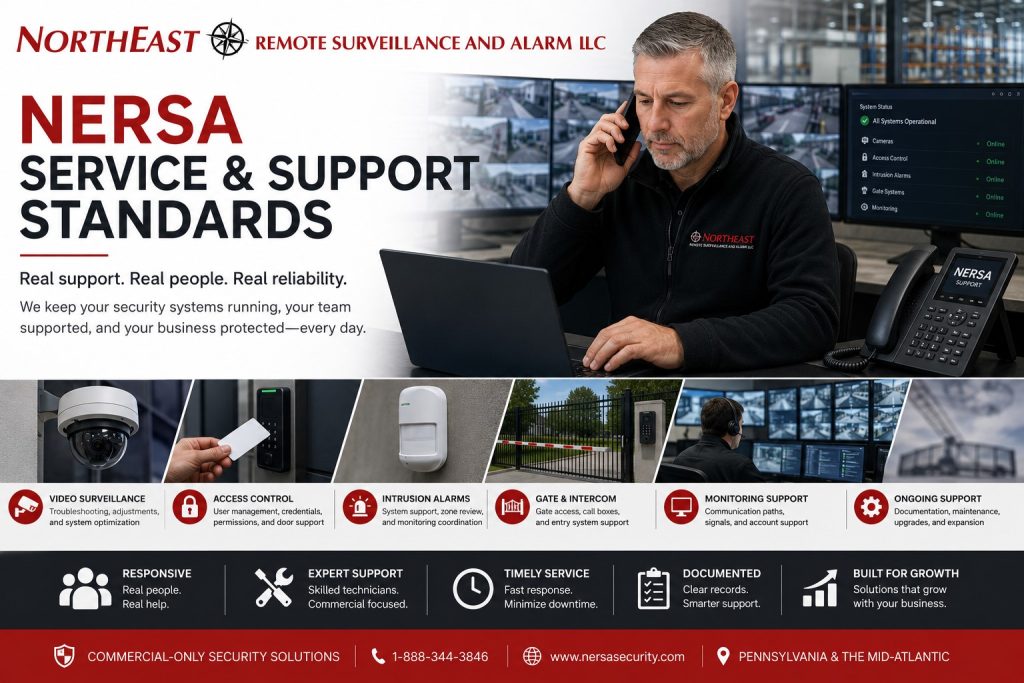
NERSA supports commercial and industrial clients with service communication, troubleshooting, system adjustments, user changes, equipment support, upgrade planning, and long-term security reliability.
For company background and commercial service information, visit About Northeast Remote Surveillance and Alarm, LLC .
Commercial Security Support Does Not End After Installation
A commercial security system should not be judged only by how it looks on installation day. It should be judged by how well it performs when employees need access, managers need footage, alarms need review, monitoring paths need attention, or the facility needs future expansion.
NERSA treats service and support as part of the system lifecycle. Cameras, access control, intrusion alarms, monitoring systems, gates, intercoms, and low-voltage infrastructure all need practical support as the building, users, schedules, equipment, and risks change.
That is why NERSA’s service and support standards are built around long-term commercial use, not one-time equipment installation.
Built for Commercial and Industrial Clients
NERSA supports business and professionally managed security environments where downtime, unclear access control, missing footage, weak alarm communication, or disconnected systems can affect real business operations.
Supported environments may include:
- Warehouses
- Distribution centers
- Logistics facilities
- Manufacturing plants
- Office buildings
- Medical and healthcare facilities
- Municipal buildings
- Schools
- Contractor yards
- Truck yards
- Industrial parks
- Multi-tenant commercial buildings
- Commercial properties with multiple doors, cameras, users, buildings, or sites
These properties need more than basic residential-style support. They need a security partner that understands operational urgency, facility access, employee turnover, vendor movement, system documentation, and future growth.
Standard 1: Clear Service Communication
Commercial clients need clear communication when a security issue occurs. A service request should not leave the customer guessing about what information is needed, what system is affected, or what the next step should be.
NERSA’s support approach focuses on understanding:
- What system is affected
- What issue the customer is experiencing
- Whether the issue affects cameras, alarms, access control, monitoring, gates, intercoms, or infrastructure
- Whether the problem is urgent or operationally disruptive
- Whether remote review is possible
- Whether an on-site service visit may be needed
- Whether the issue is related to equipment, user settings, network conditions, wiring, power, or system configuration
Clear service communication helps reduce confusion and speeds up practical troubleshooting.
Standard 2: Support for Real Business Operations
Security support has to account for how the business operates. A door reader issue at an employee entrance is different from a camera view concern in a storage room. An alarm communication issue is different from a user permission change. A gate problem at a truck yard is different from a recorder storage issue.
NERSA evaluates service concerns based on real operational impact.
Examples include:
- Employees unable to access a controlled entrance
- Managers unable to retrieve needed video
- Cameras offline or showing weak views
- Alarm users having trouble arming or disarming
- Monitoring communication concerns
- Access schedules needing adjustment
- User credentials needing changes
- Gate access problems
- Intercom or visitor entry concerns
- System expansion needs
- Equipment replacement planning
Commercial service should be practical, not generic.
Standard 3: Troubleshooting Before Unnecessary Replacement
Not every issue requires replacing equipment. A commercial security problem may be caused by settings, cabling, power, network conditions, user permissions, communication paths, environmental damage, aging hardware, or installation conditions.
NERSA’s support process may consider:
- Device status
- Power conditions
- Network connection
- Cable or pathway concerns
- User settings
- Alarm zones
- Access permissions
- Camera recording status
- Monitoring communication
- Equipment age
- Environmental exposure
- Prior service history
The goal is to identify the actual cause before recommending replacement. When replacement is needed, it should be recommended for a clear operational reason.
Standard 4: Camera System Support
Commercial camera systems need to remain usable after installation. Over time, camera views may be affected by lighting changes, new equipment, building changes, weather exposure, vegetation, changed operations, recorder storage, network issues, or user access problems.
NERSA may support camera systems through:
- Camera troubleshooting
- View adjustments
- Recording review
- Remote access support
- User access support
- Recorder or storage review
- Camera replacement planning
- Network-related troubleshooting
- Expansion planning
- Documentation updates
- Review of blind spots or changed conditions
The goal is to help the camera system continue producing usable footage when the business needs it.
Standard 5: Access Control Support
Access control systems require ongoing support because employees, vendors, tenants, managers, doors, schedules, and permissions change over time.
NERSA may support access control through:
- User changes
- Credential updates
- Access group adjustments
- Schedule changes
- Door troubleshooting
- Reader troubleshooting
- Lock or hardware coordination
- Controller or power supply review
- Event history review
- Multi-door expansion planning
- Gate access adjustments
- Documentation updates
Access control support should help the business maintain control over who can enter, where they can enter, and when they can enter.
Standard 6: Alarm System Support
Commercial alarm systems must remain dependable as buildings, users, schedules, communication paths, and business operations change.
NERSA may support alarm systems through:
- User code changes
- Zone troubleshooting
- Door contact review
- Motion detector review
- Glass-break detection review
- Overhead door protection review
- Communication path review
- Opening and closing schedule support
- Monitoring signal review
- Alarm panel replacement planning
- Expansion planning
- Documentation updates
A commercial alarm system should be understandable for users and dependable for the property.
Standard 7: Monitoring and Communication Path Support
Monitoring reliability depends on communication paths, alarm programming, account information, signal transmission, and response expectations. Commercial clients need monitoring systems that support the actual risk profile of the property.
NERSA may review support concerns involving:
- Alarm communication paths
- Monitoring signals
- Account information
- Contact procedures
- Signal history
- Communication failures
- Cellular or network-based paths
- Changes to responsible parties
- Opening and closing activity
- Fire/life-safety monitoring coordination where applicable
Monitoring support should help reduce confusion and keep the correct people connected to the correct security events.
Standard 8: Gate, Intercom, and Visitor Entry Support
Commercial gates, intercoms, call boxes, and visitor entry systems are high-impact systems because they affect who enters the property. When they fail or become misconfigured, access control can quickly become an operational problem.
NERSA may support:
- Gate access credentials
- Keypad or reader issues
- Intercom communication
- Visitor entry workflows
- Remote release concerns
- Camera views at entry points
- Gate event review
- Access schedule changes
- Vehicle entry problems
- Vendor access changes
- System expansion planning
Gate and visitor entry support should help maintain controlled access without creating unnecessary disruption.
Standard 9: Documentation and System Knowledge
Commercial security systems become harder to support when no one knows where devices are located, how users are configured, what equipment is installed, or how the system was designed.
NERSA’s service and support standards emphasize documentation where appropriate.
Documentation may include:
- Device locations
- Camera names
- Door names
- Alarm zone information
- Access control notes
- Monitoring account details
- Equipment records
- Service history
- User management notes
- Future expansion notes
- Known limitations
- Recommended upgrades
Good documentation helps future service, troubleshooting, user changes, and phased improvements.
Standard 10: User Changes and Staff Turnover Support
Commercial properties change constantly. Employees leave, managers change roles, tenants move, vendors change, contractors need temporary access, and new departments may require different permissions.
NERSA can help support security changes involving:
- Removing former users
- Adding new users
- Updating credentials
- Adjusting schedules
- Changing alarm codes
- Updating responsible contacts
- Reviewing access permissions
- Supporting new managers
- Adjusting access groups
- Planning cleaner user management
User management is an ongoing security issue. A system with outdated users, old codes, or unmanaged permissions can become a risk even if the equipment still works.
Standard 11: Serviceability and Long-Term Expansion
A commercial security system should be supportable and expandable over time. Businesses may add buildings, doors, cameras, gates, users, yards, tenants, departments, or monitoring requirements.
NERSA supports long-term growth through:
- Expansion planning
- Equipment compatibility review
- Infrastructure review
- Camera additions
- Door additions
- Alarm expansion
- Monitoring updates
- Gate or intercom expansion
- Network and cabling review
- Phased upgrade planning
- Replacement planning for outdated systems
For broader planning across cameras, access control, alarms, monitoring, life-safety coordination, and infrastructure, use Commercial & Industrial Security Systems in Pennsylvania and the Mid-Atlantic.
Standard 12: Support After Project Delivery
Service and support are connected to project delivery, but they are not the same thing. Project delivery focuses on how NERSA plans, installs, tests, documents, and turns over a system. Service and support focus on keeping that system useful after the customer begins relying on it.
For installation quality, scope, testing, training, and handoff standards, use NERSA Project Delivery Standards.
After turnover, NERSA’s service role may involve troubleshooting, updates, adjustments, user support, system expansion, replacement planning, and long-term reliability.
Why Service and Support Standards Matter
Security systems are active business tools. They affect daily access, incident review, alarm response, employee movement, vendor control, after-hours oversight, and facility management.
Without strong service and support standards, businesses can experience:
- Unresolved camera issues
- Lost access control accountability
- Outdated users and credentials
- Alarm confusion
- Monitoring communication problems
- Poor documentation
- Weak system expansion planning
- Equipment replacement without a clear reason
- Disconnected support paths
- Systems that become harder to manage over time
NERSA’s service and support standards are designed to keep commercial systems understandable, maintainable, and aligned with real business needs.
Best-Fit Clients for NERSA Service and Support
NERSA is a strong fit for commercial and industrial clients that need ongoing security support instead of one-time installation only.
Best-fit clients include:
- Businesses with existing cameras, access control, or alarms
- Facilities replacing outdated systems
- Warehouses with changing access needs
- Logistics properties with gates, docks, and yards
- Manufacturing sites with restricted areas
- Office buildings with employee and visitor access
- Medical facilities with controlled entry needs
- Municipal and school properties
- Contractor yards and truck yards
- Multi-tenant commercial properties
- Multi-site organizations
- Facilities planning phased upgrades
The strongest customers are the ones that understand security is a long-term operational system, not a one-time product purchase.
Request Service, Support, or System Review
A commercial security system needs dependable support after installation. Cameras need to stay useful, access control needs to stay accurate, alarms need to remain reliable, monitoring paths need attention, and systems need to grow as the business changes.
Northeast Remote Surveillance and Alarm, LLC supports commercial and industrial clients with service standards built around communication, troubleshooting, documentation, user changes, system adjustments, and long-term reliability.
To review your facility, update an existing system, or plan long-term support, call 1-888-344-3846 or use Request a Security Assessment to schedule the next step.
Frequently Asked Questions About NERSA Service and Support Standards
What are NERSA service and support standards?
NERSA service and support standards are the communication, troubleshooting, documentation, user support, system adjustment, maintenance, and long-term planning practices used to support commercial and industrial security systems after installation.
Does NERSA support systems after installation?
Yes. NERSA supports commercial security systems after installation through troubleshooting, user changes, system adjustments, documentation updates, equipment review, expansion planning, and long-term service support.
What types of systems does NERSA support?
NERSA may support commercial video surveillance, access control, intrusion alarms, monitoring systems, gate access, intercoms, visitor entry systems, and supporting low-voltage infrastructure.
Why is support important for commercial security systems?
Support is important because commercial properties change over time. Employees, users, doors, cameras, schedules, buildings, tenants, gates, and operating needs may all change after installation.
Can NERSA help with camera system problems?
Yes. NERSA can help review camera issues, recording concerns, remote access problems, weak views, offline cameras, storage needs, replacement planning, and future camera expansion.
Can NERSA help with access control user changes?
Yes. NERSA can help with access control users, credentials, permissions, schedules, door issues, gate access, and access group adjustments.
Can NERSA help with commercial alarm system support?
Yes. NERSA can support commercial alarm systems through user code changes, zone review, device troubleshooting, communication path review, monitoring coordination, and upgrade planning.
Does NERSA help replace outdated systems?
Yes. NERSA can evaluate outdated cameras, access control, alarms, monitoring paths, wiring, and infrastructure to recommend replacement, upgrades, or phased improvements.
How does ongoing support relate to project delivery?
Project delivery covers planning, installation, testing, documentation, and handoff; ongoing service and support address the system’s needs after installation.
How does a business request service or support from NERSA?
A business can call Northeast Remote Surveillance and Alarm, LLC at 1-888-344-3846 or request a security assessment to review an existing system, discuss service needs, or plan future upgrades.