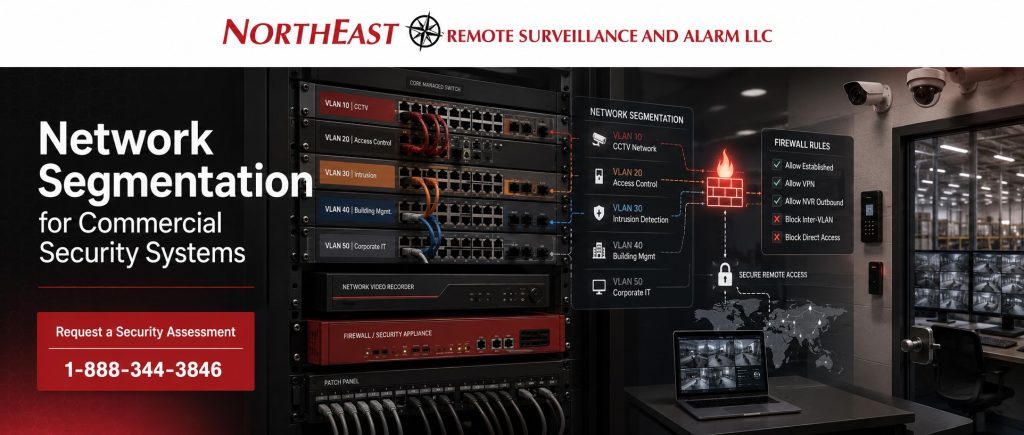
Network segmentation for commercial security systems controls communication between security devices, business users, and management tools.

Begin with security network design and remote access to define the overall architecture.
This guide focuses on the permitted communication paths and the controls that enforce them.
Northeast Remote Surveillance and Alarm, LLC designs commercial security systems for businesses that need cameras, access control, intrusion alarms, intercoms, remote monitoring, and video recording to operate reliably without creating unnecessary network risk. Segmentation is especially important for warehouses, manufacturing plants, offices, healthcare facilities, municipal properties, logistics sites, contractor yards, multi-tenant buildings, and multi-site commercial environments.
A security system should not be casually added to an unmanaged business network. Cameras, recorders, cloud-managed devices, access control panels, intercoms, and monitoring equipment should be planned around network performance, user permissions, remote access, bandwidth, cybersecurity expectations, and IT coordination.
What Network Segmentation for Commercial Security Systems Means
Network segmentation means separating certain devices, users, or traffic into organized network areas instead of allowing everything to operate on one flat network. In commercial security, segmentation may be used to separate security cameras, access control panels, video recorders, intercoms, alarm communicators, and remote monitoring equipment from office computers, guest Wi-Fi, point-of-sale systems, phones, and general business devices.
Segmentation may involve:
- dedicated security VLANs
- separate camera networks
- firewall rules
- managed switches
- access control lists
- recorder network separation
- user permission controls
- secure remote access methods
- IT coordination
- device documentation
- segmented cloud-managed security devices
The goal is not to make the system complicated. The goal is to make the security network more organized, more manageable, and less exposed.
Why Network Segmentation for Commercial Security Systems Matters
Commercial security systems often include many connected devices. If those devices are installed on a flat or unmanaged network, the business may face performance problems, cybersecurity concerns, service confusion, and remote access risks.
Segmentation may help support:
- cleaner camera traffic management
- improved network performance
- better remote access control
- reduced exposure between business devices and security devices
- more organized troubleshooting
- clearer user permissions
- easier device documentation
- stronger IT coordination
- more reliable video recording
- more scalable system expansion
A security system should improve protection without becoming a weak point in the business network.
Security Devices That May Need Segmentation
Different security devices may need different network treatment depending on how the system is designed.
Devices that may be included in a segmented security network include:
- IP security cameras
- PoE camera switches
- network video recorders
- video management servers
- cloud-managed camera gateways
- access control panels
- mobile credential controllers
- intercom systems
- visitor entry systems
- alarm communicators
- remote monitoring equipment
- wireless bridge radios
- gate control devices
- license plate recognition cameras
- security workstations
Each device should be planned based on communication needs, remote access requirements, manufacturer requirements, IT policy, and service expectations.
Flat Networks vs Network Segmentation for Commercial Security Systems
A flat network allows many devices to communicate broadly across the same network environment. This may be simple, but it can create risk when security devices, office computers, printers, guest devices, cameras, recorders, and cloud-connected equipment are all mixed together.
A segmented network creates more organization. Cameras may be separated from office computers. Guest Wi-Fi may be separated from business systems. Security devices may be placed on a dedicated VLAN or network zone. Remote access may be controlled through managed rules instead of open exposure.
For commercial facilities, segmentation helps reduce confusion and makes the system easier to manage as the property grows.
Camera Network Segmentation
Video surveillance systems can produce large amounts of network traffic. Camera count, resolution, frame rate, compression, recording type, remote access, and monitoring needs can all affect network performance.
Camera segmentation may help support:
- dedicated camera traffic
- stable recording to NVRs or servers
- cleaner PoE switch design
- bandwidth planning
- camera access control
- remote viewing security
- multi-site camera management
- troubleshooting
- future camera expansion
For broader camera-system planning, use Commercial & Industrial Video Surveillance Systems as the main video surveillance hub.
Camera networks should be planned before equipment is installed, especially when the property has high camera counts, remote viewing, cloud-managed recording, or live monitoring.
Network Segmentation for Access Control Systems
Access control systems may include panels, controllers, mobile credential devices, intercom integrations, door hardware interfaces, and cloud-managed services. These systems should be planned carefully because they control entry to doors, gates, restricted rooms, and facility areas.
Access control segmentation may support:
- protected controller communication
- clearer device management
- limited access to door control equipment
- separation from guest or public networks
- reliable credential communication
- stronger audit trail support
- coordination with IT policies
- future door expansion
Access control should also be coordinated with fire/life-safety requirements, emergency egress, door hardware, and building operations.
Network Segmentation for Video Recorders and Servers
Network video recorders, servers, and video management systems are central to a commercial camera system. These devices may receive video from many cameras, store footage, provide remote access, and support user review.
Recorder segmentation may help manage:
- camera-to-recorder traffic
- user access to recorded footage
- remote viewing permissions
- export access
- system health monitoring
- storage network performance
- multi-site connections
- service access
A recorder should not be left exposed or casually accessible across the entire business network. Access should be controlled based on user roles and operational needs.
Network Segmentation for Remote Monitoring
Remote video monitoring depends on stable and secure camera connectivity. If cameras, recorders, internet service, analytics, speakers, or monitoring devices are poorly connected, live operator review can suffer.
Monitoring-ready segmentation may consider:
- event camera access
- remote operator permissions
- secure monitoring paths
- bandwidth allocation
- speaker or talk-down device access
- alarm verification workflows
- internet redundancy
- firewall coordination
- system health alerts
For monitoring-specific planning, use Remote Video Monitoring as the supporting resource.
Remote monitoring should be designed so operators can access the views they need without exposing unrelated business systems.
Segmentation for Wireless Bridges and Remote Cameras
Wireless bridges, remote camera poles, detached building cameras, gate cameras, parking lot cameras, and trailer yard cameras can add complexity to the network. These devices may connect through radios, remote PoE switches, outdoor cabinets, fiber, or cellular equipment.
Network planning should consider:
- remote camera traffic
- wireless bridge management access
- remote PoE switch access
- outdoor cabinet network design
- camera VLAN extension
- monitoring access
- service access
- security of wireless devices
- documentation
Remote devices should be organized and documented so they do not become hidden weak points in the system.
Segmentation for Cloud-Managed Security Systems
Cloud-managed cameras, access control, intercoms, and security platforms may require outbound internet communication. These systems can be useful, but they should still be deployed with intentional network planning.
Cloud-managed segmentation may involve:
- outbound access rules
- device grouping
- limited administrative access
- firmware management
- user permission control
- IT policy review
- secure credential management
- device documentation
- bandwidth planning
Cloud-managed security does not remove the need for local network planning. The local network still supports device connectivity, uptime, performance, and serviceability.
Guest Wi-Fi and Security Networks
Commercial properties often provide guest Wi-Fi for visitors, tenants, customers, vendors, or public users. Security systems should not share open guest networks.
Guest Wi-Fi should generally be separated from:
- security cameras
- access control panels
- alarm communicators
- video recorders
- business computers
- payment systems
- administrative devices
- building management systems
A segmented design helps prevent guest devices from reaching systems they should not access.
Bandwidth and Performance Planning
Segmentation also supports performance planning. Cameras and security devices can use significant bandwidth, especially when recording high-resolution video, streaming remotely, uploading cloud footage, or supporting live monitoring.
Bandwidth planning may include:
- camera resolution
- frame rate
- compression
- recording method
- remote viewing
- cloud upload needs
- monitoring requirements
- switch uplinks
- fiber backbone
- firewall throughput
- internet speed
- multi-site access
The network should be able to support the security system without degrading business operations or losing video quality.
Firewall Coordination and Remote Access
Remote access should be planned carefully. Commercial systems should avoid unsafe shortcuts such as unmanaged port forwarding, shared passwords, or uncontrolled administrative access.
Cybersecurity-aware remote access may include:
- firewall coordination
- VPN or secure access methods where appropriate
- platform-managed remote access
- role-based user permissions
- multi-factor authentication where supported
- restricted administrative access
- documented access procedures
- device firmware management
- strong credential practices
The right method depends on the platform, business IT policies, monitoring needs, and support requirements.
User Permissions and Role-Based Access
Not every user should have the same level of access to the security system. Business owners, managers, IT staff, facility teams, security users, monitoring operators, and service technicians may all need different permissions.
Permission planning may include:
- live video access
- recorded video access
- export permissions
- access control administration
- user management
- alarm notifications
- monitoring access
- system configuration access
- location-based permissions
- camera-group permissions
Role-based access helps reduce risk and improves accountability.
Documentation and Long-Term Serviceability
A segmented security network should be documented. Without documentation, future service work becomes harder and the system may be misunderstood by technicians, IT staff, or facility managers.
Documentation may include:
- VLAN names
- IP address ranges
- switch locations
- port assignments
- camera names
- recorder locations
- access control panel locations
- firewall rules
- remote access methods
- cloud platform information
- wireless bridge addresses
- service notes
- user permission structure
Documentation supports troubleshooting, system expansion, ownership changes, and long-term support.
Multi-Site Network Segmentation
Multi-site businesses may need a consistent network segmentation strategy across several locations. This can help standardize camera access, permissions, naming conventions, monitoring, remote support, and incident review.
Multi-site segmentation may support:
- standardized security VLANs
- centralized user access
- location-based camera permissions
- consistent recorder naming
- remote monitoring workflows
- multi-site access control management
- clearer service documentation
- scalable system growth
A scalable network design helps the business add locations without rebuilding the security architecture each time.
Compliance, Privacy, and Cybersecurity-Aware Planning
Network segmentation supports responsible system planning, but it is not a substitute for formal compliance or cybersecurity policy. Businesses with regulated environments, sensitive data, healthcare operations, municipal systems, payment systems, or special contractual requirements should coordinate with appropriate IT, legal, compliance, or cybersecurity advisors.
Commercial security planning should consider:
- user access controls
- privacy-sensitive areas
- camera permissions
- secure remote access
- data handling expectations
- vendor access
- system documentation
- device lifecycle management
- password practices
- firmware updates
Security systems should be planned to support the property without creating unnecessary risk.
Common Network Segmentation Mistakes
Common mistakes include:
- placing cameras on the general office network without planning
- mixing guest Wi-Fi and security devices
- using weak passwords
- exposing recorders through unsafe remote access
- failing to document IP addresses
- failing to separate camera traffic
- overloading switch uplinks
- ignoring firewall coordination
- giving too many users administrator access
- failing to manage firmware
- adding cloud devices without IT review
- treating security networks as an afterthought
These mistakes can create performance problems, cybersecurity exposure, and long-term service issues.
When Network Segmentation Should Be Planned
Network segmentation should be reviewed before cameras, access control panels, intercoms, recorders, monitoring devices, or cloud-managed systems are installed. Planning after installation can lead to rework, downtime, access problems, and service confusion.
A segmentation review should consider:
- existing IT network
- camera count
- access control devices
- recorder location
- switch design
- firewall rules
- remote access needs
- monitoring needs
- internet reliability
- cloud platform requirements
- user permissions
- future expansion
- service documentation
Planning early makes the system more reliable and easier to support.
Frequently Asked Questions
What is network segmentation for commercial security systems?
Network segmentation separates security devices such as cameras, recorders, access control panels, intercoms, and monitoring equipment from general business network traffic using VLANs, dedicated networks, firewall rules, or other network design methods.
Why should security cameras be segmented?
Security cameras can generate heavy network traffic and may need controlled access. Segmentation can improve performance, reduce unnecessary exposure, simplify troubleshooting, and support more organized recording and remote access.
Should access control be on a separate network?
Many commercial access control systems benefit from planned network separation or controlled communication. The right design depends on the access control platform, IT policy, door count, cloud requirements, and facility needs.
Is network segmentation the same as cybersecurity?
No. Network segmentation is one part of cybersecurity-aware planning, but it is not a complete cybersecurity program. It should be combined with strong passwords, firmware management, user permissions, secure remote access, documentation, and IT coordination.
Do cloud-managed security systems still need segmentation?
Yes. Cloud-managed systems still rely on local network connectivity. Cameras, access control panels, intercoms, and gateways should still be planned around performance, permissions, security, and serviceability.
Can network segmentation improve camera performance?
Yes. Segmentation can help organize camera traffic, reduce unnecessary network exposure, and support cleaner routing between cameras, switches, recorders, and remote access platforms.
Does remote monitoring need network segmentation?
Remote monitoring benefits from stable and secure access to the correct camera views, event triggers, speakers, and monitoring equipment. Segmentation can help operators access what they need without exposing unrelated business systems.
Who should be involved in security network planning?
Security network planning often involves the security integrator, business owner, facility manager, IT provider, network administrator, and sometimes compliance or cybersecurity advisors.
Can NERSA help with network segmentation for security systems?
Yes. Northeast Remote Surveillance and Alarm, LLC supports cybersecurity-aware security infrastructure planning, including camera networks, access control connectivity, recorder access, remote monitoring paths, managed switches, VLAN coordination, and security system documentation.
Request a Security Network Assessment
Network segmentation should be reviewed before cameras, access control, recorders, intercoms, remote monitoring, or cloud-managed security platforms are installed. A professional assessment helps identify network structure, device count, bandwidth needs, remote access requirements, firewall coordination, user permissions, and long-term service needs.
Use Request a Security Assessment to begin planning network segmentation for a commercial or industrial security system.
Northeast Remote Surveillance and Alarm, LLC provides business and facility security system assessment, infrastructure planning, installation, monitoring, and support for commercial and industrial facilities across the Lehigh Valley, Pennsylvania, and selected Mid-Atlantic markets.