
Fire alarm phone-line replacement changes how signals reach the monitoring center when aging POTS lines are retired.

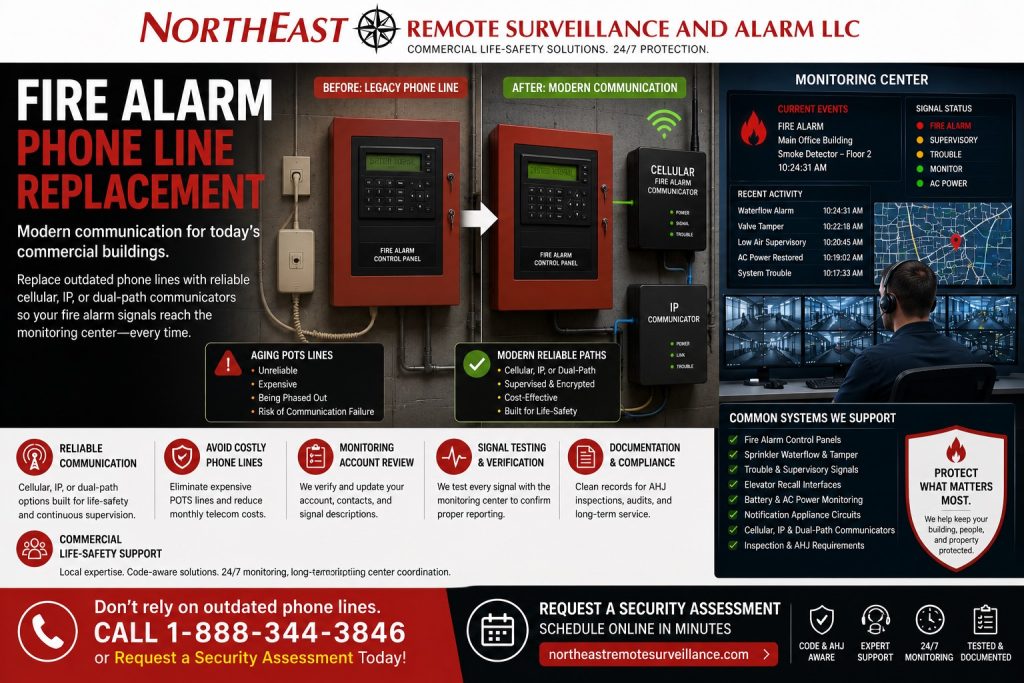
Signals may include alarm, trouble, supervisory, waterflow, tamper and communicator events.
NERSA reviews old communication paths and communicators, cellular and IP options, signal tests and account records.
See Fire Alarm Monitoring and Supervision to coordinate the change with the rest of the system.
Modernizing Alarm Communications
Many commercial fire alarm systems still rely on traditional phone lines.
The fire alarm control panel may still be serviceable. The smoke detectors, pull stations, sprinkler monitoring points, notification appliances, and backup batteries may still be acceptable. The weak point may be the communication path.
Old phone lines can become expensive, unreliable, poorly documented, or vulnerable to service changes. If the building owner or telecom provider changes or removes phone service, the fire alarm system may develop communication trouble or stop reporting.
A fire alarm phone line replacement focuses on the monitoring path, not automatically replacing the entire fire alarm system.
The goal is to replace outdated phone-line communication with a more supportable fire alarm communicator path while confirming that the correct signals reach the monitoring center.
Why Fire Alarm Phone Lines Are Being Replaced
Older fire alarm communicators were commonly installed with traditional phone-line service.
That approach can become a problem as telecom service changes. A system that worked for years may suddenly become harder to support when analog lines are removed, converted, bundled into newer phone systems, or no longer provide dependable signal transmission.
Common reasons for fire alarm phone line replacement include:
- Old POTS lines are being removed.
- Phone service is being converted or changed.
- The fire alarm panel shows communication trouble.
- Monitoring signals are not being received consistently.
- The communicator is outdated or unsupported.
- Monthly phone-line costs are too high.
- The building owner does not know which line supports the fire alarm.
- Signal testing records are incomplete.
- Inspection documentation needs cleanup.
- The fire alarm panel is still usable, but the communication path is weak.
- The facility needs a cleaner long-term monitoring support plan.
The phone line may be the weak point even when the rest of the fire alarm system is still usable.
What the Work Includes
Fire alarm phone line replacement is not just removing a phone line.
A proper replacement should review the fire alarm panel, communicator, monitoring account, signal types, backup power, documentation, and AHJ expectations.
For an Alarm.com-specific assessment of existing panels and reporting paths, see commercial fire communicator planning.
A fire alarm phone-line replacement project may include:
- Existing fire alarm panel review
- Existing communicator review
- Phone-line dependence review
- Cellular communicator planning
- IP communicator planning
- Dual-path communication review where applicable
- Monitoring account review
- Emergency contact list review
- Signal description cleanup
- Alarm signal testing
- Trouble signal testing
- Supervisory signal testing
- Waterflow and tamper signal testing where applicable
- Restoral signal verification
- Documentation updates
- AHJ-aware planning
Before closing the project, obtain monitoring-center confirmation of the correct signals from the correct account.
Fire Alarm Communicator Replacement
The communicator is the part of the system that sends fire alarm signals from the building to the monitoring path.
When the communicator still depends on old phone lines, it may need to be replaced or upgraded. The correct replacement depends on the fire alarm panel, monitoring provider, cellular signal strength, IP or network availability, backup power, manufacturer instructions, local requirements, and AHJ acceptance.
A communicator replacement may support:
- Alarm signal transmission
- Trouble signal reporting
- Supervisory signal reporting
- Waterflow signal reporting
- Valve tamper signal reporting
- Restoral signals
- Communication trouble supervision
- Monitoring account updates
- Inspection documentation
For broader communicator planning, see Fire Alarm Communicator Upgrades.
Cellular Fire Alarm Communicator Options
Cellular fire alarm communicators are commonly used when approved for the application.
A cellular communicator can help reduce dependence on legacy phone lines and provide a modern signal transmission path. Cellular communicator planning must consider signal strength, antenna placement, panel compatibility, monitoring account programming, backup power, serviceability, and signal testing.
Cellular fire alarm communicator planning may include:
- Cellular signal review
- Antenna location review
- Fire alarm panel compatibility
- Communicator installation
- Power and battery review
- Monitoring account programming
- Alarm signal testing
- Trouble signal testing
- Supervisory signal testing where applicable
- Monitoring center confirmation
- Documentation updates
After installing a cellular communicator, test it with the monitoring center to verify reporting.
IP Fire Alarm Communicator Options
Some buildings may use IP-based fire alarm communication where appropriate and accepted.
IP communicator planning requires careful review because the network becomes part of the communication path. The fire alarm communication path should not depend on unmanaged, unlabeled, unprotected, or unreliable network equipment.
IP fire alarm communicator planning may include:
- Network connection review
- Switch or router location review
- Internet reliability review
- UPS or backup power review
- Supervision requirements
- Fire alarm panel compatibility
- Monitoring center compatibility
- Account programming
- Signal testing
- IT coordination where needed
- Documentation updates
IP communication may be a useful option, but the plan must address reliability, supervision and AHJ expectations.
Dual-Path Fire Alarm Communication
Some commercial buildings may require or benefit from dual-path fire alarm communication.
Dual-path communication may use cellular, IP, or other approved communication methods depending on the fire alarm system, communicator, monitoring provider, local requirements, and AHJ direction.
Dual-path communication may improve resilience by supporting more than one path. However, both paths need proper design and testing.
NERSA reviews the building conditions, fire alarm panel, monitoring path, and requirements before recommending a communication method.
Phone Line Replacement Without Replacing the Fire Alarm Panel
Replacing old fire alarm phone lines does not always mean replacing the entire fire alarm system.
A phone-line replacement or communicator upgrade may be appropriate when:
- The fire alarm panel is still serviceable.
- The field devices are still acceptable.
- The main problem is the communication path.
- The system still meets the building’s needs.
- Monitoring account information can be updated.
- Signals can be tested and verified.
- Documentation can be cleaned up.
A larger fire alarm replacement may be needed if the panel is obsolete, unsupported, locked, failing, not accepted, or unable to support modern communicator requirements.
The right answer should come from a system review, not a blind replacement recommendation.
Existing Fire Alarm System Review
Before replacing a fire alarm phone line, NERSA reviews the existing fire alarm and communication setup.
The review may include:
- Fire alarm control panel
- Existing communicator
- Current phone-line connection
- Monitoring account information
- Cellular signal availability
- IP or network availability
- Trouble conditions
- Alarm signal descriptions
- Trouble signal descriptions
- Supervisory signal descriptions
- Waterflow and tamper signals where applicable
- Sprinkler monitoring points
- Elevator recall interface points where applicable
- Backup battery condition
- Available documentation
- AHJ or inspection concerns
- Future system upgrade needs
This review helps determine whether the correct path is communicator replacement, monitoring account cleanup, signal testing, documentation correction, or broader fire alarm modernization.
Monitoring Account Review
The monitoring account must be accurate before and after the phone-line replacement.
A new communicator does not solve the problem if the monitoring center has the wrong site information, old contacts, vague signal descriptions, or outdated response instructions.
Monitoring account review may include:
- Site name
- Site address
- Monitoring account information
- Emergency contact list
- Call list order
- Alarm signal descriptions
- Trouble signal descriptions
- Supervisory signal descriptions
- Waterflow and tamper descriptions where applicable
- Elevator recall interface descriptions where applicable
- Restoral descriptions
- Signal testing records
- Monitoring center receipt confirmation
For dedicated account cleanup planning, see Fire Alarm Monitoring Account Review.
Signal Testing and Verification
Signal testing is the most important part of fire alarm phone line replacement.
A communicator can show power, signal strength, or online status and still need complete monitoring verification. The monitoring center must confirm that it receives the correct signal types from the correct account.
Testing may include:
- Fire alarm signal testing
- Trouble signal testing
- Supervisory signal testing
- Waterflow signal testing where applicable
- Valve tamper signal testing where applicable
- Restoral signal testing
- Communication trouble testing where applicable
- Account identification confirmation
- Signal description confirmation
- Monitoring center receipt confirmation
- Documentation of test results
Plan fire alarm phone line replacement as a change to a monitored life-safety communication path, with testing and documentation beyond the device swap.
Waterflow and Tamper Signal Reporting
Many fire alarm phone line replacement projects involve sprinkler monitoring.
If the existing system monitors waterflow, valve tamper, low air or other sprinkler supervisory signals, review and test them after communicator replacement.
Sprinkler-related signal review may include:
- Waterflow alarm reporting
- Valve tamper supervisory reporting
- Low air supervisory reporting where applicable
- Fire pump supervisory signals where applicable
- Trouble and restoral reporting
- Signal descriptions
- Monitoring account records
- Documentation and testing notes
Elevator Recall and Fire Alarm Interfaces
Some buildings with elevators may also need fire alarm elevator recall interface records reviewed during phone-line replacement or communicator modernization.
The phone-line replacement itself does not redesign elevator recall, but the monitoring account and documentation should still reflect the building’s fire alarm system accurately.
Elevator-related review may include:
- Elevator lobby smoke detector descriptions
- Machine room or control room detector descriptions where applicable
- Recall relay documentation
- Trouble or supervisory descriptions where applicable
- Monitoring account notes
- Testing records where applicable
Fire Alarm Trouble and Supervisory Signals
Phone-line problems often show up as communication trouble, but fire alarm systems may also have unrelated trouble or supervisory conditions that need review.
A phone-line replacement project is a good time to identify and document these issues.
Common conditions may include:
- Communication trouble
- AC power trouble
- Battery trouble
- Device trouble
- Wiring trouble
- Ground fault
- Supervisory signal
- Valve tamper condition
- Low air condition
- Restoral issue
Fire Alarm Phone Line Replacement vs. General Security Phone Line Upgrades
Fire alarm phone line replacement is different from general security alarm phone-line replacement.
Intrusion and fire alarms may both use phone lines, cellular communicators or IP paths. Fire alarms have separate life-safety requirements, record needs, signal types and AHJ expectations. Plan each system accordingly.
This guide addresses the paths used to communicate fire alarm signals.
Documentation and Inspection Readiness
A fire alarm phone line replacement should leave the building with cleaner records.
Documentation may include:
- Existing communicator information
- New communicator information
- Communication path notes
- Cellular or IP path details
- Monitoring account notes
- Signal test records
- Alarm, trouble, and supervisory descriptions
- Waterflow and tamper signal notes where applicable
- Contact list review
- Trouble condition notes
- Inspection or AHJ documentation where applicable
- Service notes for future support
AHJ and Code-Aware Planning
Fire alarm phone line replacement must be handled with code awareness.
The Authority Having Jurisdiction has final authority over fire alarm approval, inspection, and acceptance. Requirements may vary by municipality, building type, occupancy, adopted code, communicator type, monitoring arrangement, fire alarm panel, sprinkler system, and documentation needs.
NERSA plans fire alarm phone line replacement with attention to:
- AHJ expectations
- Fire alarm panel requirements
- Communicator compatibility
- Monitoring provider requirements
- Manufacturer instructions
- Signal supervision
- Backup power
- Testing requirements
- Documentation
- Inspection readiness
For broader code planning, see NFPA 72 Fire Alarm Standards for Commercial Buildings.
Before and After
| Before Phone Line Replacement | After Phone Line Replacement |
|---|---|
| Fire alarm depended on old phone lines | Modern cellular, IP, or approved communication path reviewed |
| Communication reliability was uncertain | Signal transmission can be tested with the monitoring center |
| Phone service changes created risk | Reduced dependence on outdated telecom service |
| Monitoring account details may be outdated | Account information and contacts can be reviewed |
| Signal descriptions were unclear | Alarm, trouble, supervisory, waterflow, and tamper signals can be cleaned up |
| Communicator trouble was unresolved | Communication trouble can be reviewed and corrected where possible |
| Documentation was limited | Better records for inspection and service readiness |
| Owner had uncertainty | Clearer long-term fire alarm monitoring support path |
Planning by Facility Type
Fire alarm phone line replacement is common in:
- Warehouses
- Distribution centers
- Manufacturing facilities
- Industrial buildings
- Office buildings
- Healthcare offices
- Schools and education facilities
- Retail stores
- Industrial parks
- Multi-tenant commercial buildings
- Logistics facilities
- Professional offices
- Municipal buildings
- Institutional properties
- Buildings with sprinkler systems
- Buildings with monitored fire alarm systems
- Buildings with old POTS-line fire alarm communication
- Buildings changing phone or internet service
Review each facility’s fire alarm system, monitoring requirements, communication path, documentation and AHJ expectations.
Related Planning
Confirm panel and communicator compatibility before changing the communication path. Coordinate required testing and local authority review.
Project Planning and Support
Northeast Remote Surveillance and Alarm, LLC provides security and life-safety systems for commercial, industrial, and institutional facilities.
Fire alarm phone line replacement requires more than disconnecting old telecom service. It requires fire alarm panel review, communicator compatibility, monitoring center coordination, signal testing, account cleanup, documentation, backup power review, and code-aware planning.
NERSA helps commercial facilities modernize fire alarm communication paths while avoiding unnecessary full system replacement when a targeted communicator upgrade is the right solution.
When to Request a Review
A commercial facility should request fire alarm phone line replacement review if:
- The fire alarm system still uses old phone lines.
- Phone service is being changed, removed, or converted.
- The fire alarm panel shows communication trouble.
- The communicator is outdated or unsupported.
- Monitoring signals have not been tested recently.
- The monitoring account information is unclear.
- Emergency contact lists are outdated.
- Waterflow or tamper signals need review.
- The building is preparing for inspection.
- The building is changing tenants, ownership, or service providers.
- The owner wants a more supportable fire alarm monitoring path.
Planning Checklist
Before replacing fire alarm phone lines, evaluate:
- Fire alarm control panel
- Existing communicator
- Current phone-line connection
- Current monitoring path
- Cellular signal strength
- IP/network availability
- Panel compatibility
- Backup power
- Alarm signal reporting
- Trouble signal reporting
- Supervisory signal reporting
- Waterflow reporting where applicable
- Valve tamper reporting where applicable
- Monitoring account information
- Emergency contact list
- Call list order
- Zone or point descriptions
- Signal testing records
- Trouble history
- Documentation
- AHJ expectations
- Future system upgrade needs
Request a Communication-Path Review
To prepare for a communication-path review, gather the latest telephone bill, the line numbers believed to serve the fire alarm, any provider change or cancellation notice, and the current monitoring provider’s contact information. Include available panel and communicator model records, the most recent service report, and the name of the person who can authorize work. These records give the review team a starting point for confirming the existing arrangement and planning the transition.
Frequently Asked Questions
What is fire alarm phone line replacement?
Fire alarm phone line replacement is the process of replacing or modernizing the old phone-line communication path used by a commercial fire alarm system to transmit signals to the monitoring center.
Why are fire alarm phone lines being replaced?
Many old phone-line paths are becoming expensive, unreliable, unsupported, or affected by telecom service changes. A modern communicator can help create a more supportable monitoring path.
Does replacing the phone line mean replacing the fire alarm panel?
Not always. If the existing fire alarm panel is still serviceable and compatible with a modern communicator, the phone-line path may be replaced without replacing the entire fire alarm system.
Can a fire alarm system use a cellular communicator?
Yes, where appropriate and accepted. Cellular fire alarm communicators are commonly used to reduce dependence on old phone-line service, but panel compatibility, signal strength, monitoring requirements, backup power, and AHJ expectations must be reviewed.
Can a fire alarm system use IP communication?
Yes, where appropriate and accepted. IP communication requires reliable network infrastructure, supervision, backup power, monitoring compatibility, and documentation.
Should signals be tested after replacing fire alarm phone lines?
Yes. Test alarm, trouble, supervisory, waterflow, tamper and restoral signals where applicable. Then confirm that the monitoring center receives the correct signals from the correct account.
Can old phone-line trouble conditions be corrected?
Often, yes. Communication trouble can sometimes be corrected through communicator replacement, programming review, signal testing, or monitoring path modernization. Some issues may require broader panel or system service.
Is fire alarm phone line replacement the same as burglar alarm phone line replacement?
No. Fire alarm phone line replacement involves life-safety signal reporting and AHJ-aware planning. Burglar alarm or intrusion alarm communication upgrades are separate security services.
Does the AHJ need to approve fire alarm phone line replacement?
The Authority Having Jurisdiction has final authority over fire alarm approval, inspection, and acceptance. Requirements vary by building, municipality, adopted code, communicator type, and monitoring arrangement.
How do we start a fire alarm phone line replacement project?
Call 1-888-344-3846 or use Request a Security Assessment.
NERSA can review the fire alarm panel, existing phone-line communicator, monitoring path, account information, signal descriptions, documentation, and upgrade options before recommending the right path.
Compliance, Codes & Project Standards
NERSA plans commercial and industrial security work with applicable code, documentation, inspection and authority-having-jurisdiction requirements in mind. Requirements vary by system, property and jurisdiction. These resources support project planning; they do not establish legal compliance, certification or AHJ approval.
Related guidance: Regulatory compliance & inspection readiness · Fire alarm inspection readiness · NERSA project standards