License plate recognition systems along the Lehigh Valley Route 33 industrial corridor should be built around the way vehicle traffic actually moves through industrial properties. Truck entrances, gate lanes, service drives, employee parking entrances, fleet areas, contractor access points, and controlled yard approaches all create situations where general exterior cameras may not provide enough usable vehicle identification. A properly designed system should capture readable plate data, support vehicle documentation, strengthen entry-point visibility, and help properties review the parts of the site where vehicle movement creates the most risk.
Northeast Remote Surveillance and Alarm, LLC provides license plate recognition systems along the Lehigh Valley Route 33 industrial corridor for properties that need stronger vehicle identification, better entry-lane documentation, more dependable review of truck and vehicle activity, and a more practical security design built around how industrial traffic actually operates.
This page is focused specifically on license plate recognition along the Lehigh Valley Route 33 industrial corridor. For broader corridor planning, visit Lehigh Valley Route 33 Industrial Corridor Security Systems. For yard-focused protection, visit Truck Yard and Trailer Security Systems Along the Lehigh Valley Route 33 Industrial Corridor. For broader warehouse-focused coverage, visit Warehouse Security Systems Along the Lehigh Valley Route 33 Industrial Corridor
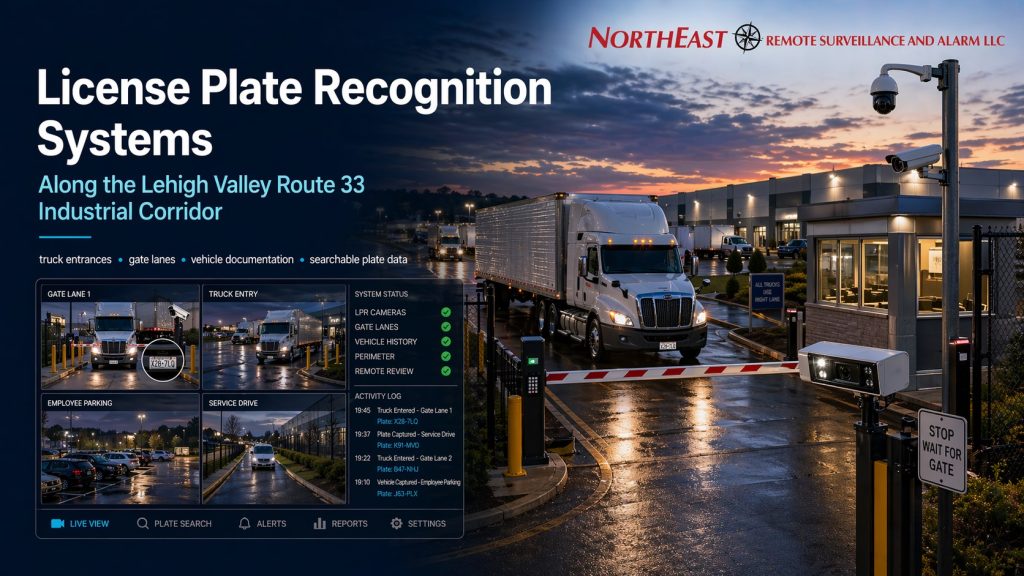
Security Systems Built for Vehicle Identification
License plate recognition is not the same as general lot coverage. A general outdoor camera may show a vehicle entering or leaving the property, but that does not mean it will consistently capture a readable plate under real operating conditions. Glare, darkness, lane width, speed, headlights, angle, and distance can all reduce usefulness if the system is not designed specifically for vehicle identification.
A properly designed LPR system should be built around the actual lane, the actual traffic type, and the actual vehicle flow on the property. That is especially important along the Lehigh Valley Route 33 industrial corridor, where many properties depend on recurring truck traffic, employee vehicle movement, service traffic, and controlled industrial entry points.
What Route 33 Corridor Properties Commonly Need to Protect With LPR
Properties along the Lehigh Valley Route 33 corridor often need stronger vehicle documentation around the points where traffic enters, exits, or moves through controlled areas.
Truck Entrances and Freight Access Lanes
Truck entrances and freight access lanes often need stronger documentation because they handle the vehicles most closely tied to shipping, receiving, drop-and-hook activity, yard circulation, and after-hours logistics movement.
Gate Lanes and Controlled Vehicle Entry Points
Gate lanes create natural capture points for license plate recognition. These areas often provide the best opportunity to document inbound and outbound vehicle traffic in a deliberate, searchable way.
Service Drives and Rear Access Routes
Some properties also need stronger plate capture at side drives, rear service routes, vendor approaches, and other less-visible entry points where vehicles may enter outside the main traffic pattern.
Employee and Visitor Parking Entrances
Not every LPR application is tied only to tractor-trailers. Some Route 33 corridor properties also need stronger documentation around employee parking entrances, visitor vehicle access points, and recurring after-hours passenger-vehicle movement.
Yard-Linked Vehicle Approaches
Properties with active truck courts, trailer yards, fleet areas, or detached staging sections often need better documentation around the approaches feeding those exterior logistics zones.
For yard-focused protection, visit Truck Yard and Trailer Security Systems Along the Lehigh Valley Route 33 Industrial Corridor.
License Plate Recognition Should Be Built Around the Lane
A strong LPR system should be designed around a controlled capture point, not around a generic wide scene. That means understanding how many lanes need coverage, whether vehicles stop or roll through, whether the lane serves passenger vehicles, box trucks, or tractor-trailers, what the nighttime lighting conditions look like, and how headlights or angle of approach affect plate readability.
This is especially important along the Lehigh Valley Route 33 industrial corridor, where industrial properties often have mixed vehicle traffic, broad drive lanes, recurring truck movement, and vehicle patterns that are different from a standard office or retail lot.
Common Security Priorities for LPR Along Route 33
Better Documentation of Vehicle Entries and Exits
Many properties need a clearer record of which vehicles entered, when they arrived, which lane they used, and whether they returned. Stronger license plate capture helps create a more useful vehicle history than general overview footage alone.
Better Review of Recurring Vehicle Activity
Some properties need to track repeated visits, after-hours appearances, unusual vehicle timing, contractor arrivals, or vehicles tied to operational questions or investigations. LPR makes those reviews more targeted and more searchable.
Better Support for Yard and Gate Investigations
When an incident happens, management often needs to know whether a specific truck or vehicle entered the site, whether it used a different entrance, or whether it appeared before or after an event. LPR helps provide that vehicle-based review.
Better Control at High-Traffic Vehicle Entry Points
Some properties need stronger plate documentation at truck lanes, gate approaches, fleet entrances, or controlled yard routes where vehicle traffic matters operationally, not just visually.
Better Separation Between Overview Cameras and Plate Capture
A strong LPR design often works best when general overview coverage and dedicated plate capture are treated as different jobs. One camera can document the broader scene, while the LPR camera handles readable plate capture.
License Plate Recognition Is Not the Same as General Camera Coverage
This page is intentionally focused on license plate recognition. It should not drift into a general commercial camera page, a broader yard-security page, a gate-access page, or a full warehouse-security page. The purpose here is vehicle identification, searchable vehicle history, and entry-point documentation.
If the main concern is broader yard exposure, trailer rows, or perimeter visibility, visit Truck Yard and Trailer Security Systems Along the Lehigh Valley Route 33 Industrial Corridor. If the property needs broader warehouse coverage, visit [Warehouse Security Systems Along the Lehigh Valley Route 33 Industrial Corridor]. If the main concern is broader gate control rather than plate capture, that should be handled as a separate access-control or gate-focused spoke.
Security Systems for License Plate Recognition Along the Lehigh Valley Route 33 Industrial Corridor
Northeast Remote Surveillance and Alarm, LLC designs license plate recognition systems for properties that need stronger documentation around truck entrances, gate lanes, service drives, employee parking access points, yard approaches, and other vehicle entry zones. These systems may involve dedicated plate-capture cameras, better lane-focused design, stronger documentation around inbound and outbound vehicle activity, and clearer review of the parts of the property where vehicle movement creates the greatest operational risk.
The right design depends on lane layout, vehicle mix, speed, lighting conditions, angle of approach, gate structure, and the parts of the site where readable plate capture matters most.
Get a Quote for License Plate Recognition Systems Along the Lehigh Valley Route 33 Industrial Corridor
If your property operates along the Lehigh Valley Route 33 industrial corridor and needs stronger vehicle identification, better gate-lane documentation, more dependable truck-entry review, or a more practical LPR system built around real traffic conditions, Northeast Remote Surveillance and Alarm, LLC can help design a solution around the way your property actually functions.
For broader corridor planning, visit Lehigh Valley Route 33 Industrial Corridor Security Systems.