
The Lehigh Valley Route 33 corridor supports a concentrated network of warehouses, distribution centers, manufacturing facilities, industrial parks, truck courts, loading docks, trailer yards and other freight-intensive commercial properties.

Request a Route 33 Corridor Commercial Security Assessment
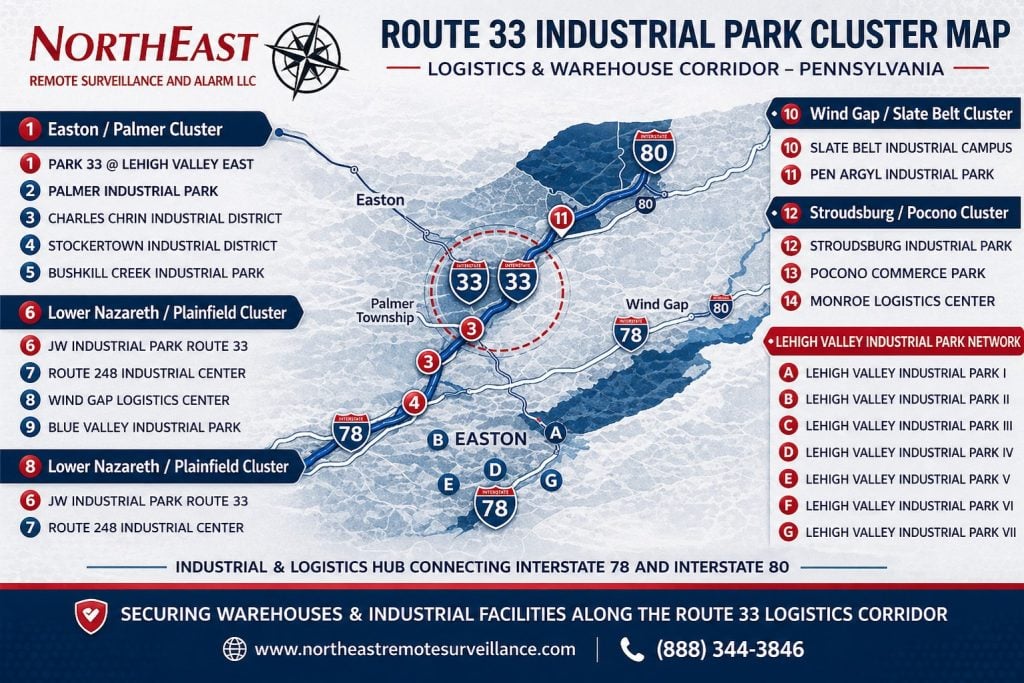
Northeast Remote Surveillance and Alarm, LLC (NERSA) designs, installs, integrates, monitors, upgrades and supports commercial and industrial security systems for businesses throughout the Lehigh Valley section of the Route 33 corridor.
Route 33 connects industrial and logistics properties around Tatamy, Nazareth and Stockertown with I-78, Route 22, Easton-area commercial markets, industrial parks and the broader Lehigh Valley freight and distribution network. NERSA supports manufacturing facilities, warehouses, contractor yards and multi-building commercial properties in these communities with security planning for cameras, managed entry, intrusion detection, gates and after-hours response.
Properties along this corridor often operate across several shifts. Trucks may arrive outside office hours, and docks may stay active while other areas are closed. Trailers, equipment and materials may remain exposed overnight. The security plan needs to account for those differences.
Security planning should therefore follow the movement of people, vehicles, freight and materials across the property rather than begin with a predetermined camera count, alarm package or access-control system.
For broader commercial and industrial security throughout the region, visit Lehigh Valley Commercial and Industrial Security Systems.
Commercial and industrial systems only.
Commercial Security Planning Along the Route 33 Industrial Corridor
The Route 33 corridor includes properties with significant employee movement, truck traffic, shipping and receiving activity, exterior exposure and after-hours operations.
A Route 33 commercial security assessment may consider:
- Employee entrances
- Contractor access
- Driver entrances
- Loading docks
- Shipping and receiving
- Overhead doors
- Warehouse areas
- Production spaces
- Restricted rooms
- Parking
- Truck courts
- Trailer storage
- Vehicle gates
- Exterior storage
- Fence lines
- Service drives
- Detached buildings
- After-hours activity
- Existing security systems
- Network and power infrastructure
- Documentation
- Future expansion
The objective is to create useful visibility, controlled access, dependable detection, practical response and reliable documentation around the way the property actually operates.
Route 33 Industrial Corridor Security Resources
Each resource below addresses one specific security requirement commonly found at commercial and industrial properties along Route 33.
For facilities handling inbound and outbound freight, review Route 33 distribution center security planning.
For camera coverage around freight and storage areas, review Route 33 warehouse security cameras planning.
For staff entrances and restricted warehouse areas, review Route 33 warehouse access control planning.
For freight, trailer, and yard risks, review Route 33 cargo theft prevention planning.
Warehouse & Distribution Security
For employee entrances, warehouse areas, loading docks, inventory, trailer parking and distribution operations, visit Warehouse Security Systems Along the Lehigh Valley Route 33 Industrial Corridor.
Manufacturing Facility Security
For production areas, employee entrances, maintenance spaces, materials, shipping operations and restricted industrial areas, visit Manufacturing Facility Security Systems Along the Lehigh Valley Route 33 Industrial Corridor.
Industrial Park Security
For shared entrances, common roads, tenant areas, parking, loading zones and multi-building industrial properties, visit Industrial Park Security Systems Along the Lehigh Valley Route 33 Industrial Corridor.
Commercial Intrusion Alarm Systems
For doors, overhead openings, interior detection, user management, partitions, monitoring and after-hours response, visit Commercial Alarm Systems Along Route 33.
Remote Video Monitoring
For selected yard, gate, dock and exterior events that need active review and a defined response procedure, visit Remote Video Monitoring Along Route 33.
Loading Dock Security
For dock doors, receiving lanes, shipping areas, freight movement and loading-dock activity, visit Loading Dock Security Systems Along the Lehigh Valley Route 33 Industrial Corridor.
Truck Yard & Trailer Security
For trailer rows, truck courts, yard lanes, fenced areas, vehicle movement and exterior exposure, visit Truck Yard and Trailer Security Systems Along the Lehigh Valley Route 33 Industrial Corridor.
License Plate Recognition
For dedicated vehicle documentation at truck entrances, service drives, employee parking entrances and controlled gate lanes, visit License Plate Recognition Systems Along the Lehigh Valley Route 33 Industrial Corridor.
Code & Compliance Planning
For projects involving controlled openings, life-safety coordination, documentation and regulated building conditions, visit Code and Compliance for Commercial Security Systems.
Coordinate cameras, alarms, controlled entry, and monitoring around the way employees, vehicles, and deliveries move through your Route 33 property.
Security Around Route 33 Freight Movement
Freight movement is one of the defining characteristics of many Route 33 commercial and industrial properties.
A single facility may have tractor-trailers, delivery vehicles, employee vehicles, contractors, vendors, forklifts, loading crews and shipping personnel moving through the property at different times.
These activities often intersect around:
- Loading docks
- Truck courts
- Shipping offices
- Gate lanes
- Warehouse entrances
- Trailer staging areas
- Employee parking
- Service drives
Security planning should distinguish between general property visibility and locations where more specific documentation is required.
The goal is to help authorized personnel understand what happened, where it happened, when it happened and which people or vehicles were involved.
Route 33 Properties & Operating Environments
Warehouses & Distribution Centers
For Route 33 warehouses requiring focused security around employees, inventory, loading areas and freight movement, visit Warehouse Security Systems Along the Lehigh Valley Route 33 Industrial Corridor.
Manufacturing Facilities
For manufacturing properties requiring security around production areas, employees, materials, maintenance spaces and shipping operations, visit Manufacturing Facility Security Systems Along the Lehigh Valley Route 33 Industrial Corridor.
Industrial Parks & Multi-Building Properties
For common entrances, tenant areas, shared parking, loading zones and several buildings, visit Industrial Park Security Systems Along the Lehigh Valley Route 33 Industrial Corridor.
Truck Courts & Trailer Areas
For truck yards, trailer rows, fenced areas and other exterior freight operations, visit Truck Yard and Trailer Security Systems Along the Lehigh Valley Route 33 Industrial Corridor.
Test the Handoff Between the Gate, Yard, and Dock
At a Route 33 freight property, trace one agreed delivery from vehicle arrival through the shipping office and assigned dock. Identify who admits the driver, who changes the destination when a dock is occupied, and which record lets staff locate the relevant activity later. Keep vehicle-entry permission separate from permission to enter the warehouse.
Use that sequence to check camera views, time alignment, gate or door events, and the authorized operator’s ability to retrieve a record. Include a normal exception, such as an early truck or a closed shipping office, so staff know the fallback contact and waiting arrangement. Repeat relevant checks after dark when the site operates overnight, and document any limits caused by parked trailers, lighting, or unavailable connections.
Existing Route 33 Security Systems
Industrial properties frequently change as buildings expand, loading positions are added, tenants change or operations grow.
Existing cameras, recording systems, access-control equipment, intrusion alarms, gates, cabling, fiber, networks, power and documentation can be evaluated before a replacement plan is developed.
Existing equipment may remain useful when it is compatible, serviceable and appropriate for the finished system.
The goal is to preserve useful infrastructure where practical while correcting gaps that affect reliability, coverage, administration or expansion.
Infrastructure for Route 33 Industrial Properties
Large industrial and logistics properties may require supporting infrastructure across buildings, gates, parking areas and exterior operating zones.
That infrastructure can include:
- Structured cabling
- Fiber
- PoE switching
- Wireless building connections
- Equipment cabinets
- Network racks
- Backup power
- Surge protection
- Outdoor pathways
- Network segmentation
- Equipment labeling
- System documentation
Infrastructure should be planned around system reliability and future expansion rather than treated as an afterthought.
Code-Aware Commercial Security Planning
Commercial security equipment can interact with controlled doors, emergency egress, fire alarm systems, accessibility requirements, electrical systems and other building conditions.
Security technology does not replace required workplace-safety, fire, life-safety or other compliance responsibilities.
Projects involving sensitive building conditions should be coordinated appropriately for the property.
For broader guidance, visit Code and Compliance for Commercial Security Systems.
How NERSA Approaches a Route 33 Security Project
A Route 33 project begins with the property and its daily operations.
NERSA may review:
- Employees and contractors
- Loading docks
- Shipping and receiving
- Truck traffic
- Trailer areas
- Parking
- Gates
- Exterior storage
- Warehouse areas
- Production spaces
- Restricted rooms
- Existing cameras
- Alarm protection
- Access control
- Vehicle documentation
- Infrastructure
- Documentation
- Future expansion
The objective is to create a security environment that supports normal operation and gives management better visibility and control around people, vehicles, freight, restricted areas and after-hours activity.
For an example of coordinated camera and controlled-entry planning, see the Easton Route 33 warehouse security camera and access-control case study.
Frequently Asked Questions About Lehigh Valley Route 33 Industrial Corridor Security Systems
What is the Lehigh Valley Route 33 Industrial Corridor?
It is the section of Route 33 serving warehouse, distribution, manufacturing, industrial-park and freight-intensive properties throughout the Lehigh Valley market.
What types of properties does NERSA support along Route 33?
NERSA supports qualifying warehouses, distribution centers, manufacturing facilities, industrial parks, truck courts, trailer yards, fleet properties and multi-building commercial sites.
Why do Route 33 properties require property-specific security planning?
Many properties combine truck traffic, freight movement, employee access, loading docks, trailers, gates, exterior exposure and significant after-hours activity.
Can NERSA upgrade an existing Route 33 security system?
Yes. Existing cameras, access control, alarms, gates, cabling, fiber, networks and supporting infrastructure can be evaluated to determine what should remain, be repaired, expanded or replaced.
Can Route 33 warehouses and manufacturing facilities have different security requirements?
Yes. Warehouse and manufacturing operations can have different movement patterns, restricted areas, equipment, materials and operating schedules, so the finished design should reflect the specific property.
Can NERSA support truck yards and trailer areas?
Yes. Qualifying exterior commercial properties can require dedicated planning around gates, truck movement, trailer areas, fence lines, lighting and after-hours exposure.
Can license plate recognition be used at Route 33 properties?
Yes, when the vehicle entrance, lane geometry, camera position, lighting and operating conditions support dependable plate capture.
Does security equipment replace fire or life-safety requirements?
No. Security systems can support visibility, documentation and access accountability but do not replace applicable fire, life-safety, workplace-safety or other required responsibilities.
Does NERSA install single-family home security systems?
No. NERSA does not provide security installations for individual homes or single-family residences. We serve businesses, industrial and institutional facilities, and professionally managed apartment communities, including shared entrances, common areas, and grounds.
How does a Route 33 security project begin?
A project begins with a review of the property, operating conditions, employees, vehicles, freight movement, entrances, exterior exposure, current systems and the security results the organization needs.
Request a Route 33 Corridor Security Assessment
If your property operates along the Lehigh Valley Route 33 Industrial Corridor and needs stronger visibility, tighter control, improved after-hours protection or modernization of an existing system, NERSA can evaluate the facility around the way it actually operates.
Request a Route 33 Corridor Commercial Security Assessment.
Use the Route 33 access-control guide to plan credentials, schedules, and permissions for the entrances identified in your assessment.
- Lehigh Valley Route 33 Industrial Corridor Access Control Systems — Review controlled-entry planning for properties along Route 33.
Compliance, Codes & Project Standards
NERSA plans commercial and industrial security work with applicable code, documentation, inspection and authority-having-jurisdiction requirements in mind. Requirements vary by system, property and jurisdiction. These resources support project planning; they do not establish legal compliance, certification or AHJ approval.
Related guidance: NERSA project standards · Documentation, testing & inspection readiness