
Plan Route 33 truck yard security around trailer movements, gate access, and the hours your yard operates.

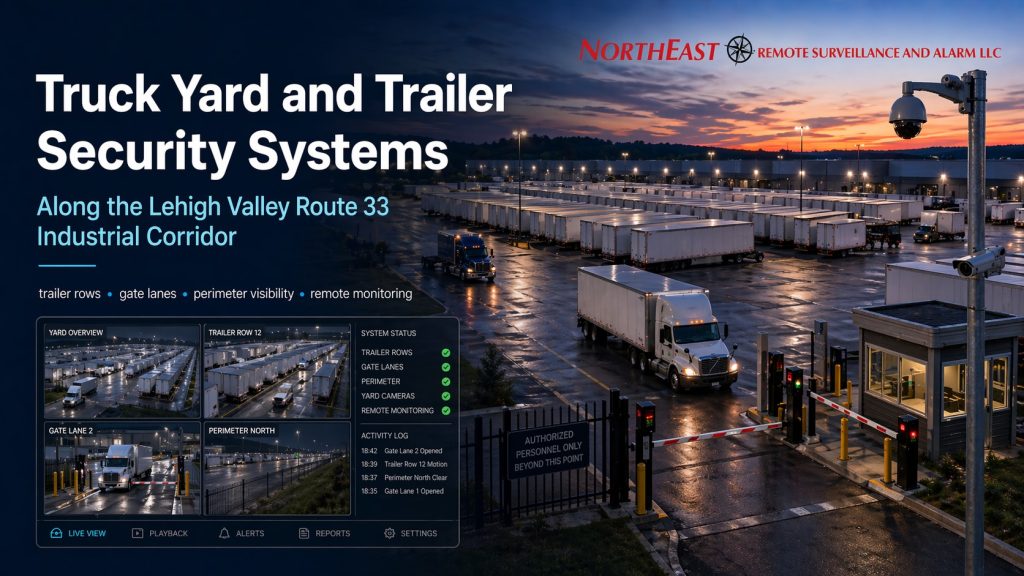
Trailer rows, truck courts, yard lanes, fenced perimeters, gate approaches, detached trailer parking, and after-hours vehicle movement all create security demands that are different from loading docks, warehouse interiors, and standard parking areas. A properly designed system should improve visibility, support investigations, strengthen perimeter awareness, and protect the parts of the property where exterior exposure and operational risk are most concentrated.
Northeast Remote Surveillance and Alarm, LLC provides truck yard and trailer security systems along the Lehigh Valley Route 33 corridor. We plan for yard visibility, records of truck and trailer movement, and control of outdoor logistics areas. The design should follow the way your yard operates.
For broader corridor planning, visit Lehigh Valley Route 33 Industrial Corridor Security Systems.
For broader warehouse-focused coverage, visit Warehouse Security Systems Along the Lehigh Valley Route 33 Industrial Corridor.
For dock-focused protection, visit Loading Dock Security Systems Along the Lehigh Valley Route 33 Industrial Corridor.
Security Systems Built for Truck Yards and Trailer Areas
Truck yards may stay active when the main building is closed. Plan coverage for early arrivals, late departures, and overnight periods with few staff on site. Trailers may be staged for pickup, dropped for later handling, moved between positions, or left in place while freight remains on site. Drivers, employees, contractors, and service vehicles may all move through the yard differently.
That kind of environment needs its own security planning. A truck yard security system should not be treated like a simple extension of the dock camera layout or a generic perimeter camera package. It should be built around trailer movement, truck circulation, vehicle entry points, fenced yard exposure, and the parts of the property where exterior logistics activity creates the most risk.
What Truck Yard and Trailer Areas Along the Route 33 Corridor Commonly Need to Protect
Properties along the Lehigh Valley Route 33 corridor often need stronger protection around the exact areas where exterior freight activity and yard exposure create the greatest operational risk.
Trailer Rows and Staging Areas
Trailer rows and staging areas often need stronger visibility because they hold assets, shipments, and equipment outside the building envelope. These areas may remain exposed for long periods, especially overnight or between scheduled pickups and deliveries.
Truck Courts and Yard Lanes
Truck courts and internal yard lanes often involve constant vehicle circulation, backing movement, trailer swaps, and turning activity. These areas can become difficult to review without deliberate camera placement and broader yard visibility.
Gate Approaches and Exterior Entry Lanes
Many truck yards depend on defined vehicle entry points, service drives, gate lanes, and approach roads. These areas often need stronger documentation around arrivals, departures, unusual vehicle movement, and recurring after-hours traffic.
For vehicle-entry documentation, visit License Plate Recognition Systems Along the Lehigh Valley Route 33 Industrial Corridor.
Fenced Perimeters and Yard Edges
Fence lines, rear lot edges, side yard boundaries, and other perimeter zones often become some of the most vulnerable parts of the property once activity drops. These areas may need broader coverage and stronger after-hours awareness than the rest of the site.
Detached Trailer, Equipment, and Exterior Storage Areas
Some properties also need stronger protection around detached trailer parking, chassis storage, equipment zones, or other exterior staging areas that sit outside the main dock line but still carry real operational and theft exposure.
Truck Yard Security Should Be Built Around Exterior Logistics Movement
A truck yard security system should do more than show a broad exterior scene. It should be built around how trailers, trucks, drivers, and support vehicles actually move through the property. That includes where trailers are staged, how trucks circulate, where vehicles approach the gate, what areas remain exposed after hours, and which yard sections need the clearest review when something goes wrong.
Route 33 logistics properties often have large outdoor areas, frequent carrier visits, and busy trailer staging. Activity and exposure can continue after normal business hours. Security planning needs to cover the yard as well as the building.
Common Security Priorities for Truck Yards Along Route 33
Better Visibility Across Trailer Rows
Many properties need stronger visibility across parked trailer rows, detached trailer sections, and high-value exterior staging areas so management can review movement, identify unusual activity, and investigate yard-related incidents more clearly.
Better Documentation Around Truck and Trailer Movement
Truck yards often create disputes, questions, and investigations tied to trailer repositioning, drop-and-hook activity, vehicle timing, and unexpected movement across the site. Stronger yard coverage helps provide a clearer record of what actually happened.
Better Perimeter Awareness
Fenced yard sections, outer yard edges, and less-traveled perimeter areas often remain exposed when staffing drops. A stronger yard security design should account for those areas instead of focusing only on the main building.
For stronger monitored awareness, visit Remote Video Monitoring Along the Lehigh Valley Route 33 Industrial Corridor.
Better Documentation at Yard Entrances and Gate Lanes
Some properties need more than yard overview coverage. They need stronger documentation around which vehicles entered, when they arrived, how often they appeared, and what lane or approach they used.
For vehicle identification, visit License Plate Recognition Systems Along the Lehigh Valley Route 33 Industrial Corridor.
Better Control Around Yard-Linked Doors and Restricted Openings
Some properties also need tighter control around employee entrances, shipping-office doors, dispatch areas, gatehouse-related openings, and other access points tied to yard operations.
For controlled warehouse entry, visit Warehouse Access Control Systems Along the Lehigh Valley Route 33 Industrial Corridor.
Truck Yard Security Is Not the Same as Loading Dock Security
Coordinate the yard plan with Route 33 warehouse camera coverage, cargo-theft prevention planning, and industrial-corridor access control.
Each guide addresses a different part of the vehicle-to-building handoff.
A truck yard creates a broader exterior logistics environment than a loading dock alone. Yard security is more heavily centered on trailer rows, truck circulation, gate approaches, perimeter exposure, detached storage, and after-hours visibility across open exterior space.
If the main concern is concentrated dock activity, visit Loading Dock Security Systems Along the Lehigh Valley Route 33 Industrial Corridor.
If the property is better defined by broader warehouse operations, visit Warehouse Security Systems Along the Lehigh Valley Route 33 Industrial Corridor.
If the site needs a full distribution-center strategy, visit Distribution Center Security Systems Along the Lehigh Valley Route 33 Industrial Corridor.
Security Systems for Truck Yards and Trailer Areas Along the Lehigh Valley Route 33 Industrial Corridor
NERSA designs truck yard and trailer security around trailer rows, truck courts, yard lanes, fences and gate approaches. Cameras can improve yard visibility and help staff review trailer movement and vehicle activity. Planning also addresses outdoor areas exposed after hours.
Start with yard size, trailer positions, and truck routes. Then review gates, the perimeter, and after-hours exposure. These details help identify where activity creates the greatest risk and where security improvements would be useful.
Plan Your Yard Security Project
Does your Route 33 industrial property need better yard visibility, trailer-movement records or perimeter coverage?
NERSA can plan security around your exterior logistics areas.
We can design a solution around the way your property operates.
For broader corridor planning, visit Lehigh Valley Route 33 Industrial Corridor Security Systems.
Compliance, Codes & Project Standards
NERSA plans commercial and industrial security work with applicable code, documentation, inspection and authority-having-jurisdiction requirements in mind. Requirements vary by system, property and jurisdiction. These resources support project planning; they do not establish legal compliance, certification or AHJ approval.
Related guidance: Regulatory compliance & inspection readiness · Warehouse & logistics compliance · NERSA project standards