
Security system integration connects cameras, access control, intrusion alarms, intercoms, monitoring, analytics, and infrastructure so commercial facilities can review events, manage access, verify alarms, and support daily operations more effectively.

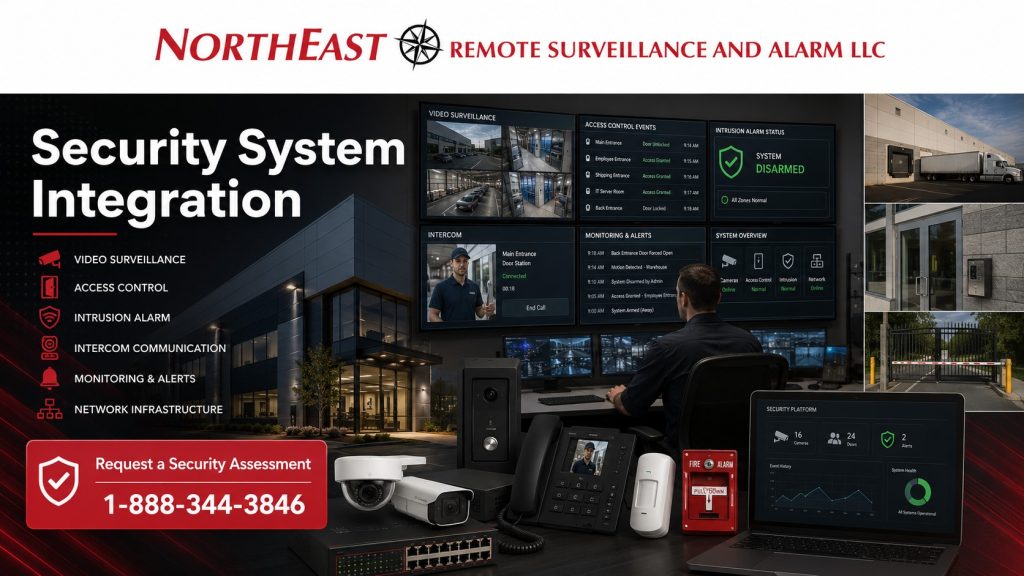
This guide covers the integration process for commercial and industrial properties that need security systems to work together instead of operating as disconnected equipment.
For broader service planning, start with Commercial and Industrial Security Services.
Security System Integration Built Around Real Facility Operations
Many commercial properties add security systems over time. A business may install cameras during one project, access control during another, intrusion alarms later, and monitoring or intercoms after that. Over time, the facility can end up with multiple systems that protect different areas but do not share information cleanly.
That creates problems when an incident occurs. Managers may need to check one system for video, another system for access events, another for alarms, and another for monitoring records. Security system integration helps reduce that friction by coordinating the systems around how the facility actually operates.
Northeast Remote Surveillance and Alarm, LLC designs security system integration for commercial and industrial environments where visibility, controlled access, alarm verification, event review, monitoring, and documentation need to work together.
What Security System Integration Means
Security system integration means connecting related security systems so they support a shared workflow. The goal is not to make the system complicated. The goal is to make it easier to understand what happened, where it happened, who was involved, and what response is needed.
A commercial integration project may connect:
- Video surveillance cameras
- Access control doors
- Intrusion alarm zones
- Intercoms and visitor entry stations
- Gate access points
- Remote video monitoring
- AI video analytics
- License plate recognition cameras
- Alarm verification workflows
- User permissions
- System reporting
- Network and low-voltage infrastructure
The right integration depends on the property. A warehouse, office building, school, municipal facility, contractor yard, manufacturing plant, and healthcare property may all need different integration priorities.
Why Disconnected Security Systems Create Gaps
Disconnected systems can still function, but they often make security harder to manage. A camera may record the area near a door, but the access-control event may live in another platform. An intrusion alarm may trigger after hours, but the camera review may require a separate login. An intercom may release a door, but the video record may not be tied to the visitor event.
Common problems include slow incident review, unclear user permissions, missed alarm verification opportunities, poor after-hours visibility, disconnected reporting, inconsistent documentation, and difficult troubleshooting.
A properly integrated system helps the business move from separate devices to a coordinated security workflow.
Video Surveillance and Access Control Integration
Linking video with access events can help staff review activity at controlled openings. Access control can show which credential was used at a door, gate, or restricted area. Video can show what happened at that location.
This helps managers review badge events, tailgating concerns, held-door alarms, forced-door events, employee entrances, contractor movement, visitor access, and restricted-area activity.
For example, a warehouse may need video tied to employee entrances and shipping office doors. An office building may need lobby cameras tied to access-controlled doors. A manufacturing plant may need video review around restricted production rooms or contractor entrances.
Intrusion Alarm and Video Verification Integration
Intrusion alarms help identify protected areas that have been triggered. Relevant video may help reviewers assess the cause when the event is visible and the recording is available.
When intrusion alarms and cameras are coordinated, a business can review whether an alarm was caused by unauthorized entry, an employee, a delivery, a door issue, weather, animals, or another condition. This can help reduce uncertainty and support better response decisions.
This is especially useful for loading docks, rear doors, exterior yards, warehouses, storage rooms, offices, remote buildings, and after-hours commercial properties.
Intercom, Visitor Entry, and Door Release Integration
Intercom systems are often part of the access workflow. Visitors, vendors, delivery drivers, contractors, tenants, or service providers may request entry at a front door, receiving entrance, gate, or service door.
When intercoms are integrated with cameras and access control, authorized users can verify who is requesting entry, review the correct camera view, release the door or gate when appropriate, and maintain a clearer event record.
The integration plan should define who answers calls, who can release doors, which cameras support the intercom location, and how after-hours requests are handled.
Gate, Yard, and Vehicle Access Integration
Commercial and industrial facilities often need integration beyond the building. Gates, yards, parking lots, truck entrances, trailer areas, fleet areas, and contractor yards may need cameras, access credentials, intercoms, vehicle detection, license plate recognition, and monitoring workflows to work together.
A stronger integration design can help document vehicle movement, gate activity, visitor access, contractor entry, after-hours events, and incidents around exterior areas.
This is important for logistics facilities, warehouses, manufacturing plants, municipal yards, contractor yards, industrial parks, and properties with exterior assets or vehicle traffic.
Monitoring and Event Review Workflows
Security system integration should support the way events are reviewed. A monitored camera alert, intrusion alarm, forced-door event, intercom call, or AI detection should not exist in isolation.
The system should help authorized users or monitoring personnel understand:
- Which event occurred
- Which camera view applies
- Which door, gate, or zone was involved
- Whether the activity is expected
- Who should be notified
- Whether the event needs escalation
- Whether footage should be exported or retained
The strongest integration plans are built around response procedures, not just equipment connections.
Infrastructure Behind Security System Integration
Integrated systems depend on reliable infrastructure. Cameras, access control panels, alarm communicators, intercoms, gates, servers, monitoring paths, and cloud platforms all rely on cabling, switching, power, network design, bandwidth, backup, and documentation.
A weak infrastructure layer can create camera dropouts, failed door events, unreliable remote access, delayed alerts, poor monitoring performance, or difficult troubleshooting.
For technical planning, use Commercial Security Infrastructure Planning to plan PoE switching, structured cabling, fiber, UPS backup, network segmentation, recording equipment, wireless links, and long-term system support.
User Permissions and System Governance
Security system integration increases the importance of user permissions. The more systems that work together, the more important it becomes to define who can view cameras, unlock doors, export video, manage users, change schedules, respond to alerts, or access sensitive reports.
A receptionist, warehouse supervisor, facilities manager, IT administrator, executive, property manager, security supervisor, and monitoring user may all need different access levels.
Clear role-based permissions help reduce confusion, protect sensitive footage, prevent unnecessary system access, and support better long-term management.
Documentation and Long-Term Serviceability
Integrated security systems should be documented clearly. Without documentation, it becomes harder to troubleshoot problems, expand the system, train users, update permissions, replace equipment, or review system performance.
Useful documentation may include camera schedules, access control door lists, alarm zones, intercom locations, gate points, network diagrams, device names, user roles, monitoring procedures, retention settings, export procedures, service records, and as-built notes.
Documentation makes the system easier to support after installation and helps the business avoid confusion as staff, tenants, buildings, or operations change.
Compliance-Aware Integration Planning
Security system integration should be planned with attention to life-safety conditions, access-controlled doors, emergency egress, fire alarm coordination, privacy expectations, cybersecurity, documentation, and inspection readiness.
Integration does not make a facility compliant by itself. It can, however, support incident documentation, access accountability, alarm review, monitoring procedures, and operational records when properly designed.
Security systems should never interfere with required egress, fire alarm operation, emergency procedures, door hardware function, or authority-having-jurisdiction expectations. Integration planning should respect the way the building is used and the safety requirements that already apply to the facility.
Facilities That Benefit From Security System Integration
Security system integration is useful for commercial and industrial properties where disconnected systems create operational gaps.
Common environments include:
- Warehouses and logistics facilities
- Manufacturing plants
- Industrial buildings
- Office buildings
- Multi-tenant commercial properties
- Healthcare and medical office facilities
- Schools and educational buildings
- Municipal and public-sector facilities
- Contractor yards and fleet yards
- Truck yards and trailer storage areas
- Distribution centers
- Industrial parks
- Multi-building campuses
- Multi-site commercial organizations
The integration plan should be based on the facility’s access points, movement patterns, risk zones, operating hours, infrastructure, and management workflow.
Verify Compatibility and the Complete Workflow
Document the exact device models, firmware, platform versions, licenses, and supported interfaces before promising an integration. Specify the required function: displaying a live image, retrieving recorded video for a door event, transferring an alarm, or issuing an authorized command are different requirements. Support for one connection does not establish support for every desired action.
For ONVIF-based connections, check the product, firmware or software version, and relevant profiles in the official ONVIF conformant-products database.
Also review the receiving platform’s supported-device information and the features required for the project. Manufacturer membership or a general compatibility label should not replace checking the listed product and version.
Pilot a representative workflow before wider deployment. Generate the agreed event, confirm its location and timestamp, retrieve the corresponding evidence, and test the permitted action using the actual operator role. Check denied permissions and the behavior when a connection is unavailable so integration does not depend on an administrator account being used for routine work.
Record the supported configuration, test results, known limitations, backup arrangements, and the party responsible for each interface. Plan a way to restore the previous working arrangement if a change fails. Recheck affected workflows after firmware, software, credentials, network settings, or connected equipment changes.
Request a Security System Integration Assessment
If your facility has cameras, access control, alarms, monitoring, intercoms, gates, or infrastructure that do not work together cleanly, Northeast Remote Surveillance and Alarm, LLC can help review the system and design a better integration plan.
Call 1-888-344-3846 or use the Request a Security Assessment page to begin a commercial security system integration review.
Frequently Asked Questions about Security System Integration
What is security system integration?
Security system integration connects related security systems such as video surveillance, access control, intrusion alarms, intercoms, monitoring, analytics, gates, and reporting so they work together in a coordinated workflow.
Why is security system integration important for commercial facilities?
Integration helps commercial facilities review events faster, connect video to door activity, verify alarms, manage users, improve monitoring workflows, and reduce confusion between disconnected systems.
Can cameras integrate with access control?
Yes. Cameras can integrate with access control so managers can review video tied to badge events, door activity, forced-door alarms, held-door events, tailgating concerns, and restricted-area access.
Can intrusion alarms integrate with video surveillance?
Yes. Intrusion alarms can be coordinated with video surveillance so a triggered door, motion detector, protected area, or alarm zone can be reviewed with nearby camera footage.
Can intercoms be part of an integrated security system?
Yes. Intercoms can be integrated with cameras and access control so authorized users can verify visitors, contractors, vendors, tenants, or delivery drivers before releasing a door or gate.
Does integration require replacing all existing equipment?
Not always. Some existing systems may be reused, upgraded, integrated, or phased into a better structure depending on age, compatibility, manufacturer support, network condition, and system goals.
Can integrated security systems support remote monitoring?
Yes. Integrated systems can support remote monitoring by connecting cameras, alarm events, AI alerts, live video review, and response procedures.
Is security system integration useful for warehouses?
Yes. Warehouses often need cameras, dock coverage, employee access control, intrusion alarms, truck yard visibility, gate activity, and monitoring workflows to work together.
Is security system integration useful for office buildings?
Yes. Office buildings often need cameras, access control, visitor entry, intercoms, parking lot coverage, tenant access, and after-hours activity review to work together.
Can integrated systems support multiple locations?
Yes. Multi-site businesses can use integration planning to standardize users, permissions, camera access, door schedules, monitoring workflows, reporting, and system management.
Does security system integration affect fire alarm or life-safety systems?
It can, so it must be planned carefully. Security systems should never interfere with required egress, fire alarm operation, emergency procedures, door hardware function, or inspection requirements.
What is the next step for security system integration?
The next step is a site-specific assessment. NERSA reviews the existing cameras, access control, alarms, intercoms, monitoring, gates, infrastructure, user permissions, and operational workflows before recommending an integration plan.