
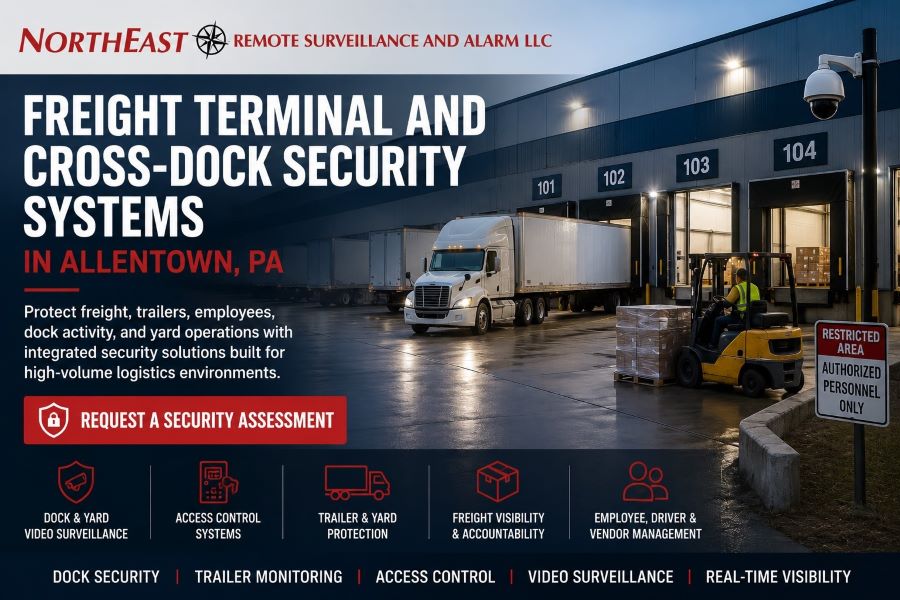
Allentown cross-dock and freight terminal security systems help logistics operators protect fast-moving shipments, trailers, dock doors, drivers, employees, staging areas, and yard activity with coordinated video, access control, alarms, and monitoring.

Request a freight terminal and cross-dock security assessment in Allentown
Coordinate freight-terminal coverage with the rest of the building using Warehouse Security Systems in Allentown, PA, which covers the wider warehouse security plan.
Allentown Cross-Dock Security for High-Throughput Operations
A cross-dock operation has a different security problem from a warehouse where inventory sits for days or weeks. Freight can arrive, change hands, move through staging, and leave again during the same shift. That makes timestamps, dock assignments, trailer positions, driver activity, employee routes, and usable video especially important when a shortage, damage claim, or unexplained movement has to be reconstructed.
The security plan should make it practical to follow a shipment through the parts of the terminal that matter without trying to record every square foot at the same level of detail. Focused dock, gate, staging, check-in, and vehicle views can work with access-control and alarm records to give operations staff a clearer chain of activity.
Plan Around Dock Assignments and Freight Flow
Northeast Remote Surveillance and Alarm, LLC designs commercial security around rapid inbound and outbound freight movement. First, we review dock assignments, trailer flow, staging lanes, driver check-in, employee routes, restricted areas, and after-hours operations. Then we place each device around a clear operating need.
A system can support one smaller terminal or a standardized enterprise network of logistics locations.
For all local security services, visit Commercial Security Systems in Allentown, PA.
Security for Fast Freight Movement
Cross-dock facilities differ from storage-focused warehouses because freight may stay only briefly. Drivers, forklifts, employees, contractors, and trailers can move through several zones during one shift. Blind spots and unclear handoffs can make damage, shortages, unauthorized entry, and delivery disputes harder to investigate.
The security plan should show how freight enters, moves, waits, and leaves. It should identify who can access each operational area and how staff respond to an event.
Dock Door and Freight-Lane Video
Camera views may cover inbound doors, outbound doors, trailer positions, staging lanes, pallet movement, forklift paths, driver windows, and employee transitions. For example, a wide dock view can show activity while a focused view captures detail at a check-in point or high-value lane.
NERSA also reviews lighting, distance, motion, recording quality, retention, time settings, and video export.
For dock-specific design, visit Loading Dock Security Cameras in Allentown, PA.
Trailer Yard and Vehicle Visibility
Freight security often extends beyond the dock face. The survey should include trailer drops, tractor movement, gate activity, parking, perimeter approaches, and after-hours yard use. Camera views should reflect actual lanes and parking patterns rather than a generic exterior layout.
Access Control for Freight Areas
Access control can limit entry to shipping offices, receiving rooms, employee doors, inventory holds, dock-adjacent spaces, and restricted freight zones. Permissions may follow role, shift, department, vendor status, location, or expiration date.
The complete opening must include suitable locks, readers, door monitoring, request-to-exit devices, power, and safe operation.
See Loading Dock Access Control Systems in Allentown, PA.
Driver, Visitor, and Contractor Entry
Drivers and contractors often need limited access without receiving the same permissions as employees. For instance, an intercom or managed entry point can direct a driver to the correct office. Temporary credentials can also expire after a defined visit or schedule.
Define where drivers wait and how staff handle exceptions so routine arrivals do not depend on propping a controlled door. Event records show which credential was used and when; review them alongside footage and shipment records.
Intrusion Detection and After-Hours Monitoring
Alarm zones can protect perimeter doors, offices, cages, storage rooms, and selected interior areas after hours. However, the design must account for late shifts, early arrivals, cleaners, maintenance, and trailer activity. Separate partitions and schedules can help match real operations.
Remote video monitoring may support selected exterior events when compatible cameras, clear views, communication, and response rules are in place. Review Allentown Remote Video Monitoring for that focused service.
Incident Review and Chain of Activity
When a shipment issue occurs, staff may need to follow activity from gate arrival through dock assignment, unloading, staging, reloading, and departure. Camera names, system time, retention, and export steps should support that review. Access and alarm events can add context when systems use compatible integration.
A Scalable Terminal Security Plan
- Map operations: document freight, driver, vehicle, and employee movement.
- Define views: state the detail required at each dock, lane, gate, and entry point.
- Control access: assign doors, roles, schedules, and temporary entry rules.
- Plan response: set alarm, monitoring, notification, and escalation procedures.
- Verify capacity: check storage, network, power, licenses, and future expansion.
- Document: label devices, doors, zones, accounts, and service records.
A smaller terminal may start with high-risk docks and entry points. By comparison, an enterprise may need shared naming, retention, permissions, and health reporting across many facilities. The initial design should leave capacity for added cameras, doors, users, lanes, and locations.
Verify a Complete Freight Movement
Before handover, follow a representative shipment from arrival through transfer and departure with normal trailers and staged freight in place. Have an authorized reviewer retrieve the sequence using the terminal’s bay assignments and shipment records. Record where a view loses the load or cannot establish the detail needed; footage should be interpreted alongside operational records.
Check the agreed temporary-entry restrictions and selected alert workflow with the staff who will use them. Document who handles missing video, unavailable communications, or a changed dock assignment, and recheck affected views when lanes or staging practices change.
Freight Security FAQs
Can cameras follow freight through several zones?
They can support that goal when views overlap appropriately and the system uses clear names, time settings, retention, and export steps.
Can drivers receive temporary access?
Sometimes. The access platform, opening, policy, and visitor process must support limited and expiring credentials.
Can one design scale to several terminals?
Yes. A common standard can scale across sites while adjusting cameras, doors, and alarms to each facility’s workflow.
Request a Freight Terminal Security Assessment
Bring the dock and staging layout, typical shipment route, shift schedule, existing camera list, and examples of incidents your team needs to reconstruct.
Identify who will retrieve footage and approve temporary entry.
Request a freight terminal and cross-dock security assessment in Allentown.
Compliance, Codes & Project Standards
NERSA plans commercial and industrial security work with applicable code, documentation, inspection and authority-having-jurisdiction requirements in mind. Requirements vary by system, property and jurisdiction. These resources support project planning; they do not establish legal compliance, certification or AHJ approval.
Related guidance: Regulatory compliance & inspection readiness · Warehouse & logistics compliance · NERSA project standards