
NERSA designs unified security for commercial and industrial properties.

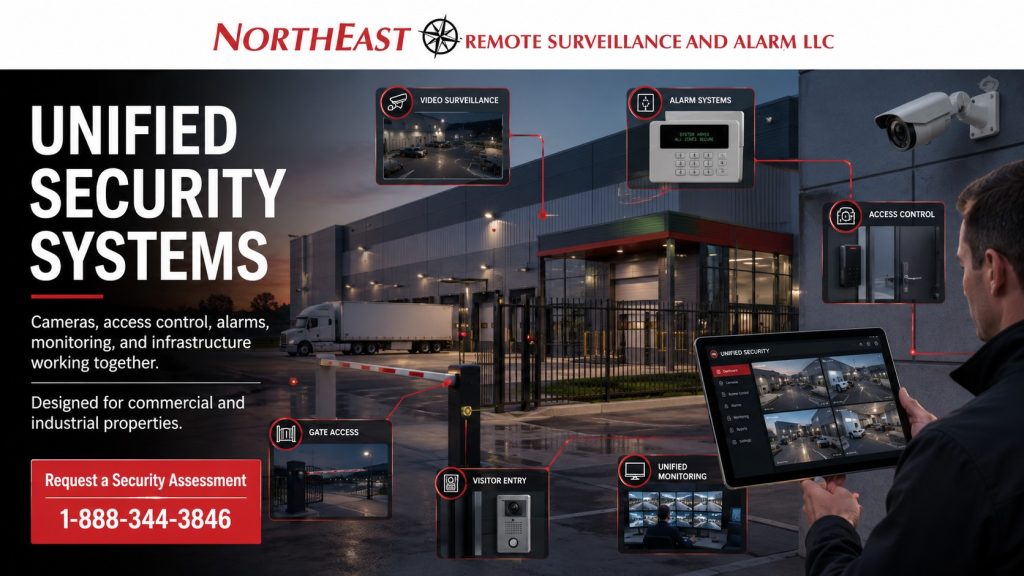
The plan brings cameras, access control, alarms, monitoring, gates, intercoms and infrastructure together, with life-safety coordination where needed.
This resource explains planning around daily work, risks, users, records and ongoing support.
For company background, commercial-only focus and project standards, see About Northeast Remote Surveillance and Alarm, LLC.
Design process: use this guide to prepare operational requirements, define system interfaces and plan acceptance checks.
The overview explains the concept, while integration services covers implementation.
Unified Security Starts With One Operating Goal
A unified security system is not just a collection of cameras, alarms, access control readers, intercoms, and monitoring services. It is a planned system where each part supports the same security objective.
For a commercial property, that objective may be stronger visibility, better access control, clearer incident documentation, faster event response, safer building operation, or more reliable management oversight.
NERSA begins unified security design by identifying what the business needs the system to accomplish. The equipment comes after the operating goal is clear.
Why Disconnected Security Systems Create Problems
Many commercial properties grow their security systems over time. A camera system may be added first. Then an alarm panel. Then access control. Then a gate. Then a cloud video platform. Then an intercom or monitoring service.
When those systems are added separately, the property can end up with:
- Different logins
- Different vendors
- Different service paths
- Poor documentation
- Unclear event history
- Cameras that do not match access points
- Alarms that are not supported by useful video
- Gates that open without clear accountability
- Access control that does not match employee workflow
- Systems that are difficult to expand later
NERSA designs unified systems to reduce those gaps and help the customer manage security as one planned environment.
Step 1: Understanding the Property
Unified security design starts with understanding the property. A warehouse, office building, manufacturing plant, logistics facility, medical office, municipal building, school, truck yard, or contractor yard may all need different security priorities.
NERSA evaluates how the facility operates, including:
- Employee entrances
- Visitor paths
- Vendor access
- Loading docks
- Shipping and receiving areas
- Truck courts
- Trailer yards
- Parking areas
- Restricted rooms
- Office spaces
- Production areas
- Network rooms
- Exterior doors
- Gates and perimeter access points
- Detached buildings
- After-hours activity
The design has to match the way people, vehicles, assets, and information move through the property.
Step 2: Designing Cameras Around Useful Events
Video surveillance is one of the most important parts of a unified security system, but cameras should not be planned in isolation. Camera placement should support the events the business needs to understand.
NERSA may design camera coverage around:
- Entry and exit activity
- Access-controlled doors
- Gate lanes
- Loading docks
- Truck yards
- Trailer rows
- Reception areas
- Hallways and common areas
- Restricted rooms
- Parking lots
- Exterior perimeters
- Cash handling or storage areas
- Equipment zones
- After-hours exposure points
The goal is usable video, not just more cameras. A camera should help explain what happened, where it happened, when it happened, and who or what was involved.
Step 3: Connecting Access Control to Real Workflow
Access control should support how the business actually operates. A unified system should help manage who can enter, where they can enter, when they can enter, and how the event is documented.
NERSA considers access control needs such as:
- Employee credentials
- Visitor entry
- Vendor access
- Restricted rooms
- Office suites
- Warehouse doors
- IT rooms
- Medical or records areas
- Yard gates
- Truck entrances
- Multi-tenant access
- After-hours permissions
- User groups and schedules
- Audit history
Access control becomes more valuable when camera views, alarm conditions, intercoms, and gate events are planned around the same access points.
Step 4: Coordinating Alarms With Building Use
Commercial alarm systems need to match the property layout and daily schedule. A unified security design should connect alarm protection to actual building use, not just door contacts and motion detectors.
NERSA may review:
- Perimeter doors
- Interior motion areas
- Overhead doors
- Detached buildings
- Storage areas
- Office areas
- Shops and support spaces
- Restricted rooms
- Alarm user codes
- Opening and closing schedules
- Monitoring communication paths
- Alarm response expectations
When alarm events are supported by cameras, access history, and clear user management, the customer has a stronger picture of what happened.
Step 5: Adding Monitoring Where It Makes Sense
Monitoring should be planned around the property’s risk and response expectations. Not every site needs the same monitoring approach, and not every event should generate the same response.
NERSA may evaluate monitoring needs for:
- Intrusion alarm signals
- Fire alarm or life-safety monitoring paths
- Video verification
- Remote video monitoring
- Gate or yard activity
- After-hours activity
- Repeat trespassing areas
- High-risk exterior zones
- Critical building events
Unified design helps determine what should be monitored, how events should be verified, and where cameras, alarms, speakers, or access control records can support the response.
Step 6: Planning Gates, Intercoms, and Visitor Entry
Vehicle gates, pedestrian gates, call boxes, intercoms, and visitor entry systems are important parts of many commercial properties. These systems should not be treated as separate add-ons.
NERSA may design gate and visitor entry around:
- Vehicle access
- Delivery traffic
- Employee entry
- Vendor access
- Visitor screening
- Remote release needs
- Camera views at entry points
- Access logs
- After-hours entry rules
- Emergency access concerns
A unified design helps connect gate access, intercom communication, camera visibility, and event documentation into one practical workflow.
Step 7: Building the Infrastructure Behind the System
Unified security depends on reliable infrastructure. Cameras, access control, alarms, gates, intercoms, monitoring paths, and network-connected devices all depend on cabling, power, equipment locations, communication paths, and long-term serviceability.
NERSA may review infrastructure needs such as:
- Low-voltage cabling
- Network closets
- Cable pathways
- Switches and network equipment
- Recorder or server locations
- Cloud, on-premise, or hybrid design
- Door controller locations
- Power supplies
- Backup power
- Alarm communicators
- Exterior device mounting
- Future expansion capacity
Step 8: Designing Around Management Use
A unified security system should be practical for the people who use it. Owners, facility managers, operations leaders, IT teams, office managers, municipal staff, school administrators, and property managers may all interact with the system differently.
NERSA designs with management needs in mind, including:
- How users will view cameras
- How recorded video will be searched
- How access permissions will be managed
- How alarm users will be assigned
- How managers will review events
- How system alerts will be handled
- How service issues will be reported
- How future users, doors, and cameras will be added
A system that is powerful but confusing will not support the business well. Unified security should make management easier, not harder.
Step 9: Code-Aware and Life-Safety-Aware Design
Unified security systems can affect more than security. Access control, electrified door hardware, fire alarm interfaces, emergency egress, low-voltage wiring, backup power, emergency access, and monitoring paths may connect to larger building and life-safety requirements.
NERSA designs with awareness of:
- Door function
- Emergency egress
- Access-controlled openings
- Fire alarm coordination
- Backup power
- Low-voltage wiring
- Emergency responder access
- Inspection readiness
- System documentation
This does not replace the authority having jurisdiction, engineer, architect, code consultant, insurance provider, or legal review where required. It does help commercial clients avoid treating security devices as isolated equipment when they may affect building operation or life-safety expectations.
Step 10: Planning for Long-Term Expansion
Commercial properties change. Businesses add employees, tenants, doors, cameras, buildings, gates, yards, departments, and new operating requirements.
A unified system should be designed with future growth in mind.
NERSA may plan for:
- Additional cameras
- Additional doors
- More users and credentials
- Expanded alarm coverage
- More buildings
- More gates
- More storage or yard areas
- Larger video retention needs
- Cloud, on-premise, or hybrid changes
- System upgrades
- Monitoring changes
- Future project phases
A strong unified system should not trap the customer in a dead-end design.
Where Unified Security Is Most Valuable
Unified security design is especially valuable for properties with multiple systems, users, buildings, or risk areas.
Common best-fit properties include:
- Warehouses
- Distribution centers
- Logistics facilities
- Manufacturing plants
- Office buildings
- Medical and healthcare facilities
- Schools
- Municipal buildings
- Contractor yards
- Truck yards
- Industrial parks
- Multi-tenant commercial properties
- Storage facilities
- Multi-site commercial organizations
The more complex the property, the more important unified planning becomes.
Why NERSA Designs Before Installing
NERSA does not approach unified security as a pile of devices. The company starts with the property, the risk, the workflow, the infrastructure, and the long-term support need.
That design-first approach helps avoid:
- Poor camera placement
- Access control confusion
- Alarm gaps
- Monitoring mismatch
- Weak documentation
- Disconnected vendors
- Poor user management
- Infrastructure problems
- Systems that cannot expand
- Security that does not match real operations
For buyers who want to understand how NERSA reviews a facility before recommending equipment, use Security Assessment Process as the next planning step.
Request Unified Security System Planning
A unified security system should help a business manage cameras, access control, alarms, monitoring, gates, intercoms, infrastructure, and documentation as part of one organized security plan. Northeast Remote Surveillance and Alarm, LLC designs unified security systems for commercial and industrial properties that need practical protection, reliable operation, and long-term support.
To review your facility and plan a unified security system, call 1-888-344-3846 or use Request a Security Assessment to schedule the next step.
Frequently Asked Questions About How NERSA Designs Unified Security Systems
What is a unified security system?
A unified security system connects cameras, access control, alarms, monitoring, gates, intercoms, and supporting infrastructure into one planned commercial security environment instead of treating each system as a separate device.
Why does unified security matter for commercial properties?
Unified security matters because commercial properties often have multiple users, doors, cameras, alarm points, gates, vendors, visitors, and operating schedules. A unified design helps the systems support each other instead of creating separate islands of security.
Does NERSA design unified systems for warehouses and logistics facilities?
Yes. NERSA designs unified security systems for warehouses, distribution centers, logistics facilities, truck courts, trailer yards, loading docks, employee entrances, restricted areas, and outdoor storage zones.
Can access control and cameras work together?
Yes. Access control and cameras can be planned together so doors, gates, visitor entrances, and restricted rooms have better event documentation when someone enters, exits, or attempts access.
Can alarm systems be part of a unified security design?
Yes. Intrusion alarms can be coordinated with cameras, access control, monitoring paths, user schedules, and building layouts so alarm events are easier to understand and respond to.
Does unified security include monitoring?
It can. Monitoring may include intrusion alarm monitoring, fire/life-safety monitoring paths, video verification, remote video monitoring, or other response workflows depending on the property and risk level.
Is unified security only for large facilities?
No. Unified security is valuable for any commercial or industrial property where cameras, alarms, access control, gates, monitoring, or infrastructure need to work together. It is especially useful for larger or more complex facilities.
Does NERSA consider infrastructure during system design?
Yes. NERSA reviews cabling, network conditions, power, equipment locations, recorder or server needs, cloud or hybrid requirements, communication paths, and future expansion capacity.
Can NERSA replace disconnected security systems?
Yes. NERSA can review disconnected cameras, alarms, access control, intercoms, gates, and monitoring systems to recommend upgrades, integration, replacement, or phased improvements.
How does a business start planning a unified security system?
The best starting point is a commercial security assessment. NERSA can review the property, identify system gaps, evaluate infrastructure, discuss operational needs, and recommend a unified security design based on the facility’s real conditions.
Plan Your Next Security Improvement
Tell NERSA about your commercial facility, existing systems, and project priorities. We can help you plan an installation, evaluate an upgrade, or coordinate security across multiple locations.
Compliance, Codes & Project Standards
NERSA plans commercial and industrial security work with applicable code, documentation, inspection and authority-having-jurisdiction requirements in mind. Requirements vary by system, property and jurisdiction. These resources support project planning; they do not establish legal compliance, certification or AHJ approval.
Related guidance: Regulatory compliance & inspection readiness · NERSA project standards · Documentation, testing & inspection readiness