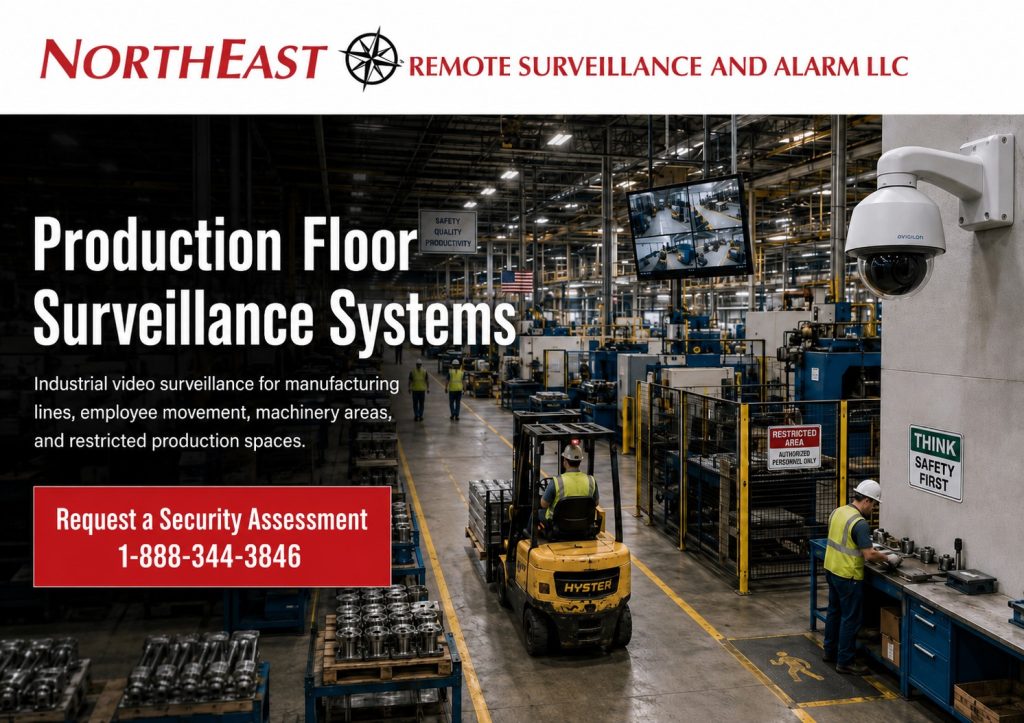
Production floor surveillance systems help industrial facilities document activity around production lines, employee movement, forklift routes, equipment zones, incident areas, and restricted spaces without disrupting operations.
Northeast Remote Surveillance and Alarm, LLC designs production floor camera systems for manufacturing plants, industrial buildings, processing areas, assembly environments, and multi-building facilities across Pennsylvania and the Mid-Atlantic.
For broader industrial camera planning, start with Industrial Video Surveillance Systems.
Production Floor Surveillance Systems for Production Environments
Begin with the production-floor events your team needs to review, such as a material transfer, a reported incident or entry to a restricted area. Mark the relevant work zones and travel routes on a floor plan. Use that record to define camera views and installation access around the operating shifts.
A properly designed production floor camera system helps management review incidents, document activity, investigate damage, monitor restricted areas, verify movement around equipment, and improve visibility across the facility. The goal is not to watch employees unnecessarily; the goal is to create useful operational visibility where the facility has risk, exposure, or documentation needs.
NERSA designs production floor surveillance systems around real plant conditions, including ceiling height, lighting, vibration, dust, obstructions, work zones, network availability, power access, recording requirements, and long-term serviceability.
Where Production Floor Surveillance Systems Provide Camera Coverage
Production floor camera placement should follow how the facility operates. A camera system should not be installed from a generic drawing without understanding workflow, employee movement, equipment layout, and incident-prone areas.
Production Lines
Production lines may need camera coverage to document workflow, movement around equipment, material handling, stoppages, and incident conditions. Cameras should be positioned to support review without interfering with production or creating unsafe installation points.
Assembly and Work Areas
Assembly spaces, workstations, packing areas, fabrication tables, and production support areas often need visibility for incident review and operational documentation. Camera placement should consider employee privacy, viewing angle, lighting, and whether footage will actually help management understand what happened.
Forklift and Pedestrian Routes
Production floors often include forklift paths, pedestrian walkways, intersections, blind corners, staging areas, and crossing points. Cameras can help document incidents involving material handling equipment, pedestrian movement, property damage, and near-miss events.
Machine Areas and Equipment Zones
Machinery areas may require camera coverage for incident review, restricted-area awareness, downtime investigation, and damage documentation.
For deeper equipment-specific planning, use Machine Area Monitoring Cameras.
Employee Entrances and Time Clock Areas
Production employees often enter and exit in waves during shift changes. Cameras near employee entrances, production-floor access doors, time clock areas, badge readers, lockers, and transition points can support accountability and incident review.
Restricted Production Spaces
Some facilities have controlled production rooms, quality-control areas, tool cribs, electrical rooms, IT rooms, chemical areas, inventory zones, or intellectual property-sensitive spaces. Production floor surveillance can support management review when paired with proper access control procedures and permission management.
Loading and Production Support Areas
Many production floors connect directly to loading docks, shipping areas, receiving zones, staging lanes, material storage, and packaging areas. Cameras in these areas help document product movement, freight handling, loading activity, and incidents involving inventory or equipment.
Camera Planning for Production Floor Surveillance Systems
Production floor surveillance should be designed carefully because industrial environments create difficult camera conditions. Open areas, high ceilings, reflective surfaces, machinery movement, poor lighting, vibration, dust, and obstructions can all reduce video quality if the system is not planned correctly.
Viewing Angle and Identification
Not every camera needs the same purpose. Some cameras are used for general awareness, while others need enough detail to identify people, activity, materials, equipment movement, or incident conditions.
A strong system separates overview views from identification views. Wide-angle cameras may show movement across a production area, while tighter cameras may document access points, equipment zones, or restricted spaces.
Lighting and Glare
Production floors may have high-bay lighting, shadows, reflective equipment, welding glare, dock light changes, or uneven illumination. Camera selection and placement should account for lighting conditions during normal production, shift changes, cleaning, maintenance, and after-hours operation.
Ceiling Height and Mounting Conditions
Industrial ceilings, beams, conduit, cranes, racks, ductwork, and equipment can limit camera placement. Mounting decisions should consider service access, safe installation, vibration, cabling paths, field of view, and long-term maintenance.
Dust, Heat, Moisture, and Environmental Exposure
Some production environments expose cameras to dust, temperature swings, moisture, washdown activity, oil mist, chemicals, or airborne particles. Camera housings, mounting hardware, cabling, and equipment placement should be selected based on the actual environment, not just the camera specification sheet.
Network and Recording Infrastructure
Production floor cameras depend on reliable network infrastructure. Switch locations, fiber paths, PoE capacity, UPS backup, bandwidth, recording storage, cybersecurity controls, and remote access permissions should be planned before cameras are installed.
Production Floor Incident Review
One of the strongest reasons to install production floor surveillance is incident review. When something happens inside a plant, management needs usable footage that shows the right area, from the right angle, with enough retention to support investigation.
Production floor camera systems can support review of:
- Equipment damage
- Material handling incidents
- Forklift and pedestrian movement
- Product damage
- Restricted-area access
- Contractor activity
- Shift-change incidents
- Workplace disputes
- Inventory movement
- Safety-related events
- After-hours access
- Production interruptions
The system should be designed so footage can be searched, exported, protected, and reviewed by authorized personnel.
For evidence and storage planning, use Industrial Video Retention and Evidence Planning.
AI Video Analytics for Production Floors
AI video analytics can help industrial facilities identify important events without relying only on basic motion detection. On production floors, analytics should be used carefully because people, machinery, forklifts, materials, and lighting changes can create complex movement patterns.
AI analytics may support:
- Person detection
- Vehicle and forklift detection
- Restricted-zone alerts
- Line-crossing alerts
- After-hours movement detection
- Loitering or unusual activity review
- Event filtering around entrances and sensitive areas
- Yard-to-production transition monitoring
Analytics should be tied to real operational goals.
Turning on every analytic everywhere can create noise.
For deeper planning, use AI Video Analytics for Industrial Facilities.
Compliance-Aware Production Floor Surveillance
Production floor cameras do not make a facility OSHA compliant by themselves. Safety compliance depends on training, procedures, hazard controls, supervision, documentation, equipment guarding, and applicable workplace standards.
However, video surveillance can support incident documentation, investigation workflows, access accountability, restricted-area awareness, and management review. Camera systems should be planned so they do not interfere with egress, fire/life-safety systems, equipment access, signage, emergency procedures, or safe maintenance pathways.
Production facilities should also consider cybersecurity, user permissions, retention policies, camera placement, and documentation standards when using video in safety-sensitive or restricted environments.
For broader operational compliance planning, use Industrial and Warehouse Security Compliance.
Integration With Access Control and Facility Security
Production floor surveillance is stronger when it works with access control, intrusion alarms, intercoms, gates, and monitoring procedures. A badge record may show who entered a production area, but video helps show what happened after the entry.
Cameras can support review around:
- Employee doors
- Contractor entrances
- Restricted production rooms
- Tool cribs
- Equipment cages
- IT and electrical rooms
- Quality-control areas
- Shipping and receiving transitions
- After-hours access events
The system should be designed so authorized managers can connect video events with access activity, alarm events, and facility procedures without creating unnecessary complexity.
Production Floor Surveillance Systems – Camera Types
The right camera type depends on the area being covered. Industrial facilities often need a mix of camera models instead of one standard camera everywhere.
Fixed IP Cameras
Fixed IP cameras are useful where a consistent view is needed. They are commonly used for production lines, employee entrances, corridors, restricted rooms, machine areas, and work zones.
Dome and Turret Cameras
Dome and turret cameras can support interior production areas, production support spaces, employee entries, hallway transitions, and general plant coverage. They are often used where a clean, protected camera profile is helpful.
Bullet Cameras
Bullet cameras are useful for longer directional views, production-floor edges, drive lanes, loading transitions, exterior doors, and industrial approaches. They should be mounted where they are protected from impact and environmental exposure.
Multi-Sensor Cameras
Multi-sensor cameras can help cover large open production areas with fewer devices. They are useful for high-ceiling industrial spaces, wide production floors, staging zones, and open manufacturing areas where broad visibility matters.
Specialty and Environmental Cameras
Some production spaces may need cameras designed for dust, moisture, temperature, impact, vibration, washdown areas, or hazardous conditions. Specialty cameras should be selected based on a real site review and the operating environment.
Industrial Facilities NERSA Supports
NERSA designs production floor surveillance systems for:
- Manufacturing plants
- Assembly facilities
- Fabrication shops
- Processing facilities
- Industrial buildings
- Production support areas
- Multi-building industrial properties
- Equipment rooms
- Tool crib areas
- Quality-control spaces
- Packaging and staging areas
- Shipping and receiving transitions
- Contractor-access areas
- Restricted production rooms
- Harsh or difficult camera environments
The system should be built around the way the facility actually runs, not around a generic camera package.
Request a Production Floor Surveillance Assessment
NERSA can review camera coverage, incident review, and evidence retention on your production floor. We also assess where AI analytics, equipment-area views, restricted-zone documentation, and integration with access control or monitoring may fit your operations.
Call 1-888-344-3846 or use the Request a Security Assessment page to begin a production floor surveillance review.
Frequently Asked Questions about Production Floor Surveillance Systems
What is a production floor surveillance system?
A production floor surveillance system is a video camera system designed to document activity inside manufacturing, assembly, processing, fabrication, and industrial work areas. It helps facility managers review incidents, monitor restricted areas, document equipment zones, and improve visibility across active production environments.
How is production floor surveillance different from regular security cameras?
Production floor surveillance must account for machinery, employees, forklifts, production lines, lighting changes, vibration, ceiling height, restricted zones, and industrial network conditions. A generic camera layout usually does not provide the right views or retention for an active manufacturing floor.
Where should cameras be placed on a production floor?
Common camera locations include production lines, machine areas, forklift routes, pedestrian intersections, employee entrances, time clock areas, restricted rooms, tool cribs, quality-control spaces, staging areas, and loading transitions. Placement should be based on real workflow and incident-review needs.
Can Production Floor Surveillance Systems monitor machinery areas?
Yes. Cameras can support incident review, restricted-area awareness, equipment-zone documentation, and management review around machinery areas. Camera placement should be planned so it does not interfere with safe equipment operation, maintenance access, or production activity.
Can production floor cameras help with forklift incidents?
Yes. Cameras can help review forklift routes, pedestrian crossings, staging areas, blind corners, loading transitions, and property-damage incidents. Video does not replace safety programs or training, but it can support documentation and investigation.
Do production floor cameras make a facility OSHA compliant?
No. Cameras do not make a facility OSHA compliant by themselves. They can support incident review and documentation, but workplace safety compliance depends on training, hazard controls, procedures, supervision, and applicable safety standards.
Can AI analytics be used on production floors?
Yes. AI analytics can help detect people, vehicles, restricted-area entry, line crossing, and after-hours activity. Analytics should be configured around specific risks because production floors have constant movement that can create unnecessary alerts if the system is not planned correctly.
Should production floor video be stored locally or in the cloud?
The best recording method depends on camera count, retention needs, network conditions, cybersecurity policies, remote access needs, and management structure. Many industrial facilities benefit from hybrid video recording that combines local reliability with remote access.
Can Production Floor Surveillance Systems integrate with access control?
Yes. Production floor cameras can integrate with access control so management can compare credential activity with video footage at employee doors, restricted production rooms, contractor entrances, tool cribs, and controlled areas.
What is the next step for planning production floor surveillance?
The next step is a site-specific security assessment. NERSA reviews the facility layout, production activity, camera views, infrastructure, recording needs, access points, restricted areas, and integration goals before recommending a system design.
Plan Your Next Security Improvement
Tell NERSA about your commercial facility, existing systems, and project priorities. We can help you plan an installation, evaluate an upgrade, or coordinate security across multiple locations.
Compliance, Codes & Project Standards
NERSA plans commercial and industrial security work with applicable code, documentation, inspection and authority-having-jurisdiction requirements in mind. Requirements vary by system, property and jurisdiction. These resources support project planning; they do not establish legal compliance, certification or AHJ approval.
Related guidance: Regulatory compliance & inspection readiness · Manufacturing compliance planning · NERSA project standards