
Industrial perimeter security cameras help industrial facilities monitor fence lines, rear approaches, exterior yards, utility areas, drive lanes, gates, equipment storage areas, and after-hours movement.

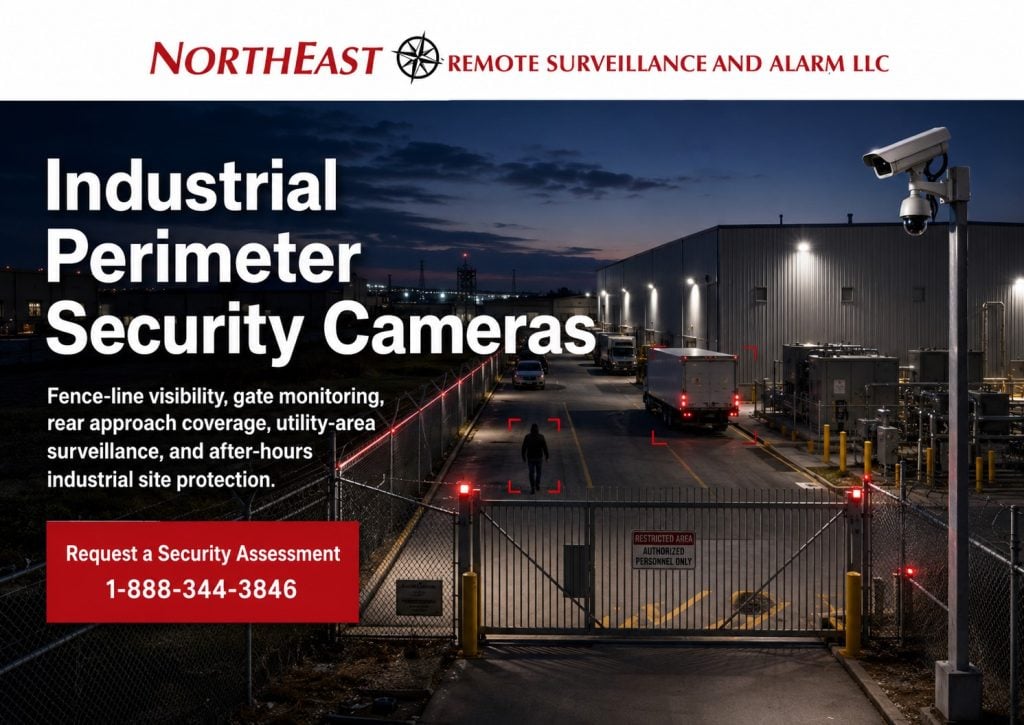
Northeast Remote Surveillance and Alarm, LLC designs industrial perimeter camera systems for manufacturing plants, production facilities, industrial buildings, equipment yards, utility areas, logistics-connected properties, and multi-building industrial sites across Pennsylvania and the Mid-Atlantic.
For broader industrial camera system planning, start with Industrial Video Surveillance Systems.
Industrial Perimeter Security Camera Coverage for Industrial Facilities
Industrial perimeters can include open spaces, long fences, dark approaches, vehicle routes, outdoor storage and utility areas. After-hours exposure adds to the challenge. Plan cameras around how people, vehicles, materials and equipment move through these areas.
Perimeter cameras can document exterior activity and help staff review incidents or after-hours movement. They can support gate and yard monitoring and reduce blind spots in areas staff cannot see from inside.
NERSA designs industrial perimeter security cameras around camera placement, lighting, detection distance, mounting stability, network infrastructure, recording retention, AI analytics, monitoring workflows, and long-term serviceability.
Where Industrial Perimeter Cameras Are Used
Plan coverage around the site’s exterior risks. Review rear and side approaches, utility spaces and outdoor storage as well as the front entrance and main parking lot.
Fence Lines
Fence lines may need camera coverage where unauthorized entry, cut fencing, after-hours movement, trespassing, or vehicle approach activity is a concern. Camera placement should account for fence length, lighting, blind spots, vegetation, grade changes, and detection distance.
Rear Building Approaches
Rear approaches are often less visible than main entrances. Cameras can help document activity around back doors, overhead doors, utility access, employee exits, service areas, exterior stairs, and unmonitored side paths.
Industrial Gates and Drive Entrances
Gates and drive entrances are important perimeter control points. Cameras can document vehicle arrival, gate activity, contractor access, delivery movement, and after-hours entry attempts.
Equipment Yards and Exterior Storage
Industrial yards may contain vehicles, machinery, trailers, raw materials, tools, metals, fuel tanks, utilities, or other valuable assets. Perimeter cameras help document activity around stored equipment and exterior inventory.
Utility Areas
Utility areas, electrical services, generators, tanks, mechanical equipment, telecom points, and exterior infrastructure may need coverage because they can affect operations if damaged, tampered with, or accessed without authorization.
Truck Courts and Exterior Drive Lanes
Truck courts, industrial drive lanes, trailer movement areas, and service routes may need camera coverage for incident review, vehicle documentation, property damage investigation, and after-hours activity review.
Perimeter Parking Areas
Industrial parking areas often sit along property edges and may need coverage for employee safety, vehicle incidents, after-hours movement, and access between parking areas and building entrances.
Industrial Perimeter Security Cameras Planning
Industrial perimeter cameras require different planning than interior cameras. Exterior conditions change constantly, and poor camera placement can create footage that is too dark, too distant, too shaky, or too cluttered to support investigation.
Detection Distance
Perimeter cameras should be selected and positioned based on the distance they need to cover. A camera watching a gate does not need the same lens, angle, or mounting height as a camera covering a long fence line or large yard.
Lighting and Low-Light Performance
Exterior cameras must account for darkness, glare, headlights, shadows, dock lighting, weather, and seasonal changes. Some areas may need improved lighting, infrared capability, thermal detection, or a different camera position to support usable footage.
Mounting Height and Stability
Perimeter cameras may be mounted on buildings, poles, fences, gates, towers, or exterior structures. Mounting locations should be stable enough to reduce vibration from wind, vehicle movement, machinery, and weather.
Field of View
A wide view may help show general activity, but it may not provide enough detail for identification or review. A strong perimeter design balances overview coverage with tighter views at gates, doors, drive lanes, and high-risk exterior points.
Weather and Environmental Exposure
Outdoor industrial cameras must be selected for the actual environment. Wind, rain, snow, dust, heat, cold, insects, sunlight, moisture, impact risk, and corrosive exposure can all affect camera performance and service life.
Network and Power Infrastructure
Industrial perimeter cameras often require careful infrastructure planning. Long cable runs, fiber, PoE switches, wireless bridges, power availability, surge protection, UPS backup, and equipment enclosures may all affect system reliability.
Industrial Perimeter Security Cameras with AI Analytics for Perimeter Detection
AI video analytics can help industrial facilities reduce nuisance alerts and identify meaningful perimeter activity faster. Analytics may support people detection, vehicle detection, line crossing, zone-based alerts, after-hours movement, and perimeter-event filtering.
AI analytics are strongest when cameras are aimed correctly, subjects are large enough in frame, lighting is adequate, and detection zones are drawn around real risk areas. A poorly placed camera will not become reliable just because analytics are enabled.
For deeper analytics planning, use AI Video Analytics for Industrial Facilities.
Remote Monitoring for Industrial Perimeters
Perimeter cameras can support remote monitoring when the system is designed with the right camera views, alert rules, lighting, analytics, recording quality, and response procedures. This can be especially valuable for industrial facilities with after-hours yard exposure, exterior equipment, remote gates, fenced perimeters, or repeated trespass activity.
Live monitoring and talk-down should be planned around areas where a verified response is realistic. The strongest monitored perimeter systems combine clear camera views, useful analytics, properly scheduled alerts, and defined escalation procedures.
For active event review and response planning, use Industrial Remote Video Monitoring.
Compliance-Aware Industrial Perimeter Security Cameras Planning
Industrial perimeter cameras do not make a facility compliant by themselves. They can, however, support incident documentation, restricted-area awareness, after-hours review, access accountability, and exterior risk management.
Camera placement should be planned so it does not interfere with required egress paths, fire department access, emergency equipment, signage, gates, utility access, or maintenance pathways. Facilities should also consider cybersecurity, user permissions, retention settings, signage practices, and documentation standards when exterior surveillance is used across industrial properties.
For broader operational compliance planning, use Industrial and Warehouse Security Compliance.
Common Industrial Perimeter Camera Mistakes
Industrial perimeter cameras often fail when they are installed as generic exterior cameras instead of being designed around real site conditions.
Common mistakes include:
- Using cameras that cannot see far enough
- Relying on one wide camera for an entire fence line
- Ignoring low-light conditions
- Mounting cameras where wind or vibration affects footage
- Placing cameras too high for useful detail
- Failing to cover rear approaches and utility areas
- Not planning power or network infrastructure
- Using basic motion detection in high-noise exterior environments
- Ignoring headlights, weather, insects, or vegetation
- Not connecting perimeter events to monitoring or evidence review
- Failing to protect exterior equipment from weather and tampering
A strong perimeter camera design is planned around the property’s actual risk, not a generic exterior camera layout.
Industrial Perimeter Security Cameras and Industrial Facilities NERSA Supports
NERSA designs industrial perimeter security camera systems for:
- Manufacturing plants
- Production facilities
- Industrial buildings
- Equipment yards
- Utility areas
- Fenced perimeters
- Truck courts
- Exterior storage areas
- Contractor entrances
- Service gates
- Rear building approaches
- Industrial parking areas
- Multi-building properties
- Warehouses connected to industrial operations
- Harsh exterior camera environments
The system should be built around the property’s real exterior conditions, not a standard camera package.
Request an Industrial Perimeter Camera Assessment
NERSA can review camera coverage along fence lines, rear approaches, gates, and exterior yards. We assess low-light conditions, after-hours detection, AI analytics, and monitoring options against the site’s actual conditions.
Call 1-888-344-3846 or use the Request a Security Assessment page to begin an industrial perimeter camera review.
Frequently Asked Questions for Industrial Perimeter Security Cameras
What are industrial perimeter security cameras?
Industrial perimeter security cameras are exterior surveillance cameras designed to monitor fence lines, gates, rear approaches, exterior yards, utility areas, drive lanes, equipment storage areas, and after-hours activity around industrial facilities.
How are perimeter cameras different from regular outdoor cameras?
Industrial perimeter cameras must account for longer distances, low-light conditions, weather, vibration, vehicle movement, exterior storage areas, fence lines, and after-hours detection needs. Generic outdoor cameras may not provide the right coverage, detail, or reliability for industrial properties.
Where should perimeter cameras be placed?
Common locations include fence lines, gates, rear doors, drive entrances, truck courts, exterior storage areas, utility spaces, service roads, employee parking transitions, and building corners. Placement should be based on real approach paths and incident-review needs.
Can perimeter cameras detect people and vehicles?
Yes, when the system is designed correctly. AI-supported cameras or video management platforms can help detect people, vehicles, line crossing, and restricted-zone activity, but performance depends on camera placement, lighting, distance, and system tuning.
Do industrial perimeters need thermal cameras?
Some sites may benefit from thermal cameras, especially where long-range detection, low-light conditions, weather, or dark exterior areas create challenges for standard cameras. Thermal cameras should be selected based on the site conditions and detection goals.
Can perimeter cameras support live monitoring?
Yes. Perimeter cameras can support live monitoring, event verification, and talk-down when the system includes clear camera views, reliable alerts, proper lighting, AI analytics, and defined response procedures.
How long should perimeter camera footage be stored?
Retention depends on the facility’s risk, incident-review needs, insurance exposure, after-hours activity, exterior theft risk, and management procedures. Perimeter footage should be retained long enough to support realistic investigation timelines.
Can perimeter cameras integrate with gates and access control?
Yes. Perimeter cameras can support review around vehicle gates, pedestrian gates, service entrances, and controlled access points. Video can help management compare access activity with actual exterior movement.
What causes perimeter camera footage to be unusable?
Common causes include poor lighting, cameras mounted too far away, bad angles, vibration, weather exposure, glare, insects, vegetation, blocked views, low resolution, and underbuilt network or recording infrastructure.
What is the next step for planning industrial perimeter cameras?
The next step is a site-specific security assessment. NERSA reviews fence lines, gates, exterior yards, lighting, camera views, utility areas, network infrastructure, recording needs, and monitoring goals before recommending a perimeter camera design.
Compliance, Codes & Project Standards
NERSA plans commercial and industrial security work with applicable code, documentation, inspection and authority-having-jurisdiction requirements in mind. Requirements vary by system, property and jurisdiction. These resources support project planning; they do not establish legal compliance, certification or AHJ approval.
Related guidance: Regulatory compliance & inspection readiness · Video surveillance compliance · NERSA project standards