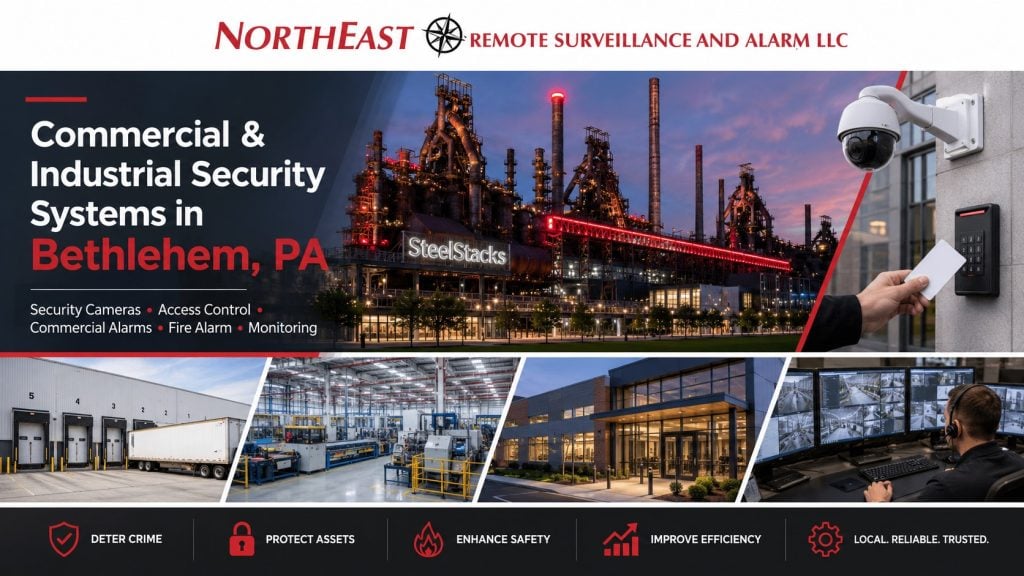
Industrial access control in Bethlehem, PA helps manufacturing plants, production facilities, industrial buildings, utility areas, restricted spaces, contractor entrances, employee doors, and multi-building properties control who can enter sensitive areas. Northeast Remote Surveillance and Alarm, LLC designs industrial access control systems for Bethlehem facilities that need credentialed entry, audit trails, contractor accountability, restricted-area control, and integration with cameras, alarms, and monitoring. For broader Bethlehem manufacturing and industrial planning, start with Manufacturing & Industrial Security Systems in Bethlehem, PA.

Access Control in Bethlehem, PA for Industrial Facilities
Industrial access control is different from basic office door control. Manufacturing and industrial facilities often include employee entrances, production areas, equipment rooms, contractor doors, utility spaces, loading zones, fenced gates, electrical rooms, inventory areas, and restricted operational zones.
A strong system should control entry without slowing down legitimate work. The goal is to help management know who entered, when access occurred, which door or gate was used, whether the person had permission, and whether the event needs review.
NERSA designs industrial access control around real Bethlehem operating conditions, including shift changes, contractor activity, multi-building layouts, production schedules, after-hours service work, and restricted industrial spaces.
Where Bethlehem, PA Industrial Facilities Need Access Control
Industrial access control should be planned around the way people, vehicles, vendors, and employees move through the property. Every controlled point should have a clear purpose.
Employee Entrances
Employee entrances are often the busiest access points in a manufacturing or industrial facility. Access control can support scheduled entry, shift-based permissions, badge use, audit trails, and review of who entered during specific time periods.
Employee entrance design should account for high traffic during shift changes, parking lot transitions, time clock areas, visitor separation, and video coverage at the door.
Contractor and Vendor Entrances
Contractor and vendor entrances often involve outside personnel who should only access approved areas during approved time windows. Access control can help manage temporary credentials, service schedules, vendor accountability, and restricted access.
For video documentation around these access points, use Contractor and Vendor Entrance Surveillance.
Restricted Production Areas
Some production spaces need tighter access control because of safety risk, intellectual property concerns, process sensitivity, inventory value, or equipment exposure. Controlled access can help separate general employee movement from authorized production, maintenance, or management access.
Equipment Rooms and Utility Areas
Electrical rooms, mechanical rooms, IT closets, compressor rooms, control spaces, utility rooms, and infrastructure areas should not be accessible to everyone in the building. Access control can help limit entry and create an audit trail when service work or maintenance activity occurs.
Industrial Gates and Yard Access
Industrial gates may control access to exterior yards, storage areas, truck courts, utility zones, fleet parking, equipment storage, and contractor lanes. These locations often need a combination of gate hardware, credentials, intercoms, video surveillance, and event review.
For exterior camera planning, use Industrial Perimeter Security Cameras.
Loading and Shipping Areas
Loading areas often combine employees, drivers, vendors, materials, forklifts, dock doors, and open building access. Access control can help limit who can enter specific doors, staging areas, receiving zones, and shipping offices.
Credential and Entry Methods for Industrial Access Control
The right credential method depends on the facility, risk level, user group, and operating schedule. Industrial facilities may need different access methods for employees, contractors, vendors, managers, service personnel, and emergency access.
Common options include card credentials, key fobs, mobile credentials, PIN pads, intercom release, gate credentials, and role-based access permissions. Higher-risk areas may require stronger controls, tighter schedules, or multi-factor procedures.
Credential planning should also include what happens when employees leave, contractors finish a project, vendors change, badges are lost, or temporary access needs to be removed quickly.
Door Hardware and Industrial Conditions
Access control depends on the door hardware behind the credential. Industrial facilities may include hollow metal doors, exterior service doors, roll-up doors, pedestrian gates, equipment-room doors, fire-rated doors, electrified locks, strikes, maglocks, request-to-exit devices, door contacts, power supplies, and controller enclosures.
The hardware must match the opening, traffic pattern, code conditions, security need, and life-safety requirement. A card reader alone does not make a door properly controlled.
Door conditions should be reviewed before installation. Damaged frames, misaligned doors, worn closers, corroded hardware, poor weather sealing, weak power pathways, and improper mounting locations can all affect system reliability.
Access Levels, Schedules, and Audit Trails
Industrial access control should be managed by role, location, and schedule. Not every employee, contractor, vendor, or supervisor should have access to every area.
Access levels may separate production employees, warehouse staff, maintenance personnel, management, contractors, cleaning crews, drivers, IT personnel, and emergency responders. Schedules may limit when doors, gates, and restricted areas can be used.
Audit trails help management review access activity after an incident. They can show when a credential was used, where it was used, whether access was granted or denied, and whether activity matched the approved schedule.
Integration With Cameras, Alarms, and Monitoring
Industrial access control becomes stronger when it is integrated with video surveillance, intrusion alarms, intercoms, and monitoring workflows. Access events are more useful when management can see the video that corresponds to the door or gate activity.
Access control can show which credential was used. Video can show who actually entered. An alarm can identify an unusual event. Monitoring can help escalate activity after hours.
For camera planning around Bethlehem manufacturing environments, use Manufacturing Security Cameras in Bethlehem, PA.
Contractor Accountability and Temporary Access
Bethlehem industrial facilities often rely on outside contractors for maintenance, HVAC, electrical work, machine service, janitorial work, inspections, utility access, and special projects. These users should not be managed the same way as permanent employees.
Temporary access can be limited by door, date, time, and role. This helps prevent old contractor credentials, shared codes, or unmanaged keys from creating long-term security exposure.
Contractor access control should also be coordinated with cameras at service doors, gates, receiving areas, and restricted zones so management can verify activity when needed.
Multi-Building and Industrial Campus Access Control
Many industrial properties are not a single front-door environment. They may include multiple buildings, exterior gates, employee parking areas, warehouse-connected spaces, utility structures, storage buildings, and detached operational areas.
A well-designed access control system can help centralize permissions across multiple access points while still allowing each building, door, gate, or area to have its own rules.
This is especially important when management needs to reduce key control problems, standardize permissions, or support growth across additional facilities.
Compliance-Aware Industrial Access Control Planning
Industrial access control must be planned carefully around doors, egress, fire alarm coordination, emergency access, life-safety conditions, accessibility concerns, documentation, and AHJ-sensitive installation conditions.
Access control does not override life-safety requirements. Doors must still support proper egress, emergency response, required release conditions, and applicable code considerations.
Security planning may also need to account for Pennsylvania UCC-sensitive work, fire-rated openings, electrified hardware, emergency release, power supplies, backup power, and documentation practices.
For broader compliance planning, use Industrial and Warehouse Security Compliance.
Cybersecurity and User Management
Modern access control systems are network-connected systems. User permissions, administrative rights, remote access, software updates, audit logs, credential management, and cloud or server configuration should be handled with care.
Weak passwords, shared administrator accounts, unmanaged users, outdated credentials, and poorly controlled remote access can create security problems even when the door hardware is strong.
Industrial facilities should plan access control as both physical security and security infrastructure.
Industrial Facilities NERSA Supports in Bethlehem
Northeast Remote Surveillance and Alarm, LLC designs industrial access control systems for Bethlehem manufacturing plants, production facilities, industrial buildings, warehouse-connected operations, utility areas, equipment rooms, contractor entrances, employee doors, restricted areas, loading areas, gates, and multi-building commercial properties.
These environments often involve shift-based employee movement, contractor access, after-hours service work, exterior storage, high-value equipment, safety-sensitive areas, and operational continuity concerns.
The access control system should be designed around the facility’s actual risk, movement patterns, door conditions, user groups, and long-term support requirements.
Request a Bethlehem Industrial Access Control Assessment
If your Bethlehem facility needs better control over employee entrances, contractor doors, restricted spaces, equipment rooms, gates, utility areas, loading zones, or multi-building access points, Northeast Remote Surveillance and Alarm, LLC can help design the system around the way your property actually operates.
Call 1-888-344-3846 or use the Request a Security Assessment page to begin a Bethlehem industrial access control review.
Frequently Asked Questions for Industrial Access Control in Bethlehem, PA
What is industrial access control?
Industrial access control is an electronic entry system designed to control doors, gates, restricted spaces, equipment rooms, contractor entrances, employee areas, and sensitive operational zones in manufacturing and industrial facilities.
How is industrial access control different from office access control?
Industrial access control usually involves more complex environments, including production areas, contractor access, exterior gates, utility rooms, loading areas, restricted spaces, shift changes, and safety-sensitive openings. These conditions require more careful planning than a basic office door system.
What areas of a Bethlehem industrial facility should use access control?
Common areas include employee entrances, contractor doors, equipment rooms, utility areas, restricted production spaces, IT rooms, loading-area doors, gates, inventory areas, and multi-building access points.
Can access control help manage contractors and vendors?
Yes. Access control can limit contractor and vendor access by door, date, time, and permission level. It can also help create an audit trail for service work, maintenance activity, inspections, and temporary access.
Should industrial access control integrate with cameras?
Yes. Integration with cameras helps management compare credential events with video footage so they can see who entered, whether anyone followed behind, and what happened at the door or gate.
Can access control be used on industrial gates?
Yes. Industrial gates can use credentials, keypads, intercoms, vehicle access devices, gate operators, cameras, and monitoring workflows depending on the facility’s access needs and site layout.
Does access control replace keys?
Access control can reduce reliance on physical keys, but some facilities may still need keys for certain doors, emergency access, mechanical override, or backup procedures. The goal is to improve control, accountability, and auditability.
Does industrial access control affect fire code or egress?
It can. Access-controlled openings must be planned so they do not interfere with required egress, emergency release, fire alarm coordination, or life-safety conditions. Door hardware and release methods must be reviewed carefully.
Can access control support multi-building industrial properties?
Yes. Access control can help centralize permissions across multiple buildings, gates, doors, utility areas, and restricted spaces while still allowing different rules for each location.
What is the next step for planning industrial access control in Bethlehem?
The next step is a site-specific security assessment. NERSA reviews the facility layout, doors, gates, user groups, access schedules, hardware conditions, life-safety concerns, existing infrastructure, and integration goals before recommending a system design.