
Commercial access control door hardware standards help businesses avoid unsafe, unreliable, or poorly documented controlled openings.

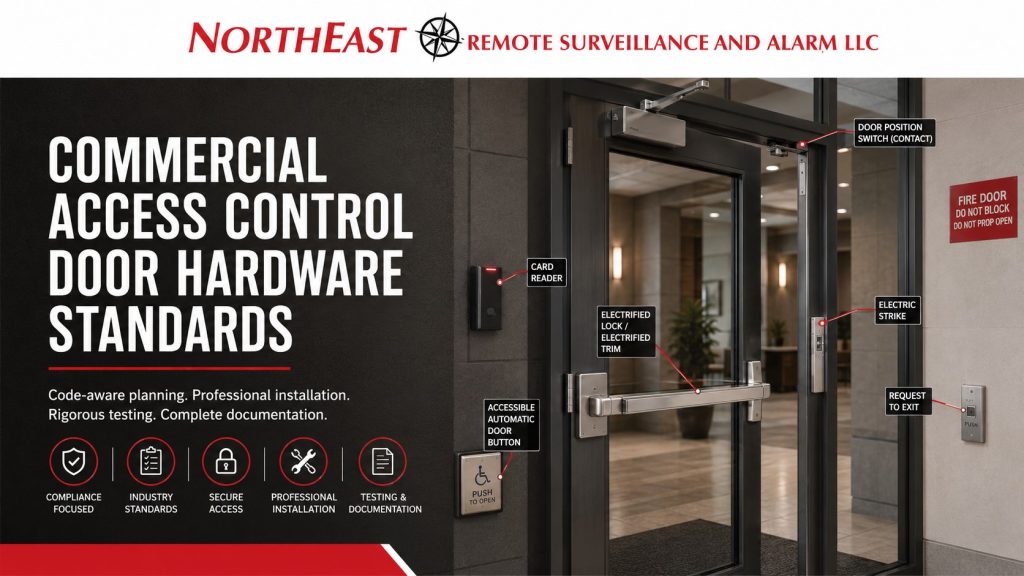
Northeast Remote Surveillance and Alarm, LLC plans access-control door hardware around door function, egress, fire alarm coordination, ADA accessibility, electrified locking, field wiring, testing, and documentation.
This resource is part of our Commercial Security Trust and Project Standards service guide and explains how controlled openings should be reviewed before hardware is selected or installed.
This is not a general access control sales page.
For full system planning involving credentials, controllers, schedules, user permissions, reporting, and managed access, visit Commercial & Industrial Access Control Systems.
For product-level door hardware education, visit Access Control Trim & Strike Hardware.
Access Control Door Hardware Built Around Safe Door Function
Access control should improve security without creating unsafe, unreliable, or non-compliant door behavior. A card reader, mobile credential, keypad, or controller may decide who is authorized, but the door hardware determines how the opening actually locks, releases, latches, reports status, and supports emergency egress.
That makes door hardware one of the most important parts of any commercial access control project.
Northeast Remote Surveillance and Alarm, LLC reviews controlled openings around real building conditions, including the door, frame, lockset, exit device, fire rating, traffic pattern, egress path, accessibility needs, power transfer, request-to-exit method, door position monitoring, and fire alarm interface where applicable.
Why Door Hardware Standards Matter
Many access control problems come from treating the door like an afterthought. A system may have good software and strong credentials, but still fail because the opening has the wrong strike, weak lock hardware, poor alignment, missing request-to-exit logic, bad power transfer, unclear fire alarm behavior, or no documentation.
Commercial door hardware standards help avoid problems such as:
- Shared keys remaining in use after access control is installed
- Door hardware that does not match the traffic pattern
- Electrified locks installed without proper egress review
- Fire-rated openings modified without proper coordination
- Maglocks or delayed-egress hardware used without life-safety review
- Readers or controls placed without ADA accessibility awareness
- Door position switches missing from important openings
- Unclear fail-safe or fail-secure behavior
- Poor labeling, weak testing records, or incomplete handoff documentation
The goal is not just to make the door unlock. The goal is to make the controlled opening work safely, reliably, and clearly for the long term.
Door and Opening Review Before Hardware Selection
Before access control door hardware is selected, each opening should be reviewed as a complete door assembly. That review may include the door type, frame condition, existing lockset, exit device, closer, latch condition, fire label, swing direction, traffic pattern, user type, emergency egress path, and whether the opening is part of a required life-safety route.
A warehouse employee entrance does not operate like a school vestibule door. A medical office staff door does not operate like a manufacturing maintenance room. A multi-tenant lobby entrance does not operate like a restricted IT closet or fire-rated corridor door.
NERSA’s standard is to match the access-control method to the opening instead of forcing the same hardware approach onto every door.
NFPA, ADA, and Code-Aware Coordination Links
Access control door hardware can touch several standards and coordination areas. These links should support the page without turning this service into a full code page.
Explore these related NERSA compliance resources:
NFPA Standards for Commercial Security, Fire Alarm, Access Control, and Life Safety Systems
NFPA 101, Door Hardware, and Access Control Egress Compliance
NFPA 80 Fire Doors, Opening Protectives, and Door Hardware
NFPA 72 and Commercial Fire Alarm Systems
NFPA 70 NEC and Low-Voltage Security System Wiring
NFPA 730 Premises Security Risk Assessments and Security Planning
NFPA 731 and Electronic Premises Security Systems
ADA Compliance for Electronic Access Control Systems
For official external reference, use:
NFPA Free Access to Codes and Standards
2010 ADA Standards for Accessible Design
U.S. Access Board Guide: Entrances, Doors, and Gates
U.S. Access Board Guide: Operable Parts
NFPA 101 and Egress Coordination
NFPA 101 is one of the key references when access control affects egress, electrified locking, door release, delayed egress, sensor release, emergency behavior, or how occupants leave during an emergency.
For controlled openings, the basic planning question is not only “Can authorized users get in?” The more important question is also “Can people get out safely when they need to?”
Access control door hardware should be reviewed so it does not create unsafe exit conditions, trapped occupants, confusing emergency operation, or improper release behavior.
For the deeper egress page, use NFPA 101, Door Hardware, and Access Control Egress Compliance.
NFPA 80 and Fire-Rated Openings
Fire-rated doors and opening protectives require special care. A fire-rated door is not just another door that can be modified freely.
Access control hardware on rated openings should be coordinated with the door rating, listed hardware, latch requirements, field modifications, annual inspection concerns, and the expectations of the authority having jurisdiction.
This matters when adding electric strikes, electrified trim, electrified locksets, door contacts, power transfer devices, request-to-exit devices, or other hardware to a rated opening.
For the dedicated page, use NFPA 80 Fire Doors, Opening Protectives, and Door Hardware.
NFPA 72 and Fire Alarm Release Coordination
Some access-control openings may need to interact with fire alarm systems, emergency release logic, or life-safety workflows. When fire alarm release, emergency response, alarm interface, or fire alarm documentation is involved, the access control plan should not be treated as a standalone security decision.
The door hardware, access control system, fire alarm system, emergency release method, and testing process may need to be coordinated together.
For broader fire alarm coordination, use NFPA 72 and Commercial Fire Alarm Systems.
NFPA 70 NEC and Low-Voltage Wiring
Access control door hardware depends on low-voltage wiring, power supplies, controllers, request-to-exit wiring, door position wiring, lock power, communication circuits, and sometimes PoE-connected devices.
Low-voltage does not mean informal. Wiring methods, power-limited circuits, pathways, cable protection, labeling, grounding awareness, power supplies, and equipment locations should be planned cleanly.
For wiring methods, pathways, power architecture, and low-voltage installation discipline, use NFPA 70 NEC and Low-Voltage Security System Wiring.
ADA Accessibility and Controlled Openings
Access control should also be planned with accessibility in mind. Readers, keypads, intercoms, door controls, automatic operators, gate controls, and entry hardware can affect how people enter, exit, and move through a facility.
ADA-aware access control planning may involve reader placement, reach range awareness, clear floor space, door maneuvering clearance, operable hardware, entry sequence, automatic operator coordination, and whether controlled openings remain usable for people with disabilities.
For the dedicated internal resource, use ADA Compliance for Electronic Access Control Systems.
For official reference, use the 2010 ADA Standards for Accessible Design, the U.S. Access Board guide for entrances, doors, and gates, and the U.S. Access Board guide for operable parts.
Hardware Types That Require Careful Planning
Commercial access control door hardware may include electric strikes, electrified locksets, electrified trim, electrified exit devices, maglocks, request-to-exit devices, door position switches, power transfer hinges, door loops, transfer devices, power supplies, readers, keypads, mobile credential readers, and automatic operator interfaces.
Each hardware type has a proper use case.
An electric strike may work well on one opening and be the wrong choice for another. An electrified lockset may fit one door but not another. A maglock can create additional egress and release concerns. A delayed-egress opening requires careful review. A fire-rated opening may limit hardware choices. A high-traffic employee entrance may need different hardware than a restricted storage room.
NERSA’s standard is to match the hardware to the opening, the risk, the user flow, the building conditions, and the life-safety requirements.
Fail-Safe, Fail-Secure, and Emergency Behavior
Fail-safe and fail-secure behavior should not be guessed. Each controlled opening should be reviewed based on the door’s purpose, egress requirements, fire alarm behavior, security risk, power failure expectations, and building use.
A door that unlocks during power loss may support egress but may create a security concern. A door that remains locked during power loss may protect assets but may create a life-safety problem if applied incorrectly.
The correct behavior depends on the opening, the code context, the hardware, the emergency plan, and the authority having jurisdiction where applicable.
Door Schedules and Documentation
Commercial access control door hardware should be documented. A proper access-control door schedule may include the door number, location, door type, hardware type, reader type, lock type, request-to-exit method, door position monitoring, power supply, controller, fire alarm interface, credential group, schedule, and testing notes.
Documentation helps owners, facility managers, IT teams, inspectors, service technicians, and future vendors understand what was installed and how the opening is supposed to operate.
For broader documentation and handoff planning, use Security System Documentation, Testing, and Inspection Readiness.
Testing and Commissioning Standards
A controlled opening should be tested before handoff. Testing may include credential operation, denied access, door release, door relock, request-to-exit function, door position reporting, forced-door reporting, held-open reporting, emergency release behavior, fire alarm interface where applicable, and user permissions.
The goal is to verify the door as a complete opening, not just confirm that a reader beeps.
Testing should also confirm that the client understands how to use the system, manage credentials, review activity, and request service when changes are needed.
What This Standards Page Does Not Replace
This resource does not replace engineering review, code interpretation, permitting, inspection, manufacturer instructions, fire door inspection requirements, ADA review, or the authority having jurisdiction.
Northeast Remote Surveillance and Alarm, LLC helps commercial and industrial clients plan, install, document, and support access control door hardware with compliance awareness. Formal approvals, enforcement, and project-specific code decisions remain with the proper code officials, design professionals, inspectors, and authorities having jurisdiction where applicable.
Request Access Control Door Hardware Planning
If your commercial or industrial facility needs controlled doors, electrified hardware, card readers, mobile credentials, gate access, restricted-room access, employee entrances, warehouse doors, or a review of existing access-control openings, Northeast Remote Surveillance and Alarm, LLC can help.
Call 1-888-344-3846 or use Request a Security Assessment to review your doors, hardware, egress needs, accessibility concerns, fire alarm coordination, wiring, documentation, and long-term access control goals.
Frequently Asked Questions about Commercial Access Control Door Hardware Standards
What are commercial access control door hardware standards?
Commercial access control door hardware standards are planning practices used to review controlled openings, hardware choices, egress, fire alarm coordination, accessibility, wiring, testing, and documentation before and after installation.
Why does access control door hardware need standards?
Access control directly affects how doors lock, release, latch, report status, and support emergency egress. Poor planning can create unreliable doors, unsafe exit conditions, failed inspections, unclear emergency behavior, and long-term service problems.
Which NFPA standards are most relevant to access control door hardware?
The most relevant NFPA resources are usually NFPA 101 for egress and controlled-door behavior, NFPA 80 for fire-rated openings and door hardware, NFPA 72 for fire alarm coordination, NFPA 70 for low-voltage wiring, NFPA 731 for electronic premises security systems, and NFPA 730 for premises security planning.
Does ADA apply to access control door hardware?
ADA considerations can apply when readers, keypads, intercoms, door controls, gates, automatic operators, or entry hardware affect how people enter, exit, or move through a facility. Reader placement, operable parts, clear floor space, and accessible route conditions should be reviewed where applicable.
Can access control be installed on fire-rated doors?
Sometimes, but fire-rated openings require careful coordination. Hardware selection, field modifications, listing requirements, latching, inspection expectations, and AHJ requirements must be reviewed before changes are made.
Do maglocks require special planning?
Yes. Magnetic locks can create additional egress, release, power, fire alarm, sensor, push-button, signage, and AHJ coordination concerns. They should not be treated as a simple lock substitute.
What should be included in an access control door schedule?
A door schedule may include door location, opening type, reader type, lock type, request-to-exit device, door contact, power source, controller, fire alarm interface, schedule, credential group, and testing notes.
Does NERSA replace the authority having jurisdiction?
No. NERSA helps clients plan and install commercial access control door hardware with compliance awareness, but authorities having jurisdiction, inspectors, engineers, design professionals, and code officials remain responsible for formal approvals and enforcement where required.