
NFPA 101 is commonly known as the Life Safety Code, and it affects how doors, exits, locking arrangements, and means of egress are evaluated in many occupied commercial and institutional buildings.

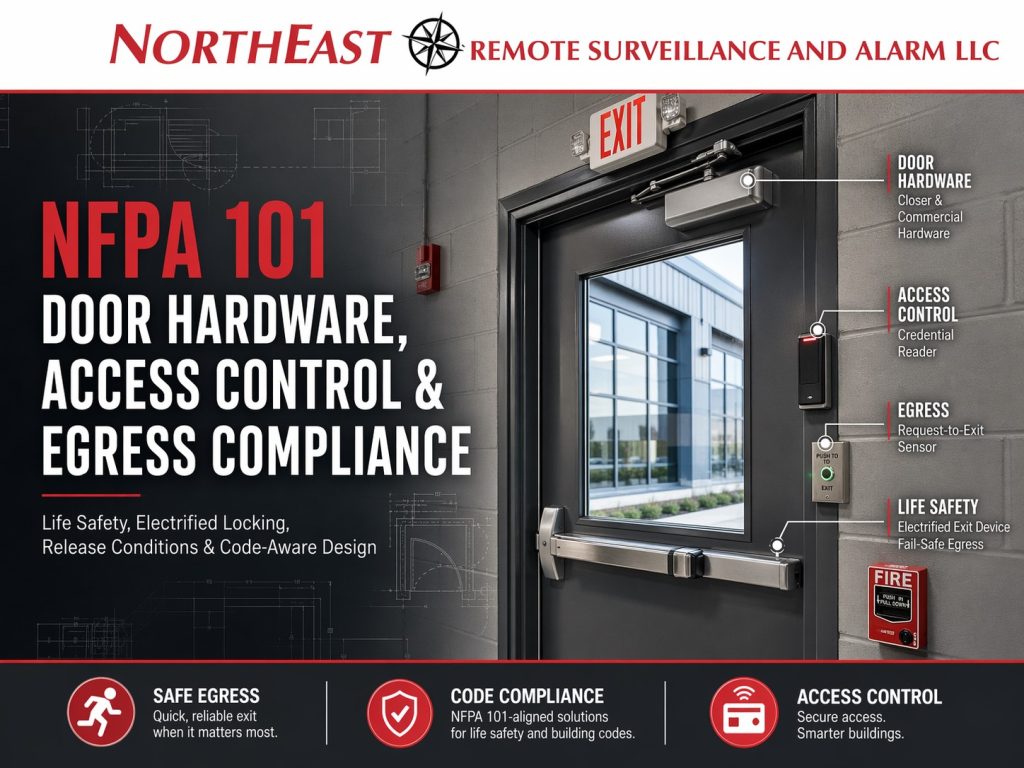
Why NFPA 101 Matters to Access Control and Door Hardware
For access control projects, the key issue is simple: security hardware cannot be planned only around keeping unauthorized people out. If the door is part of the required means of egress, the design also has to preserve safe, reliable, code-compliant exit from the building.
That makes access-controlled doors a shared concern between:
- Security design
- Door hardware
- Emergency egress
- Fire alarm coordination
- Life-safety planning
- Building occupancy
- Inspection expectations
- AHJ review
- Facility operations
A card reader, electric strike, maglock, delayed-egress lock, request-to-exit device, electrified trim, or access control panel may look like a security item, but once it affects an egress door, it becomes part of a larger life-safety conversation.
Access Control Cannot Interfere With Required Egress
Access control is commonly used to manage who can enter a commercial facility, but ingress control cannot be allowed to defeat required egress.
That means the design question is not only, “How do authorized users get in?” It is also, “How does every occupant get out during normal use, power loss, fire alarm activation, emergency conditions, or confusion?”
Access control planning should consider:
- Whether the door is in the means of egress
- Whether the occupant can leave without special knowledge
- Whether the door hardware releases properly
- Whether electrified locking affects exit
- What happens during power failure
- What happens during fire alarm activation
- Whether manual release is required
- Whether the occupancy permits the intended locking arrangement
- Whether the AHJ needs to review the design
- Whether documentation and testing are required
For general access control design beyond the compliance issue, visit Commercial & Industrial Access Control Systems.
Door Hardware Selection Is Part of Compliance
Door hardware is not just a finish item or a security preference.
The lock, latch, exit device, closer, reader, electrified trim, power transfer, request-to-exit device, door position switch, power supply, and release method can all affect whether an opening operates properly during an emergency.
Door hardware planning may include:
- Electric strikes
- Electrified locks
- Electrified trim
- Maglocks where permitted
- Exit devices
- Fire exit hardware where required
- Door closers
- Request-to-exit devices
- Door position switches
- Power transfer hardware
- Power supplies
- Card readers
- Keypad readers
- Mobile credential readers
- Intercom release
- Fire alarm interface wiring where required
A door can look correct from the secure side but still create problems on the egress side if the hardware, release sequence, power-loss behavior, or emergency operation is wrong.
Special Locking Arrangements Need Careful Review
Not every electrified lock is treated the same way.
NFPA 101 recognizes specific types of locking arrangements, and those arrangements depend on the occupancy, the door function, the adopted edition, the hardware, the release method, and the authority having jurisdiction. Businesses should not assume that any electric lock, keypad, maglock, delayed-egress function, or remote-release setup can be used on any egress door.
Special locking arrangements may involve:
- Delayed-egress locking
- Sensor-release electrical locking
- Door-hardware-release electrical locking
- Controlled egress applications in limited occupancies
- Manual release devices
- Fire alarm or sprinkler system release logic where required
- Power-loss release behavior
- Emergency lighting or signage requirements where applicable
- Inspection and testing expectations
These arrangements should be reviewed before installation, not corrected after inspection.
Delayed Egress Is Not a General Security Shortcut
Delayed-egress locking can be useful in limited applications, but it is not a general permission to slow people from leaving a building.
A delayed-egress opening must be evaluated around the occupancy, code edition, hardware, signage, emergency lighting, release method, fire alarm behavior, approved delay, and AHJ expectations. It should never be treated as a simple add-on to stop theft, prevent unauthorized exit, or control employee movement without a full life-safety review.
Delayed egress may come up in:
- Healthcare environments
- Certain institutional settings
- High-value retail or storage areas
- Controlled public-facing environments
- Facilities with specific operational risks
- Buildings where the occupancy chapter permits it
The design should always confirm whether the arrangement is permitted for that specific door and occupancy.
Maglocks, Request-to-Exit Devices, and Sensor Release
Maglocks and sensor-release arrangements require careful planning because the lock may depend on electrical release logic instead of purely mechanical operation.
A design involving maglocks or sensor release should consider:
- Egress-side detection
- Manual release devices
- Door hardware operation
- Power-loss behavior
- Fire alarm interface behavior where required
- Location of release devices
- Signage where required
- Emergency lighting where applicable
- Inspection and testing procedures
- AHJ review
A request-to-exit device should not be used as a substitute for proper code review. The door still has to operate safely under the conditions that apply to that building and occupancy.
Door-Hardware-Release Electrified Locking
Some electrified locking arrangements are based on the occupant operating the door hardware itself.
In these applications, the act of operating the listed or approved release hardware in the direction of egress is part of how the electric lock is released. That makes the hardware selection, wiring, power interruption, and mechanical operation part of the life-safety design.
These doors should be reviewed for:
- One-motion or permitted release operation where applicable
- Proper exit device or trim selection
- Hardware compatibility
- Listed hardware requirements where applicable
- Immediate release behavior
- Door position monitoring
- Power supply design
- Fire alarm coordination where required
- Inspection and maintenance planning
The access control system should support the door. It should not become the reason the door fails to release correctly.
Fire Alarm, Sprinkler, and Power-Loss Coordination
Access control and fire alarm systems can intersect when electrified locking hardware must release during alarm, sprinkler, detection, power-loss, or emergency conditions.
This is where security, life safety, and fire alarm design must be coordinated. If the fire alarm system is expected to release locks, trigger door release, support stair re-entry, or affect door behavior, the access control side and fire alarm side cannot be designed separately.
Coordination may include:
- Fire alarm interface requirements
- Lock release on alarm where required
- Lock release on power loss where required
- Sprinkler or detection system release where required
- Stair door re-entry considerations
- Emergency egress operation
- Power supply supervision
- Documentation of release logic
- Testing with the fire alarm contractor
- AHJ inspection coordination
For broader fire alarm planning, visit Commercial & Industrial Fire Alarm Installation.
Fire-Rated Openings Change the Door Hardware Conversation
If the door is part of a fire-rated assembly, the access control design has another layer of concern.
Fire-rated openings may have requirements for listed hardware, door integrity, labels, closers, latching, field modifications, annual inspection, and proper repair or replacement procedures. A rated door should not be treated like a standard opening just because the security goal is to add a card reader or electrified lock.
Fire-rated door planning may involve:
- Listed fire door hardware
- Fire exit hardware where required
- Door labels
- Frame labels
- Proper latching
- Door closing operation
- Field modification limits
- Hardware compatibility
- Annual inspection expectations
- Coordination with qualified door professionals
Security upgrades should not compromise the fire-rated assembly.
Pennsylvania UCC and Local Enforcement Matter
In Pennsylvania, access control and egress compliance also sit inside the Uniform Construction Code environment.
That means the adopted code framework, local enforcement path, municipality, occupancy, project scope, permit requirements, and AHJ expectations can affect how a door-security project is reviewed. The same access control idea may be simple on one non-egress interior door and much more complex on a required exit, stair door, rated opening, school vestibule, healthcare door, or delayed-egress application.
Pennsylvania projects should consider:
- Local code enforcement
- Department enforcement in opt-out municipalities
- Commercial building requirements
- Accessibility considerations
- Fire alarm requirements
- Door hardware requirements
- Permit and inspection expectations
- AHJ review
- Documentation and testing records
The correct answer is based on the actual building, door, occupancy, adopted code, and enforcement authority.
Access-Controlled Doors in Commercial and Industrial Facilities
Commercial and industrial facilities often create harder door problems than small office suites.
A warehouse, manufacturing facility, logistics building, school, municipal site, healthcare facility, or multi-tenant commercial property may include many different door types in one building. Some doors may be employee entrances. Some may be public entries. Some may be fire-rated. Some may serve stairs or corridors. Some may open to loading docks, restricted rooms, or warehouse interiors.
Common access-controlled openings include:
- Main entrances
- Employee entrances
- Visitor doors
- Office-to-warehouse doors
- Shipping offices
- Receiving offices
- IT rooms
- Tool rooms
- Parts rooms
- Records rooms
- Stair doors
- Cross-corridor doors
- Healthcare support doors
- School vestibule doors
- Municipal staff entrances
- Loading dock area doors
Each door should be evaluated by function, not just by hardware preference.
Access Control, Alarms, and Egress Coordination
Access control is often installed alongside intrusion alarms, cameras, intercoms, and monitoring systems.
That can be a strong design when the systems are coordinated correctly. A door event can be reviewed by camera. An after-hours access event can be compared against alarm schedules. An intercom can help control visitor entry. A forced-door event can support alarm response.
But these systems should never interfere with required egress.
Coordination may involve:
- Access control schedules
- Intrusion alarm schedules
- Door held-open alerts
- Forced-door alerts
- Intercom release
- Video review
- Alarm partitions
- After-hours access rules
- User permissions
- Fire alarm release logic where required
- Documentation of system behavior
For intrusion system planning, visit Commercial & Industrial Alarm Installation.
Documentation, Testing, and Inspection Readiness
Access-controlled egress doors should be documented and maintained.
A door that works on installation day may not remain compliant if hardware is replaced, settings are changed, fire alarm interfaces are altered, closers are adjusted incorrectly, access permissions are changed, or rated-door components are modified without review.
Documentation may include:
- Door list
- Hardware schedule
- Reader locations
- Locking hardware type
- Request-to-exit method
- Door position switch location
- Power supply information
- Fire alarm interface notes
- Release sequence description
- Alarm and access control coordination notes
- User permissions
- Test records
- Inspection notes
- As-built documentation
For project closeout and system records, visit Commercial Security Documentation and Handoff.
When to Request a Compliance-Focused Review
A compliance-focused review is useful when the door-security decision affects egress, fire alarm coordination, rated openings, public access, schools, healthcare, municipal buildings, warehouses, industrial facilities, or complex commercial properties.
Request a review when:
- Card access is being added to egress doors
- Electrified locks are being installed
- Maglocks are being considered
- Delayed egress is being discussed
- Fire alarm release is required
- A rated door is being modified
- A stair door is involved
- A public entrance is being controlled
- A school or healthcare door is being secured
- Older locking arrangements need cleanup
- Inspection issues need correction
- Documentation is missing
- Alarm, access, and fire alarm systems need coordination
Northeast Remote Surveillance and Alarm, LLC helps commercial and industrial clients plan access control, door hardware, alarms, cameras, intercoms, fire alarm coordination, and life-safety-aware security upgrades around real building conditions.
Code Note
This resource is general informational content for commercial planning purposes. The adopted edition, occupancy chapter, authority having jurisdiction, project scope, actual door condition, fire alarm design, door hardware listing, emergency egress requirements, and full system design control the project. Northeast Remote Surveillance and Alarm, LLC does not replace the AHJ, architect, engineer, fire alarm designer, code consultant, door hardware consultant, or legal counsel.
FAQ: NFPA 101 Access Control, Door Hardware & Egress Compliance
What is NFPA 101 access control egress compliance?
NFPA 101 access control egress compliance refers to planning access-controlled doors, electrified locks, door hardware, release devices, fire alarm interfaces, and emergency operation so security hardware does not interfere with required egress.
Does access control have to allow people to exit?
Yes. Access control can manage who enters a door, but it must not prevent required egress from the building when the door is part of the means of egress.
Can a card reader be installed on an egress door?
A card reader may be allowed on the ingress side of many doors, but the egress side still has to release properly based on the door function, occupancy, hardware, adopted code, and AHJ requirements.
Are maglocks allowed on commercial egress doors?
Maglocks may be allowed only when the door, occupancy, release method, power-loss behavior, fire alarm interface, manual release, and inspection expectations satisfy the applicable requirements and AHJ review.
Is delayed egress allowed in every building?
No. Delayed egress is a limited locking arrangement that depends on the occupancy, code edition, door location, hardware, signage, emergency lighting, release sequence, and AHJ approval.
Do access-controlled doors need fire alarm release?
Some electrified locking arrangements may require release upon fire alarm, sprinkler, detection, or power-loss conditions, depending on the code section, occupancy, door type, and system design.
Are fire-rated doors different when adding access control?
Yes. Fire-rated openings may require listed hardware, proper latching, closing, labels, limited field modification, and inspection procedures that must be considered before access control hardware is added.
Who decides whether an access-controlled door is compliant?
The authority having jurisdiction, adopted code, occupancy, design professionals, fire alarm requirements, door hardware conditions, and project scope determine compliance.
Does NERSA provide code consulting?
Northeast Remote Surveillance and Alarm, LLC supports compliance-aware security planning, access control design, door hardware coordination, fire alarm coordination, documentation, and inspection readiness, but final code interpretation belongs to the AHJ and qualified design professionals.
Related NFPA Guidance
Explore the NFPA standards directory for related commercial security and life-safety guidance.
Request an Access-Control Egress Review
Request an assessment to review existing door conditions, proposed security hardware, and egress coordination.