
Commercial intrusion alarm systems detect selected signs of unauthorized entry and route alarm events through an agreed notification and response process.

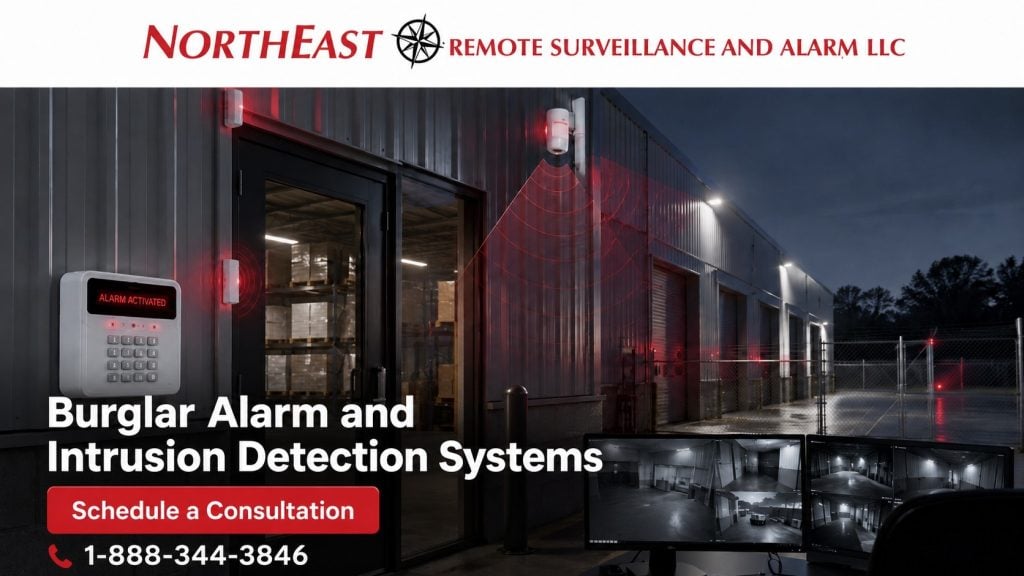
Northeast Remote Surveillance and Alarm, LLC designs, installs, and supports burglar alarm and intrusion detection systems for warehouses, manufacturing facilities, offices, schools, municipal buildings, retail properties, logistics operations, and multi-building commercial sites.
Every system is built around the way your property actually operates, including doors, docks, gates, employee entrances, restricted rooms, perimeter openings, alarm schedules, user permissions, and monitoring requirements.
Burglar Alarm and Intrusion Detection Systems Built for Real Properties
A burglar alarm system should do more than make noise when a door opens after hours. It should identify where the alarm started, help verify what happened, notify the right people, and support a fast response.
NERSA designs intrusion detection systems for commercial and industrial environments where layout, building size, traffic flow, employee access, and operating hours all matter. A small office, a warehouse with dozens of dock doors, and a manufacturing facility with restricted production areas should not be protected the same way.
Our burglar alarm systems can protect:
- Main entry doors
- Employee entrances
- Overhead doors
- Loading docks
- Shipping and receiving areas
- Offices and administrative spaces
- Storage rooms
- Tool rooms and parts rooms
- Electrical, IT, and mechanical rooms
- Inventory and product storage areas
- Exterior gates and fenced yard access points
- Detached buildings and outbuildings
- High-value equipment areas
- Restricted interior spaces
The goal is not just to install sensors. The goal is to create a system that matches the property, reduces false alarms, protects critical openings, and gives owners, managers, and monitoring personnel the information they need when an event occurs.
Burglar Alarm and Intrusion Detection Systems Designed Around Risk
Every property has different intrusion risks. Some businesses are most vulnerable at the front entrance. Others need protection around dock doors, rear access points, fenced yards, employee doors, or separate warehouse sections.
NERSA evaluates the site before designing the system. We look at how the building is used, where people enter, where deliveries happen, what areas are occupied after hours, and which openings are most exposed.
A properly planned intrusion detection system may include:
- Door and window contacts
- Overhead door contacts
- Motion detectors
- Glass-break detection
- Interior trap protection
- Perimeter detection
- Gate and fence-line detection
- Panic and duress buttons
- Alarm keypads
- Sirens and strobes
- Cellular or internet alarm communication
- User codes and access schedules
- Remote arming and disarming
- Alarm reporting and notifications
- Video verification when cameras are integrated
For larger properties, intrusion detection can also be divided into areas or partitions. This allows one section of the building to remain armed while another section is still occupied.
Wired, Wireless, and Hybrid Alarm Systems
Not every building is the same, and not every alarm system should be installed the same way. Some properties are best served with hardwired alarm devices. Others require wireless sensors because of building conditions, tenant limitations, finished walls, long distances, or difficult cable paths.
NERSA can design wired, wireless, or hybrid burglar alarm systems depending on the property.
A wired system may be the best fit for new construction, major renovations, or buildings where cable pathways are available. Wireless alarm devices can be useful for finished spaces, detached areas, overhead doors, hard-to-reach openings, and buildings where running wire would be disruptive or costly. Hybrid systems allow both wired and wireless devices to work together, giving commercial properties flexibility without sacrificing coverage.
The right design depends on the building construction, system size, signal path, operating environment, future expansion needs, and the level of protection required.
Alarm Protection for Doors, Docks, Gates, and Restricted Areas
Many commercial break-ins do not happen through the front door. They happen through rear entrances, dock doors, side doors, overhead doors, fenced yard gates, service entrances, or areas with limited visibility.
NERSA designs intrusion detection systems that protect the openings most likely to be targeted.
For warehouse and logistics properties, dock doors and shipping areas are often critical. For manufacturing facilities, tool rooms, parts rooms, electrical rooms, and production support areas may require added protection. For offices and professional buildings, entry doors, interior suites, storage rooms, and IT spaces may need separate alarm coverage.
For properties with multiple buildings or outdoor areas, intrusion detection can be coordinated with cameras, access control, and remote notifications. These tools can help staff distinguish a possible threat from employee or vendor activity and false alarms.
Video Verification for Intrusion Alarms
A burglar alarm tells you that something happened. Video verification can help show what happened.
When intrusion detection is integrated with cameras, alarm events can be matched with video footage from the affected area. This helps owners, managers, and monitoring personnel verify whether an alarm is caused by an intruder, an employee mistake, a delivery, weather, an unsecured door, or another condition.
For many commercial properties, video verification for intrusion alarms is one of the most valuable upgrades because it adds visual context to alarm events.
Instead of responding blindly to a signal, the system can help identify the area, the event type, and the activity around the alarm.
Video verification is especially useful for:
- Warehouses
- Loading docks
- Truck yards
- Manufacturing facilities
- Contractor yards
- Equipment storage areas
- Multi-tenant commercial buildings
- After-hours commercial properties
- Sites with repeated false alarms
- Properties with limited overnight staff
A better alarm response starts with better information.
Access Control and Intrusion Alarm Integration
Intrusion detection becomes more powerful when it works with access control. Doors, card readers, schedules, user permissions, forced door alerts, and alarm arming status can all work together to create a more complete security system.
NERSA can integrate intrusion alarms with access control and intrusion alarm integration so commercial properties can better manage employee access, after-hours activity, and unauthorized entry attempts.
This can help with situations such as:
- A door being forced open after hours
- An employee entering outside an approved schedule
- A restricted area being accessed without authorization
- A door being propped open
- A manager needing remote control of alarm status
- A facility requiring different alarm schedules for different areas
- A site needing card reader activity connected to alarm events
For businesses with multiple employees, vendors, managers, and shifts, this type of integration can reduce confusion and improve accountability.
Alarm Systems for Warehouses and Industrial Buildings
Warehouses and industrial buildings often need more than basic door contacts and a keypad. These properties may include dozens of overhead doors, large open spaces, long walls, multiple employee entrances, shared office areas, fenced yards, trailers, inventory storage, and restricted rooms.
NERSA designs intrusion detection systems for large commercial and industrial properties where coverage must be planned carefully. The system needs to protect the perimeter, avoid unnecessary false alarms, support daily operations, and give management practical control.
For warehouse-specific protection, see our page on warehouse intrusion alarm systems.
Alarm Schedules, User Codes, and Remote Management
A commercial burglar alarm system should be manageable for the people responsible for the property. Owners, facility managers, supervisors, and authorized users may need different levels of control.
NERSA can help set up alarm systems with:
- Individual user codes
- Employee access schedules
- Opening and closing reports
- Remote arm and disarm capability
- App-based notifications
- Area-based alarm control
- Manager-level permissions
- Temporary user access
- Vendor access control
- Event history and reporting
This helps reduce shared codes, improves accountability, and makes it easier to know who armed or disarmed the system.
For businesses with multiple shifts, cleaning crews, vendors, delivery activity, or after-hours operations, user management is an important part of the overall alarm design.
Reducing False Alarms
False alarms cost time, create frustration, and can weaken confidence in the system. A properly designed intrusion detection system should reduce unnecessary alarms while still protecting the property.
NERSA helps reduce false alarms through proper device selection, correct placement, clean programming, user training, and better system design.
Common false alarm causes include:
- Poorly placed motion detectors
- Loose overhead door contacts
- Employees entering through the wrong door
- Shared alarm codes
- Unclear opening and closing procedures
- Doors left unsecured
- Pets, pests, balloons, or moving objects
- HVAC movement
- Unprotected or poorly adjusted devices
- Lack of user training
A commercial alarm system should be reliable enough that when it activates, the signal matters.
Commercial and Industrial Properties We Protect
NERSA installs burglar alarm and intrusion detection systems for a wide range of commercial and industrial properties, including:
- Warehouses
- Manufacturing facilities
- Distribution centers
- Logistics facilities
- Truck yards
- Contractor yards
- Office buildings
- Medical offices
- Schools and education facilities
- Municipal buildings
- Retail properties
- Multi-tenant commercial buildings
- Mixed-use commercial properties
- Storage facilities
- Equipment yards
- Industrial parks
Each property type has different risks. A one-size-fits-all alarm package is not enough for most commercial environments.
Related Planning
- video verification for intrusion alarms — Review how camera views can help assess an intrusion event.
- access control and intrusion alarm integration — Coordinate access permissions, arming procedures and door events.
- commercial alarm systems — Review the broader alarm-design and management requirements.
Why Choose Northeast Remote Surveillance and Alarm
Northeast Remote Surveillance and Alarm, LLC designs commercial security systems for businesses that need more than a basic alarm package. Our team understands commercial buildings, industrial environments, warehouse operations, employee access, loading docks, restricted spaces, and the practical challenges of securing active properties.
We do not approach intrusion detection as a simple box-and-sensor installation. We look at how the site works, where the risks are, how the staff uses the building, and what information the owner or manager needs when something happens.
Businesses choose NERSA for burglar alarm and intrusion detection systems because we provide:
- Commercial and industrial security experience
- Site-specific system design
- Professional installation
- Clean device placement and programming
- Integration with cameras and access control
- Remote management options
- Practical user training
- Service and support after installation
- Scalable systems for future expansion
A good alarm system should protect the property, support the operation, and make security easier to manage.
Schedule a Burglar Alarm and Intrusion Detection Consultation
Northeast Remote Surveillance and Alarm, LLC can help with new burglar alarms and intrusion detection upgrades. We can review protection for doors, docks, gates and restricted areas, along with security needs after hours.
Call 1-888-344-3846 or contact NERSA to schedule a commercial intrusion detection consultation.
We design, install, and support burglar alarm and intrusion detection systems for commercial and industrial properties throughout the Lehigh Valley, Northeastern Pennsylvania, Central Pennsylvania, Greater Philadelphia, New Jersey, Delaware, and the Mid-Atlantic region.
Frequently Asked Questions about Burglar Alarm and Intrusion Detection Systems
What is the difference between a burglar alarm and an intrusion detection system?
A burglar alarm is commonly used to describe a system that detects unauthorized entry and sends an alarm signal. Intrusion detection is a broader term that can include doors, overhead doors, motion detection, glass-break detection, perimeter protection, panic devices, restricted area protection, and integration with cameras or access control.
Do commercial burglar alarm systems work for warehouses?
Yes. Warehouses often need more advanced intrusion detection because they may have many dock doors, employee entrances, large open spaces, fenced yards, and restricted storage areas. NERSA designs warehouse alarm systems around the actual building layout and daily operation.
Can an alarm system be divided into separate areas?
Yes. Many commercial and industrial alarm systems can be divided into separate areas or partitions. This allows one section of the property to remain armed while another section is occupied or still operating.
Can intrusion alarms be connected to security cameras?
Yes. Intrusion alarms can be integrated with video surveillance to provide video verification. This helps confirm what caused the alarm and gives owners, managers, or monitoring personnel better information during an event.
Can a burglar alarm work with access control?
Yes. Intrusion alarms can work with access control systems to connect door activity, card reader events, forced door alerts, schedules, and alarm status. This is useful for commercial properties with employees, vendors, multiple shifts, or restricted areas.
Do you install wireless commercial alarm systems?
Yes. NERSA can design wired, wireless, or hybrid commercial alarm systems depending on the property. Wireless devices can be useful when wiring is difficult, disruptive, or unnecessary, while wired devices may be preferred for new construction, renovations, or certain high-security areas.
Can managers control the alarm remotely?
Yes. Many commercial alarm systems can be managed remotely through approved apps or platforms. Depending on the system, managers may be able to arm, disarm, receive alerts, review activity, and manage users.
Do you service existing burglar alarm systems?
NERSA can evaluate existing commercial alarm systems and determine whether they should be serviced, upgraded, expanded, integrated, or replaced. Older systems may still be usable, but communication, coverage, programming, and device condition should be reviewed.
Plan Your Next Security Improvement
Tell NERSA about your commercial facility, existing systems, and project priorities. We can help you plan an installation, evaluate an upgrade, or coordinate security across multiple locations.
Compliance, Codes & Project Standards
NERSA plans commercial and industrial security work with applicable code, documentation, inspection and authority-having-jurisdiction requirements in mind. Requirements vary by system, property and jurisdiction. These resources support project planning; they do not establish legal compliance, certification or AHJ approval.
Related guidance: Regulatory compliance & inspection readiness · NERSA project standards · Documentation, testing & inspection readiness