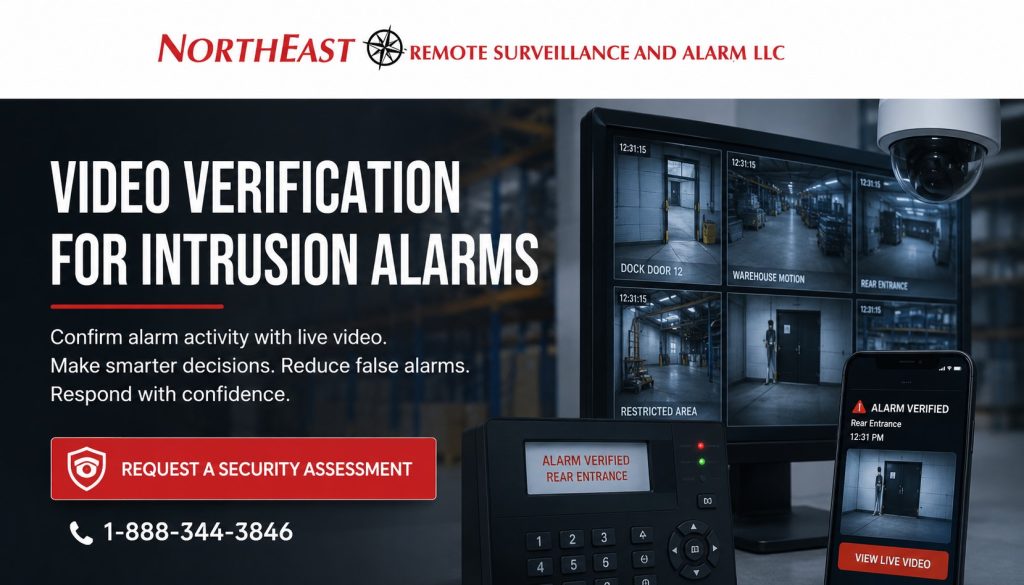
Video verification for intrusion alarms helps commercial and industrial facilities confirm alarm activity with camera views before making response decisions. Northeast Remote Surveillance and Alarm, LLC designs video verified intrusion alarm systems for warehouses, logistics facilities, manufacturing buildings, industrial properties, offices, schools, municipal buildings, medical offices, and multi-site commercial operations. For broader alarm system planning, start with Commercial & Enterprise Intrusion Alarm Systems.

Video Verified Intrusion Alarm Systems for Commercial Facilities
A video verified intrusion alarm system connects alarm events with camera footage so the activity can be reviewed with better context.
When a door contact, overhead door, motion detector, glass-break sensor, beam detector, panic device, or restricted zone triggers an alarm, video verification can help determine whether the event appears to be an actual intrusion, employee activity, delivery activity, environmental movement, or a false alarm.
For commercial and industrial properties, this can make alarm response more accurate, more useful, and easier to document.
What This Page Covers
This page focuses specifically on video verification for intrusion alarm systems in non-residential facilities.
It explains how alarm events can be connected with camera views, how video verification supports monitoring, how it helps reduce uncertainty, and how it applies to warehouses, logistics facilities, manufacturing buildings, offices, schools, medical buildings, municipal properties, and multi-site commercial operations.
What This Page Does Not Cover
This page does not replace a full commercial camera system page, access control page, fire alarm page, cybersecurity page, or complete commercial security systems page.
Video verification supports intrusion alarm response, but it does not replace proper alarm design, camera placement, access control planning, fire alarm compliance, or network security.
Why Video Verification Matters
A traditional intrusion alarm can report that a zone went into alarm, but it may not show what caused the event.
Video verification adds context. Instead of only seeing a zone description such as “rear warehouse motion” or “dock door 12,” authorized personnel may be able to review a camera view connected to that alarm event.
That added visibility can help separate real security events from harmless activity, user error, weather movement, animals, loose materials, open doors, or other false alarm causes.
Better Alarm Response Decisions
Commercial alarm response depends on clear information.
When an alarm event is supported by video, monitoring personnel, managers, supervisors, or authorized responders can better understand what may be happening at the property.
This can help determine whether the event needs police dispatch, internal response, guard response, manager notification, service follow-up, or no action beyond documentation.
Reducing False Alarm Confusion
False alarms can create unnecessary dispatches, employee frustration, lost time, and reduced confidence in the security system.
Video verification helps reduce confusion by giving alarm activity visual context. If the alarm was caused by authorized employee movement, an unsecured door, equipment motion, a delivery, or an environmental condition, the video may help identify that faster.
The goal is not just to reduce alarms. The goal is to make alarm events easier to understand and manage.
Warehouse Video Verification for Intrusion Alarms
Warehouses, distribution centers, freight terminals, and logistics facilities often have many alarm points spread across large spaces.
Dock doors, overhead doors, shipping offices, receiving areas, employee entrances, trailer-adjacent areas, inventory rooms, and after-hours warehouse zones can all generate alarm activity.
Video verification helps connect those alarm events with camera views so the business can better understand whether activity is happening at a door, dock, aisle, office, yard, or restricted area.
For broader warehouse security planning, use Warehouse Security Systems.
Dock Door and Overhead Door Verification
Dock doors and overhead doors are common alarm points in warehouse and industrial buildings.
A dock door may trigger because of unauthorized entry, an unsecured door, employee activity, wind movement, a maintenance issue, or a loading operation that ran outside the normal schedule.
Video verification can help show whether the door area appears normal, whether someone is present, whether a vehicle is near the opening, or whether the alarm needs immediate response.
Manufacturing and Industrial Alarm Verification
Manufacturing and industrial facilities often have production areas, tool rooms, material storage, equipment rooms, chemical storage, utility spaces, shipping areas, and restricted rooms that may require intrusion protection.
Video verification can help supervisors or monitoring personnel review alarm activity without relying only on a zone name.
This is especially useful in facilities with multiple shifts, approved after-hours work, maintenance access, vendors, contractors, and restricted areas that need tighter control.
Office, School, Medical, and Municipal Alarm Verification
Video verification can also support intrusion alarm systems in offices, schools, medical buildings, municipal facilities, and professional properties.
These buildings may need verification around entrances, corridors, restricted rooms, administrative offices, IT rooms, storage areas, medicine storage, records areas, and after-hours access points.
When alarm activity can be connected with camera views, the property can respond with better information and stronger documentation.
Video Verification and Commercial Monitoring
Video verification becomes more valuable when it is connected to a clear monitoring process.
A monitored video verified alarm system can help authorized personnel review alarm activity, confirm visible conditions, document events, and follow response procedures based on the property’s rules.
For broader monitoring services, use Commercial and Industrial Security Monitoring.
Camera Placement for Alarm Verification
Video verification depends on camera placement.
The camera should be able to see the area connected to the alarm event, such as a door, dock, hallway, restricted room, warehouse aisle, office entrance, gate, or equipment area.
A camera that cannot see the alarm point clearly may not provide useful verification. The best design connects alarm zones and camera views in a way that makes sense for the property.
For broader camera system planning, use Commercial Video Surveillance Installation.
Intrusion Alarm Zones and Camera Views
A strong video verified alarm design should match alarm zones with useful camera views.
For example, a rear warehouse motion detector may need a camera view of the rear warehouse area. A dock door alarm may need a camera view of the dock opening. A restricted room alarm may need a camera covering the entry point or room approach.
The more clearly the alarm zone and camera view match, the easier the event is to verify.
Access Control and Alarm Verification
Video verification can become even stronger when intrusion alarms are connected with access control.
A forced door, denied credential, after-hours entry, duress code, or unauthorized opening may be easier to understand when alarm data, access activity, and camera footage are reviewed together.
For facilities that need stronger door control, use Commercial & Industrial Access Control Systems.
After-Hours Intrusion Verification
After-hours alarm activity creates a different level of concern for many businesses.
A motion alarm inside a warehouse at 2:00 a.m., a dock door opening after closing, or activity near a restricted room may require faster review and escalation.
Video verification helps the business see whether the activity appears to be a real threat, approved employee access, cleaning staff, maintenance personnel, delivery activity, or a false alarm.
Multi-Site Video Verified Alarm Systems
Multi-site commercial operations need consistency across locations.
Video verified alarm systems can help standardize how alarm events are reviewed, reported, escalated, and documented from one property to another.
This is useful for companies with multiple warehouses, offices, retail support facilities, industrial buildings, school campuses, medical sites, or regional branches.
Environmental and Critical Condition Verification
Some commercial alarm systems also monitor environmental and critical conditions such as temperature, water detection, freezer failure, sump pump alerts, power loss, generator status, and equipment-room conditions.
Video may help support certain events when a camera can show the affected area, equipment room, storage space, freezer area, or utility location.
Environmental monitoring should be planned carefully so alerts remain useful and do not create unnecessary alarm traffic.
Communication Reliability for Video Verified Alarms
Video verified intrusion alarms depend on reliable communication.
Alarm signals, camera footage, remote access, mobile alerts, monitoring tools, and cloud dashboards may all depend on internet, cellular, or dual-path communication.
Commercial facilities should plan for signal strength, network reliability, backup communication, surge protection, battery backup, and equipment placement so the system can support alarm response when it is needed.
Network Security for Connected Alarm Verification
Video verified alarm systems are connected systems.
Alarm panels, communicators, cameras, recorders, access control equipment, cloud platforms, mobile apps, and remote management tools should be supported by proper network planning.
This may include secure passwords, documented administrator access, network segmentation, firewall rules, protected remote access, and a clear understanding of who can view alarm-related video.
When to Add Video Verification to an Existing Alarm System
A business should consider video verification when alarm events are difficult to confirm, false alarms are common, the property has high-value inventory, after-hours exposure is significant, or alarm response depends too heavily on zone names alone.
Video verification may also be valuable when a facility has many dock doors, multiple entrances, large warehouse spaces, restricted rooms, outside activity, or multiple locations.
In many cases, video verification can be added during an alarm upgrade, camera upgrade, monitoring upgrade, or full commercial security system review.
Built for Non-Residential Alarm Response
Northeast Remote Surveillance and Alarm, LLC designs video verified intrusion alarm systems for commercial and industrial facilities that need stronger alarm response, better documentation, and clearer event review.
We work with warehouses, logistics properties, distribution centers, manufacturing buildings, industrial sites, corporate offices, schools, municipal buildings, medical offices, contractor facilities, business parks, multi-tenant properties, and multi-site commercial operations.
Request a Video Verified Intrusion Alarm Assessment
If your facility needs better alarm verification, dock door alarm review, warehouse intrusion confirmation, after-hours event visibility, access control integration, monitoring support, or multi-site alarm documentation, Northeast Remote Surveillance and Alarm, LLC can help.
Request a Commercial Security Assessment or call 1-888-344-3846.
Frequently Asked Questions
What is video verification for intrusion alarms?
Video verification connects alarm events with camera views so authorized personnel can review what may have caused the alarm.
How does video verification help commercial alarm systems?
Video verification helps commercial alarm systems by adding visual context to alarm events, improving response decisions, reducing confusion, and supporting documentation.
Can video verification reduce false alarms?
Video verification can help reduce false alarm confusion by showing whether an alarm appears to be caused by real intrusion activity, employee movement, environmental conditions, or other non-threat activity.
What alarm events can be video verified?
Common video verified events include door alarms, overhead door alarms, motion detector alarms, glass-break alarms, beam detection, restricted room alarms, dock door alarms, panic alarms, and after-hours activity.
Is video verification useful for warehouses?
Yes, warehouses benefit from video verification because dock doors, overhead doors, shipping offices, inventory areas, employee entrances, and after-hours zones can be difficult to evaluate from alarm signals alone.
Does video verification replace an intrusion alarm system?
No, video verification supports the intrusion alarm system by adding camera views to alarm events, but it does not replace proper alarm design, monitoring, communication paths, or response procedures.
Does video verification replace a full camera system?
No, video verification uses cameras to support alarm response, but a full commercial camera system may also be needed for general surveillance, evidence review, operations, safety, and property coverage.
Can video verification work with access control?
Yes, video verification can be used with access control so forced doors, denied credentials, after-hours entries, and user activity can be reviewed with alarm and camera information.
What types of properties need video verified intrusion alarms?
Video verified intrusion alarms are useful for warehouses, logistics facilities, manufacturing buildings, industrial properties, offices, schools, municipal buildings, medical offices, contractor facilities, business parks, and multi-site commercial operations.
Who installs video verified intrusion alarm systems?
Northeast Remote Surveillance and Alarm, LLC designs and installs video verified intrusion alarm systems for commercial and industrial properties that need stronger alarm verification, monitoring support, and integrated security planning.